Offseason Moves and the Expectations Game

Kurt Coleman Philadelphia Eagles Expectations

Unexpected success is undoubtedly the best outcome in sports. Sure, it’s nice when we expect Roy Halladay to throw a complete game shutout and he goes out on the mound and delivers. But there’s nothing quite as invigorating as watching a no-name player like Vance Worley start a game with few expectations and perform better than anyone could have rightly predicted.

As far as the Eagles go, that means that fans often take guys like Trent Cole and Jason Peters, easily two of the best players on the team, for granted. Meanwhile, players who give you a little more than you expect - guys like Jamar Chaney and Kurt Coleman perhaps - are lauded.

What I’m saying is that the expectations matter, sometimes more than the results themselves. Perhaps Cole and Chaney aren’t in the same league, but what about Chaney and Stewart Bradley? There are lots of people who want to kick Bradley to the curb and move on with someone else. As I wrote last week, I think that the Eagles might agree.

But just because Bradley lagged behind his expectations and Chaney soundly beat his doesn’t mean that such a move would be a guaranteed win. We should be mindful such that our perceptions often outpace reality. Would King Dunlap really be an upgrade over Winston Justice? Was Dimitri Patterson much better than Ellis Hobbs in the long run?

Sometimes short term play and limited expectations for success can greatly cloud our judgement. It’s good to keep that in mind as we consider the Eagles possible offseason moves.

Photo from Getty.

Does Stewart Bradley Have a Future in Philly?

Stewart Bradley Free Agent Philadelphia Eagles

Two years ago Stewart Bradley was hailed as the next star on the Eagles defense. Then, in one fell swoop, he tore his ACL during 2009 Flight Night, ending his season before it began and crippling his future.

A few weeks back I mentioned Bradley in my post about the five Eagles most likely to lose their jobs. At the time, I still thought there was more than a 75 percent chance he would return for the 2011 season. But now, with reports indicating that unrestricted free agency will likely go back to four years of experience under the new collective bargaining agreement, that forecast looks optimistic.

Assuming the restricted free agent tender goes away (the Eagles tagged him at the second-round level), Bradley would have no reason to return to Philly. He can simply accept the largest deal on the open market. And I have a feeling that the biggest signing bonus won’t be handed down by Joe Banner and company.

The Eagles, under Juan Castillo, will likely have a new defensive system that emphasizes speed, reacting to the ball, and playing in space. The team has a host of young linebackers, three of whom were drafted specifically to play in this system. Bradley, on the other hand, seems like a relic from the post-Trotter years. He’s certainly athletic, but with a bigger, downhill style.

It might be a good idea to keep a veteran in the middle of this defensive shift. There’s enough youth all over to be worried about without looking for two new starters at linebacker. Not that the Eagles have put a big priority on consistency at the position, though.

Bradley deserves another season to prove that he’s all the way back from that knee injury. But I wonder if that chance will come in a different uniform. How much money and how many years are the Eagles going to offer to an oft-injured player blocking the development of younger linebackers who are a better fit?

Photo from Getty.

Could Michael Vick be the Oldest Eagle in 2011?

Michael Vick NFL Philadelphia Eagles Age

It’s easy to forget or to gloss over how young this Eagles team is. But there’s a fair chance that Michael Vick could be the oldest position player, if not oldest player on the whole team.

Vick turned 31 earlier this month. That’s not particularly old for a quarterback. But there aren’t more than a handful of players on the Eagles roster right now who are older. In fact, there are only four.

David Akers, 36, is as good as gone. Drafting Alex Henery in the fourth round of the draft basically assures that.

Juqua Parker, 33, certainly doesn’t have a guaranteed roster spot. He wasn’t looking any younger at the end of the season, and if a few of the rest of the muddle of defensive ends step up, he could easily be gone.

Ditto for Jamaal Jackson, 31, who’s coming off of two consecutive season-ending injuries. With plenty of young blood behind him, I could easily see Jackson being one of the older casualties.

The player who’s most likely to still be around is also the oldest: punter Sav Rocca, 37. The Eagles at least threw a tender at him, but he’s never been much better than average, so they could easily flip both kicking specialists in one offseason. I doubt many fans would complain about that.

The Eagles have always been focused on youth, but they’ve never — as far as I remember — been so close to such a young team. To have the oldest player be only 31 years old would be quite a statement, and it’s not all that unlikely.

Photo from Getty.

Is Joe Banner More Valuable than Andy Reid?

Joe Banner Philadelphia Eagles Andy Reid

Andy Reid certainly isn’t universally beloved in Philadelphia, but overall I think Eagles fans do credit the coach with the team’s decade-plus success. It has been his offensive schemes, his player decisions, his strategic choices that have driven the Eagles to so many winning seasons.

But I wonder, just as devil’s advocate, how much of the success is attributable to Reid, and what percentage of the credit actually rests with the only man in the organization who is more detested: Joe Banner.

I’ve previously talked about how we can’t really separate the two, often after reporters suggest a big rift in the Eagles front office. But it’s an interesting case to make. Coaching and personnel decisions are probably more important than financial ones, but how much more?

As good as Reid’s been, I don’t think many people would make the case that he is the absolute best coach in the NFL. He’d be in everyone’s top five, but rarely number one. On the other hand, there’s a good argument to be made that Banner is the single best financial/salary cap executive in the game. In today’s NFL, that might be more valuable — or at least closer than you might think.

Let’s be honest. How much success could Reid have had without Banner keeping the team active on the free agent market every offseason despite consecutive playoff appearances? The NFL, as noted recently, has the most financial parity and revenue sharing of any professional sports league. It’s extremely difficult to outspend other teams (although that doesn’t stop Dan Snyder from trying). Therefore, most franchises go through winning and losing cycles tied as much to salary restrictions as player performance.

Reid is responsible for the high quality of the product on the field, while Banner enables Reid to coach without significant restraints or restrictions. It will be interesting to see if the team can sustain success if one of them departs before the other.

Photo from the Philadelphia Eagles.

A Super Bowl Indicator: Net TD Efficiency

Aaron Rodgers Green Bay Super Bowl Touchdown

In the last post we ranked NFL offenses according to their touchdown efficiency per plays, yards, and drives. Eliminating field goals and calculating rankings based on efficiency rather than raw scores helped isolate the best and worst offenses.

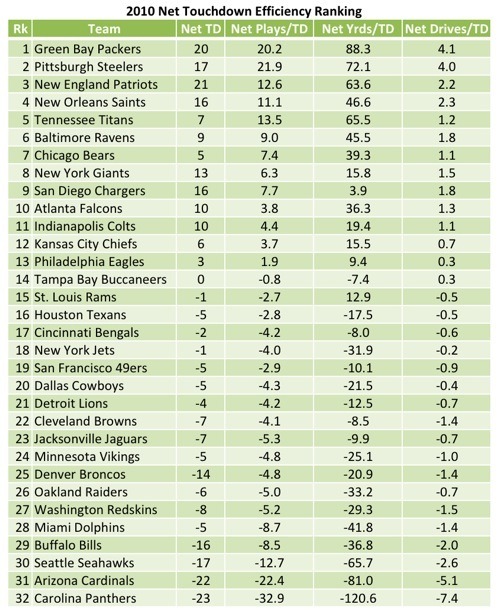
So for the next step, we’ll add defense. I added up touchdowns allowed by each defense and figured out the same efficiency stats as yesterday. Then, simple enough, I subtracted defense from offense. Positive scores indicate better teams. For example, the New England Patriots make their opponents go 13 extra plays, 64 extra yards, and 2 extra drives to get a touchdown. They are ranked third overall.

First and second, by a solid margin, go to the two Super Bowl teams. They were 1-2 in every category, and outpaced the third place teams significantly in Net Plays per TD and Net Drives per TD. Predictive stats are often too reductive, but if you used this measurement to pick the Super Bowl teams at the end of the regular season — it would have guided you well.

The Eagles, despite their highly ranked offense, come out only 13th in the net rankings. If you didn’t figure it out already, Sean McDermott’s defense was a huge liability in 2010. Also note that while we’ve eliminated some biases, the stat doesn’t account for strength of schedule. Not sure how much that would change things, but keep it in mind nonetheless.

See the full rankings below.

2010 Net Touchdown Efficiency Ranking

Photo from Getty.

Ranking NFL Offenses by Touchdown Efficiency

Michael Vick NFL Touchdowns

Yesterday we saw how offensive touchdowns are much more important for success than field goals. But let’s not stop there.

If touchdowns are important, it’s not enough to just rank teams by the number of touchdowns. Some teams have more opportunities or have worse field position. Instead of just counting overall touchdowns, we can weight them by how many yards, plays, or drives each team needs to get one.

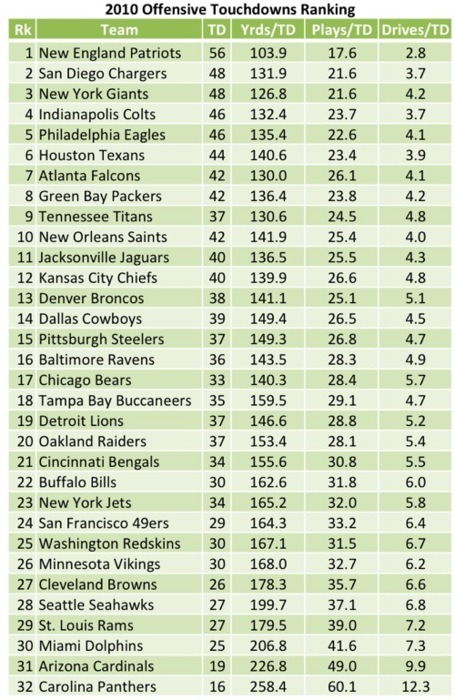
With that in mind, I calculated touchdowns scored per all three factors in the 2010 season. Each measures something slightly different. For example, the Eagles were 8th in Yards per TD, 5th in Plays per TD, and 7th in Drives per TD. Fairly close, but the best showing in Plays per TD probably reflects the huge number of big plays and long touchdown catches last year.

Below you’ll find the full chart of all NFL teams, best offense to least according to the average rank of these three measurements. It likely gives a more accurate picture of the best and worst offenses than any ranking that accounted for field goals or other methods of scoring.

2010 Offensive Touchdown Ranking

Tomorrow we’ll bring the ranking one final step further.

Photo from Getty.

Why Field Goals are Largely Inconsequential

David Akers NFL Field Goals

How do we rank offenses? Total yards gained? Total points scored? Those numbers aren’t nearly as helpful as we might think.

Not all points are created equal. Touchdowns are better than field goals. Some times have more opportunities or better field position than others. We can’t completely eliminate those biases, but we can try.

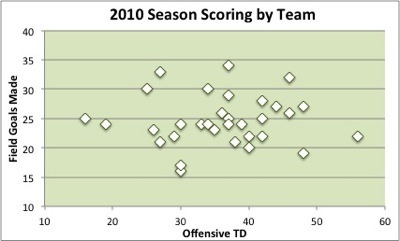
Let’s start today with touchdowns and field goals. How are they related? Do great offenses score more of both, since they make it down the field more? Do worse offenses, stalling in the red zone, turn to field goals as a replacement for touchdowns? Both would make sense, but neither is correct.

2010 NFL Scoring by Team Field Goals TouchdownsLook at the graph at right. There is simply no correlation, positive or negative, between touchdowns and field goals.
And that’s not the only thing we can learn. The difference between the team in 2010 with the most field foals (Oakland) and the team with the least (Buffalo) was 18 — or 3.4 points per game. Having an extra field goal a game sounds like a path to victory, but notice that the Raiders, as league leader, weren’t exactly taking the NFL by storm. On the flip side, the difference between the most offensive touchdowns (New England) and the least (Carolina) was 40 — a whopping 17.5 points per game including extra points.

It might seem like a cliche of conventional wisdom, but touchdowns are the difference maker. Everyone’s going to hit about the same number of field goals by the end of the season — teams are within 3.4 points per game of each other there. The key is to get into the end zone.

Perhaps not a revolutionary conclusion, but we’ll take this a step further tomorrow.

Photo from Getty.

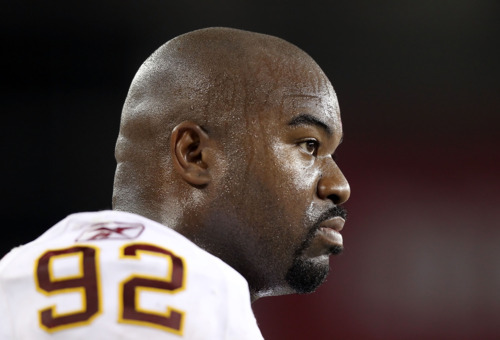
Is Albert Haynesworth the Next Terrell Owens?

Albert Haynesworth 2011 Philadelphia Eagles Terrell Owens

The Eagles have spent the last three years stocking the ranks with lots of young, respectable team players. They’ve drafted captains and All-Americans, guys who can represent the team proudly. They’ve also jettisoned a number of me-first malcontents and with questionable work ethics, like Chris Clemons, Quentin Demps, and Shawn Andrews.

Yet, after praising this change, now fans everywhere are clamoring for the Eagles to grab one of the most notoriously selfish players in the NFL: Albert Haynesworth. Here’s a guy who signed one of the richest contracts ever, and then refused to go earn it on the field. He’s undeniably one of the most talented defensive linemen in the game, but has spent most of the last two years loafing it with the Redskins. Not to mention that even when he was productive in Tennessee, Big Al was still causing trouble.

I can see the allure of a player like Haynesworth. His disruptive abilities from the defensive tackle spot are perhaps unparalleled in today’s NFL. And in theory DL Coach Jim Washburn knows how to get the most out of him. But doesn’t he represent exactly the qualities that the Eagles have purposely avoided recently? If the team trades for or signs Haynesworth, they effectively wipe away the high standards they’ve set on personnel decisions.

In many ways, getting Haynesworth would remind me a lot of 2004, when the Eagles acquired Terrell Owens. TO was another player who was unhappy with his current team and wanted out. The Eagles scooped him up and his talent propelled the team to a Super Bowl appearance. He was the quintessential difference-maker, and I’d expect the same from Haynesworth. Pairing Big Al with Trent Cole might be the defensive equivalent of Owens and Brian Westbrook.

But at what cost? TO was happy for a year, then the sit-ups began and he helped torpedo the Super Bowl hopes of a team that he cared nothing about. I wonder how long Haynesworth would remain a happy Philly citizen, especially if they sign him relatively cheaply. I wonder how long he could stay out of trouble with the law and with the league office, given his long history.

In hindsight, TO wasn’t a gamble. He was a sure thing — sure to be ticking time bomb. Is Big Al any different?

Photo by Getty.