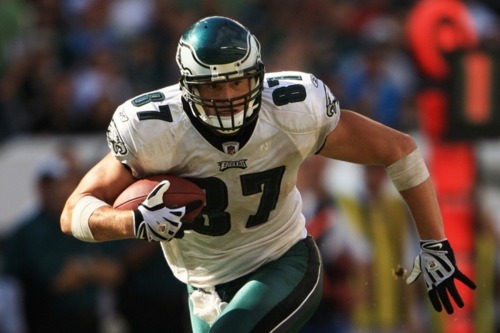
How the Eagles Misused Brent Celek in 2010

Brent Celek Play Pass Blocking 2010 Philadelphia Eagles

During Andy Reid’s online chat with fans at Philly.com yesterday, he was asked a question, “What are you going to do differently this year so that Brent Celek gets involved more?” Andy’s answer wasn’t particularly revealing, as usual. He only said that the team needed to put “more emphasis” on the short to intermediate passing game.

I’ve already talked about Celek’s disappointing season and have laid a large part of the blame on Michael Vick’s shoulders. When Celek was running routes, he just wasn’t being targeted as often. And throwing over the middle was where Vick was most inaccurate.

But the other side was just how differently the Eagles used Celek in 2010 from the previous season. His chances to go run routes as a receiver dropped and he was called on to pass block a lot more.
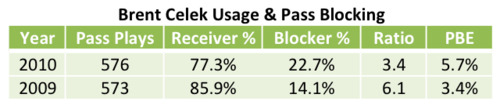
Brent Celek Play Pass Blocking 2010 DataTake a gander at the table at right. Celek was still a receiver most of the time, but his snaps as a pass blocker increased by more than half. Instead of blocking once for every six times he ran a route, Celek was a receiver only 3.4 times for every play of pass protection in 2010.

A number of factors contributed to this change in how the Eagles used Celek. The offensive line was having trouble, especially the right side with Winston Justice. However, it wasn’t as though the Eagles were constantly trying to help out the offensive line. They had the seventh-least number of blockers per pass play in the NFL. Another problem was the loss of Leonard Weaver, who was a solid pass protector. He blocked more often and more efficiently than both LeSean McCoy and Brian Westbrook in 2009.

Someone had to pick up the pass protection slack. But, unfortunately, Celek is simply a bad blocker — and he didn’t get any better with more practice. Look at the Pass Blocking Efficiency (PBE) statistic in the table above, calculated from PFF. It shows the total pressures allowed per blocking play. While Celek was alright in 2009, last year he was awful. He was the seventh-worst tight end in the NFL, yet the Eagles made him pass block more than all but four other players at his position.

That’s insanity. Wide receivers are the focal point of the offense, but Celek should be a great weapon down the middle, helping to keep the defenses honest. Making him pass block more not only removes that asset, but actually make Celek a liability.

Photo from Getty. Originally published at NBC Philadelphia.
2011 Will Test Utility of NFL Offseason Work

Work expands so as to fill the time available.

I’m sure everyone has come across this saying (also known as Parkinson’s Law) at some point in regard to school homework, projects at the office, or jobs around the house. But might it also apply to the NFL offseason?

In a normal offseason, NFL teams go through almost constant work. There are minicamps and weight training and film sessions and scouting and drills and preseason games. The events go on and on, filling almost the entire possible time between the end of one season and the start of the next. As the game has become more complex, we’ve largely accepted this increase as the cost of doing business. Some players complain about the workload, but it’s tough to side with guys who make millions but don’t want to work.

This interminable lockout, however, has already cut way back on the possible preparation time. Minicamps long forgotten, playbooks unable to be distributed. In lieu of “voluntary” workouts, the players have organized truly optional group practices. If the work stoppage stretches into the July and August, lost more will have to be cut back.

But how essential is this lost time? Are we likely to unprepared players and disorganized teams whenever football begins again? Could 2011 be the sloppiest season on record?

Bill Parcells doesn’t think so. He told Peter King, “I always felt like you really do a better job with less time than more time because when you have less time you focus immediately on what’s of the utmost importance. Whereas when you have a lot of time to deliberate as to what to do, a lot of times you kind of get off on little tangents.”

I tend to agree with Parcells. NFL teams may not be able to plan for every contingency, but the important things will be accomplished. However, 2011 will be an interesting test of his theory, and Parkinson’s Law in general. If football is still accomplished at a high level, perhaps there was never any need for offseason programs to become so comprehensive. On the other hand, if rookies produce at an all-time low we might be able to conclude that the opposite is true.

With any luck, we’ll find out soon enough.

Photo from Getty. Originally published at NBC Philadelphia.
Kickoff Rule Update: Expect Touchbacks Galore

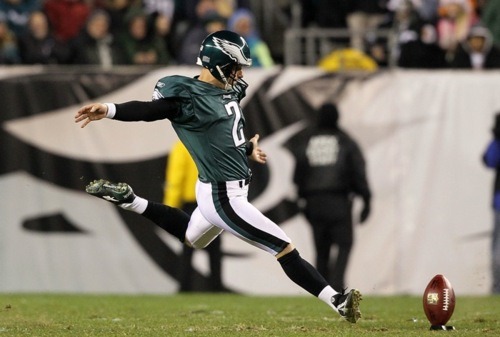
David Akers NFL Kickoff Statistics Touchbacks

After the NFL owners approved the new rule moving kickoffs up by five yards, I wrote a post about how the change might affect the number of kickoff returns. Only 16 percent of all kickoffs ended up as touchbacks last year, and I projected that they would more than double. However, my projection was only moderately scientific — I didn’t have all the data for every kickoff. Instead, I was just modeling from the averages of each kicker.

So I thought I’d go back and comb through the actual play-by-play data and see if I could come up with a more definite answer.

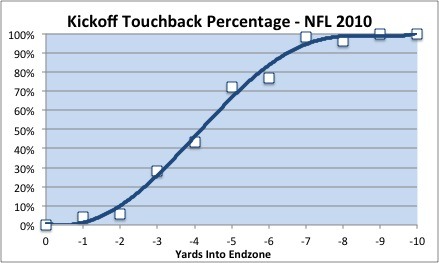
First, let’s look at how often kickoffs become touchbacks by distance. Mostly it matters where the ball lands. Obviously, if the kick never makes it to the end zone, the returner has to pick it up and take it out. But when it lands in the endzone…

NFL Kickoff Touchback Percentage

Turns out that the first yard or two don’t make a big difference. More than nine in every ten kickoffs landing less than two yards deep in the end zone get returned. But the ratio goes up sharply from there. By the time we get three yards deeper, the returner is only bringing out less than one in three kicks. And once the ball gets seven, eight, or nine yards in, only desperation would cause a player to attempt a return.

The graph shows how much of a difference five extra yards is going to make. Many more footballs last year fell in the 5 to -5 yard range than in the deep zone. As those push forward they get exponentially more difficult to return.

Therefore, when I added five yards to each kickoff from last year and assumed the same return percentage by distance, there was a huge jump in touchbacks. Unless the kickers in 2011 take a big step back, touchbacks should go from 16 percent to just under 40 percent. I know that was my rough estimate last time, but now I can fully back up such a prediction. Also, as I wrote before, this is actually still a low projection. It assumes that kickoff coverage teams won’t get any better even though they have five less yards to cover, and kickers themselves won’t change their tactics to further maximize touchbacks.

Finally, there’s the question of how much this changes the role of the players. For starters, kickers with the most powerful legs aren’t huge difference makers any more, which should please middle-of-the-road David Akers.

There’s an additional benefit for Eagles fans though. Andy Reid hasn’t been keen on investing in a kickoff returner. Last year’s main man was Jorrick Calvin, who was only slightly better than awful. Plus, kickoff coverage has often been one of the Eagles weakest units. But the rule change takes a lot of the power out of the returner’s hands. Their ability to make big plays has dropped by at least at least 30 percent.

Again, this might seem like a small rule change. But it’s going to have a big impact throughout the NFL.

Photo from Getty. Originally published at NBC Philadelphia.
Hot Read: More on DeSean, Little on Asante

Jimmy Kempski gave us a chance to examine all of DeSean Jackson’s supposed drops from last season. He only counted eight drops, instead of the 12 that Pro Football Focus found. The thing is, though, that doesn’t really change mcuh. Instead of being the 55th-worst receiver, now DeSean’s only the 49th-worst. Big deal.

I’ve already written about DeSean’s drops before, and why they might or might not be a real problem going forward. Whatever side you come down on, it’s important not to dismiss PFF’s game charting or even their subjective grading system. The truth is that these kind of statistics can be quite valuable. No numbers are perfect, and we always have to add some skepticism. Just because they are always somewhat subjective, somewhat biased, and somewhat incomplete doesn’t mean we can’t learn something from them.

That was part of the point of last week’s post comparing DYAR and EPA for receivers. It wasn’t to say that DYAR is wrong or EPA is right, or certainly that stats are wrong and our eyes are right. The point is that every piece of information tells us a different story. If one number praises DeSean and another finds fault, that means something. Even if we can’t immediately figure out what that is exactly.

* * *

ESPN’s John Clayton did his own handicapping of Kevin Kolb’s potential suitors. Interestingly enough, his thoughts are quite similar to my own predictions.

Clayton matches me with 2-1 for the Cardinals, but he thinks a lot less highly of the Seahawks.

* * *

The most boring possible commentary on Asante Samuel, courtesy of the NFL’s Top 100 Players program. Juan Castillo says Asante plants his foot. That’s better than the rest of the meaningless superlatives thrown in there to fill three minutes, but still. I assume he’s doing some heavy-duty film study and he knows other tricks. Give me something more concrete about what makes Asante such an interception machine, please.

Premature to Discuss the End of Vick's Career

Michael Vick Philadelphia Eagles Career End

Yesterday, Tommy Lawlor wrote that Michael Vick is the “short term guy” at quarterback. He wasn’t making an extensive argument on the subject and I don’t want to mischaracterize his actual point. But I think there’s an interesting question raised there: how long do we expect Michael Vick to be the Eagles quarterback?

Everyone expects that as soon as possible the team will offer Vick a new contract extension. I’m on record saying that they may already have the terms mostly settled. But how long will that contract be? Should the Eagles be looking for a new long term prospect already? Vick will turn 31 this month, after all.

To put it bluntly, I think it’s premature to suggest that Vick is anywhere particularly close to the end of his time in Philadelphia. Look at the career of his predecessor, Donovan McNabb. The Eagles signed McNabb to a contract that would pay him through age 34. They decided to trade him before that final season began, but I don’t think that was because the front office thought he was over-the-hill. Maybe on the downside of his career — but not washed up yet.

If we assume that the Eagles have the same timeline envisioned for Vick, he’s due for at least a three year extension through 2014. For starters, any player that you plan on counting on until 2014 is a long term guy. Short term is a year or two, at least in my book. Once you get to three or four football seasons out, that’s the equivalent of making predictions about 2050.

And yet I think the extension may be for even longer than three years. I actually expect something in the four to five year range. Tom Brady signed an extension for four years at age 33. The Redskins gave 34 year-old McNabb a deal for five years. That’s the going rate. Plus, who’s to say that Vick — with his extra mobility and two years of rest while in jail — isn’t cut out for playing until at least as long as those more stationary quarterbacks?

After Andy Reid surprised McNabb and the rest of the NFL by grabbing Kevin Kolb in 2007, fans are always going to expect that to happen again. But Vick isn’t a short term option. He should be in Philly a long time.

Photo by Getty.

Behind Trent Cole, Only Question Marks

Juqua Parker Eagles Defensive Ends

Even if the rest of the NFL world often underestimates Trent Cole, we know how great he’s been for the Eagles. Yet for what seems like the 15th year, the Eagles will enter their next season with Cole as their only truly reliable, above average end. There are a bunch of players behind Cole, even with none drafted in this year’s draft, but every one comes with huge question marks and caveats. Let’s quickly run through each one:

Brandon Graham — Last year’s first round pick had a promising, if not spectacular rookie season. Graham would have been the guy we all expected to step up and provide the complementary opposing pass rush to Cole, except that he tore his ACL in Week 14 against the Cowboys. Now, instead of improving on his rookie performance, he’ll likely still be rehabbing when the season starts. Andy Reid called it a “real stretch” to expect Graham back in time.

Juqua Parker — He had another solid season, but was exposed late in the year by quarterbacks as bad as Joe Webb (I was at that Vikings game, and I can’t get the image of Juqua getting consistently fooled out of my head). The truth is that if Graham hadn’t gotten hurt, Parker would probably be expendable this offseason. He’s already 33 years old. How much left is in the tank?

Darryl Tapp — The former Seahawk, acquired before last year’s draft for Chris Clemons, had a mediocre first season. He had almost as many pass rush opportunities as Parker, but caused significantly less pressure. At least he’s only 26.

Daniel Te’o-Nesheim — For a third round pick, Te’o-Nesheim had a remarkably unimpressive 2010. In fact, he barely got on the field — more than half of his season snaps came in the Week 17 reserves game. Hopefully Te’o-Nesheim can improve enough to contribute something, but he hasn’t shown anything yet.

Ricky Sapp — Not much to say other than he was on injured reserve all of last year. He’ll have to prove he’s back to full form to even have a shot at the roster, let alone get substantial playing time.

Victor Abiamiri — A weird quirk in the free agent rules means Abiamiri will be back after missing all of 2010 after microfracture surgery 16 months ago. I have no idea what to expect, since he’d never shown all that much before the injury.

Philip Hunt — 2011 will be Hunt’s first year in the NFL. After breaking the sacks record in college at Houston, he wasn’t drafted and ended up playing two seasons in the CFL. Last year Hunt led that league with 16 sacks and subsequently the Eagles signed him in January. Best case scenario he replicates Miami DE Cameron Wake’s similar journey, but that’s obviously a longshot.

The uncertainty surrounding each of these players is only compounded by the fact that new defensive line coach Jim Washburn is installing a completely new system that may play to different player strengths than the previous Eagles scheme. Trying to sort out the wheat from the chaff in this scenario seems impossible. I wouldn’t really be surprised to see any one of these guys start; nor would I be shocked if anyone outside of Graham was cut outright. Then of course there’s the possibility that free agency could bring new contenders into the mix.

Ultimately, if and when training camp ever starts, defensive end looks like the position to watch. For such an important spot, its outlook might be the most murky of any on the team.

Photo from Getty. Originally published at NBC Philadelphia.
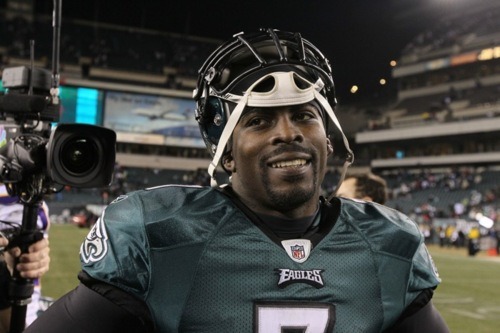
Statistics Conflict Over DeSean's Unique Game

DeSean Jackson Philadelphia Eagles Statistics

A constant trope has emerged among fans and writers, debating the relative merits of DeSean Jackson. On one side are the folks who marvel at Jackson’s speed and explosiveness, who see the way he changes the dynamics of the game with his special ability to score from anywhere on the field. On the other side are the doubters, people who see a diminutive, injury-prone and inconsistent player who’s too unreliable to be a true #1 wide receiver.

Often, statistics can help to settle questions like this. On this topic, however, the stats are split. DeSean’s proponents can sight his ridiculous 22.5 yards per reception figure and rattle off the dozens of big plays he’s been a part of over the last three years. On the other hand, Jackson’s league-leading drops percentage isn’t winning over many skeptics.

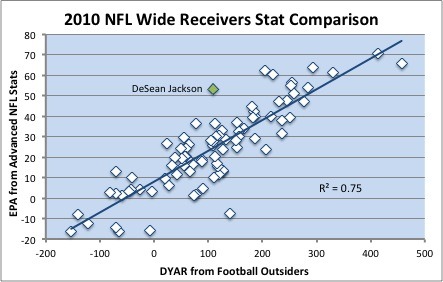
Even the “advanced” statistics are split. Check out the following graph comparing two wide receiver stats for 2010: Football Outsiders’s DYAR and Advanced NFL Stats’s EPA.

2010 NFL Wide Receiver Stat Comparison DYAR EPA

As you can see, there’s a strong correlation between the two stats among wide receivers with 50 or more targets last year. That’s encouraging — it means the two numbers often agree on player performance.

But look at DeSean, way off the trendline. Expected Points Added puts Jackson among the top ten wide receivers in the NFL. But Defense-adjusted Yards Above Replacement says he’s worse than average among the 85 most-targeted receivers. In fact, the difference between DeSean’s rank in EPA and DYAR is the greatest among all these receivers (barring only Terrell Owens, floating down in the bottom center of the graph).

DeSean is involved in a lot of plays that lead to expected point gains, but aren’t counted as highly by Football Outsiders’ statistics. I’m not really sure what causes this difference, and I’m open to suggestions. But, either way, it suggests that this debate probably isn’t going away any time soon. Some people will count one stat and some will look at another, and come to opposite conclusions.

Perhaps Jackson is just a unique type of player. Rather than referring to him as a “true” top wide receiver, we should just accept that he’s a “non-typical” #1. When we look at the whole picture, it’s clear he’s doing something different — even if the stats are split as to what exactly that means.

Photo from Getty. Originally published at NBC Philadelphia.
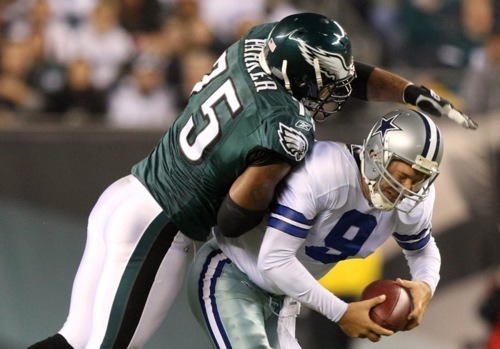
Are DeSean Jackson's Drops a Major Problem?

DeSean Jackson Drops Percentage Catch Rate

Pro Football Focus had a report earlier this week that got a lot of traction, detailing the NFL wide receivers with the best and worst hands in 2010. In it they broke down receivers by “drop percentage,” the number of drops a receiver made divided by the number of catchable passes (drops + receptions).

A surprise to many Philly fans, DeSean Jackson led the way with the worst drop percentage in the league among wide receivers with at least 50 catchable balls thrown their way. They counted 12 drops out of 61 passes, for a percentage just under 20 percent. In other words, DeSean dropped one out of every five balls — which is appallingly high.

Regardless, the immediate reaction of a lot of folks, including myself, was to dismiss the report entirely. After all, Jackson spends a large number of plays streaking down the field. Those long passes have to be harder to catch.

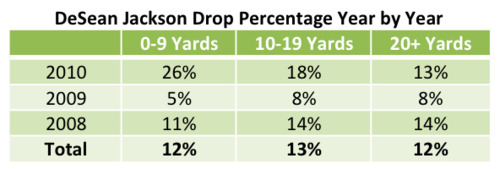
But when I actually went and looked at the numbers (also from PFF), it turns out deep passes weren’t really the problem last year. Take a look at the chart below.

DeSean Jackson Drops Percentage by Year and Distance DeSean only dropped two deep balls out of 15 possible in 2010. That’s not a fantastic rate, but it’s in line with his previous two years. The real jump, however, came on short passes. In theory, those slant routes and other underneath targets should be easier to catch. Yet Jackson dropped more than one quarter of them — way higher than his previous two seasons.

Suddenly DeSean’s deep ball excuse isn’t so convincing. It looks like he truly does have poor hands, at least compared to the average NFL wideout. But while it’s something to keep an eye on and an aspect of his game that he needs to improve, these bad drop rates still probably aren’t a huge problem. Because these are all small sample sizes, a drop here or there will matter a lot — especially when the difference between a drop and an uncatchable ball could be disputed. Jackson had a lot more drops in 2010 than 2009, but there’s no reason that couldn’t shift back toward the mean next season — whenever that season eventually happens.

Photo from Getty. Originally published at NBC Philadelphia.