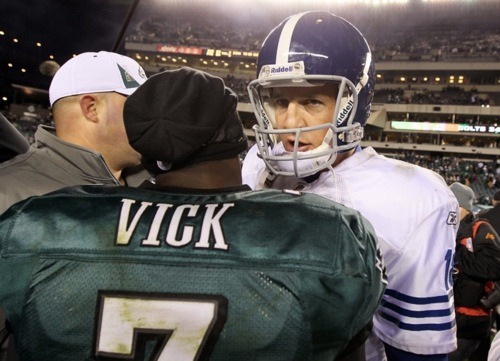
Odd Similarities: Are the Eagles the New Colts?

Michael Vick Peyton Manning Post Game Embrace Eagles Colts

There’s been one NFL team for most of the last decade that employed steady stars across the offensive skill positions, including a top five quarterback with special intangibles, two Pro Bowl-caliber wide receivers, and a cadre of complementary weapons for their pass-heavy system. This team had a speed-oriented but relatively simple 4-3 defense with lots of player turnover. And the overall system, touted for years by a steady veteran coach, was in place for season after season as the team won multiple division titles and always pushed closer to the Super Bowl — before finally making it over the hump.

I’d ask you readers what team I’m referring to, but my title probably gave it away. The Indianapolis Colts, with Peyton Manning, Marvin Harrison, Reggie Wayne, and others were one of the best teams of the 2000s. After 10 victories in Tony Dungy’s first year as coach in 2002, the Colts won 12 or more games for the next seven years.

Perhaps this is a stretch (and feel free to call me out on it if so), but in many ways haven’t the Eagles become a mirror image of those Colts teams?

Start on offense. Clearly, Michael Vick isn’t the same type of quarterback as Manning, but both are dominant stars at the position that make defenses adjust to them. DeSean Jackson and Jeremy Maclin are the new Harrison and Wayne. LeSean McCoy can be Edgerrin James and Brent Celek can grow into Dallas Clark’s shoes. Along the offensive line the Eagles now have the same “genius” position coach in Howard Mudd — so presumably that unit will start looking similar.

On defense the Eagles are apparently moving away from the complex blitzes of Jim Johnson to the opposite read-and-react style that marked Dungy’s defenses for years. New defensive coordinator Juan Castillo has praised Lovie Smith’s work in Chicago, and the Bears defense is derived from Dungy’s Tampa Two. That new philosophy should fit the Eagles personnel fine since the Colts have cycled through young linebackers at almost the same rate.

NFL teams are built in all sorts of ways, and it would have been difficult in the past to characterize these two teams as particularly similar. Suddenly though, there are these similarities and coincidences. And I don’t think it’s a bad thing.

I’ve always admired the Colts from afar for their strategy, as well as for the consistency of their success. Part of that success comes from an adherence to one of Football Outsiders’ basic principles: “Offense is more consistent from year to year than defense, and offensive performance is easier to project than defensive performance.” Colts GM Bill Polian built a consistently above average offensive unit from Manning on down, and then allowed the defense to shift around and eventually luck into a few good games in a playoff run.

Intentionally or not, the Eagles front office seems to have replicated that formula. Over the last few years they’ve focused on building a formidable offense for the foreseeable future and then started searching for defensive solutions. While the past is written for those Colts, it remains to be seen what kind of future this team has going forward.

Photo from Getty. Originally published at NBC Philadelphia.
Hot Read: the Beast, Burress, and Cheap Owners

There’s a new blog in town. Friend of the blog Jimmy Kempski (known as JimmyK at Bleeding Green Nation), kicked off his new site “Blogging the Beast” yesterday and it looks great — he’s covering the NFC East better than ESPN.

Jimmy already has some nice posts up, including a breakdown of this Plaxico Burress nonsense, which I completely agree with. The original report on the New York Post doesn’t convince me of any sort of accuracy. There isn’t even an anonymous source quoted, just a reporter shooting the breeze: “I’ve heard that the Eagles will eventually be first in line.”

Taking on a talented but reformed criminal doesn’t strike me as out of the question for the Michael Vick-era Eagles. Burress has made Eli Manning look great so many times that I’m interested to see if the guy has anything left.

But we should also remember that it takes two to tango. Even if the Eagles are interested, they aren’t going to be the most desperate for help. Burress would have to take less money and know that he won’t have an immediate chance to start in Philly — something Vick was willing to do to rehabilitate his image. I’m not sure Plaxico, at age 34, has the time or patience to take that same route.

* * *

Good for Jeffrey Lurie and the Eagles for not cutting their coaches’ salaries immediately after the lockout started. I wonder how much money the rest of the owners are saving with this cheap move over these summer months, and how much less the coaches are really working.

This probably also hints at the catastrophe that could strike the all the coaches and other support staff if this lockout extends into the regular season. We’ll certainly see a lot of layoffs in that case.

Handicapping Kevin Kolb's Next Team

Kevin Kolb Trade 2011 Philadelphia Eagles

There’s still the long shot possibility that the Eagles don’t trade Kevin Kolb. They could always keep him as a back up and then franchise/trade him after next season. But there’s really no reason not to pull the trigger as soon as the lockout is lifted.

The situation is actually fairly analogous to last year’s decision to trade Donovan McNabb. Sure, the team could have kept McNabb another year, but his value would have only declined and their leverage in trading would have only decreased. The Eagles maximized their return and moved on to the future. I expect they’ll do that again as soon as possible.

Here’s a breakdown of Kolb’s possible destinations, starting with the least likely.

Packers, Steelers, Jets, Bears, Patriots, Falcons, Ravens, Saints, Colts, Chiefs, Buccaneers, Giants, Chargers, Rams, Lions, Texans, Cowboys: I can’t invent a realistic scenario in which any of these teams were ever in the market for Kolb. 100-1 odds for the whole group.

Jaguars, Vikings, Titans, 49ers, Bengals, Panthers: All of these teams would have been contenders, but are effectively wiped out by their high selections of quarterbacks in the draft. At most they’ll need a caretaker quarterback, but there are better options for that with Donovan McNabb, Marc Bulger, Carson Palmer, Jake Delhomme, and others soon to hit the market. 9-1 for this pack.

Raiders, Dolphins, Redskins, Bills, Broncos: Jason Campbell, Chad Henne, Rex Grossman, Ryan Fitzpatrick, Kyle Orton. If you were an NFL general manager, would you be comfortable relying on any of these quarterbacks? I certainly wouldn’t. But none of them seem like particularly good bets for Kolb at this point. The Raiders don’t want a West Coast guy, the Dolphins only want a challenger for Henne, the Redskins aren’t dealing with the Eagles again, the Bills seem content with Fitzpatrick, and John Elway already has three QBs competing in Denver. 7-1 for all five.

Browns: Tom Heckert and Cleveland were linked to Kolb a few times last offseason, and now they’ve added former Eagles quarterback coach Pat Shumur. Plus, they have an extra 2012 first round pick. A match made in heaven! Apparently not. After NFL Network’s Mike Lombardi stoked the flames of a possible deal, the Browns moved quickly to put them out. Perhaps they want to give Colt McCoy a full season tryout before they move on. 7-1.

Seahawks: Another team supposedly interested in Kolb last year when the Eagles wouldn’t trade him, Seattle still hasn’t resolved its quarterback issues. Matt Hasselbeck hasn’t been a starting-caliber QB since 2007 and Charlie Whitehurst doesn’t inspire much confidence as a replacement. Let’s peg them at 3-1 odds.

Cardinals: Arizona is the front runner for Kolb because, despite probably the worse group in the NFL (Derek Anderson, Max Hall, and John Skelton), the Cardinals have done absolutely nothing to remedy their quarterback situation. Nor have they really expressed any even token support for the players on their roster right now. They know they need a solution, and aren’t even trying to prove otherwise. At this point they’re probably 2-1 favorites for Kolb.

Disagree? Let the debate rage in the comments.

Originally published at NBC Philadelphia. Photo from Getty.
The Paradox of the Moral Compass in Sports

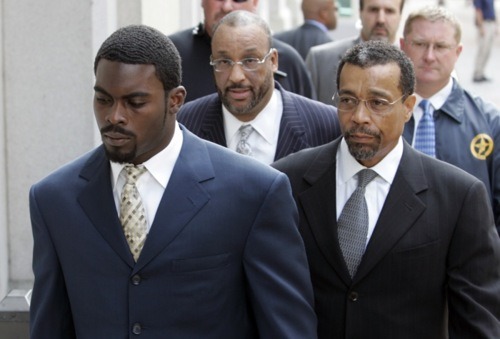
Michael Vick Court Jail Philadelphia Eagles

The Eagles have long prided themselves on acquiring morally upstanding players to represent Philadelphia. Even the notable exception of Michael Vick was wrapped in a tremendous flag of righteous leadership, as the Eagles patted themselves on the back for giving a second chance to a man who admittedly made a lot of mistakes.

Yet, in the last two drafts general manager Howie Roseman has pursued honorable, law-abiding leaders even more exclusively. Just last month the Eagles selected a fireman, at least four team captains, a few academic all-conference players, and a national anthem-singing renaissance man. Knowing this trend, it’s laughable to think that so many experts expected the team to take troubled cornerback Jimmy Smith in the first round.

But what’s behind this shift in purpose for the Eagles front office under Roseman? Something about his philosophy has cleared changed the thinking there, and I wonder what the catalyst was. Was the previous standard not high enough? I doubt the Eagles would take another Jack Ikegwuonu anyway. But this new policy goes much further. Not only is the team avoiding players who were in trouble with the law, but they’ve also shied away from almost anyone not considered the paragon of a team leader.

Maybe I’m spending too much time obsessing over something Occam’s Razor would solve with: well, Howie thinks good kids will be better than bad ones. But the shift wasn’t away from delinquents. It was toward choir-boys.

You have to wonder if the Eagles would have even taken the risk on superstar DeSean Jackson, considered a me-first player in college, had Roseman been in charge in 2009. If anything, you’d think the team’s experience with Jackson would teach then to appreciate talent above pretty much all else.

Would Jimmy Smith have become an all-star in Philadelphia? Or would he have flamed out in series of run-ins with the law? We can’t know, and that’s not the point.

The point is that this is where you start to play devil’s advocate about the deeper reasoning behind the policy. It’s easy to support a football player with a captain’s experience, a golden voice, or a fireman’s work ethic. That makes sense on a level that’s easy to understand, appreciate, and defend. But at what opportunity cost? Is there any loss?

The fact that Michael Vick isn’t dodging defenders and tossing touchdowns in another team’s jersey suggests that maybe there is a substantial sacrifice.

Originally published at NBC Philadelphia. Photo from Getty.
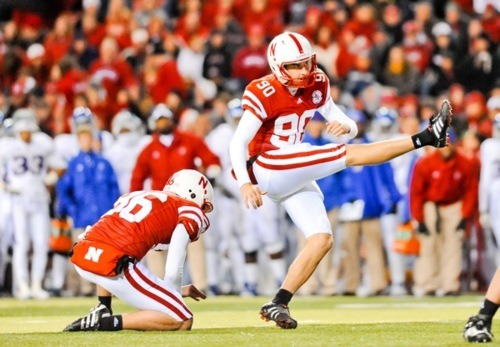
Beware the Rookie Kicker: Alex Henery's Future

Alex Henery Eagles Kicker 4th Round Pick

I’ve largely supported the Eagles’ decision to draft Nebraska kicker Alex Henery last month. Like everyone else, at first I was surprised. But after about 60 seconds, the reality set in and I started to realize that the writing was already on the wall regarding David Akers’s future.

Plus, unlike many other commentators, I didn’t really mind that the Eagles jumped on Henery in the fourth round. Partially that’s because I get annoyed with baseless pronouncements of value, but also I think that the Eagles front office showed some guts with this move. If you’re Howie Roseman and you’ve come to the conclusion that the Akers era is over, why not go for the best kicker in the draft instead of waiting around to pick up a journeyman or two?

However, after poking around at kicker statistics some more, I’m no longer quite so optimistic. Let me just throw the numbers at you.

Since 2000, NFL teams have drafted 24 different kickers, mostly in the fourth through seventh rounds. (Sebastian Janikowski, Mike Nugent, and Nate Kaeding are the only exceptions.) Of those 24, only half started even 8 games their rookie year. A number of them didn’t make the team out of training camp and a few more lost their jobs after just a few games. Then, just counting the 12 who played the majority of their rookie year, their average field goal and extra point DVOA (which compares field goals to the league average from that distance) was actually negative: -1.78.

It was unrealistic for me to think that rookie kickers could step in and perform as well as veterans right away. Perhaps I was fooled by the idea that field goals remain basically the same from college to the NFL. But the problem is that kicker, unlike most positions, typically requires an all-or-nothing commitment. Most teams can’t afford to keep two kickers on the roster, so you either have to stick with your rookie and expect some problems, or kick him to the curb before he’s even gotten a real chance.

There is a case for hope. Of the 12 kickers who started in their rookie seasons, their average DVOA improved over the next two years to 0.68 and then 1.64. So by their third season — if they make it that far — the kickers have mostly become above average.

But despite that possibility, no one should be under any delusions that Henery will be able to step in without any problems his first year and provide the veteran consistency Akers provided us for the last decade. I’m certainly not operating under that assumption any more.

Originally published at NBC Philadelphia. Photo from Getty.

Hot Read: Post-Hoc Eagles Draft Notes

Did the Eagles address their biggest needs in the draft? Advanced NFL Stats put up charts prior to the draft that ranked every NFL team by 2010 positional EPA (Expected Points Added).

On offense: QB #8, RB #6, TE #19, WR #3, OL #24. That lines right up with the Eagles drafting both early and often for the interior offensive line. Otherwise they mostly ignored the offense.

On defense: DE #3, DT #16, LB #31, S #9, CB #17. This might be too similar to yesterday’s post about draft value, but after last year’s debacle maybe the Eagles should have drafted one or more NFL-ready linebackers, rather than continue to stock the cupboard with late-round depth picks.

* * *

While we’re on the subject, I didn’t do quite so poorly in my draft predictions this year:

  • The Eagles will not take Jimmy Smith. Check.
  • But the Eagles will take a top cornerback in the top few rounds. 3rd round counts, right?
  • The Eagles won’t pick at 23rd overall. Oops.
  • At least two more linebackers. Howie rewarded me with three.
  • Less than 10 rookies. Didn’t think there would be space for another 11 guys.
  • No quarterback. Yup.
  • Correll Buckhalter 2.0. That’s the optimistic outcome for Dion Lewis.
  • Ignoring the defensive line? Thank you, thank you. I’ll be here all week.

Questioning the Eagles Draft Strategy

DeSean Jackson Eagles Draft Strategy

Over the years, the Eagles have often been lauded for their overall draft strategy of trading back and picking up lots of extra draft picks. Unlike a lot of teams that put all of their eggs in a few baskets, the Eagles understand that the draft is just a giant gamble, and the more times you play the more likely you are to win.

Rubeun Frank over at CSN Philly is the most recent to praise this style of drafting. He noted that (after four trades) Howie Roseman turned a second round pick from last year into six players: Daniel Te’o-Nesheim, Mike Kafka, Clay Harbor, Ricky Sapp, Riley Cooper and Dion Lewis. That’s certainly impressive considering the team could have had only one player and instead were able to draft six. But, to play devil’s advocate for a minute, might that have been the wrong move?

It’s too early too tell for sure, but right now none of those six players look like starters, at least yet. Te’o-Nesheim barely got on the field, Kafka was mostly inactive, Harbor got some minutes but only as back up, Sapp missed the year with a knee injury, Cooper is fourth-string, and Lewis was just drafted. That’s six players who might contribute down the road, but none of them look like potential stars, or even starters this coming season. It’s tough to isolate even one of them who’s sure to be a big contributor with the team.

Instead, the team could have picked a second round player, like Dallas did in the spot the Eagles traded out of last year, number 55 overall: linebacker Sean Lee. Obviously, Lee isn’t a guaranteed long-term starter, let alone star, but he showed more potential last season in limited play than any of the six players the Eagles received in return. Lee was named NFC defensive player of the week for his performance in week 13 against the Colts, in which he made nine tackles, broke up two passes, and made two key interceptions — including one that he returned for a touchdown. Again, the future is still murky for all of these players. But, while you might disagree with me, I hesitate to name a single player of those six the Eagles drafted who has the potential to be as good as Lee.

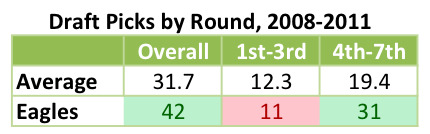
NFL Draft Picks by Round, 2008-2011 Philadelphia EaglesThe truth about the Eagles draft strategy is that it amasses lots of extra draft picks, but most of these picks come in the later rounds when many of the players won’t even make the team long term. Look at the table at right. Yes, over the last four drafts the Eagles have made 10 more selections than the average team — but all them came in the second half of the draft. In fact, despite their numerous picks, the team has actually drafted fewer players in the first three rounds than average.

Sure, there are tradeoffs involved either way. But would you rather make 11 early picks and 31 late-round selections like the Eagles did, or go the Patriots route — 19 picks in 1st-3rd rounds and 18 after that? Look at the rising stars on the team, and consider where they were drafted: Jeremy Maclin (1st round), DeSean Jackson (2nd), LeSean McCoy (2nd), Nate Allen (2nd), Brandon Graham (1st).

The Eagles give themselves a lot of chances to succeed by gathering draft picks the way a kid runs house to house for candy on Halloween. But at the end of the night the danger is that they end up with lots of raisin boxes and mysterious hard candies rather than one or two big Reese’s Peanut Butter Cups or Snickers bars that they really crave.

Originally published at NBC Philadelphia. Photo from Getty.
Hot Read: Competing Values on Heisman Winner

On Wednesday, Tommy Lawlor discussed the possibility that the Eagles could sign likely free agent Reggie Bush. The idea is fun to think about, especially from a video game all-star team perspective. But the debate over Bush actually raises an interesting dichotomy of Eagles front office philosophies.

First, there’s the motivation to bring in dynamic, multi-dimensional offensive players. Especially at running back the Eagles show little interest in anyone who can’t catch the football as well as they can run it. And when they do, often the results aren’t pretty (see: Hunt, Tony).

And yet, there’s also the guiding conviction not to overpay for second-string players. You can see this all over the field, where the Eagles look for bargains and/or young players to fill in as back ups, but especially at running back. Correll Buckhalter never required a large investment before the team let him walk away for four years, $10 million last offseason.

When the Eagles signed Chad Hall — the poor man’s Reggie Bush — these two strategies came together perfectly. But with Bush himself, those values would clash and I tend to think frugality would win out.

* * *

Recently I’ve seen a couple of positive remarks about Trevard Lindley, and how we shouldn’t count him out for an increased role in 2011. I hope he can improve and make a significant contribution in year two, but in limited snaps last season his numbers were ugly. Just compare him to Dimitri Patterson, everyone’s favorite whipping boy:

Patterson — Target Rate = 19.4%, Catch Rate = 62.8%, Pass Defensed Rate = 7.7%

Lindley — Target Rate = 19.1%, Catch Rate = 65.8%, Pass Defensed Rate = 0%

* * *

Kevin Kolb rumors all converge on Arizona, where the latest analysis examined the possibility that the Cardinals could offer a deal similar to what Houston sent Atlanta for Matt Schaub: a first round swap and two second round picks. Just for the record, that kind of deal would be perfectly in line with Kolb being worth a mid-to-late first rounder. According to the draft trade value chart and accounting for one of the second rounders being a future pick, that 2007 deal assessed Schaub’s value as equal to the 21st overall selection.