A Real Linebacker? No Way!

DeMeco Ryans

It’s a year too late, but let’s not spoil the fun. The Eagles finally have a real linebacker. It’s a miracle.

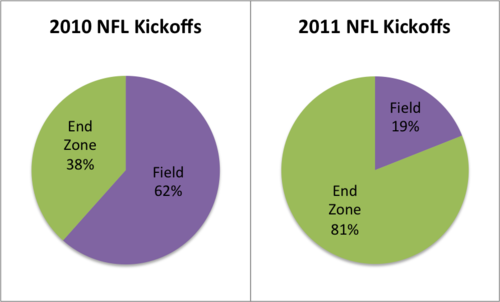
The trade yesterday for Texans middle linebacker DeMeco Ryans is everything the Eagles needed and more. In fact, it’s a master stroke by the front office. While the best free agent linebackers have zero Pro Bowls between them, Howie Roseman and company went out and acquired a two-time Pro Bowler for basically the same money and the equivalent of a late third round pick.

There are obvious caveats to the deal, starting with why the Texans would be willing to trade the 27-year-old Ryans. The decision to move him probably amounts to three factors. First, Ryans was going to cost upwards of $6 million a year for the foreseeable future, and the Texans are not in great salary cap shape. Second, the linebacker’s production fell in 2011 playing in Houston’s new 3-4 scheme. Instead of playing virtually every defensive snap, he only was on the field 58 percent of the time last year (according to PFF).

With the Eagles’ salary cap wizardry and 4-3 scheme, neither of those should be a problem here. The only remaining question is whether he’s lost a step following achilles surgery in 2010. Ryans played all 16 games last season, but many observers called it a down year for him. Hopefully the injury won’t be a factor going forward.

Even with that potential drawback, getting Ryans is a big win for the Eagles. He instantly becomes the most talented linebacker in this city, probably since Jeremiah Trotter first left in 2002. And he doesn’t have to return to Pro Bowl strength in order to make a huge impact in the middle of the Eagles defense.

Moreover, Ryans was a team captain and by all accounts a tremendous leader. The Eagles have had problems in that area too, but it seems likely that the team has found it’s vocal defensive signal-caller for the foreseeable future.

Photo from Getty. Video h/t BGN.
phonz3 Called It: Eagles Trade for DeMeco Ryans

Philadelphia Eagles message board:

You heard it here first. We’re trading for DeMeco Ryans
Started by phonz3, Monday, 08:32 PM

I’m in awe. As Jay Glazer would say, MAJOR SCOOPAGE!

(Credit Michael Kivland and the guy for the find.)

Touchbacks: Returning More With Less

Alex Henery Kickoffs

Last year, I projected that the new kickoff rules — mainly the new default kick spot at the 35, rather than 30 yardline — would result in a huge increase in touchbacks. The math from 2010 showed that touchbacks would likely go from 16 percent to almost 40 percent of all kicks.

Turns out I was close, but not high enough. According to what I compiled directly from play-by-play data, 44.5 percent of all kicks were touchbacks in 2011. But let’s go a little bit deeper.

Just how much did those extra five yards help the kickers? Check out the graphs at right.
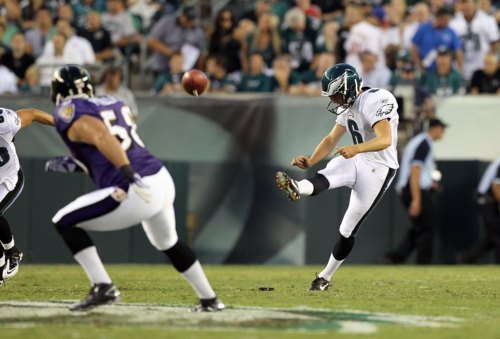
In 2010, only 38 percent of all kickoffs made it to the end zone. With an extra five yards of distance, NFL kickers took advantage. They kicked 81 percent of all kicks into the end zone in 2011.

But that’s not all. With that kind of increase, we would expect even higher levels of touchbacks than just 44 percent. So what kept it down? Apparently, the returners.

Kickoffs Touchback Percentage

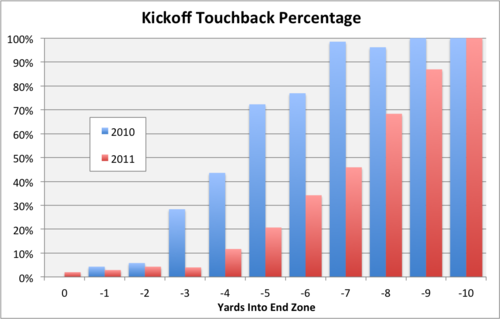
The chart above plots the percentage of kickoffs that became touchbacks by where they landed in the end zone. Obviously, as the kicks got deeper, returns became more rare.

The odd thing is that the end zone kicks were returned much more frequently in 2011 than in 2010. The first two yards are still almost always returned. But under the old rules, returners frequently didn’t bring out kicks that were just 3 or 4 yards deep. By 5 yards into the end zone, 72 percent were touchbacks.

This past year, that changed. Returners actually brought out more than half of all kicks as deep as 7 yards into the end zone. There were still more touchbacks overall, and a higher percentage of kicks into the end zone became touchbacks with the added distance. But returners took more risk than before, even knowing that the coverage teams also had five yards less to make up.

Perhaps kick returners felt the need to justify their continued presence on the roster. Kneeling down over and over would drive many a fierce competitor to take unnecessary risks. It will be interesting to see how that changes in year two after the kickoff changes.

Photo from Getty.

Making One's Own Bed

Geoff Mosher:

If your notebook never left the back pocket and your recorder stayed off, you could heard the gripes and complaints from some prominent, homegrown players who felt that the Eagles were more financially friendly to outsiders than their own.

It didn’t go over well years ago when millions were splurged on free agents such as Darren Howard, Stacy Andrews and Chris Clemons – guys whose performances never matched their paychecks – while Eagles-drafted players worked under modest long-term deals that paid out generous bonus money up front but looked outdated one or two years later when the market changed.

Without directly admitting it, the Eagles took a giant step toward diffusing what could have been an explosive locker room situation this season by extending the contracts of Todd Herremans, Trent Cole and DeSean Jackson on the first few days of free agency and then bringing back Evan Mathis.

The truth is that last year with Jackson and Asante Samuel, the Eagles already had an “explosive locker room situation” on their hands. This reversal (return?) is by far the biggest storyline of the offseason so far.

No Top Linebacker for the Eagles

Jeff McLane:

In other words, there hasn’t been a rush as the price tag for linebackers steadily drops. But it probably won’t dip low enough for the Eagles to be interested in either Lofton or Tulloch, according to NFL sources.

This is, frankly, stunning to me. I assumed the Eagles were simply waiting for the price to drop, a strategy that seemed to be working. But McLane’s connection to Howie Roseman has been solid, so it’s hard to take this as anything but an advance warning for Eagles fans.

Supposedly the team was interested in bringing back Joe Mays. The second tier of LBs also includes 90-year-old London Fletcher and Jameel McLain of the Ravens. A cheap purchase like that would either confirm the Eagles’ long term disinterest in the position, or suggest that Luke Kuechly’s arrival is imminent.

Inside Trent Cole's Contract Extension

Brian McIntyre has the details of Trent Cole’s contract. Here is the basic breakdown:

2012: $8 million signing bonus, plus original $3 million salary now guaranteed.
2013: Original $3.5 million salary now guaranteed.
2014: New $5 million salary (plus $500,000 $ack$-based bonus).
2015: New $10 million salary.
2016: New $11 million salary.
2017: New $14 million salary.

Cole turns 30 this year, which should give you a sense of which years are more or less fake money. To my eyes, the last three years all look unlikely. The Eagles gave Cole a lot of security by guaranteeing the final two years of his old contract and handing him a signing bonus on top of it. The 2014 additional year also looks attainable and very reasonably priced. After that, I don’t see the Eagles paying $10 million or more per year for a 33-year-old and up.

Still, don’t let that detract from what the deal really means. It’s not intended to purchase many more years of performance, but rather to serve as a thank you gift, a reward for Cole’s quiet excellence over the last few years. And in many ways, that’s more important.

Analyzing DeSean Jackson's New Contract

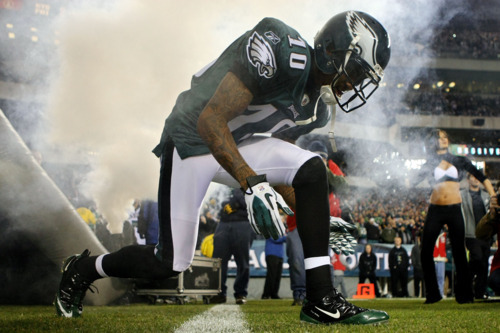
DeSean Jackson

Two weeks ago, I speculated that the Eagles franchise tag and DeSean Jackson’s acceptance of it could help bring the two sides together on a long term deal. With the threat of separation and the lack of respect behind them, it appears that’s exactly what happened. Reports differ on whether Jackson actually signed the tender or not, but regardless they were able to find common ground before it came to that.

From looking at the details of the contract, as reported by Pro Football Talk, it seems that both sides compromised somewhat. The Eagles came up from their absurdly low $6 million per year reported offer, and in exchange Jackson didn’t extract the maximum guaranteed money he likely could have received on the open market.

As it stands now, the deal (before Pro Bowl/Super Bowl escalators) looks like so:

2012: $10 million signing bonus plus $1 million base salary/workout bonus.
2013: $7 million salary/workout, $4 million fully guaranteed with rest for injury only.
2014: $10.5 million salary/workout.
2015: $10 million salary/workout.
2016: $8.5 million salary/workout.

What it comes down to, as far as I can tell, is basically a guaranteed two year, $18 million contract with three team option years in which Jackson’s paid very well in base salary but the team can move on from him if necessary.

It clearly helped to have other wide receivers signing long term deals recently. Look at the guaranteed money those players received:

Stevie Johnson, Bills: $18 million.
Marques Colston, Saints: $19 million.
Pierre Garçon, Redskins: $13-18 million.
Vincent Jackson, Bucs: $26 million.

DeSean didn’t get Vincent Jackson money, but he slots in quite comfortably among the other top wide receivers. DJacc’s full contract over five years is bigger than the other guys, but the money at the end isn’t guaranteed, making it somewhat of a “prove it” deal for the wide receiver. If he keeps his head on straight and plays up to his potential, Jackson could make more than most of the rest of them over the life of the deal.

All in all, it’s a happy day for Eagles fans. You simply don’t win in the NFL without retaining your top talent, and the Eagles came perilously close to not doing so. Now the nearly two year drama of Jackson’s status is over, and with any luck he will take to the field with a renewed purpose, showing us that his best years are yet to come.

Photo from Getty.