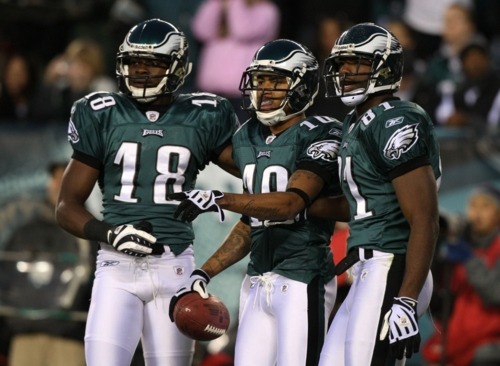
2011 Eagles Offseason Guide: Wide Receiver

DeSean Jackson Jeremy Maclin Jason Avant Eagles Wide Receivers

This is the third in a series of posts breaking down the Eagles position by position in advance of the upcoming draft and (hopefully) free agency. We’ve already looked at quarterback and running back. Today we’ll examine the wide receivers.

2010 Recap:  I already explored wide receiver performance in a previous post — so go check that out. Jeremy Maclin led all receivers in targets and DeSean Jackson had the highest yards per target, with Jason Avant retaining his premier slot position role. Because the top three guys are so talented, there was little left in the pie for the large rookie Riley Cooper or tiny Chad Hall. The duo combined for only 17 receptions the whole season.

Who’s Leaving:  No one has to leave. They’re all under contract for next season, although Hall’s roster spot certainly isn’t guaranteed. He didn’t do a whole lot to impress in limited action.

2011 Depth Chart: Everything seems to be set except for the last spot, unless Riley Cooper makes big enough strides in year two to challenge the elder statesman Avant (who’s only 27 years old) for playing time. I expect the Eagles will draft another late round wide receiver to compete with Hall and the practice squad fodder on the roster like Sinorice Moss, Rod Harper, and Jeremy Williams.

Potential Additions: If the Eagles are going to dress a fifth wideout, the player is going to have to offer something else. That something extra is probably on special teams, where the Eagles are still looking for a reliable kick returner. Look for someone like that in a late round. I’m certainly no draft expert, but reading some of the scouting reports guys like Ronald Johnson from USC, Dwayne Harris from East Carolina, or Jeremy Kerley from TCU could fit.

Future Outlook:  Future is brighter here than perhaps anywhere else on the team, assuming the Eagles can lock up DeSean Jackson to a long term deal. Once all this lockout nonsense is behind us, that should happen fairly quickly and the reign of explosive young wide receivers will continue.

Originally published at NBC Philadelphia. Photo from Getty.
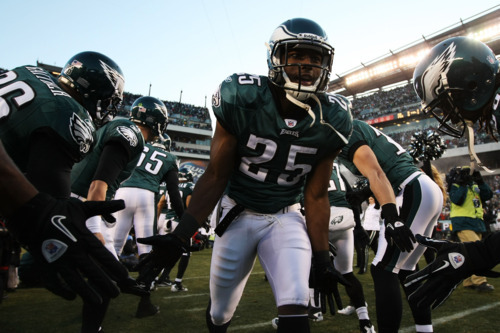
2011 Eagles Offseason Guide: Running Back

LeSean McCoy Eagles Running Backs 2011 Offseason

This is the second in a series of posts breaking down the Eagles position by position in advance of the upcoming draft and (hopefully) free agency. Yesterday we looked at quarterback. Today we’ll examine the running back spot.

2010 Recap: Last season was all about LeSean McCoy. The Eagles young starter ran the ball even more efficiently than Brian Westbrook at the same age. But other than McCoy, the running back position was a revolving door. Mike Bell was signed before the season but showed nothing. He was then traded midseason to the Cleveland Browns for Jerome Harrison. Harrison didn’t play a lot, but he performed when he was called on, including 100-yard rushing days against the Redskins and Cowboys. Eldra Buckley was the third back and saw very limited action. Although he did perform well on special teams.

At fullback, fan favorite Leonard Weaver severely tore his ACL on his very first carry of the season in week one. The team signed Owen Schmitt to take his place for the rest of the year and the former West Virgina grad performed adequately, if not particularly noteworthy.

Who’s Leaving: Much depends on the rules of the new collective bargaining agreement (assuming there is one). Harrison, a restricted free agent, was tendered at a second-round level under the current rules — meaning that any team who wanted to sign him would have to give up a high pick to the Eagles. Buckley was only tendered at the lowest level that allows the Eagles to match any offer, so he’s more likely on his way out. Finally, the team is only going to keep one fullback, so Weaver will have to fight to show he’s fully recovered to keep his job.

2011 Depth Chart: McCoy is the starter, backed up by a veteran (likely Harrison) and probably a rookie. Unless the team adds another fullback to make the battle more interesting, only Weaver or Schmitt will return.

Potential Additions: There are a few interesting free agent names. Darren Sproles of the Chargers is a lightning-quick back who would fit nicely into the Eagles’ speed offense — although he may be too expensive. Brian Leonard or Kevin Faulk also could be options.

If the Eagles miss out on Sproles, Oklahoma State’s Kendall Hunter may be the runner-returner that the team turns to in the draft instead. Hunter visited the Eagles for a workout last month.

Future Outlook: With McCoy in place for the long term, now would be a good time to get a secondary back who could grow into the back up spot. This would be the Correll Buckhalter to McCoy’s Westbrook, taking 5-10 carries a game and keeping McCoy from shouldering the entire load. It remains to be seen if the Eagles consider that high on their priority list.

Originally published at NBC Philadelphia. Photo from Getty.
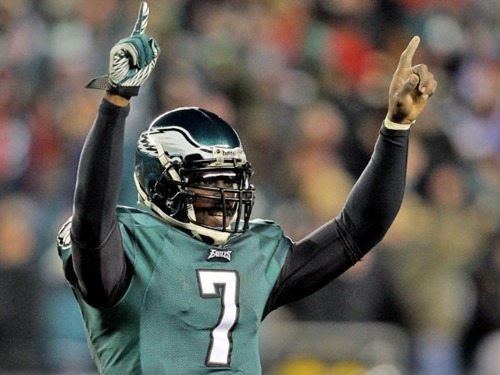
2011 Eagles Offseason Guide: Quarterback

Michael Vick Kevin Kolb Mike Kafka 2011 Offseason

This is the first in a series of posts breaking down the Eagles position by position in advance of the upcoming draft and (hopefully) free agency. Today we’ll start with quarterback.

2010 Recap: Pretty much the story of the season. Michael Vick took over for injured anointed starter Kevin Kolb and never looked back. Vick threw for over 3000 yards, 22 passing touchdowns with only 7 interceptions in just 13 games (including the Wild Card game). Plus, he used his quick feet to turn gain another 676 yards and 9 touchdowns on the ground.

Who’s Leaving: Kolb is almost certainly gone this offseason. While he was inconsistent in 2010, Kolb still had a four-game stretch as a starter in which he threw over 1000 yards with 6 touchdowns and 4 interceptions. There should be plenty of suitors for Kolb, perhaps enough demand to get a 1st round pick or more (although whether that’s for 2011 or 2012 remains to be seen). That kind of value would greatly outweigh his potential contributions as a backup.

2011 Depth Chart: Vick is the starter. The question is about second-year quarterback Mike Kafka. Can he be the main back up without any NFL playing experience? Certainly it’s possible. Everyone remembers A.J. Feeley’s five-game win streak in 2002 when Donovan McNabb was injured. Feeley was also a sophomore mid-round pick. Kolb, with a higher profile, became McNabb’s primary back up in his second year (although an older Feeley was still around in reserve).

Despite the Eagles working out a few quarterback prospects, such as TCU’s Andy Dalton and Nevada’s Colin Kaepernick, I’d be surprised to see them add another young player at quarterback this year. Kafka and a rookie QB would be the least experienced pair of quarterback back ups the Eagles have ever had under Andy Reid.

Potential Additions: The team will likely look to find a veteran player to plug into that hole instead. Free agents Matt Hasselbeck, Tarvaris Jackson, and Alex Smith all might be options if they can’t find starting jobs.

Future Outlook: Vick’s value, both on and off the field, is tremendous. As soon as possible the Eagles will give him a multi-year contract extension. However, Vick is turning 31 this June, so he probably only has three or, at most, four good years left. Within a year or two Reid’s going to have to start thinking about drafting his successor.

Originally published at NBC Philadelphia. Photo from Getty.
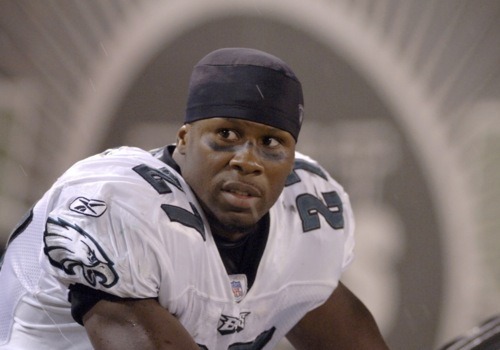
The Doomed Case for Re-signing Quintin Mikell

Quintin Mikell Contract Extension Free Agency Philadelphia Eagles 2011

Yesterday, Philadelphia Sports Daily had an interesting interview with Quintin Mikell, in which the veteran safety and Eagles defensive leader spoke about the uncertain position the team has left him in as a free agent. Mikell hopes to resign with Philadelphia but isn’t sure if the team wants him back.

If the Eagles don’t lock up a player long term prior to them hitting the market, the player typically doesn’t return. This is especially true of players on the wrong side of 30, who the team would rather replace with younger, less expensive talent. Given that the Eagles already have two young safeties who played admirably in 2010 — soon-to-be second year players Nate Allen and Kurt Coleman — and apparently haven’t talked to Mikell about an extension already, fans should assume the worst.

Yet not all older free agents are equal, and a number of factors suggest that letting Mikell walk would be a mistake. I talked about some of these issues last August when I predicted that the Eagles would probably negotiate a contract extension with Mikell. Although those reasons clearly weren’t enough to convince the Eagles during the season, I still think they should bring their starting strong safety back.

First of all, Mikell’s only 30 years old, which isn’t bad, at least for a safety. While he’s one of the elder statesmen on the team, plenty of defensive backs around the league have productive seasons after the age of 30. Last year, for example, 23 such cornerbacks and safeties started at least 10 games for their teams. It will be tough for him to still be playing when he’s Brian Dawkins’s age (37), but Mikell should have at least two more good seasons left in him — especially since he didn’t become a starter until he was 27.

I also mentioned last year that Mikell likely won’t need to be given a big-time contract extension. Mikell’s recent quotes suggest that he’s willing to take a hometown discount out of loyalty. Plus, despite his one Pro Bowl selection, he isn’t considered a star by anyone around the league.

Finally, while Mikell may not be absolutely necessary anymore with the emergence of the younger players, he would provide a important stability to the defensive backfield. Allen is coming off a season-ending torn patellar tendon injury and Coleman has only three career starts under his belt. You can’t count on either of them to step up as bona fide starters for 2011 and beyond. With that in mind, why not solidify that spot for the next two years with a relatively inexpensive Pro Bowler?

As I said at the beginning, I think the signs pointing to Mikell starting in a different uniform next year are too strong to overcome. His age doesn’t fit with general youth movement on the defense, which is getting retooled schematically anyway. And if Joe Banner and company haven’t reached out to Mikell by now, they probably never will.

Still, there’s always hope.

Originally published at NBC Philadelphia. Photo from Getty.

Eagles Drafting 1st Round Cornerback is Unlikely

Brandon Graham NFL Draft Philadelphia Eagles First Round Pick

A lot of reporters and fans have been putting together their mock drafts for the upcoming NFL draft, and many guesses converge on the Eagles taking a cornerback with their first round pick. That’s a scenario I don’t actually find likely, based on recent precedent.

Typically mock draft “experts” are guessing based on the Eagles most glaring weakness or biggest roster hole. They assume that the Eagles will look at their most vulnerable position and attempt to draft a player to plug into that hole. In truth, this isn’t a bad strategy to create mock drafts — it’s how most of the NFL conducts business. But the Eagles aren’t like everyone else.

Last year, I examined the Eagles recent strategy of drafting and concluded that the team rarely drafts players to fill an immediate need. For example, in 2007 the team drafted quarterback Kevin Kolb while Donovan McNabb still was in his prime. Neither DeSean Jackson (2008) or Jeremy Maclin (2009) were immediate need picks, although they both contributed as rookies because of injuries. And then last year the Eagles jumped up in the draft but didn’t do so to fill holes in the secondary. They went with a more long term need: Brandon Graham to be a pass rusher opposite Trent Cole in the years to come.

This philosophy suggests that the Eagles don’t want to count on rookies maturing into starters in one short offseason. If they’re ready, sometimes players can step up after injuries (Jackson, Maclin, Nate Allen, LeSean McCoy), or even beat out veterans for the opening day job (Brandon Graham). But the emphasis with the Eagles is never to draft a player with that intention — they don’t expect instant success.

With this in mind, it’s unlikely that the Eagles will draft a player at a position that they are looking for an immediate fix. That would especially single out right cornerback, perhaps the weakest link on defense. Some mock drafts have the Eagles taking a player like Colorado cornerback Jimmy Smith or Miami’s Brandon Harris and inserting him directly into the starting lineup across from Asante Samuel.

In line with the Eagles draft philosophy, that would be a bad move for 2011. Less than half of all defensive backs taken in rounds one or two in recent drafts were able to start even 8 of their team’s 16 games. Counting on a rookie to step in and solidify that spot is unreliable. Maybe a year or two later, but not right away. Instead, the team would target one or more free agent corners (such as Nnamdi Asomugha) to fill the void.

That’s why I think the Eagles are more likely to target the offensive line. Nabbing a highly-rated lineman who could compete with a returning Jamal Jackson, an underperforming Winston Justice, or any of the questionable guards would fit with the Eagles recent history. If the rookie needed more time to adjust, there would still be veterans ahead of him — but there would be the opportunity for playing time. Defensive line might fit also, where another player to step into the mix long term (now that Graham’s situation is in jeopardy) would be desirable. Additionally, the current players along both lines may not fit with the techniques preferred by the new position coaches Andy Reid hired this offseason.

The draft is less than a month away, and I could end up being wrong. But don’t be surprised if the Eagles don’t take your favorite cornerback with the 23rd overall pick.

Originally published at NBC Philadelphia. Photo from the Philadelphia Eagles.

Kickoff Returns Will Drop Sharply with New Rule

DeSean Jackson Kick Return NFL Rules

This week the NFL owners approved a rule change that will move kickoffs forward five yards, from the 30 to the 35 yard line. And while that might not seem like a lot, it will have a huge impact on the return game, drastically cutting back on the number of kickoffs that can be brought all the way back for a game-changing play.

Last year, kickers (with at least 15 attempts, not counting onside kicks) averaged 65 yards per kickoff — so the ball landed at the 5 yard line. Because most of these kicks ended up short of or barely crossing into the end zone, returners brought out the vast majority. Only about 16 percent of kickoffs were downed in the end zone for touchbacks in 2010.

When the kickers move forward five yards and average the same distance per kick, the ball is going to land in the end zone a lot more. Some NFL reporters, such as Sal Paolantonio, have suggested that the status quo is likely to return to what it was in 1993. That was the last year that kickoffs occurred at the 35 yard line. In 1993, touchbacks accounted for 32 percent of all kickoffs.

However, we won’t see touchbacks simply double. Kickers have improved significantly since the early nineties. They kick farther and with more hang time than ever before. So  you can’t assume the league will go back to just 32 percent touchbacks.

Based on the correlation between average kickoff distance and touchback percentage, I extrapolated from the 2010 data to determine how many touchbacks we’d have if each kicker essentially gained an extra five yard head start. According to my calculations, the actual number of touchbacks will be more like 40 percent of all kickoffs in 2011.

And that’s actually a conservative estimate. Billy Cundiff of the Ravens was the only kicker in 2010 to average over 70 yards per kickoff (71.1). Most of his kicks landed in the endzone, causing over half of them to go unreturned. With the five yard bump to the 35, the average kickoff will likely be over 70 yards now, thus allowing many more kickers to also force 50 percent or more touchbacks.

Plus, when the receiving team does get a returnable kick, the opposing tacklers will now have less ground to cover in order to get down the field and cut off the angles for a long return. Teams aren’t going to be paying more money for kickoff or return specialists anymore, either.

Overall, these changes have a clear effect. By reducing the number of returnable kicks and cutting down the likelihood of a breakout play, the NFL owners may have relegated kickoffs to an afterthought in the game. Enjoy the touchdown returns, because they’ll be few and far between.

Originally published on NBC Philadelphia. Photo from Getty.

Can LeSean McCoy Carry the Eagles in 2011?

LeSean McCoy Yards Per Carry Workload 2010 2011

Fans have always wanted Andy Reid to run the ball more, but those calls were especially loud last season when LeSean McCoy was tearing up field in his first season as the starter. On Monday I examined the striking similarities and subtle differences between McCoy and former Eagle Brian Westbrook. Those statistics showed that McCoy may be an even better runner than Westbrook was at the same point in his career.

Yet even if McCoy is a better runner than Westbrook, he still may not be able to handle the bigger workload that many fans want him to take on. Last year he only averaged 13.7 carries per game, surpassing the 20 carry mark only once — in a week six win over Atlanta.

That’s not surprising. Westbrook himself only rushed more than 20 times twice in his first four and a half years in the NFL. And, to be fair, there just aren’t many running backs left in the NFL who can handle the ball all the time. In fact, only six players had over 20 carries per game in 2010, and none averaged higher than 22 carries.

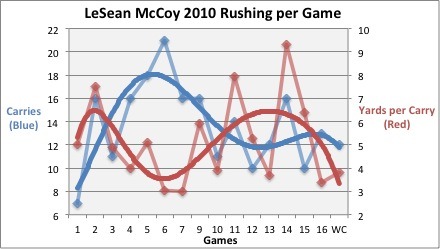
But could McCoy handle a bigger workload than the one he was given last season? Let’s look at his number of carries and yards per carry in 2010 on a game by game basis:

LeSean McCoy 2010 Rushing per Game Workload

So the blue is carries, corresponding to the left axis, and red is yards per carry, measured on the right axis. Over the season, McCoy’s workload and effectiveness varied substantially.

In the first half of the season, McCoy was being used a lot; he had 16 or more carries six times in the first eight games. Yet his production was actually down. McCoy had only three games during that stretch in which he averaged above five yards per carry and also had his two least effective games, in weeks six and seven.

Then things changed. McCoy only carried the ball an average of 12 times a game after week nine, but posted some of his best performances. While his yards per carry was a respectable 4.8 in the first half, it rose to 5.5 over the last eight games.

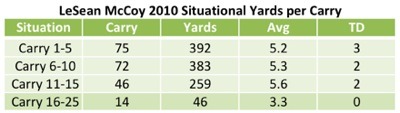
We can also separate McCoy’s performance by carry:

Eagles LeSean McCoy 2010 Situational Yards per Carry

Through the first 15 carries, McCoy was consistently great, averaging over five yards per carry. And while it’s a small sample size beyond that, McCoy experienced a significant drop off when the Eagles kept feeding him the ball last season.

Eagles fans will never stop calling for the team to run the ball more, and McCoy’s talent only makes that prospect even more tantalizing. But the truth is that McCoy might look much less special if he had to take on a huge workload. The Eagles may be better off limiting his touches, at least for now, and keeping McCoy as a fabulous second or third option — rather than the focus on offense.

Originally published at NBC Philadelphia. Photo from Getty.

Who's the Better Back: McCoy or Westbrook?

LeSean McCoy Brian Westbrook Comparison 2010 2004 Philadelphia Eagles

Recently, free agent and former Eagle Brian Westbrook said that he would like to return to Philadelphia. While such a move might make sense if Andy Reid wanted a veteran back-up, the truth is that Westbrook is a forgotten man in Philadelphia, where LeSean McCoy’s stellar 2010 campaign wiped away any doubts that he could fill his mentor’s big shoes.

When the Eagles let Westbrook walk last offseason, many people wondered if McCoy was ready for the starting job. His rookie season showed promise, but McCoy was still raw. He danced too much before hitting the hole, hadn’t mastered blocking assignments, and couldn’t be counted on in the passing game. But after changing his uniform number and physique in the offseason, McCoy was stellar in 2010. In fact, McCoy was one of the most consistent offensive leaders, racking up big numbers despite injuries at quarterback and holes along the offensive line.

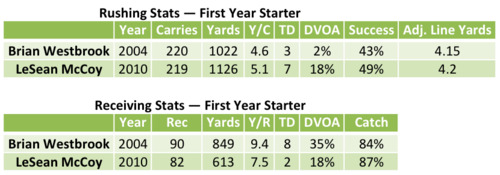
However, one question remains. Is he better than Westbrook? That’s an easy answer regarding the 2010 versions of each, but we have to compare apples to apples. As I did early last season, I’m going to look at Westbrook’s 2004 season and McCoy’s 2010 — both seasons being the running back’s first as the unquestioned starter. Here are the stats:

LeSean McCoy Brian Westbrook Statistics Comparison

I broke down the numbers by rushing and receiving, so let’s examine them in that order.

Westbrook and McCoy had a shockingly similar number of carries in the same 16 games, including playoffs. Yet see who was the more efficient runner? Looks like Shady has a leg up on his predecessor at this point in his career. McCoy averaged half a yard more per carry and scored four more touchdowns. He also scored big DVOA points compared to Westbrook and had a higher Success Rate, another Football Outsiders stat that measures consistency. McCoy did benefit from a slightly better run-blocking offensive line, according to FO’s Adjusted Line Yards, but the difference was marginal at best. McCoy, in his first season as the feature back, was clearly the better runner.

Then, when you look at the receiving numbers, the paradigm shifts. Westbrook had a significantly higher Yards per Reception figure and scored eight huge touchdowns. Plus, while McCoy’s DVOA is solid, Westbrook’s is incredible. Number 36 was simply a better receiving threat.

What does this mean? Putting it simply: McCoy is a better rusher, but a worse receiver than Westbrook was at the same time in his career. That redistribution of talent fits perfectly with the rest of the Eagles current roster, which is already bursting at the seams with explosive outside threats. There’s less of a need to design pass plays for the running back when DeSean Jackson and Jeremy Maclin are on the outside (not that Terrell Owens was a slacker).

Even with these differences, it’s fascinating to watch McCoy follow in Westbrook’s footsteps, performing the same dual-threat running back role. Already, McCoy lived up to Westbrook’s example and has surpassed the 31 year-old in some areas. Only thing to see now is if McCoy can sustain it into the future.

Originally published at NBC Philadelphia. Photo from Getty.