How to Kill the Goose that Laid the Golden Eggs

If you haven’t been following the NFL labor saga, or if you have and still can’t figure out what’s going on, let me break it down for you in really simple terms:

No one in this whole debacle — not the players, not the owners, not the commissioner, or anyone else — cares one iota about the fans who have become rabid consumers of the NFL.

They only care about lining their own pockets, and can’t come to a single reasonable compromise that would split the rapidly expanding pie of billions of dollars among themselves. Because of this, the owners and players have spent weeks posturing through meaningless negotiation sessions and will now likely spend months attacking each other in court, putting at risk the entire future of professional football for the fans who have made the league so successful in the first place.

No matter what happens, whether there’s football in 2011 or not, this entire affair has only served to show how easily reckless greed can destroy a great thing.

It’s a disgrace.

Vick Signs Franchise Tag, Akers Declines

Michael Vick David Akers Franchise Tag Free Agency 2011

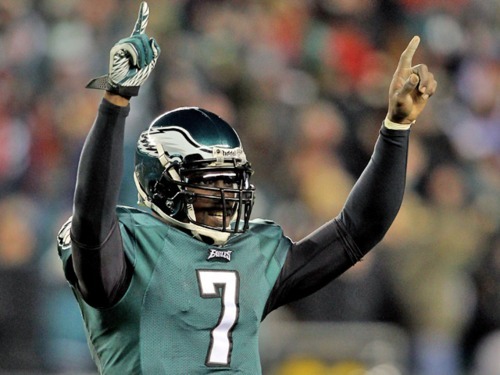
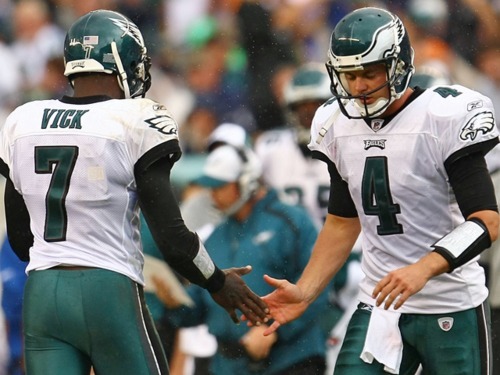
Two Eagles players were tagged with guaranteed contracts to keep them with the team through next season. Today, Michael Vick said he will sign his franchise tender, while David Akers indicated he would turn down his transition tag.

Vick signing his approximately $16 million one-year contract isn’t surprising. He has expressed on multiple occasions his desire to stay with the Eagles, and the franchise tag seems like only an intermediate step before he and the team work out a long term contract extension. Team President Joe Banner said recently, “We wouldn’t be sitting here and putting a franchise tag on him if he’s somebody that we weren’t very excited about.”

By assigning the franchise tag to Vick, the Eagles will pay him the average of the top five players at his position — money that will certainly help the quarterback as he extricates himself from his bankruptcy requirements. The tag also prevents any other teams from even trying to talk to Vick during free agency.

During the current labor talks, the NFL Players Association has argued that the tags are invalid if the collective bargaining agreement expires on Thursday. That’s the argument Akers’s agent Jerrold Colton made when he said the kicker would not sign the approximately $3 million dollar offer sheet. Colton has suggested that his client is “disappointed” with the tag, even though he still wants to return to the Eagles on a multi-year deal.

However, it’s unclear what, if any, leverage Akers has in negotiations. His transition tag allows him to talk with other NFL teams (with the Eagles having the power to match any offer), but is any team willing to spend top dollar on an aging player who’s no longer an elite kicker?

Originally published at NBC Philadelphia. Photo from Getty.

How Much is Kevin Kolb Worth as a Backup?

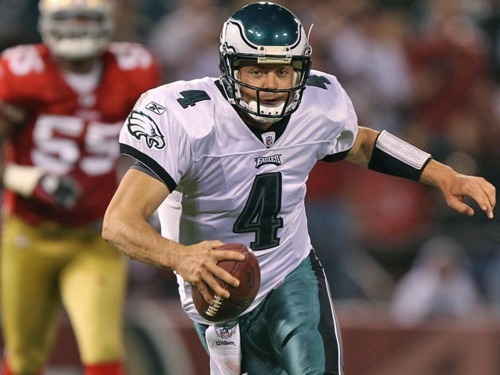
Michael Vick Kevin Kolb Backup 2011 Trade NFL

One of the more frequently-argued points in favor of keeping Kevin Kolb for 2011 is the “We need him if/when Michael Vick gets injured” meme. The idea here is that Kolb could rescue the team’s Super Bowl hopes if Vick has to miss significant time, and that without him the Eagles would be dead in the water.

That got me thinking, how much is a backup quarterback really worth? The argument being made here is one based on fear — fear of a catastrophic season-ending injury that derails a magical season. But from a statistics perspective, we can eliminate that emotional component and focus on the facts.

Let’s start from the beginning. How likely is it that Vick will get hurt? While Vick takes a lot of hits, there’s no guarantee that he’ll miss time. In fact, like Donovan McNabb, he has shown that he can play through a number of injuries. So what about across the NFL — how often do starting quarterback get hurt?

During the 2010 season, backup quarterbacks started 101 games out of a combined 512. Twelve NFL teams never had to start a backup, but that means that the majority did. Overall, teams averaged just over three games started by backups over the course of the 16-game season. Although some of these backups replaced demoted starters rather than injured ones, we can take the three game rule on the whole to be an appropriate approximation of the likely number of games the Eagles won’t have Michael Vick under center next season.

Next, we have to figure out how much worse the backups are than the starters, and how much less likely a team is to win with the second-string quarterback making the throws. I compared the win percentages from the games started and completed by starters with those by backups, eliminating the teams who avoided the injury bug all year.

What I found was that the average win percentage by team with their starter was 50 percent, an even split. However, the backup-led teams only won 32.7 percent of their games. That’s a sizable difference. When we apply the win percentages to the three game expected injury time, where the starter would win 1.5 of those games, the backup only would win .98 of the three.

By this logic, the drop off to the backup quarterback was worth, on average, about .5 wins over the course of the season.

The final piece of the puzzle addresses the Eagles specifically. During the Andy Reid era, has the drop off from Donovan McNabb to his backups been similar to the NFL average? During seasons in which McNabb missed at least one game, his win percentage was 61.3 percent. His backups came in at 50.5 percent. Obviously, since the Eagles have produced better teams than average over the past decade, their win percentages are going to be higher. Thus, in the three game average backup window, where McNabb would win 1.8 games, the backups averaged 1.5 victories.

That the difference for the Eagles has been only .3 wins rather than the .5 NFL average in 2010 could be the result of a number of factors, including random luck, better backups than average, or better coaching. While Jeff Garcia was a revelation in 2006, I tend to think the truth falls more into the first and third categories.

Either way, whether you look at the league average or the Eagles, a half victory here or there likely doesn’t make the difference between a Super Bowl season and another disappointment. Even if Kolb came in and played at exactly Vick’s level, the difference (on average) is relatively minor. Obviously there are scarier scenarios where Vick gets injured for six, eight, or ten games instead of three. But we must keep in mind (a) that it’s just as, if not more, likely that Vick doesn’t miss any games, and (b) that there’s no guarantee Kolb would provide any more than the standard backup .3-.5 win drop off we’d expect from any other free agent the Eagles brought in. If he were as good as Vick the Eagles probably wouldn’t have demoted him in the first place.

After all that, it’s clear to me that the argument for keeping Kolb as a backup “just in case” has little going for it besides fear of circumstances beyond anyone’s control. If the Eagles aren’t still contemplating keeping Kolb long term, sending him off for a first round draft pick seems like the smart move.

Originally published at NBC Philadelphia. Photo from Getty.

Should the Eagles Pursue Nnamdi Asomugha?

Nnamadi Asomugha Eagles Free Agency

Perhaps the biggest hole in the Eagles defense right now is at right cornerback, opposite Asante Samuel. Ellis Hobbs, Dimitri Patterson, and Joselio Hanson all got the chance to start in 2010 but none could even consistently play at an average level. So going into 2011, fans have been clamoring for the team to add perhaps the biggest star on the free agent market — Raiders cornerback Nnamdi Asomugha.

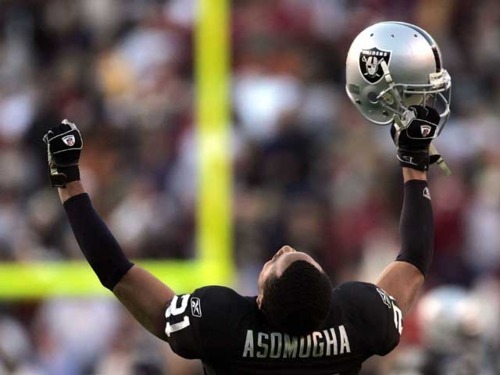
Asomugha is often touted as one of the best, if not the best cover corner in the league. The three-time consecutive Pro Bowler doesn’t come up with a lot of interceptions, but quarterbacks notoriously avoid his side of the field. Last year, according to Pro Football Focus, receivers Asomugha covered were targeted only 29 times for 3.7 percent of his snaps, by far the least in the NFL (Samuel was second with 41 targets and 6.1 percent).

Asomugha would fit perfectly at right cornerback with the Eagles, where his size (6’ 2” 210 lbs.) and athleticism could balance Samuel’s ball-hawking skills. And it doesn’t appear that Asomugha is losing any of his game. One of the best wide receivers in the NFL, Larry Fitzgerald praised him last year: “The thing you see on tape for a man of his size, he has incredible hips and amazingly quick feet, and that’s just God given ability to be that tall and be able to move and cut and drive on balls the way he’s able to.”

Certainly on talent alone, the Eagles have to be interested. They’re used to making big splashy free agency moves and have the cash to do so. Plus, considering the cornerback spot is a pressing current concern, the team likely won’t try to look to the draft for a remedy.

Major Eagles Acquisitions

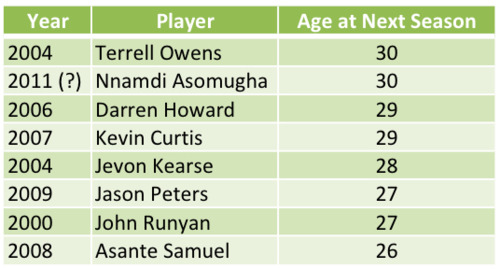
But the main question mark with Asomugha is his age. The All-Pro will turn 30 on July 6th, and giving a long-term contract to a cornerback (or any player) at that age is risky business. As you can see from the table at right, Asomugha would be the second-oldest big-time acquisition the team has ever made.

Additionally, consider recent Eagles history with cornerbacks. Troy Vincent stayed with the team through age 33, then switched to safety to prolong his career. Bobby Taylor had injury problems that preceded being let go at age 30, after which he only played one more year. Sheldon Brown lasted until just after his 31st birthday before he was traded last offseason to Cleveland. And while we might lament that decision now, keep in mind that quarterbacks throwing Brown’s way in 2010 had a 114 passer rating, third worst in the NFL among starting cornerbacks.

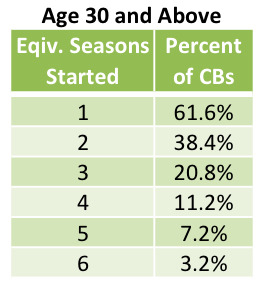
The broader trend among 30-plus year old cornerbacks isn’t particularly golden either. A free agent deal for Asomugha would have to include at least four years, if not more. But can he produce at a high rate for that long?

Cornerbacks After Age 30

My analysis shows that among cornerbacks from the last 15 years who started at least one game after turning 30, less than 40 percent of them started the equivalent of two full seasons in their thirties. Only 21 percent managed to start three full seasons. Unfortunately, the vast majority of players are not Eric Allen, Ronde Barber, or Charles Woodson. They slow down, they get hurt, and they drop out of the starting lineup before you know it.

What does that mean for Asomugha’s chances of coming to Philly? It depends on how risk-averse the Eagles front office is right now. Giving Asomugha a rich contract with heavy guarantees — which is what it will take to get any deal done — is no safe move. Maybe he’ll buck the odds and perform at a high level for years to come, making any contract worthwhile. More likely, if the Eagles do pursue him, it would be for a contract that puts big money up front but few guarantees down the road.

At the end of the day, Asomugha is the type of player that could instantly lift the Eagles defense and conceal a number of other weaknesses. It’s worth getting excited about any potential addition of that caliber, even if some caution is also warranted.

Originally published at NBC Philadelphia. Photo from Getty.
Winston Justice to Undergo Knee Surgery Today

Winston Justice Knee Surgery

Eagles right tackle Winston Justice will undergo surgery today on his left knee to treat a bone chip. Depending on the results of the surgery, Justice could be riding the pine for a few weeks — or sidelined for the entire 2011 season.

It’s tough to tell exactly what will happen with Justice. A team source told Reuben Frank that the procedure was only a “clean-out” and that there’s “absolutely no reason” to believe the injury is serious. On the other hand, Geoff Mosher cites a (presumably separate) team source that told him Justice might need microfracture surgery. Microfracture surgery is the same procedure that derailed Victor Abiamiri’s 2010 season.

NBC10’s John Clark reports, “Winston tells me he hopes its nothing bad, expecting just a cleanout.”

If only wishing made it so. Either we have a reporter blowing up a report into something much bigger than it should be or the Eagles front office trying to spin Justice’s injury to deflect attention from their pursuit of a replacement. Neither party inspires much trust, so we may just have to wait for the results of the surgery to be made public.

Justice has a reasonable contract through 2013, but if his health and reliability are in doubt, the Eagles will need to bring in new players who can replace him. Presumably, that will happen through the draft, where the Eagles were already expected to look closely at offensive tackle prospects who could also contribute at guard. Backups King Dunlap and Austin Howard could also get opportunities to start in Justice’s absence.

Originally published at NBC Philadelphia. Photo from Getty.
My Worst Eagles Predictions for 2010

Kevin Kolb Scramble

Sports have a way of making predictions look silly. There’s so much luck and uncertainty involved in every part of an NFL game or season that the reliability of any prediction is suspect.

But what were my worst predictions of 2010? Let’s break it down.

* * *

I disagreed with the Football Outsiders Almanac that Brent Celek’s numbers would drop from 2009, and predicted that Celek would have a monster, career year with Kevin Kolb under center:

“I look at it basically this way: by virtue of his great rapport with Kolb, Brent should exceed his great 2009 season — any numbers that suggest Celek will be worse don’t take into account the facts… My actual projection for Celek in 2010: Jason Witten circa 2007.”

That didn’t turn out so well. Celek’s production was almost cut in half from ‘09, although at least it was only because of Kolb’s benching and Michael Vick’s allergy to throwing to his tight ends over the middle.

* * *

Predicting any kind of draft strategy is probably a bad idea in general.

* * *

I thought last year’s biggest personnel blunder would probably be that the Eagles only kept three safeties going into the regular season:

“What if Mikell gets hurt? Playing two rookies at safety isn’t very “safe” at all. Or what if if Allen, talented though he may be, struggles in his transition to the NFL? Are you going to replace him with another rookie?”

Turns out, safety wasn’t the problem, but cornerback. The Ellis Hobbs-Dimitri Patterson-Joselio Hanson-Trevard Lindley group shuffled in and out as starters with equally subpar results, and when Asante Samuel went down to injury the unit devolved into complete chaos.

* * *

I argued that the McNabb-to-Washington deal couldn’t be accurately judged in 2010, with so many pieces (such as the development of the Eagles draft picks) still up in the air.

Turns out, that argument was unnecessary. Even with all of the long-term ramifications of the trade still unresolved, the disintegration of the Redskins and likely departure of McNabb from Washington this offseason proves that the Eagles “won” this deal handily.

* * *

This headline doesn’t sound so likely now: Could Nick Cole be the Eagles Best Pass Blocker?

* * *

Finally there was this gem:

“I know that if Vick starts a game in Philadelphia it means that Kevin Kolb has been unfortunately injured and the team will undoubtedly go down in a horrific display of offensive ineptitude.”

Followed by this one:

“Having Kolb go down for any extended period of time would essentially end the season.”

I’m not going to try to justify those beauties.

* * *

Make any poor Eagles predictions? Guarantee something that never came true? Let your badges of shame ring in the comments.

Originally published at NBC Philadelphia. Photo from Getty.
Finally, Eagles Place Franchise Tag on Vick

In a move that will come as no surprise to any Philly fan, the Eagles used their franchise tag on Michael Vick today, officially retaining his rights for next season.

Franchising Vick was rumored for weeks as a solution to keep the free agent quarterback in Philadelphia, although the current NFL labor situation clouded the reliability of such a move. The players association seeks to challenge the ability for teams to tag players in 2011 without a new collective bargaining agreement.

Still, this is obviously the first step to retaining Vick long term, after his stellar comeback season in 2010. Assuming a new CBA is worked out before the season begins, the Eagles will likely use the leverage from the franchise tag to work out a contract extension with their starting quarterback. But even if those talks never occur, Vick won’t suffer much — franchised quarterbacks made $16.5 million last year.

That should help ease Vick’s financial burdens, while keeping him with the team and coach he wants to play for. Vick is worth a tremendous deal to the Eagles both on the field, marshaling an explosive offense, and off of it, bringing excitement and fans to Lincoln Financial Field.

The Eagles also announced today that they placed their transition tag on kicker David Akers, who also would also have been a free agent. The transition tag allows the Eagles to match any free agent offer Akers receives, although it grants no compensation to the team if Akers signs somewhere else. The Eagles must tender Akers a one-year deal for the average salary of the ten highest-paid kickers and punters in 2010, which was just shy of $3 million in 2010.

As we looked at recently, Akers still appears to have the leg strength to be above average on kickoffs, but he’s no longer reliable or even league average on field goals over 50 yards. Still, his consistency, professionalism, and veteran leadership is certainly worth keeping around, especially when there are no obviously better options available.

Originally published at NBC Philadelphia. Photo from Getty.
The Vick Offense & Its Explosive Wide Receivers

Before the 2010 season began, I examined the Eagles passing offense and how it had changed over the years, both in regards to pass targets by position and by player. At the time, we were considering the impact the switch from Donovan McNabb to Kevin Kolb would have on the Eagles passing attack. Of course, that didn’t exactly go as planned, and now we look back on season one of the Michael Vick era.

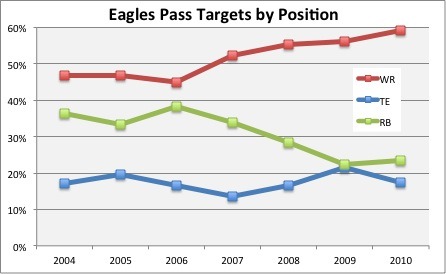
Let’s start by breaking down the pass targets by position (from Advanced NFL Stats):

As you can see, for the fourth straight season the wide receivers’ share of the pass targets has increased — to 59 percent of all passes, the highest point in the last decade. That long-term trend corresponds with both an increase in receiving talent (DeSean Jackson, Jeremy Maclin, and Jason Avant are easily one of the best starting groups in the NFL) as well as the decline of Brian Westbrook from his peak in 2006 and 2007, when he was the focal point of the entire offense.

LeSean McCoy brought up the pass targets to running backs in 2010, but only slightly. Meanwhile, Brent Celek’s role in the offense declined with Vick at the helm, bringing down the tight end position.

The ultimate takeaway here is that with Vick’s powerful arm and a set of explosive wide receivers on the outside, the focus on a down-the-field, receiver-centric passing attack is only likely to increase.

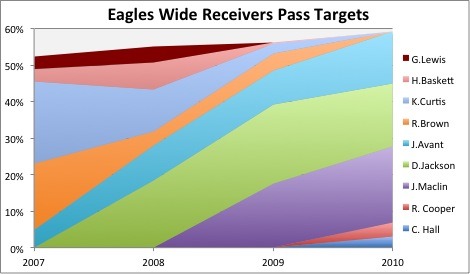
But taking on the wide receivers individually, we can see some other interesting trends:

This chart may seem visually complicated at first. Each wedge or section indicates the percent of pass targets a player received in a given year. Looking just at 2010, for example, we see that newcomers Riley Cooper and Chad Hall had minimal impact, while Maclin, Jackson, and Avant each carved out a sizable portion of the targets. Over time, the shifts in emphasis as the sections wax and wane become clear as well. Both Maclin and Avant had increased targets, while Jackson fell off a bit from his high in 2009.

Maclin actually was the most-targeted Eagle in 2010, with almost 21 percent of passes going his way. Jackson basically swapped spots with him, posting 17 percent. DeSean did miss one game, but overall he was just less reliable than Maclin last year. While in all but three games Maclin at least four receptions, Jackson had eight games in which he had less than that.

The fact that Maclin is now targeted more than Jackson doesn’t mean that he’s the Eagles new number one receiver, because pass targets aren’t everything. DeSean outpaced him with a huge 11 yards per target (tied for best in the league), compared to Maclin’s 8.5. He remains the more dangerous weapon, and the one opponents will game plan heavily to stop. Still, it’s an interesting fact to keep an eye on.

It also remains to be seen how much a player like Cooper can break into this three-man logjam at the top of the Eagles receiving corps. The rookie showed some promise in 2010, but will likely need injuries ahead of him to get any extensive playing time.

Overall, assuming the team signs DeSean Jackson and Michael Vick to new long term deals, an Eagles passing attack focused on wide receivers should be explosive and exciting for years to come.

Originally published at NBC Philadelphia. Photo from Getty.