Vick's Value to Eagles Goes Beyond Touchdowns

Michael Vick

Let’s just assume for a minute that football decisions aren’t always, purely, football decisions. As the impending player lockout shows, the NFL is a business. At its most basic level, the game is just a form of entertainment that exists for the sole purpose of filling stadiums, selling jerseys, and getting massive television contracts.

Regarding the quasi-quarterback controversy the Eagles face this offseason, on the field the choice looks to be Michael Vick over Kevin Kolb. And as the weeks go on we’ll delve more into the actual quarterbacking differences between the hash marks. But what about from a business perspective?

The Eagles as an organization certainly don’t have trouble making money. They’ve been selling out all their games for years and Lincoln Financial Field brings in tons of revenue. Plus, the team has consistently dominated Philly sports talk radio and local TV ratings.

But with the recent emergence of the Phillies as a legitimate World Series contender year in and year out, the Eagles no longer have a monopoly on the city’s sports attention. And even on a national level the team isn’t as big a draw as the Redskins, Cowboys, or Steelers. As a business that wants to continue to grow its audience and profits, Jeff Lurie and company know that they need to keep their fans excited.

When you look at the quarterback choice from that point of view, there really is no choice at all. Vick is your guy. Say what you want about negative press and a polarizing personality, but there simply aren’t many players who can raise the profile of an entire organization the way Vick can.

Just look at the numbers we have to gauge fan interest. Google searches for Vick’s name trumped Kolb even while he was just a back-up, and Vick even out-polled the Eagles organization for most of the season. Not even Donovan McNabb in his prime could command that kind of attention. In Vick’s first year as a starter since going to jail for dog fighting, he also had the NFL’s sixth top-selling jersey. And Vick came second in Pro Bowl voting only to Tom Brady.

The Eagles organization sees all those numbers, and the fact that television networks wanted to showcase Vick as much as possible — the team played six games in prime time last year. Furthermore, they can sense the special excitement that Vick (along with his fellow star DeSean Jackson) brings to each game. Those qualities are irreplaceable, even if the on-the-field production is. When you’re trying not only to put the best team on the field, but also the best product, there’s really no comparison between Kolb and Vick.

One’s a football player, and the other’s a national sensation.

Originally published at NBC Philadelphia. Photo from Getty.
Kolb a Valuable Commodity in Today's NFL

In today’s pass-happy NFL, having that elusive “Quarterback of the Future” is perhaps the biggest difference between haves and have-nots. The successful teams, the playoff teams, exhibit varying philosophies and talent disparities across the field, but all of them have a quarterback that they are counting on keeping for years to come.

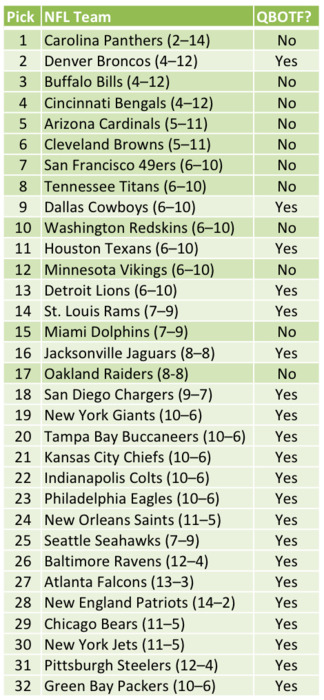
Want to see the big difference that having that “QBOTF” makes? Just take a glance at the order of the NFL draft, shown below right.

2011 NFL Draft Order Quarterback of the FutureYou can take issue with my individual assessments. Maybe Seattle and Jacksonville don’t really have absolute Quarterbacks of the Future, maybe Cleveland does. But the trend overall is clear. In order to be a playoff team at all, your quarterback position ought to be rock solid now and for the foreseeable future. Ben Rothlisberger vs. Aaron Rodgers only illustrated that point on Super Bowl Sunday.

Furthermore, only two teams picking in the top ten, Dallas and Denver, have found a quarterback to hitch their franchise to (and Tim Tebow may not even be that guy for the Broncos). Everyone else is lost, and they will stay lost until they find someone to lead their team.

All of this is interesting, but for the Eagles it’s of great importance. They are the only team in the league with more than one franchise-caliber quarterback. Michael Vick’s 2010 heroics make it practically automatic that the team will keep him around for the long haul. But Kevin Kolb has proven to be no slouch. He could easily start for all 11 teams on this list without a QBOTF.

And unlike last year, when the Eagles put Donovan McNabb on the open market, the quarterback isn’t viewed by many in the league as a declining veteran. Kolb, despite his limited experience, is only 26 years old and thus has tremendous upside. He’s the same age that Matt Schaub was when Atlanta traded him to Houston for two second-round picks and a first-round swap (because Schaub was also blocked by Vick). And Kolb’s a year younger than Rodgers, the newly crowned Super Bowl MVP.

So while last year teams like St. Louis preferred to go with the drafting-a-quarterback option, more teams looking for long-term solutions this year will be willing to look at Kolb as an alternative. That’s why we have already starting hearing grumbles about Kolb already in demand in places like Arizona. Basically every team marked with a “No” on the chart will be at least considering the option — especially if they miss out in the draft.

While the trade process is complicated this offseason by the lack of a new collective bargaining agreement, eventually one of these teams will be willing to pay a substantial price to make Kolb their Quarterback of the Future. NFL executives know that without one, they’re doomed to continued failure.

Originally published at NBC Philadelphia. Photo from Getty.
Why "Be Fundamentally Sound" is a Worthless Strategy

Every NFL coach or coordinator who’s ever taken a job has emphasized “fundamentals.” On the defensive side, you have to play aggressively, be physical, make sound tackles. Yet, according to his statements over the last few days, that’s essentially new Eagles defensive coordinator Juan Castillo’s entire plan: “be fundamentally sound.”

Certainly we wouldn’t expect Castillo to lay out his whole defensive philosophy in his first press conference. But two years ago, when Sean McDermott replaced the late Jim Johnson, we did get an immediate sense that McDermott had a clear idea of his Xs and Os. On his first day, the former coordinator said:

“There is one thing I know, and that is that this system, it works. Jim has spent a considerable amount of time in his coaching career researching and finding things that work and finding things that didn’t work, quite frankly, and I’m going to respect that and we’re going to build on that. From there we’ll add wrinkles.”

McDermott obviously had a plan to take the blitz concepts and continue to tinker with them. When asked basically the same question, Castillo replied:

“First of all, what we’re going to do is be fast and physical, and we’re going to be fundamentally sound. We have good players here. This is the NFL, you change, you upgrade, players get hurt, but that’s what we’re going to do.”

Since Castillo has defended those talking points recently on the radio as being the key to his success as an offensive line coach, we can assume for now that it’s essentially his philosophy. At this point you might say: what’s wrong with emphasizing fundamentals? McDermott was a scheme guy, and that didn’t turn out particularly well. Maybe if we get a coordinator who puts a priority on tackling and other basics, that will be enough to put the defense over the top.

There are two problems with this line of thinking. First, teaching fundamentals alone won’t set you apart. Doesn’t every coach teach fundamentals? You don’t think Super Bowl defensive coordinators Dick LeBeau and Dom Capers put their teams through endless tackling and other drills in practice? Of course they do. But they also have talented players and put them in good positions to succeed through complex coverage and pressure schemes.

The second problem is that this theory is based on an underlying bias we have toward valuing what we can see. The biggest example of this is missed tackles. Every fan and their grandmother can see when Asante Samuel whiffs on a running back coming right at him or Juqua Parker comes up empty on an easy sack. At the end of the game, we tend to blame these mistakes for the defense’s failure and make comments like, “they need to go back to fundamentals.”

Yet missed tackles are only one tiny part of a horrible defensive play or series. Think about everything else that went into that: bad play calling, inadequate scheme, unbalanced one-on-one match ups, lack of player talent, poor decision-making and play recognition, failure to get off blocks or take a correct angle on the ball-carrier, even luck. All these factors matter much more than a given missed tackle, but we only remember Nate Allen diving for the running back’s ankles and coming up empty.

Statistically, though, fewer missed tackles has zero correlation to a better defense. There’s no connection between missed tackles and opponent yards, points, or touchdowns per drive. Why? Because while missed tackles stick out in our minds, there aren’t enough to radically affect the success of defense. The difference between the very best and very worst tackling teams in the NFL in 2010 is about three missed tackles per game. Insignificant.

That’s why it’s worrisome to hear that Castillo’s only talking point is that the defense in 2011 is going to “be fundamentally sound.” That might work in the offensive line trenches, but in the grand chess match of offensive vs. defensive coordinators, fundamentals just don’t make as big of a difference.

Originally published at NBC Philadelphia. Photo from Getty.

Impossible to Explain Castillo's Bizarre Promotion

The switcheroo promotion of Juan Castillo from offensive line coach to defensive coordinator has to be one of the most head-scratching moves in Eagles history. Often, though, even the strangest of moves can start to make sense when you hear the reasoning behind them.

Not this time.

If you were unlucky enough to listen to the team press conference with Castillo and Andy Reid last night, you were treated to one of the most bizarre post hoc justifications for a coaching move ever.

Let’s start with the transition for Castillo “back” to the defensive side of the ball. Supposedly he’s been in Reid’s ear for years telling him that he’s a defensive coach at heart. Castillo did play linebacker in the USFL and coach defense at the beginning of his career — way back at a high school in the ’80s. The justification over and over was that Castillo’s “heart and desire has always been on the defensive side.”

But “heart” isn’t enough to run a NFL defense, to create complex pressure and coverage schemes, or know when to call them in a tight situation. “Desire” won’t help Castillo outsmart the offenses the Eagles had trouble with in 2010. Nor does his supposed experience consulting with Eagles defensive coaches mean he’s ready for this job. Lending an outside voice about which blitzes have the best chance of working is a completely different skill from actually designing them on one’s own.

Even scarier is that Castillo seemingly has no conceptual plan for the defense. He and Reid emphasized that the terminology will remain the same, but nothing else is clear. When asked what the biggest part of the defense that needed to be worked on was, Castillo said:

“First of all, what we’re going to do is be fast and physical, and we’re going to be fundamentally sound. We have good players here. This is the NFL, you change, you upgrade, players get hurt, but that’s what we’re going to do.”

I’m used to coach-speak, but there’s a difference between being coy about your goals and covering up for not having any at all. Scheme-wise, the big thing Castillo is going to emphasize is being “fundamentally sound”? What defense doesn’t need to be “fast and physical”?

Castillo went further: “We hired Jim Washburn, and I think most of you know what Jim does. Jim attacks. He’s a sic ‘em type guy, which is great for the players that we have and really what I’m going to do in the back is going to complement those four defensive linemen that are going to get up the field, going to create havoc, going to make plays. We’re going to complement that scheme.”

So, essentially, Washburn runs the defensive front autonomously, and Castillo’s going to plan the back seven to “complement” his ideas? That doesn’t sound like a defensive coordinator with a coherent plan, let alone one that wants to continue the blitzing strategy the Eagles have had in place for years.

At the end of the day, Reid couldn’t justify this decision with Castillo’s experience or knowledge or preparation. He had to fall back on “desire” and even an outlandish connection to the risk other people took when promoting Reid himself (under much more logical circumstances). For people looking to be reassured in the face of such a stunning move, these arguments don’t inspire much confidence.

Originally published at NBC Philadelphia. Photo from Getty.

Is David Akers Still An Elite Field Goal Kicker?

Yesterday, we started looking into the case of Pro Bowler David Akers, free agent, by looking at his kickoffs to see how his leg strength has held up over the years. According to those numbers, Akers doesn’t appear to be losing much as he gets older.

But what about field goals?

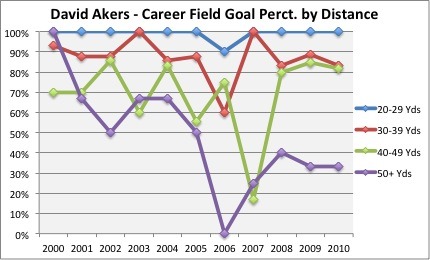
That’s certainly a more complicated case. Examining overall accuracy doesn’t help much unless you break it down by distance.

Which is what I’ve done here:

David Akers Career Field Goal Percentage

At the top, you can see that Akers is automatic under 30 yards. Then from 30 to 50 yards Akers has converged between 80 to 90 percent accuracy over the last few years. The only obvious decline appears to be in the 50 yard plus range, although those number suffer from an inherently small sample size.

But the raw numbers don’t tell us as much as comparing Akers to his peers. Check out his 2010 numbers against the NFL average:

David Akers 2010 Field Goal Percentage

Everything under 50 yards Akers is essentially as good as anyone else. Yes, he’s about 5 percentage points behind in the 30-39 yard range, but that’s not particularly significant when you consider that last year he beat the average at that distance by about the same amount.

The only consistent problem Akers has, compared to the rest of the NFL, is those super long kicks. Again, small sample size, but he hasn’t hit half of his 50 yard kicks since 2005. Despite the kickoff numbers that suggest his leg strength hasn’t decreased, Akers hasn’t been NFL average in this catagory since 2004.

What does this mean? It means Akers is basically still an above average to elite kicker under 50 yards. But the majority of NFL kickers make more than 50 percent of those long balls, so he’s no longer the type of long range weapon that might be extremely difficult to replace.

Akers’s future with the Eagles may depend on what the team wants to pay for: consistency under 50 yards, or the potential for more accurate long kicks.

Originally published at NBC Philadelphia. Photo from Getty.

Should the Eagles Let David Akers Go?

David Akers Upset

Eagles long-time kicker David Akers has been in the headlines recently after his two missed field goals in the Wild Card game came back to haunt the team. Andy Reid made some critical comments following the game about Akers.

“We can all count,” Reid said. “Those points would have helped.” But then later we learned that Akers’s six-year-old daughter was diagnosed with a malignant tumor only days before the playoffs began.

Akers’ contract is up, and some in the national media have suggested that this may be the end of his tenure in Philadelphia — especially after these recent events. At 36-years-old and after those two missed field goals, could it be time to say goodbye to Akers?

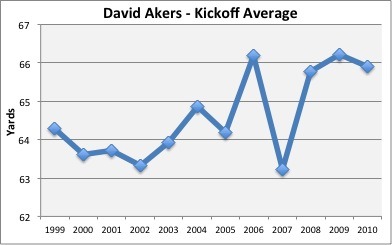
Not so fast. Looking at the kicker’s production over his career shows that even at his age, he’s playing at his highest level yet. Let’s start by looking at career kickoffs — where we can measure Akers’s leg strength:

David Akers Career Adjusted Kickoff Average

After factoring out onside kicks, it’s easy to see that Akers in 2010 has shown as much leg strength as ever. In fact, four out of the last five years have been his most productive.

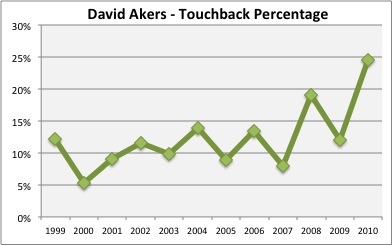
And what about touchbacks:

David Akers Career Adjusted Touchback Percentage

Again, even at 36, Akers is doing better than ever. He had his highest touchback percentage of his career in 2010.

Finally, let’s compare him to the rest of the league this season:

David Akers 2010 Kickoff Statistics NFL

Turns out Akers’s great 2010 doesn’t look quite as good in comparison to the rest of the league. He’s only average in kickoff distance although he’s in the top ten in touchbacks. Still, there’s no evidence that his leg strength is slipping, and unless the Eagles are sure they can pick up an elite kicker to replace him, there doesn’t seem to much reason to let Akers walk in free agency.

Check back soon and we’ll take a similar look at Akers’s field goal percentages to see where they measure up.

Originally published at NBC Philadelphia. Photo from Getty.

Shuey's Firing Completes Defensive Shakeup

After 10 years with the Eagles, linebacker coach Bill Shuey was let go by the team yesterday, completing a drastic and unprecedented coaching shakeup on the defense.

Shuey is the fourth member of the defensive coaching staff who won’t be back with the team next year. Defensive coordinator Sean McDermott was fired and landed the same job with Carolina. Defensive backs coach Dick Jauron took the coordinator job in Cleveland. Jim Washburn, formerly of the Tennessee Titans, replaced defensive line coach Rory Segrest. And now Shuey.

Shuey started as a lowly intern on the staff in 1999 and was promoted to assistant to the head coach, offensive assistant/quality control coach, defensive quality control coach, and finally linebackers coach in 2008. His departure means that only assistant linebackers coach Mike Caldwell and defensive quality control coach Mike Zordich remain from the 2010 staff.

Never before has Andy Reid so thorougly gutted such a large part of his coaching staff. All of the top four jobs on that side of the football have been vacated. Perhaps the soon-to-be-hired new defensive coordinator will want the openings to bring in some of his own, but the moves still raise questions.

First, how much does Reid blame the coaching staff for the defense’s struggles last season? The talent level was never particularly high, and the unit lost multiple starters to injury as the season went on. Yet it appears Reid thinks coaching was a bigger problem than the players. You don’t see the team anxious to get rid of a lot of the on-the-field talent.

And, second, with the NFL lockout looming, how are the Eagles going to institute new tactics and techniques before the season begins? Rules prohibiting player-coach contact will go into effect soon, and it’s possible they won’t be released until close to the start of the 2011 season. It’ll be tough to roll right in if players have to adapt to an entirely new system in a short window.

Originally published at NBC Philadelphia.