Negative Plays by Offensive Line: Eagles v. NFL

Philadelphia Eagles Offensive Line Jamaal Jackson Negative Plays

We’d all love for the Eagles to have one of those dominant offensive lines, one that knocks defenses back all game. But to some degree, offensive linemen are judged more by their mistakes than their positive plays.

To that end, I put together the following charts of “negative plays” by offensive lineman, according to the stats guys at Pro Football Focus. I calculated a negative play to be a penalty, sack, hit, or pressure. Obviously these individually are not equal. A sack is far worse than a simple pressure. But overall a lineman who’s letting a lot of guys get to his quarterback probably isn’t doing such a good job, and sacks are often based on luck — who has the quarterback step toward him, etc.

I added all the negative plays up and divided them by each player’s snap count: the number of times the guy actually played. For the purposes of this exercise I also limited the players to those who were on the field for at least 25% of their team’s total snaps (except for Eagles’ linemen). Finally, to make the number a little bit more digestible, I multiplied those fractions by the average number of defensive plays in an NFL game (~62).

Behold Negative Plays per Game. Click each to see the large version in a new window/tab. Tackles on the left, guards in the middle, and centers on the right:


In terms of the NFL in general, you certainly recognize a lot of the players on the top of these lists. Clearly there’s a correlation here: great offensive linemen don’t make negative plays.

That’s not to say that the causation is total. Again, there’s more to being a lineman than NOT giving up bad plays. That may be why a number of Pro Bowl guys fall down on the lists — David Diehl, Alan Faneca, Leonard Davis, etc. Or maybe the numbers expose that they aren’t quite as good as their reputations or paychecks would suggest (see: Peters, Jason).

One other note: the Jets have a kick-ass line — dominant run blockers who don’t make many mistakes. Two top-5 tackles. A top 3 guard. The number 1 center. And their only weak link, Faneca, left in free agency.

On the Eagles:

For tackles, both Peters and Winston Justice were above average. Justice was more reliable (nothing new there), but scouts seem to consider Peters’ 2009 as a down year. If he can stay healthy and cut down on the penalties, he could jump back to the top group. Todd Herremans, when subbing at tackle, played at about an Alex Barron-level, i.e. Dallas’s potential starting LT this year. With an even smaller sample size, King Dunlap was horrible. Hopefully his newfound girth can help him improve.

Herremans was also surprisingly mistake-prone as a guard. Maybe that was rust or lingering issues from missing the first 6 weeks, but it clashed with my past perception. He earned a 1.20 score in 2008, which would have been good for 15th last year, and is about what Nick Cole got. Cole may not have been dominant at guard but he didn’t make many mistakes. Both Max (Now I Can Fit Into) Jean-Gilles and the lesser but less-crazy Andrews brother have things to prove this season.

As for centers, Jamaal Jackson was great in 2009. Nick Cole wasn’t so hot, but he was better than four-time Pro-Bowler Andre Gurode. Make of that what you may.

Franchise Quarterbacks and Andy Reid's Legacy

Kevin Kolb and Andy Reid 2010 Transition from Donovan McNabb Coaching Legacy Philadelphia Eagles

What Andy Reid is attempting is the rarest of feats. Finding and tutoring not one, but two franchise quarterbacks, switching seamlessly from one to the other, and succeeding with both is a venture that no coach as achieved in recent NFL memory. Coaches have executed parts of this formula, but never the whole undertaking.

It’s hard enough to find one franchise quarterback. This is where most coaches fail first. Look at the infamous 1999 QB class. Tim Couch took down two coaches with Cleveland: Chris Palmer and Butch Davis. Akili Smith grounded two more in Cincinnati: Bruce Coslet and Dick LeBeau. Daunte Culpepper was great for a while, before putting Dennis Green and Mike Tice out of jobs. And Cade McNown’s failure doomed Dick Jauron’s regime in Chicago.

Only Reid found an elite quarterback from that bunch. Or perhaps he was the only one able to craft a great quarterback out of what he was given. Both scouting talent and coaching it are vital, and most coaches fail at one part. Sometimes a Brad Childress or a Sean Payton can grab a rare free agent veteran to lead their franchise. Sometimes coaches like Jon Gruden or Bill Cowher or Brian Billick build winning teams in the face of inferior talent behind center. But that’s a slightly different skill.

Of course, discovering and teaching aren’t enough. The coach has to build a winning team around the player. Mike Shanahan drafted Jay Cutler but couldn’t create a winner. Jim Mora couldn’t engineer a playoff win for the young Peyton Manning-led Colts. Neither could Marty Schottenheimer with Drew Brees or Philip Rivers.

Andy has succeeded at that. For eleven years he guided the Eagles to the top of the NFC again and again. Sure, no Super Bowl, but he built winners. Tony Dungy did the same thing with Peyton Manning. Bill Belichick did the same with Tom Brady. Cowher eventually found Ben Rothlisberger and won a championship. Same with Tom Coughlin and Eli Manning. The duos of Mike Smith and Matt Ryan, Mike McCarthy and Aaron Rodgers, Rex Ryan and Matt Sanchez are all reaching for similar goals.

Successful coaches find their franchise quarterback, tutor him, and flourish with him at the helm — none of which are easy tasks. Yet no coach above found a new franchise quarterback to replace the old. Cowher bowed out while his quarterback was still in his prime. Same with Dungy. A whole list of other great coaches did too. Bill Walsh left as Joe Montana’s time with the 49ers was winding down. Mike Holmgren jumped to Seattle instead of sticking with Brett Favre, then left again when the Matt Hasselbeck era was slipping away.

Partially this is due to the simple fact that coaching in the NFL is grueling, and it’s difficult to last for more than a decade or so in one place — even when you have success. Holmgren showed the ability to pick a second franchise quarterback and tutor him, just with another team. Walsh grabbed Steve Young from the dark recesses of Tampa Bay, only didn’t stay to coach the team’s future Hall of Famer.

Coaches who last past the first decade, and there aren’t many of them, have trouble finding a second elite quarterback to pick up the slack. Jeff Fisher is a good example. Fisher drafted Steve McNair third overall in 1995 and stuck with him for a decade, amassing two division titles, five playoff wins, and a lone Super Bowl appearance (sounds a little familiar). However, since trading McNair in 2006, Fisher has had trouble finding a consistent replacement. Vince Young has looked like the future at times but never received the mentoring he needed coming out of college. Kerry Collins is a stop-gap. The Titans don’t really have a “franchise quarterback” at this time.

Some teams do manage to switch directly from the old franchise quarterback to the new — Montana to Young, Favre to Rodgers, Drew Bledsoe to Brady — but it’s been almost exclusively a new coach who makes the switch: George Seifert, Mike McCarthy, Belichick. The guy who didn’t draft or coach the older veteran, who’s committed to a long-term solution even when the old player may have a few more years left.

That’s what makes what Reid is trying to do so extraordinary. His ability to find, groom, and win with Donovan McNabb has deservedly helped build his reputation as one of the best coaches in today’s NFL. But if he manages to make lightning strike a second time with Kevin Kolb, and pulls off the seamless transition, Reid’s accomplishment, in my mind, would make him one of the best coaches of all time.

Now, as for that Super Bowl…

Production Per Paycheck: Eagles Players in 2009

I went back to Win Probability Added (WPA) from Advanced NFL Stats, and paired it with the 2009 salary data at EaglesCap.com DeSean Jackson Punt Return Touchdown 2009 Philadelphia Eagles

Last month I looked at EPA/Play as a way to see the Eagles’ defensive playmakers. There were several caveats to those numbers, biggest of which was the lack of any kind of cost analysis. It’s great that Darren Howard was making plays — but given his contract, could his production have been bought for less? That’s what I’m exploring today.

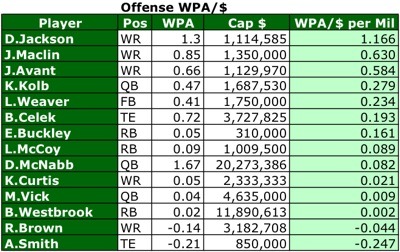
I went back to Win Probability Added (WPA) from Advanced NFL Stats, and paired it with the 2009 salary data at EaglesCap.com. I figured the cap number was the most accurate figure to use, even though some of that is inflated from impossible to reach bonuses, etc., because taking just the salary doesn’t account for some of the massive signing, workout bonuses. Here’s what I got for the offense:

Win Probability Added per Salary Cap Figure 2009 Philadelphia Eagles Offense

Observations:

  • DeSean Jackson is a ridiculous bargain. That went without saying before, but these numbers just emphasize it. In terms of performance for the money, DeSean was worth two Jason Avants, five Leonard Weavers, or fifty-six Kevin Curtises in 2009.
  • All three starting wide receivers were really good deals last year, even with Jeremy Maclin’s rookie contract. Of course, it remains to be seen if Avant’s new deal keeps him among the value group. Ditto for Weaver.
  • Considering Kevin Kolb only really played in two games, it’s interesting to note that he was still pretty cost-effective.
  • Before Brent Celek’s new deal bumped his salary/bonuses by about $3 million, his WPA/$ per Mil would have been 1.44, the highest on the offense. Wow.
  • If Michael Vick becomes a victim of his latest run-in with the law, that would mean all the bottom six on this chart would be gone this offseason — a strong trend.

Moving on…

Win Probability Added per Salary Cap Figure 2009 Philadelphia Eagles Defense

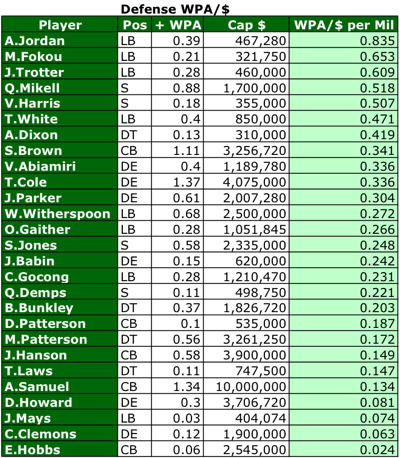
  • Asante Samuel, Darren Howard look a lot less valuable when you factor in the money they were making.
  • Almost anyone who was playing for close to the minimum, yet was good enough to make the team, was a good deal for the Eagles: Akeem Jordan, Moise Fokou, Jeremiah Trotter, Macho Harris, Antonio Dixon. This is why it’s tremendous when a late-round draft pick or undrafted free agent can contribute.
  • No wonder Sheldon Brown was unhappy. He produced the third-most +WPA for the team, but was paid less than Joselio Hanson.

Friday Figures: Eagles Offensive Play Count Stats

Philadelphia Eagles Brent Celek Offense Play Count Run Pass

Not a lot of complexity to this post. Just some stats and (hopefully) a few interesting observations. Let’s jump right in.

Ladies and gentlemen, your 2009 Eagles offensive player play counts, broken down by run/pass, courtesy of PFF:

2009 Philadelphia Eagles Play Counts Offense Players Run Pass

So about 40% of the Eagles’ offensive plays were runs last year. When some of these players were on the field though, one could make a pretty good guess that a run was coming. Take Mr. Eldra Buckley for example. When he was in the game the Eagles were over two times more likely to have Donovan hand the ball off.

The embattled wildcat quarterback, the second/blocking tight end, and the fullback, all also signaled to the defense that a run was on the way. Brian Westbook on the other hand? Not so much.

Let’s take a gander at 2008 for comparison’s sake:

2008 Philadelphia Eagles Play Counts Offense Players Run Pass

Basically the same team run/pass ratio, but it gives us a few more data points and intriguging spots to look.

  • Eldra Buckley is apparently Kyle Eckel part 2. Not good for Eldra’s chances of making this team — the Eagles can easily use Charles Scott for those 30-40 plays.
  • Speaking of which, notice how almost all of the guys who heavily skew to rushes tend to get replaced: Eckel, Klecko, Schobel, Baskett, (Alex) Smith. If you can’t be multidimensional in Andy’s offense, you’re going to have a hard time sticking around.
  • Hank Baskett is a tight end in wide receiver’s clothes. Meaning Riley Cooper better work on blocking if he wants to supplant Baskett as the #4 guy off the bench.
  • Actually there is a pretty clear correlation. The further down the depth chart a player is at wide receiver, the more run blocking he’ll be required to do.
  • Brent Celek played almost every offensive snap. What a beast.
  • Brian Westbrook became much more pass-centered last year. Might be part of how the coaches tried to shield him from a big workload.
  • Andy Reid must feel much more confident in Kevin Kolb now than a year ago. Back in 2008 he was helping Kolb out by calling runs more than half the time. In the two games in 2009, however, Kolb passed about as much as McNabb.

Eagles RB Past: Brian Westbrook and Company

Philadelphia Eagles Running Back Performance Past Brian Westbrook LeSean McCoy

The Eagles are undoubtably at a crossroads in the backfield. Yet given the huge change at quarterback, if anything the turnover at running back has been overlooked.

Two years ago Brian Westbrook was one of the best halfbacks in the NFL and received a raise from the Eagles for the vital role he played on the team. Eight years, 107 regular season games, some of the most spectacular performances we have ever seen. Now he’s gone.

There’s plenty to discuss about the future, and I’m working on a companion post about LeSean McCoy, but for now, let’s just look at the past — gaining some insight into Westbrook’s career and Eagles running backs in general.

For the first chart, I went through the seasons of data and attempted to isolated 1st & 10 rushes. The problem with taking all of the rushes as one big group is that you pull a lot of short yardage, goal line, and passing downs into the equation. This does decrease the sample size, but you take what you can get in order to make the data more usable.

Looking at basic first down yardage, we can get a sense both of how the Eagles have used their backs and how well they did. I started in 2003 (BWest’s first significant rushing year):

Philadelphia Eagles Running Back Performance Past Brian Westbrook Correll Buckhalter 1st Down 10 Yards YPC

Some general notes:

  • Correll Buckhalter was really good as Westbrook’s back-up from 06-08. Then Leonard Weaver stepped in last year and provided basically the same numbers. It’s interesting that the Eagles felt they needed to bring in Mike Bell when Weaver proved so effective as a change of pace back. Perhaps they just want him blocking more.
  • As a running team, the Eagles reached peak effectiveness in 2007. Not coincidentally, that was the year the Eagles most tried to ride the Westbrook express — to the tune of 368 touches from scrimmage.
  • This is unnecessary, but damn Lamar Gordon was bad.
  • 2009 wasn’t the Eagles’ most effective rushing year, but despite having most of the carries taken by two new additions, it wasn’t that much worse than 2008, or the Super Bowl year of 2004. In other words, good enough.
  • Speaking of 2009, McCoy may have trailed Westbrook overall in yards per carry, but when you standardize the carries, LeSean was much better than his hobbled mentor.

You can go through and find other interesting tidbits, but I’m most interested in tracking Westbrook’s career arc. And it looks pretty clear when you graph the yards per carry listed above. I also added an Effective Yards per Carry measurement based on Football Outsiders’ DVOA/Effective Yards stat:

Brian Westbrook Yards Per Carry Performance Career Philadelphia Eagles

The thing that jumped out to me first was how similar Westbrook’s career looks to Donovan McNabb’s, when I made his graph a few months back. McNabb’s career peak came later in his career (makes sense for a QB), and Westbrook was reaching the top of his game just as McNabb was just starting to decline (an interesting topic for later dicussion). Yet the career shapes are very similar: a few years of middling potential, followed by a peak of 2-3 years, and finally a drop.

As with all stats, DVOA sees something slightly different than my selection of first down runs (especially last season, when Westbrook was really bad on 1st & 10). But overall, they all likely reflect this same, impressive career arc. Too bad that career won’t end where it began.

This Isn't Going to End Well

Michael Vick Birthday Party Cake Shooting Quanis Phillips Philadelphia Eagles Dog Fighting

So apparently tomorrow is Michael Vick’s 30th birthday. And he had a party, promoted by his leg-stomping brother, at a club in Virginia Beach last night.

Oh, and someone got shot.

Well, not just someone — Quanis Phillips, one of Vick’s dog-fighting co-defendants:

The story goes that Quanis threatened to smash birthday cake in Vick’s face, or that he actually smashed the cake in Vick’s face.

Another version is that someone smashed cake in Quanis’ face — or threatened to smash it in his face.

Anyway, the confrontation moved outside — where I’m told there were several still cameras and video cameras.

Cooler heads did NOT prevail, and ‘Q’ was shot in the shopping center parking lot.

Of course, Vick’s lawyer says he wasn’t present when the shooting took place.

Still, oy vey.

Update: So, if you don’t remember all the details of the Bad Newz Kennels investigation and judicial proceedings, Phillips was one of three of Vick’s friends who accepted plea agreements — putting Vick in a “legal checkmate” that forced Vick to plead guilty as well. All of which is to say, these guys have history.

Update 2: When the Eagles signed Vick a year ago, owner Jeffery Lurie said:

The question I eventually had to ask is, ‘Going forward is Michael going to be a negative force in society the way he’s been? Is he going to be responsible for pain, suffering, disappointment, disloyalty, criminal behavior? Or is he going to have an opportunity and be able to be committed enough to take the bull by the horns and become a force for good?’

Seems like Vick may have just answered that question. Which of course leads us to:

If it becomes at all apparent that we are wrong, it won’t take very long to make that change.

See you around, Mike.

CFB Update: Big Ten Expansion and Academics

Big Ten College Football Conference Expansion Nebraska Academics

Note: this post has nothing to do with the Eagles.

University of Nebraska Chancellor Harvey Perlman recently penned a column describing why Nebraska and the Big Ten will be a good match. He wrote,

“I’m confident you’ll find that Nebraska is a natural fit with the Big Ten in terms of culture, athletics and academics.”

I’m on board with the first two. Certainly Nebraska has a history of athletic achievement, especially in football. And in terms of culture, it’s tough to argue that the white, midwestern nature of the school is markedly different from Iowa or Illinois or Purdue.

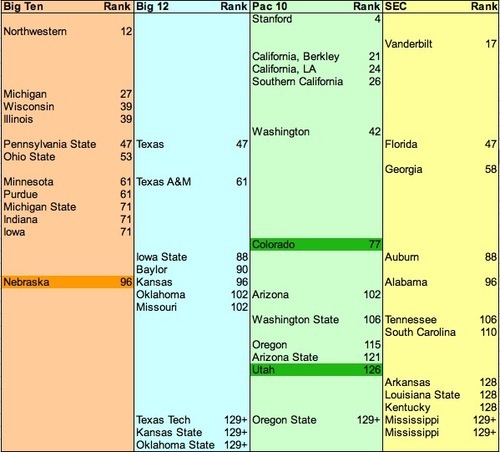
But an academic fit? Really? Academics was supposed to be a key part of any addition to the Big Ten, a conference that prides itself on its educational standards.

And clearly there were basic standards — Nebraska had to be part of the Association of American Universities. But if you look at the US News & World Report rankings (flawed but overall a good guide), it’d difficult to accept that academics played any role in this decision at all:

Big Ten College Football Conference Expansion Academics Rankings

How can the Big Ten justify accepting Nebraksa on academic grounds? While Nebraska fits right in the middle of the Big 12, it’s ranked much lower than the worst ranked Big Ten schools. The Pac-10 at least has schools that are ranked lower than the two they admitted.

The school’s far from “a natural fit.” But then again, maybe that’s the problem. No one’s actually looking at these programs as schools. They’re just sports teams, professional minor league clubs. It’s clear, when you actually look at the numbers, that there’s no academic case to be made.

So what allows the Big Ten to get away with this calculated money grab? The common white, midwestern “culture,” which people stuck in the 1980s associate with quality academics.

Introducing the DIN Theory: How the Eagles Never Draft for #1 Need

Jeremy Maclin LeSean McCoy Philadelphia Eagles Draft History DIN Theory

Ever since the draft, when the Eagles seemingly abandoned the right cornerback position, I’ve been mulling over a theory. It may not be fully baked or in any way ironclad, but hey, this is just a blog. If random theories from people thinking way too hard about the Eagles can’t go here, where can they go? Besides, maybe y’all can help me make sense of this trend.

I call it the DIN Theory, as in Drafting for Immediate Need, and hopefully it will help explain why the Eagles never seem to do what you expect in the first round of the draft. Basically the theory goes like this: if you can identify the one most important area, the one most obvious position in which the Eagles are deficient for the coming season, that is the spot the team will NOT target early on draft day.

Stay with me for a minute.

Let’s start back in 2007. What were the biggest holes after a 10-6 2006 campaign? McNabb had gotten hurt, but he was expected back at full strength. The O-line was rock solid. If anything was going to get the Eagles to the top, a #1 wide receiver might have done the trick. However, the Eagles brought in Kevin Curtis to replace Donte Stallworth and drafted Kevin Kolb — the long-term Donovan McNabb replacement — instead of someone who could help right away.

After the 2007 season the wide receivers with Curtis had looked pretty good, if not spectacular. Could still use a #1 wideout, but a pass rushing defensive end opposite Trent Cole or a linebacker would also have been an immediate impact pick. But who did the Eagles go with? Trevor Laws, a defensive tackle on a team that already had two starters, and DeSean Jackson, a guy who wasn’t expected (at the time) to compete for minutes right away.

Following the 2008 9-6-1 year, it seemed we’d found our number one wide receiver, but the team needed major help replacing their two departed offensive tackles and the incomparable Brian Dawkins. But who did the Eagles draft? A luxury offensive pick in Jeremy Maclin and long term RB prospect (no one expected he would be the starter so fast) LeSean McCoy. The immediate offensive line needs were filled in free agency/trades and FS was handed over to unproven Quintin Demps, middling veteran pick-up Sean Jones, and then eventually late-round pick Macho Harris.

This offseason, the biggest hole was clearly at right cornerback. But the Eagles trust a hodgepodge of nickel backs (Hanson), injured former starters (Hobbs), former safeties (Harris), and another late round pick (Lindley). In the draft they went after a long-term rebuilding project for pass rushing which, on the whole, didn’t seem so bad in 2009. One could argue that Nate Allen was targeted in the draft to fix an immediate hole at safety, but he was still only a second round pick and was placed into competition behind Marlin Jackson and Demps.

There are a lot of different ways to look at this, especially in hindsight, but I see a general trend here. The Eagles don’t use early picks on players they need to start right away, simply to fix immediate needs. The team would rather pick a long term starter or build depth than grab someone to plug a hole. Instead, they try to plug these urgent holes through free agent pickups or (hopefully) matured backups.

Think again about those big holes the team needed to fill recently: replacing two great OTs, replacing a fantastic FS, replacing a pro bowl RCB. None of those were immediately attended to in the draft — the Eagles seemed more interested in throwing a bunch of lesser-regarded options at the problems in the hope that one might stick, at least for the short term.

Perhaps this is an acknowledgement of the time it can take to teach up a player. Or it shows a general desire to build for the long run. And we can argue over the individual picks. But overall, despite any existing problems the team may exhibit, the Eagles pick players who they hope can have a big role a year or more away. When a player does contribute immediately, like Jackson or Maclin, that’s the exception and it’s often the result of injuries and luck. They were never expected to be counted on so early — something you can’t say about a lot of top rookies drafted by other teams.

Admittedly, it’s tough to count on rookies, but position battles like FS in 2009 aren’t pretty either. So I’m not necessarily saying this is a good or bad strategy. However, it does seem to be a strategy, and to me, that’s enough to establish the DIN Theory.