How Small is the Eagles Defense? Very.

Max Jean-Gilles Dan Klecko Training Camp Battle Philadelphia Eagles Size Speed

The Eagles’ defense has seemingly always been on the smaller side, valuing speed over size in many phases of the game. But new defensive coordinator Sean McDermott has put an even greater premium on quicker guys who can cover. This defensive philosophy is purposeful, an attempt to counter the pass-heavy nature of today’s NFL.

The question is: how small is the defense? I went back to the NFL rosters I compiled about two months back and looked at the Eagles vs. other teams. The following numbers are based on those pre-draft rosters.

Let’s break the size down by position, starting with defensive backs:

NFL Defensive Backs Size Height Weight

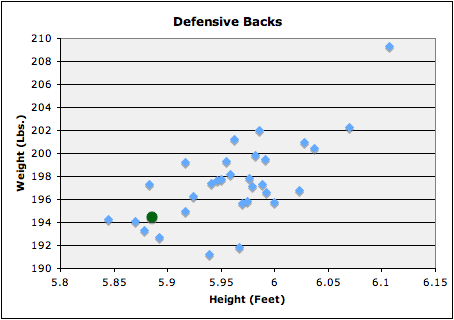
The Eagles’ corners and safeties are undoubtably small. The unit is one of only five in the whole league that averages less than 5’11” and 195 lbs. The others are Detroit, Buffalo, Atlanta, and Indianapolis — not exactly a star group.  Nate Allen and Trevard Lindley may boost the unit’s physical presence, but not by much.

The other thing that isn’t measured here is speed, and I’m not so sure this group of Eagles’ defensive backs makes up for their small stature with blazing speed.

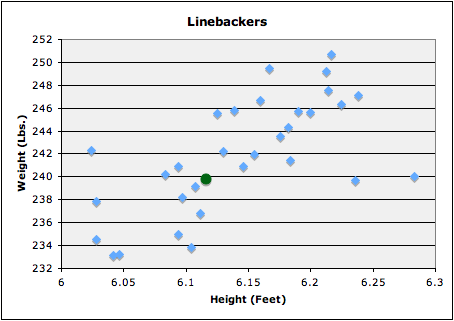
NFL Linebackers Size Height Weight

The Eagles’ linebacker corps looks more average. But Stewart Bradley is the only real big guy they have. Ernie Sims, Moise Fokou, Omar Gaither, and Akeem Jordan are all slight, and the incoming class of rookies isn’t any bigger.

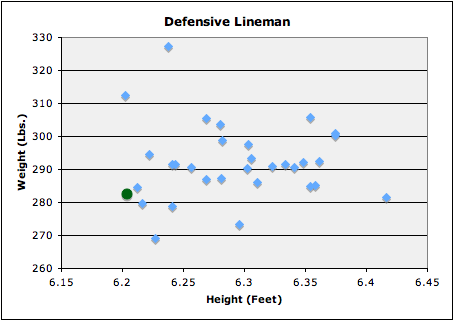
NFL Defensive Linemen Size Height Weight

Because the Eagles are big fans of both small defensive ends and using those ends in place of back-up defensive tackles, they rank toward the bottom of the NFL here. Only Green Bay has shorter linemen, and only Oakland, Seattle, Carolina, Tennessee, and Indianapolis have lighter ones.

This data doesn’t do a whole lot other than confirm our general observations. But it does show that the Eagles are on the bleeding edge of the league in terms of valuing speed over size — and the defense is only getting smaller with every new acquisition. Whether that’s foreshadowing a new league-wide trend or just a big mistake, we’ll soon find out.

Why Trent Cole Should Hold Out of Camp

Trent Cole Philadelphia Eagles Salary Contract Hold Out Training Camp

As a fan, it’s tough to support a player who holds out of training camp. No matter how much less a player makes than he “deserves,” he’s still getting a boatload and a half more than anyone you know. All fans care about is the team — and any player who holds out appears to care a lot more about themselves than winning a championship.

But, in all honesty, while I don’t necessarily want Trent Cole to hold out at the beginning of training camp, I think he should for his own sake.

First of all, it’s not like he needs to learn or compete in training camp. He’s the starting RDE and that’s not going to change with a few days or weeks missed. I’m all for working out with the team and getting in shape for the season, but there’s not much for Cole to gain at Lehigh. And there’s something positive about keeping him from suffering a Stewart Bradley-esque injury.

Second, he’s clearly underpaid. Foxsports.com compares Cole’s contract to Julius Peppers’s, but let’s put that aside for now. Soon, Cole won’t even be the top-paid defensive end on his own team — that distinction will go to first round pick Brandon Graham, who will get north of $12 million guaranteed cash (Brian Orakpo’s haul last year) before ever taking an NFL snap. Cole’s gotta be looking down the line, wondering why he can’t get some of that dough.

Third, Cole’s not getting any younger. He’s only 27 now, but he’s played in 65 straight games including in the playoffs. He can’t, and shouldn’t, count on that streak continuing forever. With that in mind, Cole deserves to be paid at least close to market value for the last few years of his prime. You never know when that window could close, and it will likely happen before he gets to free agency in 2014.

But the key point is number four: Cole’s never going to have better leverage to renegotiate his deal. Think back to the summer of 2008. Brian Westbrook was coming off a career year that put him at the top of running backs in the NFL. More importantly, he had proven that he was by far the most valuable member of the team. Westbrook parlayed that, coupled with a holdout threat carried over from his refusal to attend camp in 2005, into another contract extension (ok, so it was basically just a raise).

Cole is in a similar situation now. He is by far the most important player on the defense, and may be the most indispensable guy on the team. Just as the Eagles recognized that Westbrook was their only weapon on offense going into 2008 and drafted DeSean Jackson, so they have indicated how thin they are on the defensive line by completely reloading at that position. Sure, Graham may become great and eventaually replace Cole the way DeSean replaced Westbrook, but right now Cole’s playmaking and all-around production remain invaluable. If he wants to renegotiate his contract, the Eagles have to listen.

Plus, because Cole is indispensible and so obviously underpaid, he likely wouldn’t receive the same vitriol from the public that is often directed at training camp hold outs. Or would he? What do you think?

Meet the Eagles' Statistics Team

Philadelphia Eagles Statistics Michael Frazier

Michael Frazier attended Wooster College from 1999-2003. During his time there he interned at Wachovia Securities and Smith Barney. Immediately upon graduation the Philadelphia Eagles hired him  a “Statistical Analytics Coordinator,” a post he has held for the last seven years — in complete obscurity.

That is pretty much all we know about Michael Frazier (circled above). And it comes from his public page on LinkedIn. As a member of the coaching support staff, he merits only a name listing, with no staff bio or job description, on the PE.com Front Office list. We do know that during the games, according to a 2006 Marty Mornhinweg press conference, “Mike Frazier is up there [in the coaches’ box] with some statistics.”

Frazier’s colleague Alec Halaby, the Eagles’ “Player Personnel Analyst,” isn’t even in the most recent team photograph. He’s not a scout, but got a small promotion to this position according to Adam Caplan, who called him a “statistical analyst, young guy, been with the team for awhile.” How long that has been is unclear though, since he seems to be the same Alec Halaby who was at Harvard as recently as 2008.

However, assuming this Halaby is the same guy, we can connect some of the dots. He was clearly interested in sports statistics in 2006, commenting about them at Football Outsiders (“Let us not forget that the 43rd pick is the most valuable in the draft”) and Matthew Yglesias’s blog (“His numbers in P/40 and TS%…”). Perhaps he was an intern with the Eagles that summer, when he posted a problem with his STATA program involving “games,” “years,” and “simscores.”

Jeff DominitzWe don’t know much more about Frazier and Halaby’s presumed boss, Jeff Dominitz (pictured at left). Dominitz is the Eagles’ “Director of Statistics,” and from what I can gather, is (or recently was) also an Adjunct Staff member at the Rand Corporation, a nonprofit research organization. Before coming to the Eagles, he received a Ph.D. in economics from the University of Wisconsin, worked as Associate Professor of Economics and Public Policy at Carnegie Mellon University and served as research director of the Census Research Data Center.

All of the above could be viewed as rather stalker-esque, but it’s really just in pursuit of a very simple goal: getting some insight on the statistical analysis the Eagles do. Obviously this blog, along with a handful of others, are always looking for new and better ways to analyze pretty much anything about our favorite team. These guys do the same thing from the inside (with MUCH more distinguished backgrounds and methods), toiling anonymously in the background of all the decisions made by the Eagles over the years.

So naturally I’m interested in how the Eagles apply statistics to get an edge against the rest of the NFL. Unfortunately, there are no interviews, no revealing quotes, literally nothing on these guys other than what I’ve managed to cull above. So where does that leave us? Well, first, desperately wanting someone like Les or Domo or McLane to go get us one meager interview. But second, examining the richest source of information I could find — which came from a former member of the Eagles staff: David Lewin, Director of Statistics from 2007 to 2008 (ironically, not the same Football Outsiders Dave Lewin who pioneered the “Lewin Career Forecast” for projecting college QBs to the NFL, and now works for the Cleveland Cavaliers). Over at his public LinkedIn page, Lewin writes about his experience with the Eagles:

• Led implementation and validation of large database and integrated information from multiple sources.
• Addressed a wide variety of questions related to injury risks, game strategy, and player performance posed by the Head Coach and Team President.
• Identified characteristics of teams and players that have been successful in the NFL.
• Created models to predict how well college athletes will perform at the professional level.

Whoa, jackpot! Let’s look at what we learn here:

  1. The team uses statistics for basically everything: injury risk (maybe that model isn’t working too well right now), strategy (too bad they haven’t helped Andy with clock management), player production, and probably much more.
  2. Reid and Joe Banner ask specific questions of the stats team to analyze. These guys are embracing and using any advantage they can get. There’s a reason Jeff Lurie could easily slip a YPA mention into a discussion about Lito Sheppard — the front office is very familiar with all of this.
  3. The Eagles have some sort of huge database of what I guess are players, careers trajectories, salaries, draft picks, at more that they use to their advantage.
  4. They have models, based on past precedence, that indicate who is likely to do well, even coming out of college. I imagine this is somewhat akin to models like  “SackSEER” Nate Forster at Football Outsiders did for defensive ends.

Want some more ideas about what the Eagles’ statistics team does? Check out Lewin’s new statistics company’s website:

To determine whether a player will do well for your team, Statistically Speaking Consulting can identify the right metrics to use and how to combine them for an accurate prediction of a player’s future success. This is critical when players are transitioning from high school to college or from college to the pros, since the existing data is relative to a lower level of competition. It also helps to more accurately judge the benefit of a player, so that you do not overlook those who are undervalued by traditional methods and do not overpay for those that are overvalued.

In addition to finding the right metrics for individual players, we can help find the right metrics to identify the real areas where your team needs to improve. This can be used to change strategies for coaching decisions, or for front office personnel to find players that will have an impact in the needed areas.

In combination with your current process, these statistical results can improve your decisions so that you take better advantage of your limited resources, like scholarships, draft picks, and money.

Sounds like things Lewin probably did with the Eagles: finding metrics to judge performance more accurately, analyze areas of strategic advantage, and apply these models to help the team pursue the most cost-effective free agents, draft the correct players, and call the optimal plays.

The ability to predict player performance close to the way PECOTA does for a more individual sport like baseball would be the holy grail of football statistical analysis, and I doubt the Eagles have arrived at a secret formula for that. But every little bit of predictive power (or even just accurate data accumulation) is helpful, and I imagine, despite their reclusive nature, that the Eagles’ stats guys are hard at work providing that for Andy Reid and company.

Nate Allen: Under Pressure

Pushing down on me, Pushing down on you…

What a difference a few days make.

Second round pick Nate Allen was supposed to compete for the starting free safety spot, not have it thrown on him before OTAs even ended. But with the season-ending injury to free agent pick up Marlin Jackson, that’s exactly where Allen stands. Add in the MCL sprain to strong safety Quintin Mikell, and Nate Allen suddenly looks to have a whole lot of weight on his shoulders come training camp.

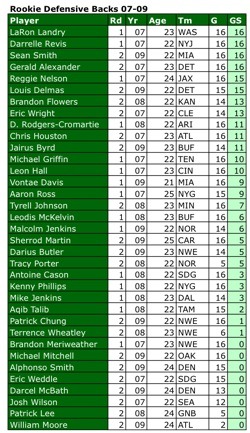
Rookie Defensive Backs NFL Draft Rounds 1 and 2 2007 to 2009As you can see from the table at right, less than half of the defensive backs taken in the first or second round of the NFL draft start even the majority of their team’s games. There’s no reason Allen, who figures to be somewhere in the middle of that pack talent-wise, couldn’t be one of those guys who starts the whole year. But it’s certainly no given.

**Interesting side note, of the 15 DBs who did start at least 9 games, it’s split down the middle (8 firsts, 7 seconds) as to which round they were taken in.

And yet perhaps the biggest transition for Allen won’t be on the field, it will be avoiding questions about how he measures up against two former Eagles in a war of media memes.

The first pattern emerging from OTAs is that Allen has to live up to being “The Donovan McNabb Pick.” Over the last week you can see this label emerge here, here, and here. I know its fun to see what teams “win” trades by looking at who they actually get from draft picks. (Anthony Spencer for Kevin Kolb, Stewart Bradley, and CJ Gaddis was especially good for that.)

But let’s just end this thing before it goes any further. It’s silly to compare Allen’s performance this year at safety to McNabb’s in Washington, especially when he already has enough responsibility and pressure. When the Redskins come to Philly in October, McNabb will probably expose the Eagles’ secondary, and the easy-way-out-seeking headline writers will champion the failure of the McNabb trade. Chill out.

The second meme of the week, resulting from the Marlin Jackson injury, is that there is some “Brian Dawkins Jinx” on the free safety spot. As Reuben Frank writes,

Quintin Demps got the first crack at it. He didn’t even make it to opening day. Then it was rookie Macho Harris’s turn. He made it through six starts. Sean Jones was up next. That lasted until late in the regular season, when Harris took over for the last few weeks. This summer, the job went to Marlin Jackson. Who limped off the practice field with a ruptured Achilles tendon on Tuesday. So when rookie Nate Allen took over as the Eagles’ starting free safety, he became the fifth different guy in 10 months to get a shot since Brian Dawkins left for Denver.

Okay, first of all, huge stretch to start calling this any kind of real curse. None of these guys (One second-year player, one rookie, two middling veteran pick-ups) could realisitically have been expected to do a great job. And if Allen struggles this year, it won’t be because of some strange voodoo Dawk left in the stadium before he flew to Denver — it will be for the simple fact that starting in the NFL as a rookie is no easy task.

Second, who breaks out the “Curse” watch just a little more than a year after a player’s exit? Were they counting missed titles in Boston in 1921? Were Philly fans in 1988? These reporters seem to be just grasping at straws these days.

And it’s trickled down to the players:

“Everybody saying the whole Dawk-jinx thing, everyone looking at him being a rookie, being the Donovan McNabb pick, all that stuff, he’s got to deal with,” Mikell said. “But if he goes out there and does what he does, don’t ask too much of himself, don’t put too much pressure on himself, just go out there and play ball, he’ll be fine.”

Yeah, that’ll be a real piece of cake. Of course, Andy Reid says Allen’s “got a nice football mind,” whatever that means. Maybe he can beat all this baggage. He’s certainly not going to get off easy if he can’t.

A Second Look at Defensive Playmakers

Philadelphia Eagles Defensive Playmaking Trent Cole Darren Howard

One of the keys to the 2010 Eagles season will be the performance of the defense. Last year the unit was, at best, inconsistent and this offseason we’ve seen a good deal of turnover. Sheldon Brown is gone. So is Darren Howard, Chris Clemons, Will Witherspoon, Sean Jones. Stewart Bradley returns, along with a whole host of draft picks and other new additions such as Darryl Tapp and Ernie Sims.

But it is often difficult to isolate individual player performance from team performance. How do we know whether the guys the Eagles jettisoned were truly underperforming? Hopefully this post will offer one possible way to gain some insight into that, simply by crossing two streams (oh no!) of data: one from Advanced NFL Stats and the other from Pro Football Focus.

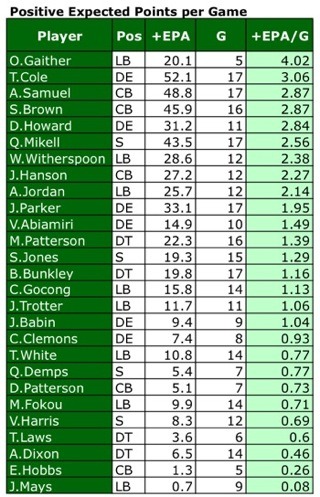
Let’s start with Brian Burke’s Advanced NFL Stats measurement of +EPA as a measurement for defensive players. As he explains here, +EPA measures positive performance: “the value of every sack, interception, pass defense, forced fumble or recovery, and every tackle or assist that results in a setback for the offense.” What the stat doesn’t do is show you when the player did something wrong — when he cost the team. Thus, one would expect risk-taking players such as Asante Samuel to score disproportionately well in this system. His positive achievements regarding turnovers are huge, while his negative tackling ability never gets factored in.

Still, even with this caveat, it is an interesting way to look at players as playmakers. Here are the Eagles’ numbers from last year as put up by Burke, ordered by +EPA per the number of games they played in.

Philadelphia Eagles Defensive Playmakers Table 1

Obviously bland +EPA is of little use to determine who’s a better player. It’s far too dependent on the amount a player is on the field. At least Burke’s +EPA/G differentiates by number of games played to factor out some of the bias from players who played constantly and without injury. However, when I looked at this for the first time, I realized that games played was only a half step toward the greater goal of figuring out who caused the most postive plays, per play.

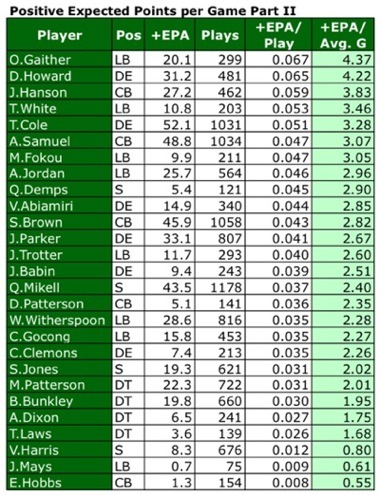
This is where Pro Football Reference’s play charting data — where they count how many times every player is on the field — comes in handy. Here’s for the Eagles. By looking at +EPA by play, rather than by game, you can get a much more “accurate” reading of playmakers. Below you can find the +EPA per time the player was on the field defensively (+EPA/Play), as well as a number that shows how much +EPA he would have accumulated had he played every defensive snap in the average Eagles’ game (~65).

Philadelphia Eagles Defensive Playmakers Table 2

Observations from this data (feel free to post your own in the comments):

  • The fewer times a player was on the field, but active in the game, the more unreliable his numbers are going to be. Looking at you Tracy White and Quintin Demps.
  • On the other hand, those who racked up huge play totals as well as +EPA/Avg. G (Trent Cole, Asante Samuel) clearly form the backbone of the playmaking contingent of the team.
  • Darryl Tapp’s numbers with the Seahawks: 39.8 +EPA total, 704 plays, for a +EPA/Avg. G of 3.67 — placing him right near the top of the list.
  • Ernie Sims’s from Detroit: 14.8 +EPA total, 490 plays, for a +EPA/Avg. G of 1.96 — positively Bunkley-ian.
  • The scheme also affects opportunities for playmaking. For example, all four of the main defensive tackles fall in a row toward the bottom, indicating that the Eagles have been using the position less for playmaking, and more for solid building blocks of run defense. At the opposite end of the spectrum is Darren Howard, who often played as a DT in pass-rushing situations, giving him many more opportunities to make plays.
  • But the fact that Howard was able to cause that pressure when he was in the game is important. While we can’t see some of the negative plays he may have allowed, Howard was clearly a better pass-rushing option than Chris Clemons, who made barely more +EPA per play than Mike Patterson. One has to wonder if Clemons for Tapp was a steal and/or if the Eagles will miss Howard’s rushing ability on third down.
  • Other players who seemed to provide little in the area of playmaking: Macho Harris, Sean Jones, Chris Gocong, Will Witherspoon.

It’s worth mentioning one more time that this is far from the final answer at evaluating defensive performance. However, by combining +EPA with play counts, we gain one more interesting nugget for individual evaluation.

    Back and Better Than Ever...

    That was a long break.

    I know there aren’t many readers over here in this small corner of the sports blogosphere (especially after that month-long hiatus), but obviously for anyone out there who’s always on the prowl for Eagles content — I’m certainly one of those — hopefully you can get a little bit of your fix right here.

    For new readers check out the archives for some of the spring’s greatest hits. Some of my favorites:

    I have some ideas and some projects in the works, but let me know if anyone has any topics or research questions to look into and I’ll try to take a stab over this long summer without football.

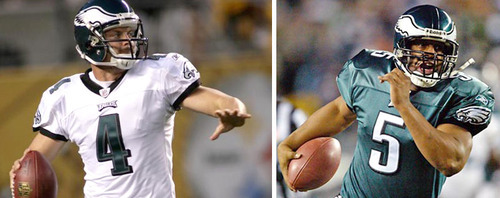
    The Next Decade: Eagles' New Passing Attack

    Kevin Kolb Donovan McNabb Pass Attempts Targets Completion Percentage

    Plenty of speculation recently about about the future of the Eagles offense. Can LeSean McCoy, minus six pounds, take over for Brian Westbrook? Will the offensive line pull its weight? Is there a new #1 receiver? Should the Eagles switch to Kelly Green permanently? Well, maybe not that last one.

    Perhaps most centrally, people want to know how the Eagles passing game will be different from previous years. Receivers have come and gone, but for the most part Donovan McNabb defined the offense. How will it change with Kevin Kolb stepping up? Marty Mornhinweg has already talked vaguely about a shift:

    “[The offense] will be different. Donovan was such a great player, and he has many, many strengths, however they’re different from Kevin’s… I thought Donovan, there’s no question, he had one of the stronger arms, maybe of all time. He could make the brilliant play. Kolb is very, very consistent. He handles two or three different play selections very well. Typically, very accurate. He is athletic, but he doesn’t have the athleticism that Donovan has. So, very different in that way.”

    The obvious change, based on our own eyes, is the difference in arm strength and accuracy. Donovan was tremendous at throwing the deep ball, but infamous for being rather streaky in the short/mid-range passes. Kolb doesn’t have that cannon arm, but he’s supposedly “more accurate.” Will that influence the play calling? And how much? Can we find a way to see what the passing offense will look like come September?

    I think so, using Pro Football Focus’s play-by-play game stats from last year to compare the playcalling and accuracy with Kolb in the game versus McNabb. Just a trove of information over at PFF, but I’m going to utilize a only small segment: passes organized by where they were thrown. Also added in some other stats like the percentage of attempts thrown, completion percentage, and a basic yards per attempt calculation. Here you go:
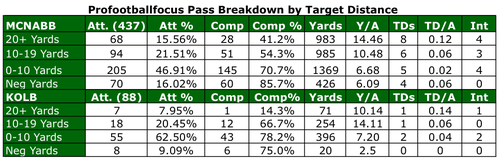
    Pro Football Focus Pass Breakdown by Target Distance

    First things first: Kolb’s numbers are victim to small sample size problems. Kolb threw only 20% of the balls that McNabb did, so his stats aren’t as reliable (although they do refute the stupid myth that Andy might run the ball more with Kolb). They are likely to change as he plays more. Perhaps Kolb’ll get better starting every day. Or maybe teams will get used to him and learn how to rattle him. Impossible to tell. Either way, the numbers can tell us a lot about the differences from last year (when Kolb and McNabb were playing with the same supporting casts), and what we might be able to expect in 2010.

    Let’s first look at playcalling, represented by the number of pass attempts:
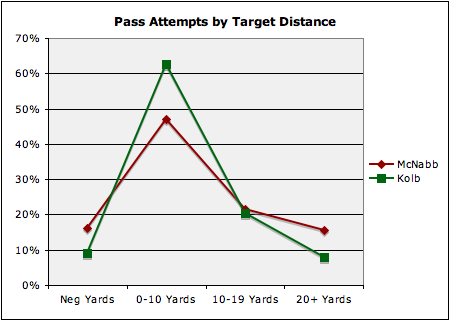
    Pass Attempts by Target Distance Kevin Kolb Donovan McNabb

    Clearly Kolb threw a lot more short passes — an over 15% bump. Also, the percentage of times he chucked it long was cut almost in half from McNabb’s numbers. The gaps may not look huge on the graph but consider them over the course of a season. If he throws at the same pace as McNabb, Kolb will get in 80 more short (0-10 yards) passes and about 36 fewer long balls (20+ yards). That’s a major difference in play-calling (or could partially be execution) and would indicate a somewhat more “typical” west-coast offense is in town.

    Okay, so Kolb is throwing more short passes. But is he completing more of them?
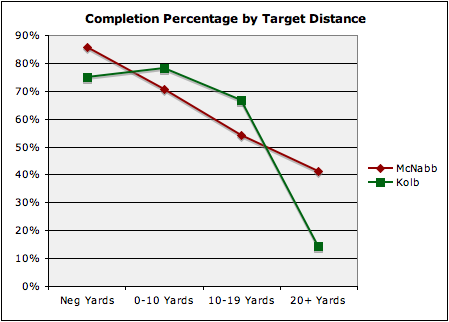
    Completion Percentage by Target Distance Kevin Kolb Donovan McNabb

    The short answer is yes. In everything from 0-19 yards, McNabb had a 65.9%  completion percentage. Kolb completed 75.3% of those same passes. That is undoubtably a more accurate quarterback, and could help the Eagles offense become, in Marty’s words, “very, very consistent.”

    However, there is an absolutely enormous gap in completion percentage on longer passes. Donovan completed a ridiculous 41% of his throws over 20 yards. Kolb, with limited action, only completed one in seven attempts (granted, that one did go for a 71-yard TD). If that trend continues, it would be a ridiculous swing what would make the Eagles much less inclined to go to the long ball.

    Still, completion percentage alone doesn’t get us exactly what we want. It only shows how accurate the two quarterbacks are over the distances, but not how productive they are at each level. Which is where YPA comes in…
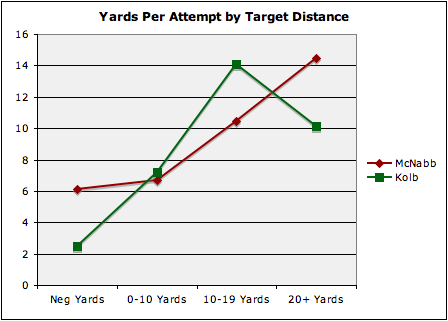
    Yards Per Attempt YPA by Target Distance Kevin Kolb Donovan McNabb

    In my mind, this is the most striking graph. Essentially YPA measures the expected output from any given pass attempt. We can see what the “best” plays are to call because the estimated yards gained shows us the optimal point. For example, look at McNabb’s numbers — the farther he threw the ball, the better the outcome was, on average, for the offense. This is the simple reason why the Eagles threw the ball so much downfield in recent years. You can complain about boom-bust, but when McNabb was behind center, the Eagles gained maximum output when he was passing it 20 yards or more down the field.

    For Kolb, at least right now, that is not the case. His sweet spot is in the intermediate, 10-19 yard range. That’s where Kolb’s accuracy makes him most productive (actually just as productive as McNabb throwing long).

    So what does this all mean? It means yes, there will be many fewer bombs launched 45 yards down the field to DeSean Jackson. But it doesn’t mean, in any way, that the Eagles will be less explosive — or that Jackson won’t be as productive (as has been the current meme, debunked by Derek at IgglesBlog). It simply means the throws that result in explosive plays will be different. Rather than launching passes to  Jackson after he’s 5 yards past the centerfielder, Kolb will have to get him the ball in the short and intermediate areas. From there it will up to Jackson (and Maclin, Celek, Avant) to run past or through defenders.

    For an example, look no further than the two games Kolb started last year, from which we’ve gotten the rest of this data. Check out DeSean’s stats from those games versus the rest of the year:

    DeSean Jackson Pro Football Focus Statistics McNabb vs Kolb

    DeSean may not have gone out as far before he caught the ball, but he was just as — if not more — productive and explosive with Kolb behind center. DeSean got more targets, receptions, yards, and touchdowns than he had in the average game with McNabb, plus had his two longest receptions of the year — all because of Yards After the Catch. Jackson already ranked 9th in the NFL last year with 6.6 YAC per Reception (25% of snaps or more). Yet Jackson’s 15 YAC/Rec. over two games with Kolb throwing him the ball blows away the rest of the receivers.

    The explosion will still be in the passing game next season. Based on these numbers though, it’ll just be in a slightly different package.

    Update: Kolb confirms the new focus of the offense—

    “It’s going to be spectacular. With [DeSean’s] talent and hopefully my ability to get him the ball in stride and yards after the catch, those types of things — it will be pretty special. I look forward to being around him and both of us being with this team for a long time.”
    On the Bubble: Projecting the Eagles 2010 Roster — Defense Edition

    Philadelphia Eagles Defense 2010 Minicamp Stewart Bradley

    There was a lot of roster turnover this offseason on the defensive side of the ball. Plenty of young blood and plenty of new toys for Sean McDermott. Here’s how I think the competition looks in early May:

    Defensive Line (13 players; 10 likely spots)
    Locks: Trent Cole, Broderick Bunkley, Mike Patterson, Darryl Tapp, Brandon Graham (r), Daniel Te’o-Nesheim (r), Ricky Sapp (r)
    On the Bubble: Victor Abiamiri, Trevor Laws, Antonio Dixon, Juqua Parker, Jeff Owens (r)
    Longshots: Eric Moncur (r)
    Analysis: The rookies are going to get good chances to contribute right away in the absence of veterans like Darren Howard, Chris Clemons, and Jason Babin. And you’ve got a motley crew fighting for the remaining jobs: the old vet, the UDFA that showed immense upside last year, the two second-round picks that haven’t done much on the field, and the 7th-round challenger. Listed Sapp here because Andy’s talked about him as a Joker-type, not a legit option at SAM. If the coaches think he can crossover he may be competing with Alex Hall (listed with the LBs) for a job. Plus, When you consider Abiamiri may not be ready for the season to start, the Eagles probably will bring in a few more UDFAs to compete.

    Linebackers (9 players; 6 likely spots)
    Locks: Stewart Bradley, Ernie Sims, Moise Fokou, Keenan Clayton (r)
    On the Bubble: Akeem Jordan, Omar Gaither, Joe Mays, Alex Hall, Jamar Chaney (r)
    Longshots: None
    Analysis: No longshots here; everybody’s got a legit chance of a spot. However, given the recent youth movement, don’t think guys with little shot of ever starting again (see: Gaither, Mays) should get too comfortable. I would bet it’s Bradley, Sims, and Fokou starting, with Clayton, Jordan, and Chaney subs. Hall could stick as a hybrid DE/LB.

    Defensive Backs (15 players; 9 likely spots)
    Locks: Quintin Mikell, Asante Samuel, Nate Allen (r), Macho Harris, Ellis Hobbs, Trevard Lindley (r)
    On the Bubble: Joselio Hanson, Marlin Jackson, Quintin Demps, Dimitri Patterson, Kurt Coleman (r)
    Longshots: Geoffrey Pope, David Pender (r), Josh Morris (r), Devin Ross (r)

    Analysis: The Eagles are in a tough spot with Macho, because he’s the best option at FS if Nate Allen can’t step up and take the job right away. However, if Macho doesn’t get reps at CB, how can he compete there? He’s better than back-up safety or dime CB (where he might end up if Allen only takes the job right before the season), so they have to hope the positions sort themselves out soon. Coleman, Demps, and maybe Jackson will be working at back-up safety. The prospects at CB are more unsettled, but clearly Hobbs, Macho, Lindley will get looks. If Jackson can’t pull his weight at safety they could try to stash him at CB as well — but that might eliminate the chances of keeping another long-term prospect at the position like Patterson or one over the UDFAs.

    Special Teams (5 players; 3 likely spots)
    Locks: David Akers, Jon Dorenbos
    On the Bubble: Sav Rocca, Durant Brooks, Ken Parrish
    Longshots: None
    Analysis: PUNTER COMPETITION! WOOHOO!

    Plenty of uncertainty there. Anyone have predictions?