Kolb Signs One-Year Extension, Gets Filthy Rich

Kevin Kolb Contract Extension Philadelphia Eagles

Yesterday Kevin Kolb got a one-year extension on his original rookie deal that would have ended after the upcoming 2010 season. You can read all about the 30%-rule in the CBA that prevented a long-term deal from happening over at IgglesBlog with Sam. But here I’m just interested in the implications of the deal.

According to Adam Schefter, the extension is worth $12.25 million — completely guaranteed. You can take this different ways. Adam Caplan says Kolb went from the lowest-paid quarterback starter in the league, to the highest-paid per year. Kolb’s agent Jeff Nailey, not one to diminish an accomplishment, portrayed the deal as one that will pay his client “seventh or eighth among the best-paid quarterbacks in the NFL this season.” Both agreed that Kevin would make more per year than Donovan McNabb.

My first thought was, wow, that’s a lot of guaranteed money for a guy who’s only started two games. And it is. But on the other hand, this is really a two year deal — to raise Kolb’s salary this year (from a paltry base pay of $550,000), and then extend him for one more. That wouldn’t place the per year money as high as either Caplan or Nailey suggests. Either way, as Joe Banner said, neither side wanted to “put Kevin in the position where he was playing this year as one of the lowest-paid players on the team.” Or, as Tommy Lawlor writes, let Kolb play with less than his new back-up Michael Vick, which could have been a pain.

This also marks the beginning of a fruitful Kolb-Front Office dynamic. Both Banner and Kolb were talking in the same language about how this deal allowed them to “bridge the gap” to a long-term contract. Of course, it’s easy to be buddy-buddy when you go through a pretty easy negotiation. Kolb had all the leverage once the Eagles sent McNabb to the Redskins, and achieved about as much as he could have asked for. He must be happy if his agent is willing to go on record with thoughts like:

“They have no chance of losing him after this year. Kevin had no desire to go anywhere [else] after this year.”

Let’s see what gets floated to news outlets a year or two from now when both sides are working out a long term deal.

On the Bubble: Projecting the Eagles 2010 Roster — Offense Edition

Projecting the Philadelphia Eagles 53 Man Roster Leonard Weaver LeSean McCoy

86 enter, only 53 will emerge. With the draft over and minicamps about to kick off, it’s time to start thinking about what the Eagles roster will look like come September. Let the drama begin…

We’ll start on the offensive side of the ball.

Quarterback (4 players; 3 likely spots)
Locks: Kevin Kolb, Mike Kafka (r)
On the Bubble: Michael Vick
Longshots: Joey Elliot (r)
Analysis: Kolb’s the clear-cut starter. Kafka, a 5th round pick, will be groomed as a long-term back-up. Vick is only on the bubble because if there’s an offer, the Eagles would probably be willing to ditch the unreliable back-up for someone proven like Jeff Garcia.

Running Back (9 players; 4 likely spots)
Locks: LeSean McCoy, Leonard Weaver, Mike Bell
On the Bubble: Charles Scott (r), Eldra Buckley
Longshots: Martell Mallet (r), Dwayne Wright, Chris Zardas (r), Keithon Flemming (r)
Analysis: McCoy and Weaver showed they can be a good one-two punch, but Bell will be the main complementary back this year after the Eagles stole him from the Saints by guaranteeing Bell $500,000. The main battle will probably be between Scott and Buckley, who was a great special teams player but contributed little in the running game. With Scott’s experience as a FB, he should have the edge.

Wide Receiver (11 players; 5 likely spots)
Locks: DeSean Jackson, Jeremy Maclin, Jason Avant
On the Bubble: Hank Baskett, Riley Cooper (r)
Longshots: Jordan Norwood, Dobson Collins, Chad Hall (r), Blue Cooper (r), Kevin Jurovich (r), Pat Simonds (r)
Analysis: Top three spots are set. Baskett should be the experienced #4, although it’s possible that 5th round pick Cooper, who has some of the same skills, could supplant him. Also, while the rest of the players likely face an uphill battle, the Eagles have had injuries to the WR position the last few years in training camp. A guy like Norwood could slip onto the roster that way.

Tight Ends (4 players; 3 likely spots)
Locks: Brent Celek
On the Bubble: Cornelius Ingram, Clay Harbor (r)
Longshots: Martin Rucker
Analysis: Celek was a star last year and could be even better in 2010 with Kolb as the starter (if you prorate Celek’s numbers from Kolb’s two starts you get 96 rec, 1300 yards). Ingram has lots of potential but has to prove he can come back from two consecutive knee injuries. Additionally, the Eagles will have to decide if they can afford to carry three TEs this year.

Offensive Line (16 players; 10 likely spots)
Locks: Jason Peters, Winston Justice, Stacy Andrews, Todd Herremans, Nick Cole
On the Bubble: Jamaal Jackson, Max Jean-Gilles, King Dunlap, Mike McGlynn, Fenuki Tupou, Dallas Reynolds
Longshots: A.Q. Shipley, Shawn Murphy Greg Isander, Austin Howard (r), Jeraill McCuller (r), Zipp Duncan (r)
Analysis: With Jackson likely to hit the PUP, there will be open competition for the center spot. Cole will get the first crack, but it would be nice if someone like McGlynn won the job and Cole kept his super-sub role for the three interior positions. None of the other guys on the bubble have really shown anything great so far. They have the edge in experience, but any of the UDFAs could grab a roster spot with a good camp.

Disagree? Think your favorite player is better than a longshot? Sound off below. Also, check back soon for the defensive breakdown.

Eagles Post-Draft Thoughts and Analysis

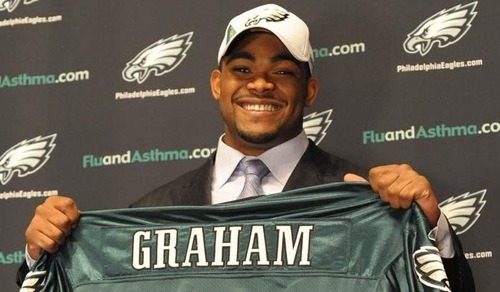
Philadelphia Eagles 1st Round Draft Pick DE Michigan Brandon Graham

Observations and opinions on this 3-day, 13-player behemoth of a draft for the Eagles:

  • Everyone, including myself, was surprised at the number of defensive ends the Eagles drafted. That was the big story, especially because it seemed like the secondary and the offensive line were bigger needs. But when you look at the offseason in hindsight, it’s easy to see that there were big needs there. The group wasn’t in any way dominant last year and we heard that some of the veteran guys were poisonous in the locker room. In any case, the Eagles jettisoned three players (Darren Howard, Jason Babin, and Chris Clemons) who combined for over 900 snaps. Essentially, they needed three more bodies — hopefully younger and more productive ones.
  • Not only was it a need, but you can see where each new DE fits a certain role on the team and, in some cases, specifically replace one of the departed veterans. Andy Reid compared Brandon Graham to Trent Cole, and he will get every chance to star opposite Cole for the next 5-10 years. Andy said Daniel Te’o-Nesheim will step in for Howard, as a DE who can move inside. Ricky Sapp replaces Clemons at the Joker spot. Darryl Tapp (while not exactly the same type of player) sounds like will take the place of 31 year-old Juqua Parker when he eventually gets cut/traded. The Eagles only have 7 DEs right now (prior to UDFAs) on their roster. They played with 6 last year, so it’s not like the team is overloaded.
  • Last point on DE: It seems like McDermott may be in the same school of thought as Steve Spagnuolo when it comes to defenses — get as many pass rushers as possible. That’s how Spags managed the defense in New York when they won the Super Bowl, and it may help explain the focus there rather than on the secondary or linebacker corps.
  • Nate Allen looks like a real solid, mature kid. Check out his press conference if you haven’t already. I will honestly be surprised if Allen’s not starting at FS come September and he has a great chance to be a new leader on the defense.
  • If Allen solidifies the starting free safety spot, as he will be given every opportunity to do, I could see the Eagles making Quintin Demps the back-up and moving Macho Harris over to corner. He, Marlin Jackson, Ellis Hobbs, Joselio Hanson, and 4th round pick Trevard Lindley will get shots at the RCB job (which now looks like the 2009 FS position). Then if Jackson or Harris loses the battle, the Eagles could stash them back in the other back-up safety spot.
  • As Scott Turnstall over at Inside the Iggles sharply noticed, all 13 players the Eagles drafted were seniors. Last year the top of the draft had two young underclassmen and that seemed to work out fine, but you have to wonder if this is a new Howie Roseman philosophy.
  • Additionally, only TE Clay Harbor from Missouri St. came from a smaller school. There were no unheard of projects from Cal Poly or McNeese St. this time around. While we’re on the tight end position, don’t be surprised if Harbor sees more playing time than Cornelius Ingram on the depth chart this year. Andy had high compliments for his blocking skills and, unlike Ingram, Harbor doesn’t have balky knees.
  • It still amazes me that the Eagles didn’t take an Offensive Lineman in this draft. Everyone agreed that it was a need — except the Eagles. Andy doesn’t even need excuses to take big uglies, but he’s willing to got to war with that depth? Nick Cole and Stacy Andrews don’t worry me that much but who do you trust if someone gets hurt again? Jean-Gilles, Dunlap have showed us very little. McGlynn, Tupou, Reynolds haven’t even been on the field before. The Eagles will bring in some UDFAs, but it’s surprising that they don’t feel the need to bring in real competition for a guy like Dunlap.
  • Andy’s response about whether there has been any interest from other teams for Michael Vick: “No.” Reid didn’t seem too pleased with the development. Could Vick really not be going anywhere? I bet the Eagles are still hoping someone like Buffalo decides they need Vick, or another team’s quarterback gets hurt.
  • Anyone else notice how much Andy went out of his way to heap praise on Howie Roseman’s shoulders? We know Reid is the final decider in the room, but he’s a real underrated leader — pushing off the success on other people and accepting blame when it comes.
  • The Eagles drafted 13 (!) players — the most ever by a team in the 7 round format. Can they keep them all? I’m going to do a preliminary roster analysis soon but my quick answer is yes. It depends on roster battles and injuries, but the Eagles got rid of so many older players that they’ll open up camp with a lot of space.
  • The fact that the Eagles only selected one player at their own pick (outside of compensatory selections) is also astounding. Howie certainly learned the art of trading from Heckert.
  • Stewart Bradley and Alex Hall are the only two big linebackers. Everyone else is small and fast. We’ll see about the SAM spot. Fokou looks like he’s going to get the first crack at the job (ala Quintin Demps in 2009) but if he can’t step up it could be another mishmash of guys from Akeem Jordan to Hall. Also, if I were Omar Gaither or Joe Mays I’d be worried about my job. The two draft picks look like almost-identical replacements to me.
  • I think the arrival of Charles Scott means Eldra Buckley is a goner. Buckley may be a better special teamer, but Scott will get a chance there since he’s probably viewed as a long-term change of pace back to LeSean McCoy. Obviously they’ll be battling it out for that 4th RB spot.
  • The Eagles already have 9 picks in the 2011 draft. Unbelievable.
  • Last chance for Trevor Laws. Jeff Owens is only a 7th round pick, but considering the move toward using DEs inside on passing downs, it’s unlikely the Eagles keep more than 4 DTs. Patterson and Bunkley are solid, and Antonio Dixon showed a lot of promise last year. It’ll be Owens, Laws, and another UDFA or two competing for the final spot.
  • Mike Kafka is right out of the AJ Feeley playbook. Both 6’3”, 220 lbs, mediocre arm strength, significant college back-up experience. I anticipate he’ll do fine in Feeley’s role.
  • Also, I like that my “Youth Movement” posts have been validated by Andy Reid, who told Nate Allen (to Les Bowen’s chagrin) that he was “trying to get a youth movement in here.”
  • Update: Bye Dawk at Bleeding Green Nation chronicles how the Eagles got 5 players and a 2011 draft pick for their second 2nd rounder. Impressive job, Howie.

I’m sure everyone else has thoughts on this draft haul. Let them loose down below in the comments…

Why the Eagles Will Trade Out of the First Round

Philadelphia Eagles NFL Draft 2010 Trade Up Jeremy Maclin

So this post comes with a fair possibility of being completely wrong come Thursday night, when the Eagles decide to buck the trends and trade their entire draft for Eric Berry. I considered calling it “Why the Eagles Won’t Trade Up,” but when making bold predictions, why play it safe? After all, this reflects what I think is mostly likely to happen tomorrow in primetime: another trade down.

Derek over at Iggles Blog, thoughtful as always, went over the things that wouldn’t suprise him this year in the draft, including trading up:

It’s been awhile, but the Eagles showed with Jerome McDougle and Shawn Andrews that they wouldn’t hesitate to package picks to move up and get a guy they really wanted/needed.  I think we really could see this here, but it’s going to depend on two factors:  1) What the Eagles think of Haden (the only cornerback you’re trading way up to get) and 2) What they think of all the corners after Haden and Wilson.

First of all, I wouldn’t be shocked if the Eagles saw some player they really wanted and jumped up to get him — simply because anything can happen on draft day. And I totally agree with Derek that a lot has to do with the cornerbacks in the draft, which (as I’ve said before) is the Eagles #1 need by far. But I think there are many more reasons to think Andy Reid & Co. will trade back rather than forward.

Let’s first look at the history, before seeing why trading back especially makes sense this year:

2007: Three years ago the Eagles were in basically the same place as now, with the #26 overall pick. Instead of picking there, they traded back (with Dallas) for second (#36 overall — Kevin Kolb), third (Stewart Bradley), and fifth round picks (Brent Celek C.J. Gaddis). Then the front office stuck with their own second rounder (Victor Abiamiri).

2008: Went into the draft with the 19th overall pick and could have taken a tackle like Jeff Otah, but traded back again with Carolina for a 2009 first rounder and 2008 second and fourth (Mike McGlynn). Then packaged Carolina’s #43 overall to Minnesota, moving back four more spots and finally taking Trevor Laws. Kept own second rounder for DeSean Jackson.

2009: Pre-draft, the Eagles traded away Carolina’s #1 for Jason Peters. They then traded up two spots from #21 for Jeremy Maclin, and stayed with their late-second round pick, scooping up LeSean McCoy.

For those keeping track at home, the Eagles started with 3 firsts and 3 seconds and ended up with 1 first and 5 second round payers

So what can we take from this?

  • The Eagles value second round picks. Plain and simple. They never once traded away their own second rounder, and multiple times traded back into the second.
  • The only other team that seems to value them that much? The Patriots, who took 4 players in the second round last year and have 3 more picks there this year. That’s good company — these are two smart teams that have figured out something about the value involved in (a) still getting top 60 talent, (b) not paying top dollar, and (c) getting more shots at striking gold by moving back.
  • Perhaps because they value their second round picks more now, the Eagles haven’t jumped up in the first since 2004 (including the entire Heckert era, for what that’s worth). It’s easy to say that the Eagles might make a big leap into the top 15, but recent history suggests otherwise. Even the Maclin trade doesn’t prove anything — they didn’t target him in the top 10 and drastically trade up. Instead they gave up a 6th round pick to sntach a guy who practically fell into the team’s lap.
  • The other reason not to trade up involves the two guys Derek references above: Jerome McDougle and Shawn Andrews. After spending a boatload on the two in both dollars and draft picks, neither panned out long term. Andy Reid and company may have taken a lesson from those two decisions: mortgaging your draft (and make no mistake, the rest of the 03 and 04 drafts were crap) isn’t worth one player, no matter how talented.

On top of all of those historical reasons, I add a couple specific to this year. First, the new draft set-up. The importance of early second-round picks may be exaggerated by the media, but Andy Reid has said:

I’d love to have that first pick of the second day. Where you can sleep on it, regather your thoughts, which you normally don’t get to do.

Or of course talk to some desperate team and get either a 1st round pick next year or more picks in rounds 2-5 this year. Imagine the power the Eagles would wield going into Friday night if they had the #37 pick from Washington, their own #55, and let’s say… #34 from Detroit, who wanted to grab someone falling in the first round. I think the Eagles front office would jump at that chance.

The second reason pertains to this year’s draft class. One could easily craft a scenario in which both Joe Haden and Kyle Wilson (as well as Berry, Thomas, Iupati, etc.) get drafted in the top 15 or 20 picks. The Eagles may like Wilson, for example, but do they like him enough to ditch their recent history and jump up 5-10 spots to get him? I’m not sure.

And after that first wave of talent, especially in the secondary, there’s a dropoff to guys like Devin McCourty, Kareem Jackson, Patrick Robinson, Nate Allen, and Morgan Burnett. Most of these players, if not all, will still be available in the second round. Why would the Eagles reach for them at 24 if they can drop back 10 spots, gather some more ammo, and still get a shot?

Look, you can take Peter King’s reporting to heart and salivate over Eric Berry or Derrick Morgan or whomever. By Thursday’s draft, you might get your wish and see the Eagles make a big splash. But try not to be too surprised if you watch all night and don’t see a single new player try on the Midnight Green…

Eagles' 2009 O-Line Actually Better than 2008?

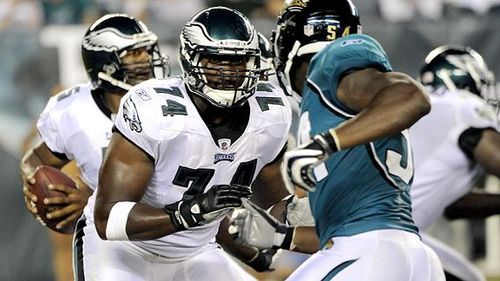
Philadelphia Eagles Winston Justice Donovan McNabb Pass Protection Offensive Line

Putting aside for a moment the new quarterback behind center, conventional wisdom says that the Eagles offensive line needs to regain top form next year if the team has any hope of making a playoff run.

Last offseason the Eagles overhauled the line, removing veteran mainstays like Jon Runyan and Tra Thomas, and bringing in new players like Jason Peters and Stacey Andrews. Yet turnover was not the only problem. Injuries to basically every position crippled the unit, and poor performance from back-ups exacerbated the issues.

This year’s group looked especially bad, considering the success the offensive line had in 2008 preventing sacks. Look at the change in Football Outsiders’ adjusted sack rate (a statistic I’ve referenced before). The Eagles went from only a 4.2% adjusted sack rate, 6th best in the NFL, to 6.6%, good for 20th. While two and a half percent may not seem like much, it accounts for a huge increase in sacks.

But how much worse at pass protection was last year’s offensive line really? Adjusted sack rate only accounts for sacks — not hits or hurries. And it can’t really tell us whose fault those sacks were. Pro Football Focus, a site that everyone who reads this blog really ought to have seen (if not spent hours reading through) put up a fabulous examination of pass protection that goes further than adjusted sack rate can.

I recommend you go read all three parts of the article, but basically Neil Hornsby over there broke down all 32 NFL teams into ranks by the average number of blockers per pass play and total pressures (which is Sacks + Hits *0.75 + Hurries*0.75) per pass play. Then he combined those two stats to come up with a “Pass Protection Rating.”

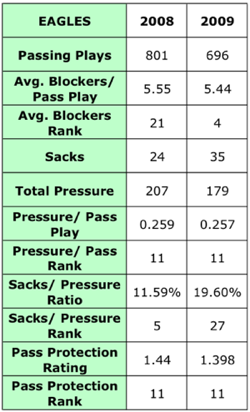
What I’ve done is grabbed his results for the 2009 Eagles and followed his methodology to construct 2008 data for comparison, including what those ranks would be this year. (Note: I used PFF’s data for consistency; their game charting often comes out with numbers that are slightly different than official stats.) I think it has some interesting things to show us:

Philadelphia Eagles Pass Protection 2008 to 2009

There’s a lot of information up there, but let me take you through it.

  1. Sacks jumped by almost 50% from 2008 to 2009, even though there were actually 100 fewer pass plays (fewer playoff games). We already knew that was a problem from adjusted sack rate.
  2. But: “total pressure” actually decreased. This is the first indication that sack numbers alone don’t tell us enough. While the sacks went up dramatically, pressure per pass play (a much better indicator of the success of the offensive line) stayed remarkably steady.
  3. And not only did pressure per play remain even year over year, last season’s offensive line actually did the “same” with less. In the last year of the Eagles’ longtime bookend offensive tackles, the team used more blockers on the average pass play than most teams — probably to cover up the fact that their two OTs were reaching the edge of retirement. However, in 2009, (even when dealing with constant injury problems) the Eagles used less extra blockers than almost anyone else. This fact suggests that last season’s hodgepodge offensive line was actually more effective at preventing pressure on the quarterback than the 2008 line.

The only caveat to this conclusion is the sack rate. The percentage of sacks as a part of pressure went way up from 2008 to 2009, to the point where almost one in five pressures resulted in a sack. However, while this isn’t an exact science, that factor likely has less to do with the line and more to do with the quarterback not reading defenses correctly and/or not releasing the ball fast enough. As Hornsby writes:

Donovan McNabb takes a lot more sacks than he should [in 2009]. He’s not Aaron Rodgers in this regard, but then he didn’t pass the ball as well as Aaron did, either. He seems to be hanging on to the ball more than he used to and is ranked 28th in terms of personal responsibility for pressure.

It’s easy to formulate opinions as to why this was true last year — McNabb’s rib injury comes to mind — but regardless it suggests some optimism for the offensive line in 2010. Last year the unit performed just outside the top ten in pass blocking (and equal to the one that got the Eagles to the 2008 NFC Championship Game), so fans should be able to reasonably hope (if the OL can avoid the injury bug) for an elite pass-blocking offensive line in front of Kevin Kolb come September.

Quintin Mikell Slams Departed Eagles Veterans

Well, that was unexpected.

Quintin Mikell, going into his third year as starting strong safety and second as the emotional leader of the defense, had some choice words, via Reuben Frank, for the players the Eagles cut:

“There was just a lot of negativity. A lot of people weren’t putting the team first… We’ve never had that before, since I’ve been here. We’ve never been a selfish team, where guys were more worried about what they did individually than how we did as a team. But we had guys who were more concerned about how the game plan affected them. It was, ‘How am I going to get my sacks if we’re doing this,’ instead of, ‘Hey, let’s go out and do whatever it takes to win the game.’ “

Ouch. He continues:

“It was, ‘Well, we had to keep going out there (because the offense wasn’t getting first downs),’ or, ‘They had great field position,’ or whatever. I don’t care if we have to go out there 20 million times, let’s go out there 20 million times and stop the other team… Sean’s a good coach, but as soon as things started going wrong, people started doubting him and second guessing him. If we had a bad game, it was like, ‘Why did he make that call? I could have gotten a sack if he made a different call.’”

That sounds pretty bad. You can’t have that kind of outright dissention in a locker room, especially with a rookie coach. Just unacceptable. Quintin made it clear that losing Sheldon Brown and Chris Gocong is “tough,” so they aren’t the culprits. That leaves veteran back-ups like Chris Clemons, Darren Howard, and Sean Jones.

But there’s more to this. These statements are part of Quintin reasserting leadership of the defense. As much as he blasted players, he didn’t name anyone in particular and said that everyone he was referring to is already gone. Somehow I doubt that second part. Maybe some of these guys the Eagles got rid of were quiet cancers in the locker room, but I think it’s also easy to read this as a shot across the bow of any defensive player who (still) tends to question or defy his assignments (see: Samuel, Asante).

Truth is, what Quintin said is just a more specific version of what Sheldon Brown talked about when he got to Cleveland:

“I just think, we as a defense in Philadelphia, you just have to believe in what coach McDermott preaches and follow the plan. You know, sometimes I look back at last year, the season, I feel that we had some players that really was questioning some of the things that were being done. And [we] never had that situation since I’ve been there. And first and foremost, you have to believe in the system, believe in the plan, or you lose before you even go out there. And if the guys can remember to do that, stick together, they’ll be fine.”

We were unsure how to take those words right after Sheldon was unceremoniously shipped away, but now we understand that they were just a frank assessment of the locker room in Philly. And at the time, we assumed he was talking about Asante. Clearly there were more players we never heard about, but that doesn’t mean Asante wasn’t also a problem.

More to the point for this blog though, is it possible that Quintin is also referring to Donovan, at least implicitly?

“When we lost, instead of looking at themselves and asking what they could have done better, there were some guys who were questioning the coaches and the game plan. But you can’t bring that negativity to the team, especially when you have a young locker room like we have. Because then the young guys hear it and it spreads, and you can’t have that and be successful.

Mikell tended to couch his comments towards the defense, but this one was ambiguous. At times last season you could see Donovan doubting the play call — he was even caught on camera yelling at Andy Reid/Marty Mornhinweg to run the ball in the red zone. When you take Donovan’s actions into account (even if overall he was the same solid role model) the locker room split doesn’t seem so unlikely. I don’t know how you can have the longest-tenured veteran question coaching decisions outright and still keep control of the locker room.

Maybe tearing things down and starting again with young players was the smart move.

The Youth Movement: An Ego Problem?

DeSean Jackson Andy Reid Bump Youth Movement Ego Problem

As I’ve explored before, the Eagles have made a conscious organizational decision to go with youth. That doesn’t mean it’s a rebuilding year, but the changing of the guard is obvious.

None of these “Young Guns,” as DeSean Jackson christened the new group of upcoming Eagles leaders, are lacking in confidence or sense of purpose. It seems as though many of them knew Donovan was on the way out and we’re just fine with that change.

Let’s kick off this discussion by going back to something Don Banks wrote right after the trade:

Sources close to the situation in Philadelphia have told me in recent months that McNabb does not have close relationships with the younger Eagles play-makers like DeSean Jackson, LeSean McCoy and Jason Avant. Those players are actually tighter with Kolb, who came to Philadelphia in 2007. So many of McNabb’s closest friends on the Eagles are now ex-Eagles.

Certainly McNabb must have been closest to guys like Dawk, Tra, Runyun, Westbrook, etc. He played well with the young players, but you never got the feeling that they were really tight. Donovan often sounded like he was an increasingly distant role model, rather than buddy, to the players almost ten years younger. He even criticized some of their play after the losses to Dallas.

You can even read more into this. Andy Reid must have seen the divide, so even if he thinks Donovan McNabb is better, there’s something to be gained by uniting the locker room around one group of players. After all, it seems like the young players already knew they were the main guys by the time they got to the NovaCare complex — and it wasn’t just all the rumors, according to Kevin Kolb:

“Once I got here and worked out I got a better feel for it — and when I was around the guys… there was a sense that “Hey, this is going to be us.” That’s what’s good about the offseason, you can build a lot of rapport and chemistry at this time of year, and so I was glad to get back here and get around those guys and get that feeling again.”

Clearly these “Young Guns” have a lot of confidence in themselves. They seem like they were waiting for this day to come, and were happy when it did. Listen to Jeremy Maclin:

I’m excited man. Kevin’s shown flashes of what he can do and he’s obviously a great quarterback and I’m looking forward to kind of getting out there and working with him a little more and hopefully we can spread the ball around a little bit… he definitely shows a lot of leadership and that’s definitely kind of rare for a guy who hasn’t been out there doing much. But I think that’s his number one thing and I think if you have a guy who’s a leader behind center he can take you a long way.”

Maclin went on to say that he wasn’t shocked about McNabb getting traded, only that he got sent to Washington. You really get the sense that he and the other young players were working out, watching ESPN, and waiting for Donovan to go — and it didn’t bother them at all.

Brent Celek has said some similar things, but on to someone far more quote-worthy. DeSean made sure no one else upstaged him on the McNabb trade. He started with just some genuine excitement about the deal:

“It just feels like some new energy is coming around and guys are pumped up. I just heard Maclin say that he’s ready to get the season started right now. We’re fired up and ready to go. We have a lot to prove and we feel like we’re a team that’s always been that close.  We’re just ready to go take it all the way.”

Besides the Barack Obama campaign reference, DeSean and friends really seem a lot more enthusiastic about losing a Pro-Bowl quarterback than you would expect. And it’s as though he’s saying that it was the older players who were holding the team back. Soon Jackson was being more explicit in his support of the trade:

“It was time for a change. We’ve got some young players here. I’m just excited about everything.

That excitement is everywhere these days. Maybe DeSean just likes having the core group of teammates also be close friends:

“When I first came to this team, we had guys like Dawkins, McNabb and Westbrook. All those guys are gone now. It’s going to be exciting. We’re able to all communicate with each other. We hang out, we do all the things together.”

It’s a strange choice of words, suggesting that things will be exciting because those old veterans are gone. Sounds like perhaps DeSean didn’t get a chance to rap in the locker room all that much when those guys were enforcing decorum.

I agree with DeSean and the guys. This is exciting. I can’t remember the last time the Eagles had so much young talent. And DeSean as a leader makes the team dynamic very different — of course, not necessarily better. That’s where you have to begin to make a value judgment. Confidence is always good, but at some point you pass into the realm of ego.

The Eagles let go of a lot of great players over the last two years. Players whose contributions both on and off the field will be very difficult to replace. I have reservations about trusting a group of young guys who seem to be unabashedly happy that those players are gone.

* * *

There’s only one player whom I expected to have joined in with Maclin, DeSean, Celek, and Kolb, but really hasn’t — LeSean McCoy. His major comment on the McNabb trade:

“I still don’t believe it. 11 years, [McNabb] played in Philly so I figured that he would finish his career here. But… this is the business side of [the NFL], and Coach Reid runs the show. It’s going to be tough seeing him [in a Redskins uniform] because he’s done so much for Philly. I don’t understand why. Donovan is a very good quarterback and Washington has a nice squad.

That’s more than even the respectful pause get got from veterans like Avant, Herremans — it’s outright questioning. I wonder if he’s just not actually that tight with the other young guys or if he just got much closer to Brian Westbrook than I realized. The latter explanation would be backed up by this quote:

“Off the field [being professional], I learned a lot from Westbrook. On the field, McNabb taught me about relaxing, staying calm and taking my time. It will be weird playing against him twice.”

Sounds like perhaps when guys like DeSean were running away from the veteran leaders, McCoy really appreciated them as mentors. Just something to keep an eye on…