Friday Figures: Eagles Offensive Play Count Stats

Philadelphia Eagles Brent Celek Offense Play Count Run Pass

Not a lot of complexity to this post. Just some stats and (hopefully) a few interesting observations. Let’s jump right in.

Ladies and gentlemen, your 2009 Eagles offensive player play counts, broken down by run/pass, courtesy of PFF:

2009 Philadelphia Eagles Play Counts Offense Players Run Pass

So about 40% of the Eagles’ offensive plays were runs last year. When some of these players were on the field though, one could make a pretty good guess that a run was coming. Take Mr. Eldra Buckley for example. When he was in the game the Eagles were over two times more likely to have Donovan hand the ball off.

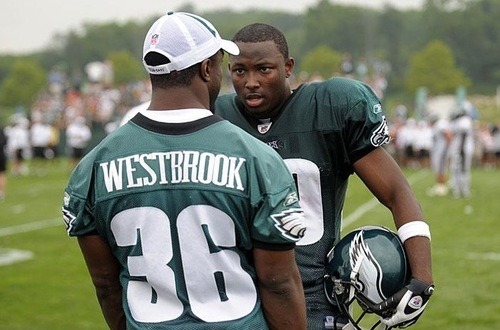
The embattled wildcat quarterback, the second/blocking tight end, and the fullback, all also signaled to the defense that a run was on the way. Brian Westbook on the other hand? Not so much.

Let’s take a gander at 2008 for comparison’s sake:

2008 Philadelphia Eagles Play Counts Offense Players Run Pass

Basically the same team run/pass ratio, but it gives us a few more data points and intriguging spots to look.

  • Eldra Buckley is apparently Kyle Eckel part 2. Not good for Eldra’s chances of making this team — the Eagles can easily use Charles Scott for those 30-40 plays.
  • Speaking of which, notice how almost all of the guys who heavily skew to rushes tend to get replaced: Eckel, Klecko, Schobel, Baskett, (Alex) Smith. If you can’t be multidimensional in Andy’s offense, you’re going to have a hard time sticking around.
  • Hank Baskett is a tight end in wide receiver’s clothes. Meaning Riley Cooper better work on blocking if he wants to supplant Baskett as the #4 guy off the bench.
  • Actually there is a pretty clear correlation. The further down the depth chart a player is at wide receiver, the more run blocking he’ll be required to do.
  • Brent Celek played almost every offensive snap. What a beast.
  • Brian Westbrook became much more pass-centered last year. Might be part of how the coaches tried to shield him from a big workload.
  • Andy Reid must feel much more confident in Kevin Kolb now than a year ago. Back in 2008 he was helping Kolb out by calling runs more than half the time. In the two games in 2009, however, Kolb passed about as much as McNabb.

Eagles RB Past: Brian Westbrook and Company

Philadelphia Eagles Running Back Performance Past Brian Westbrook LeSean McCoy

The Eagles are undoubtably at a crossroads in the backfield. Yet given the huge change at quarterback, if anything the turnover at running back has been overlooked.

Two years ago Brian Westbrook was one of the best halfbacks in the NFL and received a raise from the Eagles for the vital role he played on the team. Eight years, 107 regular season games, some of the most spectacular performances we have ever seen. Now he’s gone.

There’s plenty to discuss about the future, and I’m working on a companion post about LeSean McCoy, but for now, let’s just look at the past — gaining some insight into Westbrook’s career and Eagles running backs in general.

For the first chart, I went through the seasons of data and attempted to isolated 1st & 10 rushes. The problem with taking all of the rushes as one big group is that you pull a lot of short yardage, goal line, and passing downs into the equation. This does decrease the sample size, but you take what you can get in order to make the data more usable.

Looking at basic first down yardage, we can get a sense both of how the Eagles have used their backs and how well they did. I started in 2003 (BWest’s first significant rushing year):

Philadelphia Eagles Running Back Performance Past Brian Westbrook Correll Buckhalter 1st Down 10 Yards YPC

Some general notes:

  • Correll Buckhalter was really good as Westbrook’s back-up from 06-08. Then Leonard Weaver stepped in last year and provided basically the same numbers. It’s interesting that the Eagles felt they needed to bring in Mike Bell when Weaver proved so effective as a change of pace back. Perhaps they just want him blocking more.
  • As a running team, the Eagles reached peak effectiveness in 2007. Not coincidentally, that was the year the Eagles most tried to ride the Westbrook express — to the tune of 368 touches from scrimmage.
  • This is unnecessary, but damn Lamar Gordon was bad.
  • 2009 wasn’t the Eagles’ most effective rushing year, but despite having most of the carries taken by two new additions, it wasn’t that much worse than 2008, or the Super Bowl year of 2004. In other words, good enough.
  • Speaking of 2009, McCoy may have trailed Westbrook overall in yards per carry, but when you standardize the carries, LeSean was much better than his hobbled mentor.

You can go through and find other interesting tidbits, but I’m most interested in tracking Westbrook’s career arc. And it looks pretty clear when you graph the yards per carry listed above. I also added an Effective Yards per Carry measurement based on Football Outsiders’ DVOA/Effective Yards stat:

Brian Westbrook Yards Per Carry Performance Career Philadelphia Eagles

The thing that jumped out to me first was how similar Westbrook’s career looks to Donovan McNabb’s, when I made his graph a few months back. McNabb’s career peak came later in his career (makes sense for a QB), and Westbrook was reaching the top of his game just as McNabb was just starting to decline (an interesting topic for later dicussion). Yet the career shapes are very similar: a few years of middling potential, followed by a peak of 2-3 years, and finally a drop.

As with all stats, DVOA sees something slightly different than my selection of first down runs (especially last season, when Westbrook was really bad on 1st & 10). But overall, they all likely reflect this same, impressive career arc. Too bad that career won’t end where it began.

This Isn't Going to End Well

Michael Vick Birthday Party Cake Shooting Quanis Phillips Philadelphia Eagles Dog Fighting

So apparently tomorrow is Michael Vick’s 30th birthday. And he had a party, promoted by his leg-stomping brother, at a club in Virginia Beach last night.

Oh, and someone got shot.

Well, not just someone — Quanis Phillips, one of Vick’s dog-fighting co-defendants:

The story goes that Quanis threatened to smash birthday cake in Vick’s face, or that he actually smashed the cake in Vick’s face.

Another version is that someone smashed cake in Quanis’ face — or threatened to smash it in his face.

Anyway, the confrontation moved outside — where I’m told there were several still cameras and video cameras.

Cooler heads did NOT prevail, and ‘Q’ was shot in the shopping center parking lot.

Of course, Vick’s lawyer says he wasn’t present when the shooting took place.

Still, oy vey.

Update: So, if you don’t remember all the details of the Bad Newz Kennels investigation and judicial proceedings, Phillips was one of three of Vick’s friends who accepted plea agreements — putting Vick in a “legal checkmate” that forced Vick to plead guilty as well. All of which is to say, these guys have history.

Update 2: When the Eagles signed Vick a year ago, owner Jeffery Lurie said:

The question I eventually had to ask is, ‘Going forward is Michael going to be a negative force in society the way he’s been? Is he going to be responsible for pain, suffering, disappointment, disloyalty, criminal behavior? Or is he going to have an opportunity and be able to be committed enough to take the bull by the horns and become a force for good?’

Seems like Vick may have just answered that question. Which of course leads us to:

If it becomes at all apparent that we are wrong, it won’t take very long to make that change.

See you around, Mike.

CFB Update: Big Ten Expansion and Academics

Big Ten College Football Conference Expansion Nebraska Academics

Note: this post has nothing to do with the Eagles.

University of Nebraska Chancellor Harvey Perlman recently penned a column describing why Nebraska and the Big Ten will be a good match. He wrote,

“I’m confident you’ll find that Nebraska is a natural fit with the Big Ten in terms of culture, athletics and academics.”

I’m on board with the first two. Certainly Nebraska has a history of athletic achievement, especially in football. And in terms of culture, it’s tough to argue that the white, midwestern nature of the school is markedly different from Iowa or Illinois or Purdue.

But an academic fit? Really? Academics was supposed to be a key part of any addition to the Big Ten, a conference that prides itself on its educational standards.

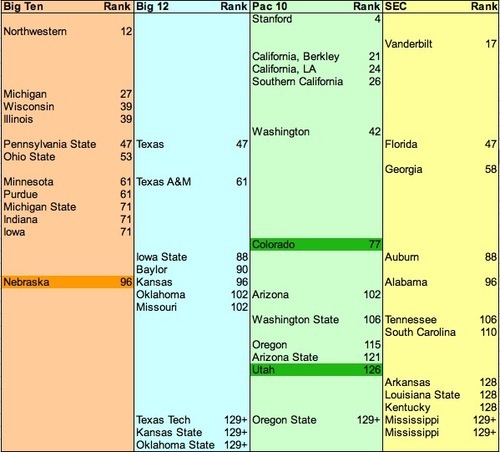
And clearly there were basic standards — Nebraska had to be part of the Association of American Universities. But if you look at the US News & World Report rankings (flawed but overall a good guide), it’d difficult to accept that academics played any role in this decision at all:

Big Ten College Football Conference Expansion Academics Rankings

How can the Big Ten justify accepting Nebraksa on academic grounds? While Nebraska fits right in the middle of the Big 12, it’s ranked much lower than the worst ranked Big Ten schools. The Pac-10 at least has schools that are ranked lower than the two they admitted.

The school’s far from “a natural fit.” But then again, maybe that’s the problem. No one’s actually looking at these programs as schools. They’re just sports teams, professional minor league clubs. It’s clear, when you actually look at the numbers, that there’s no academic case to be made.

So what allows the Big Ten to get away with this calculated money grab? The common white, midwestern “culture,” which people stuck in the 1980s associate with quality academics.

Introducing the DIN Theory: How the Eagles Never Draft for #1 Need

Jeremy Maclin LeSean McCoy Philadelphia Eagles Draft History DIN Theory

Ever since the draft, when the Eagles seemingly abandoned the right cornerback position, I’ve been mulling over a theory. It may not be fully baked or in any way ironclad, but hey, this is just a blog. If random theories from people thinking way too hard about the Eagles can’t go here, where can they go? Besides, maybe y’all can help me make sense of this trend.

I call it the DIN Theory, as in Drafting for Immediate Need, and hopefully it will help explain why the Eagles never seem to do what you expect in the first round of the draft. Basically the theory goes like this: if you can identify the one most important area, the one most obvious position in which the Eagles are deficient for the coming season, that is the spot the team will NOT target early on draft day.

Stay with me for a minute.

Let’s start back in 2007. What were the biggest holes after a 10-6 2006 campaign? McNabb had gotten hurt, but he was expected back at full strength. The O-line was rock solid. If anything was going to get the Eagles to the top, a #1 wide receiver might have done the trick. However, the Eagles brought in Kevin Curtis to replace Donte Stallworth and drafted Kevin Kolb — the long-term Donovan McNabb replacement — instead of someone who could help right away.

After the 2007 season the wide receivers with Curtis had looked pretty good, if not spectacular. Could still use a #1 wideout, but a pass rushing defensive end opposite Trent Cole or a linebacker would also have been an immediate impact pick. But who did the Eagles go with? Trevor Laws, a defensive tackle on a team that already had two starters, and DeSean Jackson, a guy who wasn’t expected (at the time) to compete for minutes right away.

Following the 2008 9-6-1 year, it seemed we’d found our number one wide receiver, but the team needed major help replacing their two departed offensive tackles and the incomparable Brian Dawkins. But who did the Eagles draft? A luxury offensive pick in Jeremy Maclin and long term RB prospect (no one expected he would be the starter so fast) LeSean McCoy. The immediate offensive line needs were filled in free agency/trades and FS was handed over to unproven Quintin Demps, middling veteran pick-up Sean Jones, and then eventually late-round pick Macho Harris.

This offseason, the biggest hole was clearly at right cornerback. But the Eagles trust a hodgepodge of nickel backs (Hanson), injured former starters (Hobbs), former safeties (Harris), and another late round pick (Lindley). In the draft they went after a long-term rebuilding project for pass rushing which, on the whole, didn’t seem so bad in 2009. One could argue that Nate Allen was targeted in the draft to fix an immediate hole at safety, but he was still only a second round pick and was placed into competition behind Marlin Jackson and Demps.

There are a lot of different ways to look at this, especially in hindsight, but I see a general trend here. The Eagles don’t use early picks on players they need to start right away, simply to fix immediate needs. The team would rather pick a long term starter or build depth than grab someone to plug a hole. Instead, they try to plug these urgent holes through free agent pickups or (hopefully) matured backups.

Think again about those big holes the team needed to fill recently: replacing two great OTs, replacing a fantastic FS, replacing a pro bowl RCB. None of those were immediately attended to in the draft — the Eagles seemed more interested in throwing a bunch of lesser-regarded options at the problems in the hope that one might stick, at least for the short term.

Perhaps this is an acknowledgement of the time it can take to teach up a player. Or it shows a general desire to build for the long run. And we can argue over the individual picks. But overall, despite any existing problems the team may exhibit, the Eagles pick players who they hope can have a big role a year or more away. When a player does contribute immediately, like Jackson or Maclin, that’s the exception and it’s often the result of injuries and luck. They were never expected to be counted on so early — something you can’t say about a lot of top rookies drafted by other teams.

Admittedly, it’s tough to count on rookies, but position battles like FS in 2009 aren’t pretty either. So I’m not necessarily saying this is a good or bad strategy. However, it does seem to be a strategy, and to me, that’s enough to establish the DIN Theory.

How Small is the Eagles Defense? Very.

Max Jean-Gilles Dan Klecko Training Camp Battle Philadelphia Eagles Size Speed

The Eagles’ defense has seemingly always been on the smaller side, valuing speed over size in many phases of the game. But new defensive coordinator Sean McDermott has put an even greater premium on quicker guys who can cover. This defensive philosophy is purposeful, an attempt to counter the pass-heavy nature of today’s NFL.

The question is: how small is the defense? I went back to the NFL rosters I compiled about two months back and looked at the Eagles vs. other teams. The following numbers are based on those pre-draft rosters.

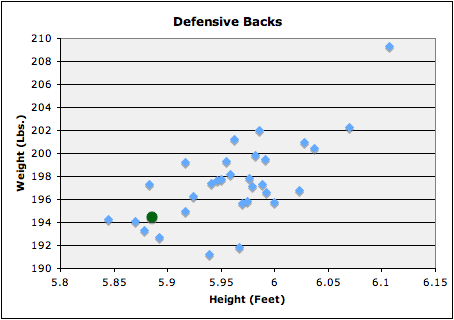
Let’s break the size down by position, starting with defensive backs:

NFL Defensive Backs Size Height Weight

The Eagles’ corners and safeties are undoubtably small. The unit is one of only five in the whole league that averages less than 5’11” and 195 lbs. The others are Detroit, Buffalo, Atlanta, and Indianapolis — not exactly a star group.  Nate Allen and Trevard Lindley may boost the unit’s physical presence, but not by much.

The other thing that isn’t measured here is speed, and I’m not so sure this group of Eagles’ defensive backs makes up for their small stature with blazing speed.

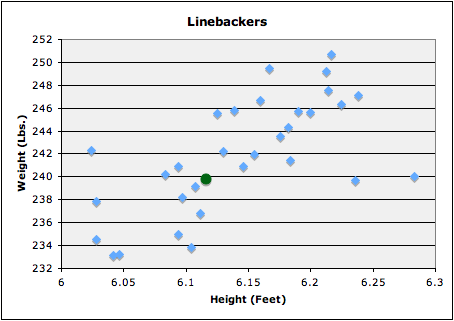
NFL Linebackers Size Height Weight

The Eagles’ linebacker corps looks more average. But Stewart Bradley is the only real big guy they have. Ernie Sims, Moise Fokou, Omar Gaither, and Akeem Jordan are all slight, and the incoming class of rookies isn’t any bigger.

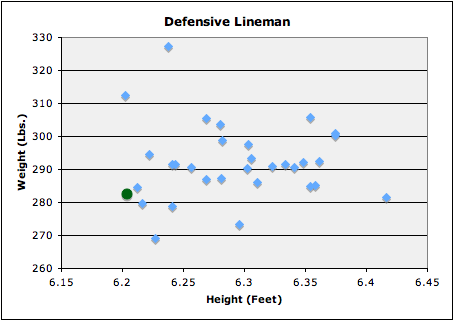
NFL Defensive Linemen Size Height Weight

Because the Eagles are big fans of both small defensive ends and using those ends in place of back-up defensive tackles, they rank toward the bottom of the NFL here. Only Green Bay has shorter linemen, and only Oakland, Seattle, Carolina, Tennessee, and Indianapolis have lighter ones.

This data doesn’t do a whole lot other than confirm our general observations. But it does show that the Eagles are on the bleeding edge of the league in terms of valuing speed over size — and the defense is only getting smaller with every new acquisition. Whether that’s foreshadowing a new league-wide trend or just a big mistake, we’ll soon find out.

Why Trent Cole Should Hold Out of Camp

Trent Cole Philadelphia Eagles Salary Contract Hold Out Training Camp

As a fan, it’s tough to support a player who holds out of training camp. No matter how much less a player makes than he “deserves,” he’s still getting a boatload and a half more than anyone you know. All fans care about is the team — and any player who holds out appears to care a lot more about themselves than winning a championship.

But, in all honesty, while I don’t necessarily want Trent Cole to hold out at the beginning of training camp, I think he should for his own sake.

First of all, it’s not like he needs to learn or compete in training camp. He’s the starting RDE and that’s not going to change with a few days or weeks missed. I’m all for working out with the team and getting in shape for the season, but there’s not much for Cole to gain at Lehigh. And there’s something positive about keeping him from suffering a Stewart Bradley-esque injury.

Second, he’s clearly underpaid. Foxsports.com compares Cole’s contract to Julius Peppers’s, but let’s put that aside for now. Soon, Cole won’t even be the top-paid defensive end on his own team — that distinction will go to first round pick Brandon Graham, who will get north of $12 million guaranteed cash (Brian Orakpo’s haul last year) before ever taking an NFL snap. Cole’s gotta be looking down the line, wondering why he can’t get some of that dough.

Third, Cole’s not getting any younger. He’s only 27 now, but he’s played in 65 straight games including in the playoffs. He can’t, and shouldn’t, count on that streak continuing forever. With that in mind, Cole deserves to be paid at least close to market value for the last few years of his prime. You never know when that window could close, and it will likely happen before he gets to free agency in 2014.

But the key point is number four: Cole’s never going to have better leverage to renegotiate his deal. Think back to the summer of 2008. Brian Westbrook was coming off a career year that put him at the top of running backs in the NFL. More importantly, he had proven that he was by far the most valuable member of the team. Westbrook parlayed that, coupled with a holdout threat carried over from his refusal to attend camp in 2005, into another contract extension (ok, so it was basically just a raise).

Cole is in a similar situation now. He is by far the most important player on the defense, and may be the most indispensable guy on the team. Just as the Eagles recognized that Westbrook was their only weapon on offense going into 2008 and drafted DeSean Jackson, so they have indicated how thin they are on the defensive line by completely reloading at that position. Sure, Graham may become great and eventaually replace Cole the way DeSean replaced Westbrook, but right now Cole’s playmaking and all-around production remain invaluable. If he wants to renegotiate his contract, the Eagles have to listen.

Plus, because Cole is indispensible and so obviously underpaid, he likely wouldn’t receive the same vitriol from the public that is often directed at training camp hold outs. Or would he? What do you think?

Meet the Eagles' Statistics Team

Philadelphia Eagles Statistics Michael Frazier

Michael Frazier attended Wooster College from 1999-2003. During his time there he interned at Wachovia Securities and Smith Barney. Immediately upon graduation the Philadelphia Eagles hired him  a “Statistical Analytics Coordinator,” a post he has held for the last seven years — in complete obscurity.

That is pretty much all we know about Michael Frazier (circled above). And it comes from his public page on LinkedIn. As a member of the coaching support staff, he merits only a name listing, with no staff bio or job description, on the PE.com Front Office list. We do know that during the games, according to a 2006 Marty Mornhinweg press conference, “Mike Frazier is up there [in the coaches’ box] with some statistics.”

Frazier’s colleague Alec Halaby, the Eagles’ “Player Personnel Analyst,” isn’t even in the most recent team photograph. He’s not a scout, but got a small promotion to this position according to Adam Caplan, who called him a “statistical analyst, young guy, been with the team for awhile.” How long that has been is unclear though, since he seems to be the same Alec Halaby who was at Harvard as recently as 2008.

However, assuming this Halaby is the same guy, we can connect some of the dots. He was clearly interested in sports statistics in 2006, commenting about them at Football Outsiders (“Let us not forget that the 43rd pick is the most valuable in the draft”) and Matthew Yglesias’s blog (“His numbers in P/40 and TS%…”). Perhaps he was an intern with the Eagles that summer, when he posted a problem with his STATA program involving “games,” “years,” and “simscores.”

Jeff DominitzWe don’t know much more about Frazier and Halaby’s presumed boss, Jeff Dominitz (pictured at left). Dominitz is the Eagles’ “Director of Statistics,” and from what I can gather, is (or recently was) also an Adjunct Staff member at the Rand Corporation, a nonprofit research organization. Before coming to the Eagles, he received a Ph.D. in economics from the University of Wisconsin, worked as Associate Professor of Economics and Public Policy at Carnegie Mellon University and served as research director of the Census Research Data Center.

All of the above could be viewed as rather stalker-esque, but it’s really just in pursuit of a very simple goal: getting some insight on the statistical analysis the Eagles do. Obviously this blog, along with a handful of others, are always looking for new and better ways to analyze pretty much anything about our favorite team. These guys do the same thing from the inside (with MUCH more distinguished backgrounds and methods), toiling anonymously in the background of all the decisions made by the Eagles over the years.

So naturally I’m interested in how the Eagles apply statistics to get an edge against the rest of the NFL. Unfortunately, there are no interviews, no revealing quotes, literally nothing on these guys other than what I’ve managed to cull above. So where does that leave us? Well, first, desperately wanting someone like Les or Domo or McLane to go get us one meager interview. But second, examining the richest source of information I could find — which came from a former member of the Eagles staff: David Lewin, Director of Statistics from 2007 to 2008 (ironically, not the same Football Outsiders Dave Lewin who pioneered the “Lewin Career Forecast” for projecting college QBs to the NFL, and now works for the Cleveland Cavaliers). Over at his public LinkedIn page, Lewin writes about his experience with the Eagles:

• Led implementation and validation of large database and integrated information from multiple sources.
• Addressed a wide variety of questions related to injury risks, game strategy, and player performance posed by the Head Coach and Team President.
• Identified characteristics of teams and players that have been successful in the NFL.
• Created models to predict how well college athletes will perform at the professional level.

Whoa, jackpot! Let’s look at what we learn here:

  1. The team uses statistics for basically everything: injury risk (maybe that model isn’t working too well right now), strategy (too bad they haven’t helped Andy with clock management), player production, and probably much more.
  2. Reid and Joe Banner ask specific questions of the stats team to analyze. These guys are embracing and using any advantage they can get. There’s a reason Jeff Lurie could easily slip a YPA mention into a discussion about Lito Sheppard — the front office is very familiar with all of this.
  3. The Eagles have some sort of huge database of what I guess are players, careers trajectories, salaries, draft picks, at more that they use to their advantage.
  4. They have models, based on past precedence, that indicate who is likely to do well, even coming out of college. I imagine this is somewhat akin to models like  “SackSEER” Nate Forster at Football Outsiders did for defensive ends.

Want some more ideas about what the Eagles’ statistics team does? Check out Lewin’s new statistics company’s website:

To determine whether a player will do well for your team, Statistically Speaking Consulting can identify the right metrics to use and how to combine them for an accurate prediction of a player’s future success. This is critical when players are transitioning from high school to college or from college to the pros, since the existing data is relative to a lower level of competition. It also helps to more accurately judge the benefit of a player, so that you do not overlook those who are undervalued by traditional methods and do not overpay for those that are overvalued.

In addition to finding the right metrics for individual players, we can help find the right metrics to identify the real areas where your team needs to improve. This can be used to change strategies for coaching decisions, or for front office personnel to find players that will have an impact in the needed areas.

In combination with your current process, these statistical results can improve your decisions so that you take better advantage of your limited resources, like scholarships, draft picks, and money.

Sounds like things Lewin probably did with the Eagles: finding metrics to judge performance more accurately, analyze areas of strategic advantage, and apply these models to help the team pursue the most cost-effective free agents, draft the correct players, and call the optimal plays.

The ability to predict player performance close to the way PECOTA does for a more individual sport like baseball would be the holy grail of football statistical analysis, and I doubt the Eagles have arrived at a secret formula for that. But every little bit of predictive power (or even just accurate data accumulation) is helpful, and I imagine, despite their reclusive nature, that the Eagles’ stats guys are hard at work providing that for Andy Reid and company.