Nate Allen: Under Pressure

Pushing down on me, Pushing down on you…

What a difference a few days make.

Second round pick Nate Allen was supposed to compete for the starting free safety spot, not have it thrown on him before OTAs even ended. But with the season-ending injury to free agent pick up Marlin Jackson, that’s exactly where Allen stands. Add in the MCL sprain to strong safety Quintin Mikell, and Nate Allen suddenly looks to have a whole lot of weight on his shoulders come training camp.
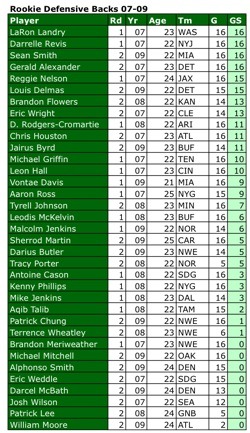
Rookie Defensive Backs NFL Draft Rounds 1 and 2 2007 to 2009As you can see from the table at right, less than half of the defensive backs taken in the first or second round of the NFL draft start even the majority of their team’s games. There’s no reason Allen, who figures to be somewhere in the middle of that pack talent-wise, couldn’t be one of those guys who starts the whole year. But it’s certainly no given.

**Interesting side note, of the 15 DBs who did start at least 9 games, it’s split down the middle (8 firsts, 7 seconds) as to which round they were taken in.

And yet perhaps the biggest transition for Allen won’t be on the field, it will be avoiding questions about how he measures up against two former Eagles in a war of media memes.

The first pattern emerging from OTAs is that Allen has to live up to being “The Donovan McNabb Pick.” Over the last week you can see this label emerge here, here, and here. I know its fun to see what teams “win” trades by looking at who they actually get from draft picks. (Anthony Spencer for Kevin Kolb, Stewart Bradley, and CJ Gaddis was especially good for that.)

But let’s just end this thing before it goes any further. It’s silly to compare Allen’s performance this year at safety to McNabb’s in Washington, especially when he already has enough responsibility and pressure. When the Redskins come to Philly in October, McNabb will probably expose the Eagles’ secondary, and the easy-way-out-seeking headline writers will champion the failure of the McNabb trade. Chill out.

The second meme of the week, resulting from the Marlin Jackson injury, is that there is some “Brian Dawkins Jinx” on the free safety spot. As Reuben Frank writes,

Quintin Demps got the first crack at it. He didn’t even make it to opening day. Then it was rookie Macho Harris’s turn. He made it through six starts. Sean Jones was up next. That lasted until late in the regular season, when Harris took over for the last few weeks. This summer, the job went to Marlin Jackson. Who limped off the practice field with a ruptured Achilles tendon on Tuesday. So when rookie Nate Allen took over as the Eagles’ starting free safety, he became the fifth different guy in 10 months to get a shot since Brian Dawkins left for Denver.

Okay, first of all, huge stretch to start calling this any kind of real curse. None of these guys (One second-year player, one rookie, two middling veteran pick-ups) could realisitically have been expected to do a great job. And if Allen struggles this year, it won’t be because of some strange voodoo Dawk left in the stadium before he flew to Denver — it will be for the simple fact that starting in the NFL as a rookie is no easy task.

Second, who breaks out the “Curse” watch just a little more than a year after a player’s exit? Were they counting missed titles in Boston in 1921? Were Philly fans in 1988? These reporters seem to be just grasping at straws these days.

And it’s trickled down to the players:

“Everybody saying the whole Dawk-jinx thing, everyone looking at him being a rookie, being the Donovan McNabb pick, all that stuff, he’s got to deal with,” Mikell said. “But if he goes out there and does what he does, don’t ask too much of himself, don’t put too much pressure on himself, just go out there and play ball, he’ll be fine.”

Yeah, that’ll be a real piece of cake. Of course, Andy Reid says Allen’s “got a nice football mind,” whatever that means. Maybe he can beat all this baggage. He’s certainly not going to get off easy if he can’t.
A Second Look at Defensive Playmakers

Philadelphia Eagles Defensive Playmaking Trent Cole Darren Howard

One of the keys to the 2010 Eagles season will be the performance of the defense. Last year the unit was, at best, inconsistent and this offseason we’ve seen a good deal of turnover. Sheldon Brown is gone. So is Darren Howard, Chris Clemons, Will Witherspoon, Sean Jones. Stewart Bradley returns, along with a whole host of draft picks and other new additions such as Darryl Tapp and Ernie Sims.

But it is often difficult to isolate individual player performance from team performance. How do we know whether the guys the Eagles jettisoned were truly underperforming? Hopefully this post will offer one possible way to gain some insight into that, simply by crossing two streams (oh no!) of data: one from Advanced NFL Stats and the other from Pro Football Focus.

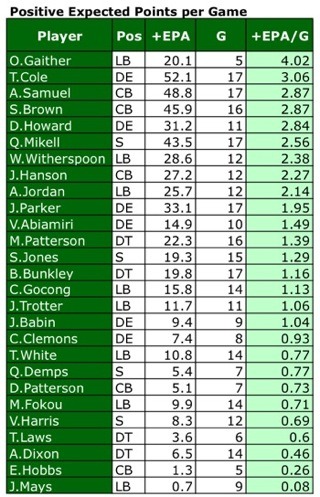
Let’s start with Brian Burke’s Advanced NFL Stats measurement of +EPA as a measurement for defensive players. As he explains here, +EPA measures positive performance: “the value of every sack, interception, pass defense, forced fumble or recovery, and every tackle or assist that results in a setback for the offense.” What the stat doesn’t do is show you when the player did something wrong — when he cost the team. Thus, one would expect risk-taking players such as Asante Samuel to score disproportionately well in this system. His positive achievements regarding turnovers are huge, while his negative tackling ability never gets factored in.

Still, even with this caveat, it is an interesting way to look at players as playmakers. Here are the Eagles’ numbers from last year as put up by Burke, ordered by +EPA per the number of games they played in.

Philadelphia Eagles Defensive Playmakers Table 1

Obviously bland +EPA is of little use to determine who’s a better player. It’s far too dependent on the amount a player is on the field. At least Burke’s +EPA/G differentiates by number of games played to factor out some of the bias from players who played constantly and without injury. However, when I looked at this for the first time, I realized that games played was only a half step toward the greater goal of figuring out who caused the most postive plays, per play.

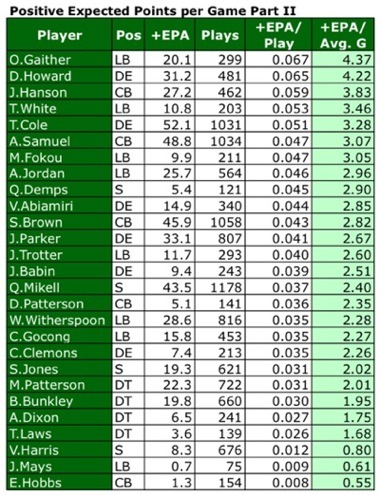
This is where Pro Football Reference’s play charting data — where they count how many times every player is on the field — comes in handy. Here’s for the Eagles. By looking at +EPA by play, rather than by game, you can get a much more “accurate” reading of playmakers. Below you can find the +EPA per time the player was on the field defensively (+EPA/Play), as well as a number that shows how much +EPA he would have accumulated had he played every defensive snap in the average Eagles’ game (~65).

Philadelphia Eagles Defensive Playmakers Table 2

Observations from this data (feel free to post your own in the comments):

  • The fewer times a player was on the field, but active in the game, the more unreliable his numbers are going to be. Looking at you Tracy White and Quintin Demps.
  • On the other hand, those who racked up huge play totals as well as +EPA/Avg. G (Trent Cole, Asante Samuel) clearly form the backbone of the playmaking contingent of the team.
  • Darryl Tapp’s numbers with the Seahawks: 39.8 +EPA total, 704 plays, for a +EPA/Avg. G of 3.67 — placing him right near the top of the list.
  • Ernie Sims’s from Detroit: 14.8 +EPA total, 490 plays, for a +EPA/Avg. G of 1.96 — positively Bunkley-ian.
  • The scheme also affects opportunities for playmaking. For example, all four of the main defensive tackles fall in a row toward the bottom, indicating that the Eagles have been using the position less for playmaking, and more for solid building blocks of run defense. At the opposite end of the spectrum is Darren Howard, who often played as a DT in pass-rushing situations, giving him many more opportunities to make plays.
  • But the fact that Howard was able to cause that pressure when he was in the game is important. While we can’t see some of the negative plays he may have allowed, Howard was clearly a better pass-rushing option than Chris Clemons, who made barely more +EPA per play than Mike Patterson. One has to wonder if Clemons for Tapp was a steal and/or if the Eagles will miss Howard’s rushing ability on third down.
  • Other players who seemed to provide little in the area of playmaking: Macho Harris, Sean Jones, Chris Gocong, Will Witherspoon.

It’s worth mentioning one more time that this is far from the final answer at evaluating defensive performance. However, by combining +EPA with play counts, we gain one more interesting nugget for individual evaluation.

    Back and Better Than Ever...

    That was a long break.

    I know there aren’t many readers over here in this small corner of the sports blogosphere (especially after that month-long hiatus), but obviously for anyone out there who’s always on the prowl for Eagles content — I’m certainly one of those — hopefully you can get a little bit of your fix right here.

    For new readers check out the archives for some of the spring’s greatest hits. Some of my favorites:

    I have some ideas and some projects in the works, but let me know if anyone has any topics or research questions to look into and I’ll try to take a stab over this long summer without football.

    The Next Decade: Eagles' New Passing Attack

    Kevin Kolb Donovan McNabb Pass Attempts Targets Completion Percentage

    Plenty of speculation recently about about the future of the Eagles offense. Can LeSean McCoy, minus six pounds, take over for Brian Westbrook? Will the offensive line pull its weight? Is there a new #1 receiver? Should the Eagles switch to Kelly Green permanently? Well, maybe not that last one.

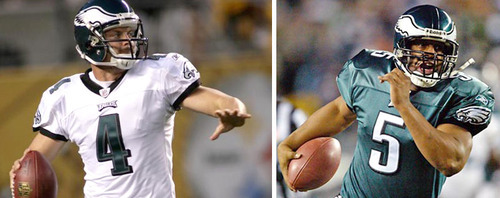
    Perhaps most centrally, people want to know how the Eagles passing game will be different from previous years. Receivers have come and gone, but for the most part Donovan McNabb defined the offense. How will it change with Kevin Kolb stepping up? Marty Mornhinweg has already talked vaguely about a shift:

    “[The offense] will be different. Donovan was such a great player, and he has many, many strengths, however they’re different from Kevin’s… I thought Donovan, there’s no question, he had one of the stronger arms, maybe of all time. He could make the brilliant play. Kolb is very, very consistent. He handles two or three different play selections very well. Typically, very accurate. He is athletic, but he doesn’t have the athleticism that Donovan has. So, very different in that way.”

    The obvious change, based on our own eyes, is the difference in arm strength and accuracy. Donovan was tremendous at throwing the deep ball, but infamous for being rather streaky in the short/mid-range passes. Kolb doesn’t have that cannon arm, but he’s supposedly “more accurate.” Will that influence the play calling? And how much? Can we find a way to see what the passing offense will look like come September?

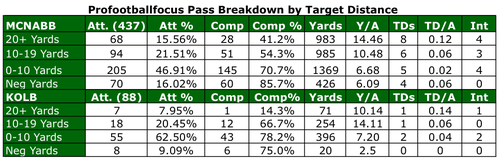
    I think so, using Pro Football Focus’s play-by-play game stats from last year to compare the playcalling and accuracy with Kolb in the game versus McNabb. Just a trove of information over at PFF, but I’m going to utilize a only small segment: passes organized by where they were thrown. Also added in some other stats like the percentage of attempts thrown, completion percentage, and a basic yards per attempt calculation. Here you go:
    Pro Football Focus Pass Breakdown by Target Distance

    First things first: Kolb’s numbers are victim to small sample size problems. Kolb threw only 20% of the balls that McNabb did, so his stats aren’t as reliable (although they do refute the stupid myth that Andy might run the ball more with Kolb). They are likely to change as he plays more. Perhaps Kolb’ll get better starting every day. Or maybe teams will get used to him and learn how to rattle him. Impossible to tell. Either way, the numbers can tell us a lot about the differences from last year (when Kolb and McNabb were playing with the same supporting casts), and what we might be able to expect in 2010.

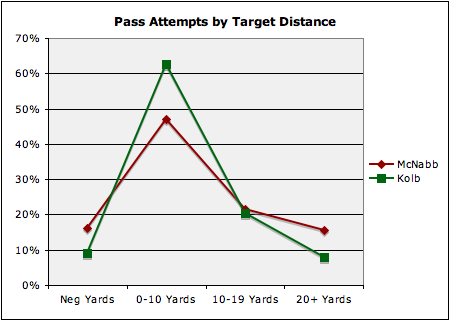
    Let’s first look at playcalling, represented by the number of pass attempts:

    Pass Attempts by Target Distance Kevin Kolb Donovan McNabb

    Clearly Kolb threw a lot more short passes — an over 15% bump. Also, the percentage of times he chucked it long was cut almost in half from McNabb’s numbers. The gaps may not look huge on the graph but consider them over the course of a season. If he throws at the same pace as McNabb, Kolb will get in 80 more short (0-10 yards) passes and about 36 fewer long balls (20+ yards). That’s a major difference in play-calling (or could partially be execution) and would indicate a somewhat more “typical” west-coast offense is in town.

    Okay, so Kolb is throwing more short passes. But is he completing more of them?

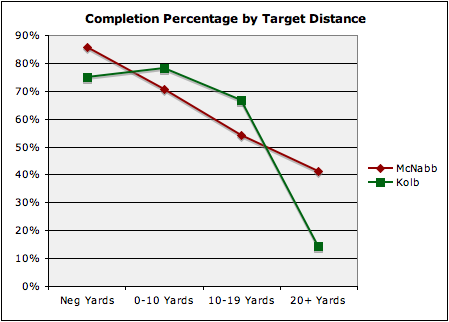
    Completion Percentage by Target Distance Kevin Kolb Donovan McNabb

    The short answer is yes. In everything from 0-19 yards, McNabb had a 65.9%  completion percentage. Kolb completed 75.3% of those same passes. That is undoubtably a more accurate quarterback, and could help the Eagles offense become, in Marty’s words, “very, very consistent.”

    However, there is an absolutely enormous gap in completion percentage on longer passes. Donovan completed a ridiculous 41% of his throws over 20 yards. Kolb, with limited action, only completed one in seven attempts (granted, that one did go for a 71-yard TD). If that trend continues, it would be a ridiculous swing what would make the Eagles much less inclined to go to the long ball.

    Still, completion percentage alone doesn’t get us exactly what we want. It only shows how accurate the two quarterbacks are over the distances, but not how productive they are at each level. Which is where YPA comes in…

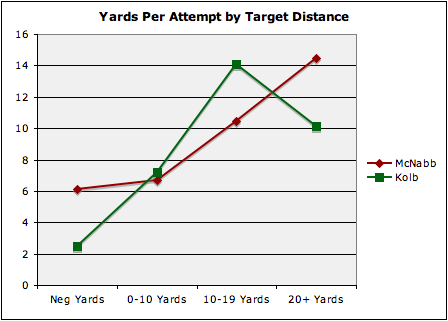
    Yards Per Attempt YPA by Target Distance Kevin Kolb Donovan McNabb

    In my mind, this is the most striking graph. Essentially YPA measures the expected output from any given pass attempt. We can see what the “best” plays are to call because the estimated yards gained shows us the optimal point. For example, look at McNabb’s numbers — the farther he threw the ball, the better the outcome was, on average, for the offense. This is the simple reason why the Eagles threw the ball so much downfield in recent years. You can complain about boom-bust, but when McNabb was behind center, the Eagles gained maximum output when he was passing it 20 yards or more down the field.

    For Kolb, at least right now, that is not the case. His sweet spot is in the intermediate, 10-19 yard range. That’s where Kolb’s accuracy makes him most productive (actually just as productive as McNabb throwing long).

    So what does this all mean? It means yes, there will be many fewer bombs launched 45 yards down the field to DeSean Jackson. But it doesn’t mean, in any way, that the Eagles will be less explosive — or that Jackson won’t be as productive (as has been the current meme, debunked by Derek at IgglesBlog). It simply means the throws that result in explosive plays will be different. Rather than launching passes to  Jackson after he’s 5 yards past the centerfielder, Kolb will have to get him the ball in the short and intermediate areas. From there it will up to Jackson (and Maclin, Celek, Avant) to run past or through defenders.

    For an example, look no further than the two games Kolb started last year, from which we’ve gotten the rest of this data. Check out DeSean’s stats from those games versus the rest of the year:
    DeSean Jackson Pro Football Focus Statistics McNabb vs Kolb

    DeSean may not have gone out as far before he caught the ball, but he was just as — if not more — productive and explosive with Kolb behind center. DeSean got more targets, receptions, yards, and touchdowns than he had in the average game with McNabb, plus had his two longest receptions of the year — all because of Yards After the Catch. Jackson already ranked 9th in the NFL last year with 6.6 YAC per Reception (25% of snaps or more). Yet Jackson’s 15 YAC/Rec. over two games with Kolb throwing him the ball blows away the rest of the receivers.

    The explosion will still be in the passing game next season. Based on these numbers though, it’ll just be in a slightly different package.

    Update: Kolb confirms the new focus of the offense—

    “It’s going to be spectacular. With [DeSean’s] talent and hopefully my ability to get him the ball in stride and yards after the catch, those types of things — it will be pretty special. I look forward to being around him and both of us being with this team for a long time.”

    On the Bubble: Projecting the Eagles 2010 Roster — Defense Edition

    Philadelphia Eagles Defense 2010 Minicamp Stewart Bradley

    There was a lot of roster turnover this offseason on the defensive side of the ball. Plenty of young blood and plenty of new toys for Sean McDermott. Here’s how I think the competition looks in early May:

    Defensive Line (13 players; 10 likely spots)
    Locks: Trent Cole, Broderick Bunkley, Mike Patterson, Darryl Tapp, Brandon Graham (r), Daniel Te’o-Nesheim (r), Ricky Sapp (r)
    On the Bubble: Victor Abiamiri, Trevor Laws, Antonio Dixon, Juqua Parker, Jeff Owens (r)
    Longshots: Eric Moncur (r)
    Analysis: The rookies are going to get good chances to contribute right away in the absence of veterans like Darren Howard, Chris Clemons, and Jason Babin. And you’ve got a motley crew fighting for the remaining jobs: the old vet, the UDFA that showed immense upside last year, the two second-round picks that haven’t done much on the field, and the 7th-round challenger. Listed Sapp here because Andy’s talked about him as a Joker-type, not a legit option at SAM. If the coaches think he can crossover he may be competing with Alex Hall (listed with the LBs) for a job. Plus, When you consider Abiamiri may not be ready for the season to start, the Eagles probably will bring in a few more UDFAs to compete.

    Linebackers (9 players; 6 likely spots)
    Locks: Stewart Bradley, Ernie Sims, Moise Fokou, Keenan Clayton (r)
    On the Bubble: Akeem Jordan, Omar Gaither, Joe Mays, Alex Hall, Jamar Chaney (r)
    Longshots: None
    Analysis: No longshots here; everybody’s got a legit chance of a spot. However, given the recent youth movement, don’t think guys with little shot of ever starting again (see: Gaither, Mays) should get too comfortable. I would bet it’s Bradley, Sims, and Fokou starting, with Clayton, Jordan, and Chaney subs. Hall could stick as a hybrid DE/LB.

    Defensive Backs (15 players; 9 likely spots)
    Locks: Quintin Mikell, Asante Samuel, Nate Allen (r), Macho Harris, Ellis Hobbs, Trevard Lindley (r)
    On the Bubble: Joselio Hanson, Marlin Jackson, Quintin Demps, Dimitri Patterson, Kurt Coleman (r)
    Longshots: Geoffrey Pope, David Pender (r), Josh Morris (r), Devin Ross (r)

    Analysis: The Eagles are in a tough spot with Macho, because he’s the best option at FS if Nate Allen can’t step up and take the job right away. However, if Macho doesn’t get reps at CB, how can he compete there? He’s better than back-up safety or dime CB (where he might end up if Allen only takes the job right before the season), so they have to hope the positions sort themselves out soon. Coleman, Demps, and maybe Jackson will be working at back-up safety. The prospects at CB are more unsettled, but clearly Hobbs, Macho, Lindley will get looks. If Jackson can’t pull his weight at safety they could try to stash him at CB as well — but that might eliminate the chances of keeping another long-term prospect at the position like Patterson or one over the UDFAs.

    Special Teams (5 players; 3 likely spots)
    Locks: David Akers, Jon Dorenbos
    On the Bubble: Sav Rocca, Durant Brooks, Ken Parrish
    Longshots: None
    Analysis: PUNTER COMPETITION! WOOHOO!

    Plenty of uncertainty there. Anyone have predictions?

    Kolb Signs One-Year Extension, Gets Filthy Rich

    Kevin Kolb Contract Extension Philadelphia Eagles

    Yesterday Kevin Kolb got a one-year extension on his original rookie deal that would have ended after the upcoming 2010 season. You can read all about the 30%-rule in the CBA that prevented a long-term deal from happening over at IgglesBlog with Sam. But here I’m just interested in the implications of the deal.

    According to Adam Schefter, the extension is worth $12.25 million — completely guaranteed. You can take this different ways. Adam Caplan says Kolb went from the lowest-paid quarterback starter in the league, to the highest-paid per year. Kolb’s agent Jeff Nailey, not one to diminish an accomplishment, portrayed the deal as one that will pay his client “seventh or eighth among the best-paid quarterbacks in the NFL this season.” Both agreed that Kevin would make more per year than Donovan McNabb.

    My first thought was, wow, that’s a lot of guaranteed money for a guy who’s only started two games. And it is. But on the other hand, this is really a two year deal — to raise Kolb’s salary this year (from a paltry base pay of $550,000), and then extend him for one more. That wouldn’t place the per year money as high as either Caplan or Nailey suggests. Either way, as Joe Banner said, neither side wanted to “put Kevin in the position where he was playing this year as one of the lowest-paid players on the team.” Or, as Tommy Lawlor writes, let Kolb play with less than his new back-up Michael Vick, which could have been a pain.

    This also marks the beginning of a fruitful Kolb-Front Office dynamic. Both Banner and Kolb were talking in the same language about how this deal allowed them to “bridge the gap” to a long-term contract. Of course, it’s easy to be buddy-buddy when you go through a pretty easy negotiation. Kolb had all the leverage once the Eagles sent McNabb to the Redskins, and achieved about as much as he could have asked for. He must be happy if his agent is willing to go on record with thoughts like:

    “They have no chance of losing him after this year. Kevin had no desire to go anywhere [else] after this year.”

    Let’s see what gets floated to news outlets a year or two from now when both sides are working out a long term deal.

    On the Bubble: Projecting the Eagles 2010 Roster — Offense Edition

    Projecting the Philadelphia Eagles 53 Man Roster Leonard Weaver LeSean McCoy

    86 enter, only 53 will emerge. With the draft over and minicamps about to kick off, it’s time to start thinking about what the Eagles roster will look like come September. Let the drama begin…

    We’ll start on the offensive side of the ball.

    Quarterback (4 players; 3 likely spots)
    Locks: Kevin Kolb, Mike Kafka (r)
    On the Bubble: Michael Vick
    Longshots: Joey Elliot (r)
    Analysis: Kolb’s the clear-cut starter. Kafka, a 5th round pick, will be groomed as a long-term back-up. Vick is only on the bubble because if there’s an offer, the Eagles would probably be willing to ditch the unreliable back-up for someone proven like Jeff Garcia.

    Running Back (9 players; 4 likely spots)
    Locks: LeSean McCoy, Leonard Weaver, Mike Bell
    On the Bubble: Charles Scott (r), Eldra Buckley
    Longshots: Martell Mallet (r), Dwayne Wright, Chris Zardas (r), Keithon Flemming (r)
    Analysis: McCoy and Weaver showed they can be a good one-two punch, but Bell will be the main complementary back this year after the Eagles stole him from the Saints by guaranteeing Bell $500,000. The main battle will probably be between Scott and Buckley, who was a great special teams player but contributed little in the running game. With Scott’s experience as a FB, he should have the edge.

    Wide Receiver (11 players; 5 likely spots)
    Locks: DeSean Jackson, Jeremy Maclin, Jason Avant
    On the Bubble: Hank Baskett, Riley Cooper (r)
    Longshots: Jordan Norwood, Dobson Collins, Chad Hall (r), Blue Cooper (r), Kevin Jurovich (r), Pat Simonds (r)
    Analysis: Top three spots are set. Baskett should be the experienced #4, although it’s possible that 5th round pick Cooper, who has some of the same skills, could supplant him. Also, while the rest of the players likely face an uphill battle, the Eagles have had injuries to the WR position the last few years in training camp. A guy like Norwood could slip onto the roster that way.

    Tight Ends (4 players; 3 likely spots)
    Locks: Brent Celek
    On the Bubble: Cornelius Ingram, Clay Harbor (r)
    Longshots: Martin Rucker
    Analysis: Celek was a star last year and could be even better in 2010 with Kolb as the starter (if you prorate Celek’s numbers from Kolb’s two starts you get 96 rec, 1300 yards). Ingram has lots of potential but has to prove he can come back from two consecutive knee injuries. Additionally, the Eagles will have to decide if they can afford to carry three TEs this year.

    Offensive Line (16 players; 10 likely spots)
    Locks: Jason Peters, Winston Justice, Stacy Andrews, Todd Herremans, Nick Cole
    On the Bubble: Jamaal Jackson, Max Jean-Gilles, King Dunlap, Mike McGlynn, Fenuki Tupou, Dallas Reynolds
    Longshots: A.Q. Shipley, Shawn Murphy Greg Isander, Austin Howard (r), Jeraill McCuller (r), Zipp Duncan (r)
    Analysis: With Jackson likely to hit the PUP, there will be open competition for the center spot. Cole will get the first crack, but it would be nice if someone like McGlynn won the job and Cole kept his super-sub role for the three interior positions. None of the other guys on the bubble have really shown anything great so far. They have the edge in experience, but any of the UDFAs could grab a roster spot with a good camp.

    Disagree? Think your favorite player is better than a longshot? Sound off below. Also, check back soon for the defensive breakdown.

    Eagles Post-Draft Thoughts and Analysis

    Philadelphia Eagles 1st Round Draft Pick DE Michigan Brandon Graham

    Observations and opinions on this 3-day, 13-player behemoth of a draft for the Eagles:

    • Everyone, including myself, was surprised at the number of defensive ends the Eagles drafted. That was the big story, especially because it seemed like the secondary and the offensive line were bigger needs. But when you look at the offseason in hindsight, it’s easy to see that there were big needs there. The group wasn’t in any way dominant last year and we heard that some of the veteran guys were poisonous in the locker room. In any case, the Eagles jettisoned three players (Darren Howard, Jason Babin, and Chris Clemons) who combined for over 900 snaps. Essentially, they needed three more bodies — hopefully younger and more productive ones.
    • Not only was it a need, but you can see where each new DE fits a certain role on the team and, in some cases, specifically replace one of the departed veterans. Andy Reid compared Brandon Graham to Trent Cole, and he will get every chance to star opposite Cole for the next 5-10 years. Andy said Daniel Te’o-Nesheim will step in for Howard, as a DE who can move inside. Ricky Sapp replaces Clemons at the Joker spot. Darryl Tapp (while not exactly the same type of player) sounds like will take the place of 31 year-old Juqua Parker when he eventually gets cut/traded. The Eagles only have 7 DEs right now (prior to UDFAs) on their roster. They played with 6 last year, so it’s not like the team is overloaded.
    • Last point on DE: It seems like McDermott may be in the same school of thought as Steve Spagnuolo when it comes to defenses — get as many pass rushers as possible. That’s how Spags managed the defense in New York when they won the Super Bowl, and it may help explain the focus there rather than on the secondary or linebacker corps.
    • Nate Allen looks like a real solid, mature kid. Check out his press conference if you haven’t already. I will honestly be surprised if Allen’s not starting at FS come September and he has a great chance to be a new leader on the defense.
    • If Allen solidifies the starting free safety spot, as he will be given every opportunity to do, I could see the Eagles making Quintin Demps the back-up and moving Macho Harris over to corner. He, Marlin Jackson, Ellis Hobbs, Joselio Hanson, and 4th round pick Trevard Lindley will get shots at the RCB job (which now looks like the 2009 FS position). Then if Jackson or Harris loses the battle, the Eagles could stash them back in the other back-up safety spot.
    • As Scott Turnstall over at Inside the Iggles sharply noticed, all 13 players the Eagles drafted were seniors. Last year the top of the draft had two young underclassmen and that seemed to work out fine, but you have to wonder if this is a new Howie Roseman philosophy.
    • Additionally, only TE Clay Harbor from Missouri St. came from a smaller school. There were no unheard of projects from Cal Poly or McNeese St. this time around. While we’re on the tight end position, don’t be surprised if Harbor sees more playing time than Cornelius Ingram on the depth chart this year. Andy had high compliments for his blocking skills and, unlike Ingram, Harbor doesn’t have balky knees.
    • It still amazes me that the Eagles didn’t take an Offensive Lineman in this draft. Everyone agreed that it was a need — except the Eagles. Andy doesn’t even need excuses to take big uglies, but he’s willing to got to war with that depth? Nick Cole and Stacy Andrews don’t worry me that much but who do you trust if someone gets hurt again? Jean-Gilles, Dunlap have showed us very little. McGlynn, Tupou, Reynolds haven’t even been on the field before. The Eagles will bring in some UDFAs, but it’s surprising that they don’t feel the need to bring in real competition for a guy like Dunlap.
    • Andy’s response about whether there has been any interest from other teams for Michael Vick: “No.” Reid didn’t seem too pleased with the development. Could Vick really not be going anywhere? I bet the Eagles are still hoping someone like Buffalo decides they need Vick, or another team’s quarterback gets hurt.
    • Anyone else notice how much Andy went out of his way to heap praise on Howie Roseman’s shoulders? We know Reid is the final decider in the room, but he’s a real underrated leader — pushing off the success on other people and accepting blame when it comes.
    • The Eagles drafted 13 (!) players — the most ever by a team in the 7 round format. Can they keep them all? I’m going to do a preliminary roster analysis soon but my quick answer is yes. It depends on roster battles and injuries, but the Eagles got rid of so many older players that they’ll open up camp with a lot of space.
    • The fact that the Eagles only selected one player at their own pick (outside of compensatory selections) is also astounding. Howie certainly learned the art of trading from Heckert.
    • Stewart Bradley and Alex Hall are the only two big linebackers. Everyone else is small and fast. We’ll see about the SAM spot. Fokou looks like he’s going to get the first crack at the job (ala Quintin Demps in 2009) but if he can’t step up it could be another mishmash of guys from Akeem Jordan to Hall. Also, if I were Omar Gaither or Joe Mays I’d be worried about my job. The two draft picks look like almost-identical replacements to me.
    • I think the arrival of Charles Scott means Eldra Buckley is a goner. Buckley may be a better special teamer, but Scott will get a chance there since he’s probably viewed as a long-term change of pace back to LeSean McCoy. Obviously they’ll be battling it out for that 4th RB spot.
    • The Eagles already have 9 picks in the 2011 draft. Unbelievable.
    • Last chance for Trevor Laws. Jeff Owens is only a 7th round pick, but considering the move toward using DEs inside on passing downs, it’s unlikely the Eagles keep more than 4 DTs. Patterson and Bunkley are solid, and Antonio Dixon showed a lot of promise last year. It’ll be Owens, Laws, and another UDFA or two competing for the final spot.
    • Mike Kafka is right out of the AJ Feeley playbook. Both 6’3”, 220 lbs, mediocre arm strength, significant college back-up experience. I anticipate he’ll do fine in Feeley’s role.
    • Also, I like that my “Youth Movement” posts have been validated by Andy Reid, who told Nate Allen (to Les Bowen’s chagrin) that he was “trying to get a youth movement in here.”
    • Update: Bye Dawk at Bleeding Green Nation chronicles how the Eagles got 5 players and a 2011 draft pick for their second 2nd rounder. Impressive job, Howie.

    I’m sure everyone else has thoughts on this draft haul. Let them loose down below in the comments…