Why the Eagles Will Trade Out of the First Round
So this post comes with a fair possibility of being completely wrong come Thursday night, when the Eagles decide to buck the trends and trade their entire draft for Eric Berry. I considered calling it “Why the Eagles Won’t Trade Up,” but when making bold predictions, why play it safe? After all, this reflects what I think is mostly likely to happen tomorrow in primetime: another trade down.
Derek over at Iggles Blog, thoughtful as always, went over the things that wouldn’t suprise him this year in the draft, including trading up:
It’s been awhile, but the Eagles showed with Jerome McDougle and Shawn Andrews that they wouldn’t hesitate to package picks to move up and get a guy they really wanted/needed. I think we really could see this here, but it’s going to depend on two factors: 1) What the Eagles think of Haden (the only cornerback you’re trading way up to get) and 2) What they think of all the corners after Haden and Wilson.
First of all, I wouldn’t be shocked if the Eagles saw some player they really wanted and jumped up to get him — simply because anything can happen on draft day. And I totally agree with Derek that a lot has to do with the cornerbacks in the draft, which (as I’ve said before) is the Eagles #1 need by far. But I think there are many more reasons to think Andy Reid & Co. will trade back rather than forward.
Let’s first look at the history, before seeing why trading back especially makes sense this year:
2007: Three years ago the Eagles were in basically the same place as now, with the #26 overall pick. Instead of picking there, they traded back (with Dallas) for second (#36 overall — Kevin Kolb), third (Stewart Bradley), and fifth round picks (Brent Celek C.J. Gaddis). Then the front office stuck with their own second rounder (Victor Abiamiri).
2008: Went into the draft with the 19th overall pick and could have taken a tackle like Jeff Otah, but traded back again with Carolina for a 2009 first rounder and 2008 second and fourth (Mike McGlynn). Then packaged Carolina’s #43 overall to Minnesota, moving back four more spots and finally taking Trevor Laws. Kept own second rounder for DeSean Jackson.
2009: Pre-draft, the Eagles traded away Carolina’s #1 for Jason Peters. They then traded up two spots from #21 for Jeremy Maclin, and stayed with their late-second round pick, scooping up LeSean McCoy.
For those keeping track at home, the Eagles started with 3 firsts and 3 seconds and ended up with 1 first and 5 second round payers
So what can we take from this?
- The Eagles value second round picks. Plain and simple. They never once traded away their own second rounder, and multiple times traded back into the second.
- The only other team that seems to value them that much? The Patriots, who took 4 players in the second round last year and have 3 more picks there this year. That’s good company — these are two smart teams that have figured out something about the value involved in (a) still getting top 60 talent, (b) not paying top dollar, and (c) getting more shots at striking gold by moving back.
- Perhaps because they value their second round picks more now, the Eagles haven’t jumped up in the first since 2004 (including the entire Heckert era, for what that’s worth). It’s easy to say that the Eagles might make a big leap into the top 15, but recent history suggests otherwise. Even the Maclin trade doesn’t prove anything — they didn’t target him in the top 10 and drastically trade up. Instead they gave up a 6th round pick to sntach a guy who practically fell into the team’s lap.
- The other reason not to trade up involves the two guys Derek references above: Jerome McDougle and Shawn Andrews. After spending a boatload on the two in both dollars and draft picks, neither panned out long term. Andy Reid and company may have taken a lesson from those two decisions: mortgaging your draft (and make no mistake, the rest of the 03 and 04 drafts were crap) isn’t worth one player, no matter how talented.
On top of all of those historical reasons, I add a couple specific to this year. First, the new draft set-up. The importance of early second-round picks may be exaggerated by the media, but Andy Reid has said:
I’d love to have that first pick of the second day. Where you can sleep on it, regather your thoughts, which you normally don’t get to do.
Or of course talk to some desperate team and get either a 1st round pick next year or more picks in rounds 2-5 this year. Imagine the power the Eagles would wield going into Friday night if they had the #37 pick from Washington, their own #55, and let’s say… #34 from Detroit, who wanted to grab someone falling in the first round. I think the Eagles front office would jump at that chance.
The second reason pertains to this year’s draft class. One could easily craft a scenario in which both Joe Haden and Kyle Wilson (as well as Berry, Thomas, Iupati, etc.) get drafted in the top 15 or 20 picks. The Eagles may like Wilson, for example, but do they like him enough to ditch their recent history and jump up 5-10 spots to get him? I’m not sure.
And after that first wave of talent, especially in the secondary, there’s a dropoff to guys like Devin McCourty, Kareem Jackson, Patrick Robinson, Nate Allen, and Morgan Burnett. Most of these players, if not all, will still be available in the second round. Why would the Eagles reach for them at 24 if they can drop back 10 spots, gather some more ammo, and still get a shot?
Look, you can take Peter King’s reporting to heart and salivate over Eric Berry or Derrick Morgan or whomever. By Thursday’s draft, you might get your wish and see the Eagles make a big splash. But try not to be too surprised if you watch all night and don’t see a single new player try on the Midnight Green…
Eagles' 2009 O-Line Actually Better than 2008?
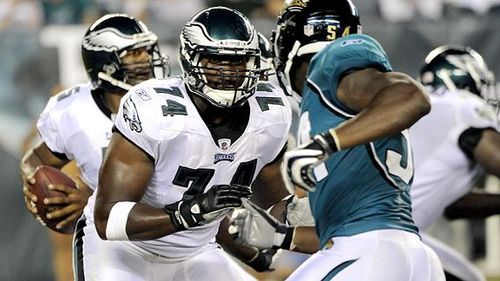
Putting aside for a moment the new quarterback behind center, conventional wisdom says that the Eagles offensive line needs to regain top form next year if the team has any hope of making a playoff run.
Last offseason the Eagles overhauled the line, removing veteran mainstays like Jon Runyan and Tra Thomas, and bringing in new players like Jason Peters and Stacey Andrews. Yet turnover was not the only problem. Injuries to basically every position crippled the unit, and poor performance from back-ups exacerbated the issues.
This year’s group looked especially bad, considering the success the offensive line had in 2008 preventing sacks. Look at the change in Football Outsiders’ adjusted sack rate (a statistic I’ve referenced before). The Eagles went from only a 4.2% adjusted sack rate, 6th best in the NFL, to 6.6%, good for 20th. While two and a half percent may not seem like much, it accounts for a huge increase in sacks.
But how much worse at pass protection was last year’s offensive line really? Adjusted sack rate only accounts for sacks — not hits or hurries. And it can’t really tell us whose fault those sacks were. Pro Football Focus, a site that everyone who reads this blog really ought to have seen (if not spent hours reading through) put up a fabulous examination of pass protection that goes further than adjusted sack rate can.
I recommend you go read all three parts of the article, but basically Neil Hornsby over there broke down all 32 NFL teams into ranks by the average number of blockers per pass play and total pressures (which is Sacks + Hits *0.75 + Hurries*0.75) per pass play. Then he combined those two stats to come up with a “Pass Protection Rating.”
What I’ve done is grabbed his results for the 2009 Eagles and followed his methodology to construct 2008 data for comparison, including what those ranks would be this year. (Note: I used PFF’s data for consistency; their game charting often comes out with numbers that are slightly different than official stats.) I think it has some interesting things to show us:
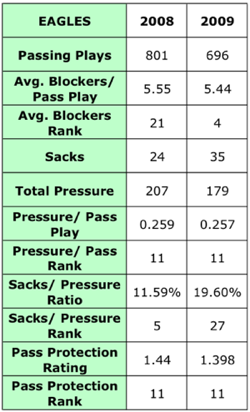
There’s a lot of information up there, but let me take you through it.
- Sacks jumped by almost 50% from 2008 to 2009, even though there were actually 100 fewer pass plays (fewer playoff games). We already knew that was a problem from adjusted sack rate.
- But: “total pressure” actually decreased. This is the first indication that sack numbers alone don’t tell us enough. While the sacks went up dramatically, pressure per pass play (a much better indicator of the success of the offensive line) stayed remarkably steady.
- And not only did pressure per play remain even year over year, last season’s offensive line actually did the “same” with less. In the last year of the Eagles’ longtime bookend offensive tackles, the team used more blockers on the average pass play than most teams — probably to cover up the fact that their two OTs were reaching the edge of retirement. However, in 2009, (even when dealing with constant injury problems) the Eagles used less extra blockers than almost anyone else. This fact suggests that last season’s hodgepodge offensive line was actually more effective at preventing pressure on the quarterback than the 2008 line.
The only caveat to this conclusion is the sack rate. The percentage of sacks as a part of pressure went way up from 2008 to 2009, to the point where almost one in five pressures resulted in a sack. However, while this isn’t an exact science, that factor likely has less to do with the line and more to do with the quarterback not reading defenses correctly and/or not releasing the ball fast enough. As Hornsby writes:
Donovan McNabb takes a lot more sacks than he should [in 2009]. He’s not Aaron Rodgers in this regard, but then he didn’t pass the ball as well as Aaron did, either. He seems to be hanging on to the ball more than he used to and is ranked 28th in terms of personal responsibility for pressure.
It’s easy to formulate opinions as to why this was true last year — McNabb’s rib injury comes to mind — but regardless it suggests some optimism for the offensive line in 2010. Last year the unit performed just outside the top ten in pass blocking (and equal to the one that got the Eagles to the 2008 NFC Championship Game), so fans should be able to reasonably hope (if the OL can avoid the injury bug) for an elite pass-blocking offensive line in front of Kevin Kolb come September.
Quintin Mikell Slams Departed Eagles Veterans

Well, that was unexpected.
Quintin Mikell, going into his third year as starting strong safety and second as the emotional leader of the defense, had some choice words, via Reuben Frank, for the players the Eagles cut:
“There was just a lot of negativity. A lot of people weren’t putting the team first… We’ve never had that before, since I’ve been here. We’ve never been a selfish team, where guys were more worried about what they did individually than how we did as a team. But we had guys who were more concerned about how the game plan affected them. It was, ‘How am I going to get my sacks if we’re doing this,’ instead of, ‘Hey, let’s go out and do whatever it takes to win the game.’ “
Ouch. He continues:
“It was, ‘Well, we had to keep going out there (because the offense wasn’t getting first downs),’ or, ‘They had great field position,’ or whatever. I don’t care if we have to go out there 20 million times, let’s go out there 20 million times and stop the other team… Sean’s a good coach, but as soon as things started going wrong, people started doubting him and second guessing him. If we had a bad game, it was like, ‘Why did he make that call? I could have gotten a sack if he made a different call.’”
That sounds pretty bad. You can’t have that kind of outright dissention in a locker room, especially with a rookie coach. Just unacceptable. Quintin made it clear that losing Sheldon Brown and Chris Gocong is “tough,” so they aren’t the culprits. That leaves veteran back-ups like Chris Clemons, Darren Howard, and Sean Jones.
But there’s more to this. These statements are part of Quintin reasserting leadership of the defense. As much as he blasted players, he didn’t name anyone in particular and said that everyone he was referring to is already gone. Somehow I doubt that second part. Maybe some of these guys the Eagles got rid of were quiet cancers in the locker room, but I think it’s also easy to read this as a shot across the bow of any defensive player who (still) tends to question or defy his assignments (see: Samuel, Asante).
Truth is, what Quintin said is just a more specific version of what Sheldon Brown talked about when he got to Cleveland:
“I just think, we as a defense in Philadelphia, you just have to believe in what coach McDermott preaches and follow the plan. You know, sometimes I look back at last year, the season, I feel that we had some players that really was questioning some of the things that were being done. And [we] never had that situation since I’ve been there. And first and foremost, you have to believe in the system, believe in the plan, or you lose before you even go out there. And if the guys can remember to do that, stick together, they’ll be fine.”
We were unsure how to take those words right after Sheldon was unceremoniously shipped away, but now we understand that they were just a frank assessment of the locker room in Philly. And at the time, we assumed he was talking about Asante. Clearly there were more players we never heard about, but that doesn’t mean Asante wasn’t also a problem.
More to the point for this blog though, is it possible that Quintin is also referring to Donovan, at least implicitly?
“When we lost, instead of looking at themselves and asking what they could have done better, there were some guys who were questioning the coaches and the game plan. But you can’t bring that negativity to the team, especially when you have a young locker room like we have. Because then the young guys hear it and it spreads, and you can’t have that and be successful.
Mikell tended to couch his comments towards the defense, but this one was ambiguous. At times last season you could see Donovan doubting the play call — he was even caught on camera yelling at Andy Reid/Marty Mornhinweg to run the ball in the red zone. When you take Donovan’s actions into account (even if overall he was the same solid role model) the locker room split doesn’t seem so unlikely. I don’t know how you can have the longest-tenured veteran question coaching decisions outright and still keep control of the locker room.
Maybe tearing things down and starting again with young players was the smart move.
The Youth Movement: An Ego Problem?
As I’ve explored before, the Eagles have made a conscious organizational decision to go with youth. That doesn’t mean it’s a rebuilding year, but the changing of the guard is obvious.
None of these “Young Guns,” as DeSean Jackson christened the new group of upcoming Eagles leaders, are lacking in confidence or sense of purpose. It seems as though many of them knew Donovan was on the way out and we’re just fine with that change.
Let’s kick off this discussion by going back to something Don Banks wrote right after the trade:
Sources close to the situation in Philadelphia have told me in recent months that McNabb does not have close relationships with the younger Eagles play-makers like DeSean Jackson, LeSean McCoy and Jason Avant. Those players are actually tighter with Kolb, who came to Philadelphia in 2007. So many of McNabb’s closest friends on the Eagles are now ex-Eagles.
Certainly McNabb must have been closest to guys like Dawk, Tra, Runyun, Westbrook, etc. He played well with the young players, but you never got the feeling that they were really tight. Donovan often sounded like he was an increasingly distant role model, rather than buddy, to the players almost ten years younger. He even criticized some of their play after the losses to Dallas.
You can even read more into this. Andy Reid must have seen the divide, so even if he thinks Donovan McNabb is better, there’s something to be gained by uniting the locker room around one group of players. After all, it seems like the young players already knew they were the main guys by the time they got to the NovaCare complex — and it wasn’t just all the rumors, according to Kevin Kolb:
“Once I got here and worked out I got a better feel for it — and when I was around the guys… there was a sense that “Hey, this is going to be us.” That’s what’s good about the offseason, you can build a lot of rapport and chemistry at this time of year, and so I was glad to get back here and get around those guys and get that feeling again.”
Clearly these “Young Guns” have a lot of confidence in themselves. They seem like they were waiting for this day to come, and were happy when it did. Listen to Jeremy Maclin:
“I’m excited man. Kevin’s shown flashes of what he can do and he’s obviously a great quarterback and I’m looking forward to kind of getting out there and working with him a little more and hopefully we can spread the ball around a little bit… he definitely shows a lot of leadership and that’s definitely kind of rare for a guy who hasn’t been out there doing much. But I think that’s his number one thing and I think if you have a guy who’s a leader behind center he can take you a long way.”
Maclin went on to say that he wasn’t shocked about McNabb getting traded, only that he got sent to Washington. You really get the sense that he and the other young players were working out, watching ESPN, and waiting for Donovan to go — and it didn’t bother them at all.
Brent Celek has said some similar things, but on to someone far more quote-worthy. DeSean made sure no one else upstaged him on the McNabb trade. He started with just some genuine excitement about the deal:
“It just feels like some new energy is coming around and guys are pumped up. I just heard Maclin say that he’s ready to get the season started right now. We’re fired up and ready to go. We have a lot to prove and we feel like we’re a team that’s always been that close. We’re just ready to go take it all the way.”
Besides the Barack Obama campaign reference, DeSean and friends really seem a lot more enthusiastic about losing a Pro-Bowl quarterback than you would expect. And it’s as though he’s saying that it was the older players who were holding the team back. Soon Jackson was being more explicit in his support of the trade:
“It was time for a change. We’ve got some young players here. I’m just excited about everything.”
That excitement is everywhere these days. Maybe DeSean just likes having the core group of teammates also be close friends:
“When I first came to this team, we had guys like Dawkins, McNabb and Westbrook. All those guys are gone now. It’s going to be exciting. We’re able to all communicate with each other. We hang out, we do all the things together.”
It’s a strange choice of words, suggesting that things will be exciting because those old veterans are gone. Sounds like perhaps DeSean didn’t get a chance to rap in the locker room all that much when those guys were enforcing decorum.
I agree with DeSean and the guys. This is exciting. I can’t remember the last time the Eagles had so much young talent. And DeSean as a leader makes the team dynamic very different — of course, not necessarily better. That’s where you have to begin to make a value judgment. Confidence is always good, but at some point you pass into the realm of ego.
The Eagles let go of a lot of great players over the last two years. Players whose contributions both on and off the field will be very difficult to replace. I have reservations about trusting a group of young guys who seem to be unabashedly happy that those players are gone.
* * *
There’s only one player whom I expected to have joined in with Maclin, DeSean, Celek, and Kolb, but really hasn’t — LeSean McCoy. His major comment on the McNabb trade:
“I still don’t believe it. 11 years, [McNabb] played in Philly so I figured that he would finish his career here. But… this is the business side of [the NFL], and Coach Reid runs the show. It’s going to be tough seeing him [in a Redskins uniform] because he’s done so much for Philly. I don’t understand why. Donovan is a very good quarterback and Washington has a nice squad.”
That’s more than even the respectful pause get got from veterans like Avant, Herremans — it’s outright questioning. I wonder if he’s just not actually that tight with the other young guys or if he just got much closer to Brian Westbrook than I realized. The latter explanation would be backed up by this quote:
“Off the field [being professional], I learned a lot from Westbrook. On the field, McNabb taught me about relaxing, staying calm and taking my time. It will be weird playing against him twice.”
Sounds like perhaps when guys like DeSean were running away from the veteran leaders, McCoy really appreciated them as mentors. Just something to keep an eye on…
McNabb Fan Robs Bank With #5 Jersey
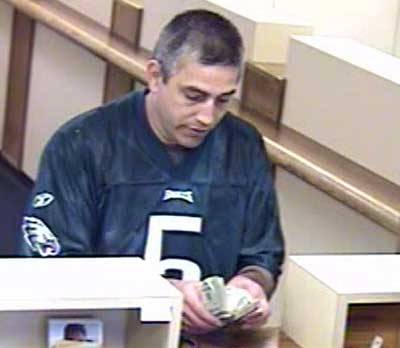
A man wearing a Donovan McNabb Eagles jersey held up a bank in Northeast Philadelphia Tuesday and fled with an undisclosed amount of cash, authorities said.
Good thing for the pictures, or I would have assume #5 came back for his bonus money.
The bandit - who is considered armed and dangerous - is described as a white male, about 45-years-old and stands about 5-foot-8. He has closely cropped dark salt-and-pepper hair and is clean shaved.
This man deserves our help. Have we not all experienced a certain helplessness since Donovan was traded? Feel for this hardened criminal and rally to his aid. The Sherriff of Nottingham (i.e. Joe Banner) is after the righteous bandit. Shelter him in the woods. Provide him with a KolbHead disguise. Anything!
Updates (hopefully) to follow.
What's the Deal with Michael Vick?

We’ve been through the whole gamut of emotions with Michael Vick: surprise when he was signed, excitement about the wildcat, boredom when he didn’t seem to have much impact, expectation that he was going to be traded, and now maybe even resignation that he might be Kevin Kolb’s back-up.
So what gives? Where are we with 7? And why have we been through such a bizarre offseason?
I think it all goes back to Vick’s goal when he signed with the Eagles. Tony Dungy and others said he could have gone in and competed for the starting job somewhere like Oakland, but the calculation was that spending a year as a back-up for an established coach and stable organization would help rehabilitate Michael’s image. Ultimately, the goal was to boost Vick’s value long term, so he could eventually pay off his creditors and return to profitability.
The tradeoff for this plan of seeking out a solid organization was that the Eagles finagled a second year into Vick’s contract. Now I don’t think he ever really thought this was a big problem. Vick assumed that after a year of rehabilitiation — even if he wasn’t able show much as a player — teams would be clamoring to get him. His calculation was that teams were worried about the bad publicity and not about his actual playing ability.
You can see this attitude at the beginning of the offseason, when Vick was talking about being a starter next year on Feb. 1:
“It would be fairly hard [to return to the Eagles as a back-up]. If I had to [come back to the Eagles], I would, just because I’m thankful.”
In other words, Vick really didn’t want to come back to the Eagles. He was ready to move on. Had he really learned anything with Andy Reid and Donovan McNabb? Doubt it. But the bankruptcy plan said it was time for a starting job for the self-stated “Top 10” quarterback.
On March 9th, the Eagles picked up Vick’s $1.5 million roster bonus, and I think Michael was genuinely surprised:
“I think the entire organization knows that I want to be a starter. I’ve reiterated that to Marty [Mornhinweg] at the end of the season and coach [Andy] Reid. They know that. They know I’m a competitor. They know I want to play. They know I want to win.”
Before the Eagles picked up Vick’s bonus, I think Vick already had one leg out the door. He had discussed teams he would like to go to, like the Carolina Panthers, and rode the “I want to be a starter” thing hard.
The problem is Vick really wasn’t helping his own cause. Any team who was looking at Vick as a veteran back-up (and his contract really isn’t expensive for one) must have been scared away by Vick’s insistence for a starting job. And the Eagles must have had a tough time getting the price they wanted for Vick as a starter (which was probably too high in the first place), because Vick was showing how much he wanted to get out of Philly.
By March 12th Vick still doesn’t really get it:
“If I’m in the same situation, I’ll just have to suck it up and go out and play and listen to what Andy [Reid] wants me to do and understand I’m there to play a certain role to try to help the Eagles win a Super Bowl. I can’t be a disgruntled employee, because that’s not who I am.”
Sure, the words are basically right. But listen to the tone. He’s willing to “suck it up” and go do his job. He doesn’t want to have to be “a disgruntled employee.” This doesn’t sound like someone who really wants to stick around.
I think these quotations also just speak to just how bad Vick is at understanding that his situation would be best served by being quiet. It’s like he took a crash course in jail on the T.O. school of negotiation.
A week and a half later Tony Dungy went on Dan Patrick’s show and discussed Vick:
Patrick: It’s been kind of quiet on the Michael Vick front. I thought he’d be with another team by now. What about you?
Dungy: You know, at first I felt the same way — that they [the Eagles] had so much money invested in roster bonuses and that type of thing. But I can kind of see [coach] Andy Reid’s point. You never can have too many quarterbacks and so they have got to make it worthwhile. If they’re going to let anybody go, they have to get what they feel is fair market value. So we’ll see what happens. I talked to Mike a few days ago and he’s very patient. If he ends up being in Philadelphia, he’s going to be fine with that and work as hard as he can.
My interpretation of this is that since Vick’s previous trade demands (which is essentially what those quotes come off as), both the organization and Tony Dungy talked with him and set him sraight. In other words, I don’t read Dungy’s quote here as “Michael is patient and willing to stay.” I read it as “I told Michael he needs to be patient and willing to stay.”
(Also, check out the answer to DP’s next question for Dungy’s take on Andy-McNabb.)
By March 25, Domo had new knowledge about Vick’s situation:
But a source in the organization said [keeping all three quarterbacks] isn’t likely. There is almost no chance Vick will return, the source said.
This is a very interesting report. It’s clearly not a purposeful leak, because (a) it would be in a headline, and (b) it actually goes against the Eagles’ interests by admitting Vick will/has to go.
The Eagles, of course, couldn’t let that slide. They leaked a story to their favorite cub reporter, Jeff McLane:
But a source said the Eagles aren’t likely to cut Vick and in fact, they aren’t shopping the 29-year-old anymore.
You could argue that this was early proof that McNabb was a goner and that Vick was needed to back-up Kevin Kolb. But I think the two things are mostly unrelated. Vick has not once been counted on by the Eagles to be a legit back-up quarterback. Throughout the season Kolb was the primary back-up, and Vick was the wildcat toy. When McNabb went down the Eagles were sure to get Jeff Garcia just in case. Michael Vick was an investment, not a real back-up; and I doubt Andy’s changed his mind on that this offseason.
The coach did call Vick the night of the McNabb trade though and give him some good spin:
“I look at the situation as not being part of God’s plan right now. I think when the opportunity knocks for me to go out and [start] again, then it’ll happen, and I’ll be ready for it. The only thing I can do is prepare myself and make sure I’m ready to play… I know I still have longevity in this league. I have to look at it as a positive. I am preserving my body and continuing to go out and learn and understand the game. That’s the value.”
Even describing the benefits of sticking around, Vick still can’t help but think and talk about starting again. He’s addicted to his own ability.
Domo then comes back and refutes the idea that Vick’s role as Kolb’s back-up is set in stone:
Reid never will admit this, but while he likes Vick as a Wildcat weapon, he doesn’t have a lot of faith in his ability to run his offense if something were to happen to Kevin Kolb this season. The Eagles still are hoping to move Vick, I’m told. But if they can’t, they really can’t afford to go with Kolb, Vick and a rookie project as their three quarterbacks.
Domo really seems to have some small tap on the Eagles organizational thinking and the general feeling at NovaCare — not to mention his theory jives with what we saw during the season. He’s not out there blasting the latest rumor from team sources, and the Eagles front office keeps putting out reports that put him down.
Like this one to Geoff Mosher:
A team source verified that the Eagles plan to keep Vick for the 2010 season unless another team blows them away with an offer, which isn’t likely to happen.
At least Mosher presents his report with some skepticism, unlike McLane.
The truth is that Michael Vick doesn’t fit into any of the Eagles quarterback plans. Andy likes to have a veteran who is well-versed in his West Coast Offense behind his starter: Koy Detmer, Jeff Garcia, AJ Feeley. Vick can’t provide that security. Which is why we hear that the Eagles have had discussions with Garcia.
Vick also doesn’t address the need for a young, developmental quarterback for the Eagles future back-up. I’ll take a closer look soon at some of the possible quarterbacks the upcoming draft, but overall I think people who are linking the Eagles to Tebow are missing the point. Andy believes he has his “Donovan” for the next decade in Kolb, now he needs to find his new AJ Feeley — not another wildcat toy.
At the end of the day I still think the Eagles will trade Vick at some point this offseason. Andy may have improved his opinion of Vick enough to let him back-up Kolb, but there has been no evidence of that. A trade may not come soon, or even before the draft, since 2011 conditional picks might be in order. But if I were a betting man, I would wager that by September the Eagles quarterback corps goes: (1) Kolb, (2) Garcia, (3) middle-round prospect.
Is The New Eagles QB Actually Paul Bunyan?

We now have our first backwoods Eagles Quarterback, complete with too-tall tales.
First and most absurdly, Kevin hunts wild hogs — not with a gun, but with his hands, a few dogs, and a 12-inch bowie knife:
“It’s not just [about] killing an animal,” says Kolb… He didn’t want to come off like some bloodthirsty savage to the non-hog-hunting fans of his new team, the Eagles, who shocked everyone from Allentown to Atco by taking Kolb with their first selection in the 2007 NFL draft, 36th overall. “A lot of times you’ve got to work before you reap your reward. Our dogs go and find ‘em first, and then we stab the pigs. It’s a little bit dangerous, but as long as you know what you’re doing, you’ll be all right.”
Jesus. I can’t even imagine what it would be like to have a wild hog coming after you and trying to gut it. Of course, this could set up the greatest of all injury reports down the road…
Kolb also perpetuates his own bass fishing myths:
Placed seventh, along with friend Jeff Gilbert, at a Texas big bass fishing tournament in February. Kolb once caught - or so he claims (wink) - a 250-pound marlin.
And finally, his barn-stormin’ explanation of what it was like growing up in the country:
“When you’re out in the woods and you get beat up, your mom’s not there to pick you up. I’d flip my four-wheeler or something, want to lay down there and be hurt. There’s nobody there to cry for you. You got to jump up and keep going.”
What a beast. Somehow I don’t think a few wide-bodied defensive tackles are going to rattle Mr. Bunyan much.