Could the Eagles Be Interested in Colt McCoy?

Jason Brewer speculates as to whether the Eagles might be looking at acquiring Colt McCoy on the cheap:

McCoy was a third round pick in 2010 and has started 25 games over his first two seasons in the league. He hasn’t been particularly good, but he is still young, he didn’t have a lot of help in Cleveland and he might benefit from a little Reid/Mornhinweg attention. And if it is true that he could be had for next to nothing, might he better extra QB than Trent Edwards?

Truth be told, that’s what I wanted the Eagles to do instead of drafting another mid-round QB like Nick Foles. McCoy is a poor man’s Kevin Kolb, but at least he has significant starting experience in a similar offense. The problem is that, barring injury, there’s no room for another McCoy on the roster.

Still Waiting for Jaiquawn Jarrett to Show Something

Dave Spadaro, via Tommy Lawlor:

I don’t see Kurt Coleman being challenged for the starting job by Jaiquawn Jarrett. Coleman had a very strong spring and is in terrific shape. The real question is: Where does Jarrett fit into the equation here?

Spuds coaches his comment with the idea that Coleman is just doing a great job, but when Jarrett can’t even get a qualified endorsement from the team’s own media (let alone coaches or other players), it’s very worrisome. Jarrett has no legitimate competition for back up safety, but if he can’t demonstrate anything positive now, over a year since he was drafted, at some point the team has to admit the mistake publicly and cut its losses. I’m starting to wonder if that time will come this offseason.

Let's Talk About Jeffrey Lurie

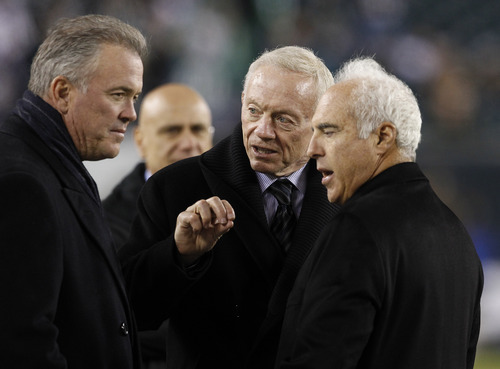
Jeff lurie

Since Joe Banner was forced out decided to leave the Eagles organziation for anyone who will take him a new, more difficult challenge, most of our focus has been on the Banner’s former underlings — Andy Reid and Howie Roseman. But what about his boss and friend, owner Jeff Lurie? Where does this firing departure leave him?

I think one of the critical things to understand about Banner is what his role was over the years. You could call him Lurie’s right-hand man, but that would understate his impact. Lurie didn’t run the organization, Banner did. Lurie certainly had input into many things, and involved himself in major decisions, but for all intents and purposes he has been the chairman of the board, not the CEO.

Banner was Lurie’s only real direct report and therfore was his default proxy in all aspects of the business — from the stadium to the football and everything in between. Everything flowed to Banner first, and the vast majority of concerns certainly never needed to make it to the owner’s box.

But now Banner is gone. In his place are three different people. Dan Smolenski, the new president, doesn’t have his former boss’s scope. He will be in charge only of the business aspects. As to what happens on the field, it’s unclear exactly what the structure looks like between Roseman and Reid, but it doesn’t seem like either one purely reports to the other.

What does that mean for Lurie? It means he’s gone from being strategically divorced from day-to-day operations by screening everything through Banner to being more involved in every part of the team. The dual wings of the organization can probably operate independently, but Lurie has placed himself in the unavoidable position of chief executive.

Ultimately, one might write all this off as basic palace intrigue, but active ownership from Lurie is something we’ve never seen before. After the 2011 debacle, he was clearly disturbed by the way his Eagles were performing on the field and being perceived in the city at large. What steps might he take to remedy those problems, especially after he already made the tough choice to fire accept his childhood friend’s decision to leave?

I doubt Lurie’s looking to model himself after peers like Jerry Jones and Dan Snyder, but there’s a wide expanse of potential influence he can exert on operations before reaching that extreme. Whether he does so will be important to keep an eye on going forward.

Photo from Getty.

The New Look Eagles

They were this close to sneaking in a “next question” joke.

Details on this, ahem, partnership from the WSJ:

On Monday, Rovio and the Philadelphia Eagles are announcing a partnership that will include an Eagles-centric Angry Birds game to be launched in the fall and a marketing push that will include everything from social media initiatives to integration on local team television shows and even in-stadium displays.

For instance, according to the team, if defensive lineman Trent Cole sacks New York Giants quarterback Eli Manning, the stadium’s video board will dump the traditional sack animation for a new one–an animation in which Angry Birds character “Big Brother Bird” Terence knocks Manning over. In short, for Angry Bird-addicted football fans, there will be no escaping your thumb-hurting vice this fall.

Highlights From a Chat with 'Coach Reid'

Jeff McLane moderated an online fan chat with Andy Reid on Philly.com, which is a cool idea, although I’m not sure why he felt the need to call him “Coach Reid” all the time. Maybe it’s just me, but it’s not like Reid is McLane’s coach.

Some choice highlights:

Comment From Philly In DC: Coach, you look great with the loss of weight. Did you have a specific goal or heath objective in mind coming into the season?

Andy Reid: Where I sat at the end of the season, my goal would be equivalent to winning five Super Bowls in one season. There was a big challenge and it will continue to be a challenge.

Comment From Matt: Are we going to see more of McCoy in the slot this year like Westbrook used to do so well?

Andy Reid: We started easing there in certain situations and even starting lining him outside away from a three-man look. So, yeah.

Comment From Guest: Andy, what is your favorite meal ?

Andy Reid: Right now, today: cottage cheese. pre-diet: great cheesesteaks of Philly.

Comment From Guest: would you ever consider allowing the behind the scenes show Hardknocks to film the Eagles? Would be awesome as a fan to see how the team operates behind the scenes and get a sense of player/coaches personalities. Or do you feel its too much of a distraction?

Andy Reid: I understand the part about it being great for TV and it’s a tribute to HBO for doing it. From an organizational standpoint it ends up being a distraction.

Comment From TRO: What is your favorite meal your wife cooks you for dinner?

Andy Reid: Does a great fried pork chops, mash potatoes and corn, chased with Mississippi Mud for dessert.

Comment From Guest: Andy, what is your bedtime?

Andy Reid: In-season, extremely late. Out of season, I’m in bed by midnight because nothing good happens after midnight, as I tell my players.

Epic non-answers:
* On what steps he took to improve game management last year.
* On whether Dion Lewis would win the back up RB job.
* On Romney or Obama (as if that’s a choice for him).
* On Eskin or Bowen (ditto).

Still Andyworld, Until It's Not

Les Bowen wants to know whether, in the absence of Joe Banner, the Eagles are dealing with “Howieworld” or “Andyworld.”

Remember, Jeffrey Lurie, in his anguished postseason address, sounded almost ready to fire Reid, but when reporters asked about Roseman — who certainly had a lot to do with all the silly Ronnie Brown and Steve Smith-type signings last summer, not to mention some poor draft decisions — Lurie got indignant. He made it clear that Roseman was not in any sort of trouble.

That’s why I kinda think it might be Howieworld. And I’d love to know what Howie really thinks of Reid.

But it’s more complicated than that. I don’t think that Roseman, unlike Banner, has the power to fire Reid. Based on the constant references to Reid’s final say on all football matters, he clearly has the upper hand on his young colleague when they disagree. Lurie knows that if he wants Reid gone, he has to do the deed himself.

In that sense, the Eagles are still Andyworld — his word is still law at NovaCare. Where things get interesting is in the future. Reid has the power now, but he’s also in a more precarious position than Roseman. If the 2012 season goes poorly, there’s little chance he returns. Roseman, meanwhile, is sitting pretty. He’s not as powerful as Reid right now, but all it would take is another losing season and he’s the man in charge, getting ready to pick a coach of his own.

How Joe Banner Became Obselete

Sam Lynch, in the Banner post everyone should read:

To understand why Joe Banner is leaving, in my view, you have to understand what he became after the 2006 CBA. Like I said earlier, the new question in the NFL was whether a player was worth the price he was asking for. It was now all about putting the right dollar value on the available guys.

Of course, this had always been a critical part of the process. Now, however, it was an unusually large part. And Banner had a view on what a player was worth. Think about that for a second, though. Valuing talent is what you would want the GM types to do — this guy is good, this guy isn’t. What Banner should be doing is figuring out how to fit as much of the good players under his cap as possible, not figuring out what the guys are worth.

Just to add a relatively random point, the Banner-Roseman mentorship is probably a good case study for not promoting your natural replacement quite so quickly.

Banner, Dawkins and Business in Philadelphia

I’ve been waiting for the former player reaction to Joe Banner’s departure and now we have Brian Dawkins’s comments on 97.5 The Fanatic, as recorded by Sheil Kapadia:

“I just think that the way things have been done for so long there, and we did have some success, but the way that some of the guys that are in house had to always scrap, fight and do different things in order to just get a deal, it kind of wears on guys,” Dawkins said. “And that was really the philosophy of this team, the way that they did things. I’m not saying that it’s going to change 100 percent going forward. The thing that I would love to see is guys in house be able to be kept. That was one of the things that always kind of frustrated me as a player, that guys who are in house and doing everything they can to improve the team are let go pretty easily, and then you go out and pay big bucks for free agents coming in.”

“When you feel like every guy that you see on your team constantly has to go through the same ringer and have the same conversations and have the same type of dealings that you have, it’s a frustrating thing,” Dawkins said. ”I just know that certain situations and certain things could have been handled differently, and there would have been a completely different feeling about doing business in Philadelphia.”

Tommy Lawlor also commented on this yesterday, and I think he comes across as defensive. Yes, the players he listed — such as Vincent, Douglas, and Staley — were ones the front office made the right call on. But what about Jeremiah Trotter, whose absence hurt the Eagles defense on their Super Bowl run? What about Sheldon Brown, whom the Eagles thought they could replace with Ellis Hobbs and Dimitri Patterson? What about Dawkins and Quintin Mikell, both of whom probably deserved another couple of years? What about Banner’s incalcitrance toward DeSean Jackson while paying Steve Smith more than $2 million?

Even more than any individual player, it’s the negative attitude in the locker room that really hurts. Healthy businesses in every industry have to make tough choices and sometimes let people go. But if employees — especially key performers — feel disrespected, that’s going to haunt you in the long run.

Update: Some more choice quotes from Trotter and Brian Westbrook:

“It was hard for players to trust the front office… Even when you let guys go at the end of their careers, there’s a way of doing that,” Trotter said. “The way Brian Dawkins left, there’s no way that he should have been ran out the door the way he was. Or if you’re going to let him go, just say ‘hey, we’re going to move in a different direction.’ Don’t tell the public that we offered him a good contract, but he didn’t want that.”

“And for him, it was a straight business,” said Westbrook. “It was by the numbers, and the problem that you have in that as a player is you build relationships, so it’s not necessarily only by the numbers. There’s a value having Brian Dawkins on that team, even though he’s not the guy that he was at 25, and by the numbers at 33, he should be declining in his play. It’s a value of having those types of guys on your team instead of letting him to go to Denver and allowing him to go to two Pro Bowls after that.”