When Conspiracy Theories Trump the Party Line

Joe Banner

You can label the Andy Reid-Joe Banner power struggle an unfounded conspiracy theory. And you can buy the general storyline presented for Banner leaving. But you have to admit that there are serious holes in that party line.

According to Jeff McLane’s report, which might as well be the official press release, Banner approached Jeff Lurie a year ago about a succession plan. Why would he want to leave the Eagles, a team he built for the better part of the last two decades, a team owned by his childhood friend and in which he was the unquestioned CEO?

The official line is that he wants to “get involved with the world of buying and selling a sports team with the possibility of becoming part of a group that buys a team.” Geoff Mosher got Banner on the phone and the former team president said that he has been less involved over the last few years:

“I spend a lot of my time right now managing people that report to me and a modest amount of time doing things myself. More passive role than this same job was not long ago. I wanna be so busy I don’t have time to breathe. That’s my personality.”

Sorry, but I just don’t buy it. Less than ten months ago, Banner was at the forefront of the Eagles efforts to sign one of the most heralded free agent classes in modern memory. You can’t listen to this interview with Mike Florio and tell me that Banner was not personally involved in every aspect of those decisions and negotiations. “More passive role”? I don’t think so.

The changes clearly began this offseason, as Les Bowen wrote and McLane papered over. The extensions for longtime Eagles, the new willingness to talk with DeSean Jackson, the relatively quick deal struck with LeSean McCoy — all of it was done with Banner completely unseen. Howie Roseman became the point person for negotiations and Reid took an unprecedented, larger role.

Drew Rosenhaus’s comments about his negotiations over Evan Mathis, Jackson, and McCoy set a lot of the Banner talk in motion, and Paul Domowitch went back to him today in a great story:

“Howie really handled exclusively the negotiations for DeSean and Evan and LeSean,” Rosenhaus said. “Joe wasn’t directly involved in any of those discussions from the start of the offseason. I actually negotiated (undrafted free agent safety) Phillip Thomas’s contract with Joe. I remember him calling and joking about the fact that he wanted to work on at least one deal with me this offseason.”

“We struggled up to this offseason really to get the club to work on an extension with DeSean,” Rosenhaus said. “The team really wasn’t aggressive as it related to DeSean’s negotiations until this offseason. I don’t know if there was a power struggle or not. There’s no way for me to know that. But I do know that things changed in terms of the Eagles’ approach to DeSean after the season.”

Those comments suggest that Banner has been marginalized since the end of the disastrous 2011 season, a season for which he was directly responsible for many of the controversial decisions — free agency splurge, stonewalling DeSean, angering Asante Samuel (basically everything up to Juan Castillo). You can connect the dots.

Domo reads the tea leaves and argues that Reid wanted Jackson extended and blamed much of last season’s locker room troubles on Banner’s inaction on that front. Les’s piece today takes a slightly different route, arguing that Lurie “was genuinely at his wits’ end over the Eagles’ sour image in Philadelphia, the inability to connect with the fan on the street.” His solution was to isolate Banner and loosen up Reid.

Either theory makes more sense than Banner’s self-proclaimed reasoning. If he had dropped out of football to pursue his philanthropic interests, one might understand. But if you want to stay in football, you don’t leave that job willingly — especially without a new, seemingly better position already lined up.

I’m sure it was painful for Lurie to take the reigns away from his friend, but that’s the kind of decision he has to make as an owner. And by delaying the announcement and concocting an elaborate and not-entirely-convincing exit story, Lurie gives Banner as gracious a departure as he can manage. The new “Special Advisor to the Owner” even has a fall-back job at NovaCare for as long as he needs.

We will never know the full truth, but let’s not be naive. There’s the official story, and then there are the explanations that actually make sense.

Photo from the Philadelphia Eagles.
After 18 Years, Joe Banner Out As Eagles President

Jeff McLane has the team-ordained scoop, with interviews with all the major players, who insist that Banner, Jeff Lurie’s childhood friend, wasn’t fired or pushed out in a previously rumored power struggle:

Lurie and Banner gathered with Smolenski, Roseman, and Eagles head coach Andy Reid to announce the finalization of what they are calling a “front-office succession plan,” one that the owner said began when Banner approached him last spring.

Banner, 59, said Wednesday that he hoped to “get involved with the world of buying and selling a sports team with the possibility of becoming part of a group that buys a team.”

Certainly, more to come on this news.

Disturbing Tackling Numbers for the Eagles LBs

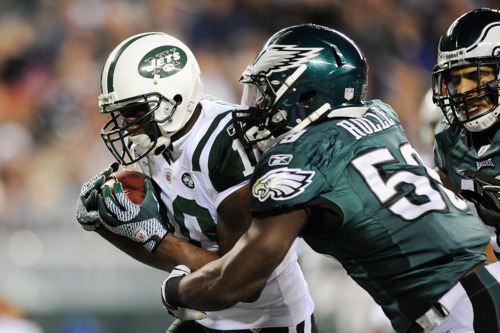
Brian Rolle Tackling

In my recent linebacker review, I evaluated all the youngsters with a fairly skeptical eye. However, in discerning some difference between their various deficiencies, I noted what now seems to be patently false.

I said, “Brian Rolle is the opposite of Chaney, smaller but smarter and a better tackler to boot.” Well, the last part just isn’t true, according to the statistics provided by Pro Football Focus. Derek Sarley alerted me to this article by PFF from a year ago.

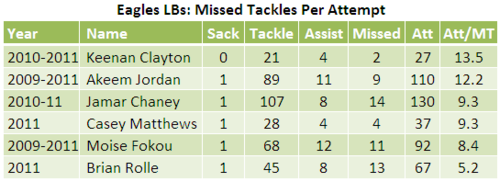
The stat they come up with is Total Attempts (sacks, tackles, assists, and missed tackles) per Missed Tackle. From 2008 to 2010, the top 15 linebackers in the NFL had more 20 or more attempts for every miss. Meanwhile, the bottom 15 qualifying linebackers registered fewer than 8.8 attempts per miss. Here are the numbers for returning Eagles:

Eagles Linebackers tackling stats

The thing that should stick out to you is Rolle’s atrocious number. According to PFF’s charters, he had a missed tackle once every five times he had the chance. None of the linebackers really have good results here, but Rolle’s is by far the worst. If he had qualified for PFF’s study last year, he would have been the single worst LB tackler in the league.

I was never that high on Rolle, given his limited upside. But apparently my eyes deceived me about his tackling. If he’s both small and a poor tackler, that makes him a real liability, and an underdog to retain his starting weakside role.

Chaney, Casey Matthews, and Moise Fokou were all pretty poor tacklers last year as well, and in truth their numbers above may actually underestimate the problem. At the risk of relying on my memory of last season again, Chaney’s problem was often that he failed to even get to the ball. That poor diagnosis and reaction wouldn’t factor in to this statistic, which just counts actual tackling attempts.

Still, we might be able to count on at least one of the youngsters to improve in 2012. Want a scarier statistic? Over the last three seasons, DeMeco “Savior” Ryans has a 9.3 attempts/missed tackle ratio. That’s no better than Chaney or Matthews.

Photo from Getty.

Small Fish in a Big Pond

Tommy Lawlor on UDFA Damaris Johnson:

Damaris is very quick and he has a good burst. He is able to gain initial separation. He just lacks the long speed you would ideally prefer. One thing I really like about him is that he plays fast. There is very little dancing and hesitation when Johnson gets the ball. That’s partly why he’s such a good KOR. He gets it and goes. That style of play actually makes him look faster than he is. One other thing about that…Johnson is able to make cuts at close to full speed. This is where his size is a benefit. He’s got good body control and is able to stop/start quickly and change directions on the move.

Damaris does look much faster on tape than his 40 time indicates — and he better be, considering his tiny stature. On a broader note, when was the last time the Eagles had so many potential contributors who were small in stature? I’m not sure anyone other than Barry Sanders did as much as Brian Westbrook at 5’8”, but this team has DeSean Jackson, Dion Lewis, and whoever emerges from the Johnson-Chad Hall roster battle. And that’s just on offense. Brian Rolle is one of the smallest linebackers in the NFL, and the slot corner competition is between two 5’9” players.

On Run Defense and Wasting the Offense's Time

Interesting nuggets on Jim Washburn’s philosophy, from Rich Hoffman:

“I know that Jason Babin is not a great run player,” he said. “But in this thing we’re doing, if he does it the right way, he can be adequate – or more than adequate.

“We could put a 300-pounder out there and he would be a whole lot better [against the run)] But this is 54 percent pass on first down in the NFL. So if you get some big stud out there that can play the run, crush the run, but can’t rush the passer, then you’ve conceded 54 percent of the time.

“[Babin] can be a whole lot better as a run player, but he wasn’t terrible. That’s the truth.”

Washburn says the goal is to hit the quarterback every pass play, and he says that his team’s performance tends to be more about what they do than what the opponent does, and that when he shows different formations and such – like when he has a player standing up and not in a stance – it tends partly to be about making the other teams waste time in practice on inconsequential stuff, and partly keeping his own guys interested. That last part, he says, is a big part of the job.

Post-Draft Position Breakdown: Cornerback

Nnamdi Asomugha

What the Eagles did: Cornerback was a mess last year. We’ve been over that. You can’t just throw three Pro Bowlers with different styles together and expect things to work out of the box. Thus, the inevitable happened: Asante Samuel was shipped out of town.

What the loss of Samuel means to this defense is tough to gauge. On one hand, he’s still a great cornerback. While his interceptions were down in 2011, other stats showed that Asante was as good as ever. On the other hand, his limited style of play clearly forced running mates Nnamdi Asomugha and Dominique Rodgers-Cromartie into suboptimal positions. Asomugha has historically shined when he locks on one of the opposing wide receivers, and Rodgers-Cromartie’s closing speed makes him a better fit on the outside.

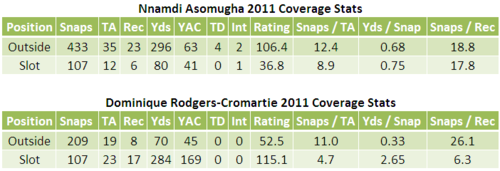
Now they can play the way they want, and it’s up to new secondary coach Todd Bowles to make them comfortable. So far the talk has been that the coverages are simpler, which should be a relief to fans. The numbers (re-posted below) show that Nnamdi and DRC can both be very effective starters — as long as they’re playing in the right spots.

Nnamdi Asomugha Dominique Rodgers-Cromartie 2011 Coverage Stats

Another downside to losing Samuel, however, is that the depth behind the Eagles two starters is relatively murky. Who are the backups on the outside if either player gets hurt? Curtis Marsh, second-year player out of Utah State, is athletically gifted, but is a relative newcomer to the cornerback position. He played a grand total of 13 snaps last season, and still needs to shed the “project” label. Brandon Hughes is entering his fourth year, but hasn’t proven he can even be Dimitri Patterson yet. Then you have a wasted 2010 fourth-round pick in Trevard Lindley, as well as undrafted free agent and apparent head case Cliff Harris.

Inside, in the slot, we have an interesting battle shaping up. Joselio Hanson, the designated nickel corner in this defense since 2007, I believe, was cut last year before being re-signed at a lower price. Clearly the Eagles think he’s replaceable. And they brought in his replacement, or at least heir apparant, in Brandon Boykin, the fourth-round pick. Boykin has all the physical skills except height going for him, and he already gained some experience in the slot at Georgia.

What I would have done: The way Howie Roseman handled the Samuel trade situation was appalling. A player of that caliber should have been worth more than a seventh-round pick, but by the time he pulled the trigger the Eagles had no leverage. That said, he had backed himself into a corner (haha). Trading Samuel was the only possible solution to a problem Roseman created in the first place.

Way-too-early prediction: Based on Rodgers-Cromartie’s stats above, I’m optimisic that he will be a solid outside cornerback this year. Actually, it seems prudent to lock up DRC at this point in order to grab a little bit of discount. And I’m only slightly worried about Asomugha losing a step in 2012. He should still have at least another good year or two left in the tank.

The slot battle is Boykin’s to lose, and I doubt he will. After that, it would be nice to see one of the other young corners step up. Bowles coached bigger, athletic corners in Miami. Hopefully he can use that experience to mold Marsh into an NFL player.

Photo from Getty.

On Mike Caldwell's Culpability

Sorry, Les, but this just isn’t true:

From Caldwell’s perspective, obviously, you’re a position coach, you don’t pick the players. You didn’t tell anybody the Eagles would be just fine with fourth-round rookie Casey Matthews opening last season in the middle. Your job is to do the best you can with what they give you.

Of course the buck stops up the line with Juan Castillo, Andy Reid, and Howie Roseman. But you don’t go into the season with just a fourth-round pick as your starting middle linebacker unless the position coach either thinks it can work or shuts his mouth and nods whenever a higher-up tells him what’s what. In either case he is at least partially responsible for the resulting disaster.

After all the time spent discussing the sway that guys like Jim Washburn, Howard Mudd, and Ted Williams have on evaluating and teaching players, how can we wipe away any culpability that Caldwell has when his unit fails so miserably?

Post-Draft Position Breakdown: Safety

Eagles Safeties

What the Eagles did: Did you notice that safety was the only defensive position the Eagles left alone this offseason? They didn’t sign any free agents. They drafted no one to compete, not even a late round pick. The front office clearly trusts the young players already there. Whether that trust is warranted is a whole different matter.

At linebacker, which was probably the bigger disaster last year, the Eagles elected to try to replace two-thirds of its starters. That plan may or may not work, but the team certainly wasn’t content to wait and see if Jamar Chaney, Brian Rolle, Casey Matthews, and others could improve. The team took the opposite approach at safety though. The plan appears to be giving third-year players Nate Allen and Kurt Coleman every chance to improve from last season.

This decision seems at least partially justified. Unlike the linebackers, both Allen and Coleman have had multi-game stretches of solid play. After falling out of the starting lineup completely in training camp while suffering lingering effects of his 2010 torn patellar tendon injury, Allen bounced back at the end of the year. While not a dominant athlete, Allen has all of the physical and mental tools necessary to be an above-average safety. Hopefully a healthy offseason will finally be the springboard to be that consistent in 2012.

Coleman has much more meager physical skills. He’s smaller and slower than Allen, which is why he was only a seventh-round pick in the same year. Overall, Coleman’s ceiling just isn’t very high. That said, he can be an average, or even good safety at times. He had eight or more tackles in four games last year (although that may speak more to LB quality) and, of course, his three interception game against the Redskins. Unfortunately, as Tommy Lawlor detailed a few weeks back, Coleman frequently screws up in the mental part of the game.

Jaiquawn Jarrett’s name should probably come up here. The former Temple product has his backers, although there’s little evidence the coaches are enamored with him at all. Despite being a second-round pick in 2011, Jarrett hasn’t even been in the conversation to start in 2012.

After that it’s unclear who will make the Eagles roster. Colt Anderson was a Pro Bowl-caliber special teams player last year but tore his ACL in December. Tom Nelson took his place and didn’t show much in the last few games. Philip Thomas, two-year starter at Syracuse, is an undrafted free agent the Eagles took a flier on. Nothing to count on.

What I would have done: Was there no veteran capable of competing with these players? Yeremiah Bell? Anyone?

Right now the Eagles have two players who have never demonstrated they can consistently start and three more who haven’t proven they even belong in the NFL (plus one injured special teams maven). That doesn’t inspire confidence.

Way-too-early prediction: Despite the fact that the Eagles have completely ignored the position, I still feel relatively optimistic. The assembled group is probably the weakest unit on the team (not counting fullback?), and I’m not expecting either Allen or Coleman to be world-beaters. In fact, I’m resigned to them both being below average. So how is that optimistic? Only because I think improved units in front of them and (hopefully) less convoluted coverage schemes will make their coverage screw-ups and poor tackling less noticeable.

As to Jarrett, I’m starting to wonder if he might not be around in a year’s time. The coaches have demonstrated absolutely zero faith in his abilities, and reports are that he has failed to bulk up like the team wished. Even more disturbing is that Jarrett couldn’t play special teams last year. He has time to turn things around and there’s quite a low bar of competition in training camp, but the signs thus far have been disconcerting.

Photo from Getty.