Answering the DeSean Jackson Question

DeSean Jackson

Sam Lynch’s post at Iggles Blitz provides a good framework for looking at the DeSean Jackson question. It’s important to note, as he does, that so much of your opinion is based on what you think about Jackson.

I’ve explored that topic a few times, most notably here. I’ll stick with the assessment I made then of DeSean’s abilities:

Perhaps Jackson is just a unique type of player. Rather than referring to him as a “true” top wide receiver, we should just accept that he’s a “non-typical” #1. When we look at the whole picture, it’s clear he’s doing something different — even if the stats are split as to what exactly that means.

To me, Jackson is a special player, and a “number one wide receiver” in this offense.

With that out there, I want to look at this issue from the opposite direction that Sam did. What are the potential end-game states for the Eagles-DeSean standoff?

The Eagles use the franchise tag on DeSean, presumably don’t pursue a free agent replacement:

1. Jackson eventually signs the offer, even after missing some training camp (who cares?). He plays out a one year deal at $9.5 million and we put everything off for a year. This is a perfectly acceptable option to my mind and one that the wide receiver has actually said he wouldn’t have a problem with.

2. Jackson refuses to sign the offer, misses some training camp, but the hardball talk about trades and a lost season eventually leads to a new long-term contract. This is ideal.

3. Jackson refuses to sign the offer, forces a trade. The Eagles leverage in this will be low, so they won’t able to get fair value — although they’ll have more than if they let him walk.

4. Jackson refuses to sign, no trade, he misses the season. The parable of Vincent Jackson makes this an unlikely result.

The Eagles don’t use the franchise tag on DeSean:

5. The Eagles pounce on a free agent wideout to replace Jackson. There are three, maybe four free agent receivers who you can argue would be as good (or better in some areas) as Jackson. This scenario is attractive for its relative certainty, since there’s no need to wait at the mercy of Jackson. However, you probably have to pay about the same amount (or more) as you would for Jackson, so there’s not much upside.

6. The Eagles let the market play out, hope Jackson doesn’t get the offer he wants and comes back. High risk, high reward.

7. Forget wide receiver entirely and hope Jeremy Maclin can take over. Use a high draft pick better spent on a linebacker to try to find Jackson replacement. Ugh.

Options 1, 2, and 5 would all be good outcomes for 2012. At least 3 nets you something in a trade. 4 and 7 are awful, and hopefully unlikely. 6 is basically a mixed strategy of 1 and 7.

All told, I would franchise DeSean and take it from there. Letting him hit the free agent market seems sub-optimal from a number of areas, unless there’s a receiver you’re confident you can sign who’s also an improvement on Jackson. I doubt those two requirements are fulfilled.

There’s an outside chance Jackson has been telling the truth with regard to not minding the franchise tag. If not, you play hardball but engage in negotiations after the wide receiver market is more clearly set by one or two free agent deals. Worst case scenario you get something back in a trade.

That’s what I would do, anyway. Of course, I’d also have struck a deal with DeSean six months ago. So maybe, just maybe, the Eagles front office isn’t actually listening to me.

Photo from Getty.

Chalk It Up to Experience

Juan Castillo

It pains me to see that people are still arguing that Juan Castillo deserves to return as defensive coordinator in 2012. I don’t hold out hope of convincing these misguided souls, but I do want to rebuke one point that keeps coming up: the myth of a single year of experience.

I’ve already spoken at length about how the final few games were a mirage, and both Jeffrey Lurie and Andy Reid have asserted as much (“fool’s gold”). But even if you grant an improvement, and attribute it to Castillo, that doesn’t mean he’s suddenly qualified to hold the job.

Not to bog you down with two days’ worth of analogies, but let’s put this into a non-football context. Let’s say the president is trying to find a new secretary of defense. It’s not the biggest job in the land, but command over our nation’s military is one of the highest-ranking appointed posts.

To fill this void at the Department of Defense, the president taps the undersecretary of the Department of Health and Human Services. This particular fellow has no experience running the military, CIA, or any other major branch of government. He has lots of experience administrating his small department, but aside from some consulting on veteran affairs and a brief stint in the Army nearly 30 years prior, he’s woefully unprepared for the job.

The appointment, widely criticized at the time, goes pretty much as poorly as everyone expected. The strategies he employs bungle major operations, the missions he supports are disasters, and the only success the military has comes from experienced generals who are given independent authority to run their operation. Meanwhile, the secretary’s record is the biggest reason the president is now looking unlikely to be re-elected.

So, after a year of this, we’re wondering whether he should be replaced, and the question becomes: how much improvement do we expect from the secretary in year two of his job? Some folks argue that after a year at the helm, the secretary is actually better than most candidates out there. He made lots of mistakes, but surely now he’ll know what not to do.

I say this is ridiculous, for one reason among many: next year won’t be a rebooted, replayed version of last year’s events. In an ideal world, the secretary now knows how to deal with a certain subset of problems he faced in his first year. But next year not only could bring different challenges, it certainly will. The enemy doesn’t stand still, and the secretary and his team will have to come up with new strategies to face new problems.

Even a veteran of these tough military decisions won’t get the answers right every time. But at least with a decade or two of experience, he or she would be able to call upon knowledge gained on the battlefield or at the elbow of a few respected superiors. The secretary, with his one year on the job, isn’t anywhere close to having that kind of knowledge, so the improvement from year one to year two will be minimal.

Whether it’s secretary of defense or defensive coordinator, we’re not talking about an entry level job where you come in at a deficit of knowledge and quickly “level up” to the point where you can accomplish everything. This is a job that people spend decades preparing for and it’s still incredibly difficult. One bad year at the helm doesn’t vault you ahead.

Photo from Getty.

Castillo, One of Three Defensive 'Head Coaches'

Chris McPherson, for the Eagles website:

Castillo said he was open to the idea of adding Spagnuolo to the defensive staff. Castillo points to Spagnuolo’s resume which includes a Super Bowl trophy from his time as defensive coordinator with the Giants.

“There’s nothing wrong with having three or four head coaches on the defensive staff,” Castillo said.

Well, that pretty much says it all right there.

Bowles, Castillo, and a Defensive Coaching Void

Todd Bowles

What do you call a defensive coordinator who isn’t in charge of his defense?

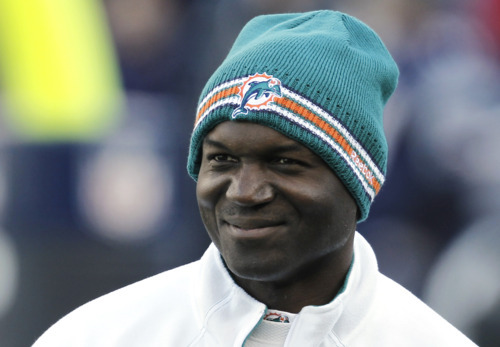
With the new hire of Todd Bowles as secondary coach, I suppose the answer is Juan Castillo.

Surely Andy Reid will tell the press today that he always planned to retain Castillo, but we don’t have to believe him. The Eagles were turned down by Steve Spagnuolo and others before they settled back in for another year of “the offensive line coach?” Castillo, who could already rely on “assistant” Jim Washburn for the defensive line, now has Bowles coaching up the defensive backs.

On the surface, given Castillo’s return, the Bowles move is quite positive. He has a long history in the league and was respected enough by his players that the Dolphins promoted him to interim head coach after Tony Sparano was fired.

But I doubt that Reid lured Bowles to town with anything less than absolute control over the secondary — much like Washburn has over the defensive line. And while that might bring better schemes and technique, it also establishes the second of Castillo’s underlings who actually have more power than he does. Juan’s role is rapidly reducing. Presumably he still has control over Mike Caldwell’s linebackers (for better or worse) and playcalling duties (mostly worse) — but that’s all.

Somehow, two authoritative assitants and one bumbling overseer doesn’t strike me as the formula for a successful defense.

Let me put it a different way. On The Wire, police Major “Bunny” Colvin (who bears more than a passing resemblance to Mr. Bowles) uses his complete control over the Western District to establish his own extra-legal, free-drug zones to isolate the gangs in uninhabited areas of Baltimore. It’s a brilliant plan in its own right, and succeeds in cutting down on violence.

But, (spoiler alert) it can’t last. Colvin’s plan is incompatible with the rest of the police force, especially his backwards superiors. Change within a corrupt bureaucratic organization is difficult, and it has to start at the top. You can’t fix problems and spearhead better policies without a cohesive plan pulling it all together.

By removing Castillo further from on-the-ground responsibilities, Reid has addressed the symptom of poor coaching without removing the cause — the lack of an experienced defensive coordinator who can actually take control of the whole defense. Until that changes, I will remain pessimistic about the unit’s future.

Photo from Getty.

The Eagles Future at Fullback

Only five teams in the NFL gave fewer snaps to their fullbacks in 2011 than the Eagles. Owen Schmitt had almost no impact on the offense, registering only 173 snaps — almost half the snaps of fourth/fifth wide receiver Riley Cooper. That’s a sharp decline from 2010, when Schmitt took over for Leonard Weaver after the first game and played in 352 snaps.

Moreover, Schmitt’s contribution on the field was limited. He carried the ball four times, ran passing routes 73 times, and pass blocked 25 times — all tasks that could have been better performed by other players. Even his 71 run blocking attempts, just over 4 per game, were at best at replacement level.

Overall, Schmitt is entirely expendable. Either through free agency or the draft, it wouldn’t be difficult to upgrade the fullback position.

However, the Eagles have long been uninterested in investing even moderate resources at fullback. Leonard Weaver was an exception, but he was also a great change-of-pace running threat. Without him, the Andy Reid has reverted back to ignoring the position. And even more so this year, as he often utilized two tight end formations with Clay Harbor instead of employing Schmitt.

The question is what to do going forward. I have no interest in retaining Schmitt or another player of his caliber. It’s a wasted roster spot that provides special teams snaps and poor offensive return.

Instead, I’d like to see the Eagles turn their diminished use of the fullback spot into an asset, by converting the position into something worthwile. How so? I can think of two ways.

The first would be to find a new version of Weaver, the RB-FB hybrid. Dion Lewis looked like he may be capable of holding down LeSean McCoy’s back up spot next year. However, his running style isn’t exactly bruising. If the Eagles signed someone like the Chiefs Le’Ron McClain, he could fill that dual role of FB-RB, and potentially free up a roster spot somewhere else. Stanley Havili — anyone remember him? — had a redshirt year on the Eagles practice squad. A draft option (taken as the most speculative of recommendations) might be Baylor RB Terrance Ganaway, who happens to be the Jeremiah Trotter’s nephew.

The second option would be to look for a more versatile H-Back. Harbor is already filling this hybrid role somewhat for the Eagles, although he’s more likely to line up as a wide receiver than as a fullback. With the offense going to more and more two tight end sets, it would be nice to keep a third guy on the roster. Having him do double duty as a part-time fullback could be a great way to get value out of the roster spot. National Football Post’s Wes Bunting projects Evan Rodriguez, tight end for Temple, as a late-round H-Back option.

The point is that keeping things as they are wastes a roster spot on a replacement-level player who is outclassed at basically every function he’s asked to perform. Even Schmitt’s role in the run game is being eclipsed. Why not try something new?

Photo from Getty.

Castillo Stays, Todd Bowles in at DBs Coach

Jeff McLane has the scoop:

The Eagles are set to hire former Miami interim head coach Todd Bowles to be their defensive backs coach in charge of cornerbacks and Juan Castillo will remain defensive coorindator an NFL source told The Inquirer on Monday.

Well, if they weren’t going to fire Juan Castillo, and they weren’t going to hire Steve Spagnuolo to oversee the defense… I suppose this is about the best you can expect.

Bowles has been a defensive backs coach in the NFL for the last 12 years. He became the Dolphins’ interim head coach after Tony Sparano was fired in December.

Andy Reid Ups the Agressiveness

Jim Armstrong at Football Outsiders analyzed “Aggressiveness Index” for coaches going for it on fourth down last season. Andy Reid ranked 12th, with an above-average .983 AI score.

What’s most interesting, however, is that over the last 12 years of data Armstrong compiled (including 2011), Andy Reid scored dead last among all 88 qualifying coaches. Over that span, Reid went for it on fourth down on only 10.6 percent of possible attempts, for an AI of .594. But last year he attacked on fourth downs 19.6 percent of the time — nearly double.

Andy was still near the bottom of the league (26th) in 2010. Seems like someone used the lockout to bone up on statistics…

Jim Washburn, the Draft, and Size at DE

Jevon Kearse Trent Cole Eagles

Linebacker is by far my preferred first round draft choice for the Eagles. Given the severe dearth of talent at that position, it’s not even a particularly close decision in my mind.

That said, teams shouldn’t reach too far for need. You should attempt to select the best player available, lest you end up with another Danny Watkins. With that in mind, I could easily see the Eagles going with a different position in the first round, perhaps cornerback after they trade Asante Samuel, or, more likely, defensive line.

Whether or not it’s the first round, Jim Washburn could use an infusion of youthful talent along the front four. Trent Cole and Jason Babin are both Pro Bowl-caliber ends, but they’re both closer to the end of their prime than they are to the start — and the situtation behind them is murky. Brandon Graham is coming off a serious injury and a lost season. Darryl Tapp and Philip Hunt have had their moments in the Wide Nine, but neither can be trusted to take over as a starter if needed.

The defensive tackle spot is in a similar situation, but I’m just going to look at defensive ends today. The question is, what kind of end does Washburn want? And the answer to that question suggests that there may be more turnover than we think.

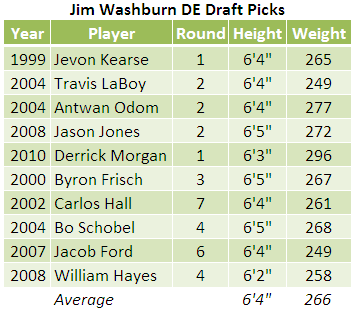
Jim Washburn DE Draft Picks At right are the defensive ends selected in Tennessee in the 12 years Washburn was coaching there. He must have had tremendous input into which players were taken. In theory, these are players that are prototypical for what Washburn wants to do at the position.

The thing that jumps out at me immediately is their size. Washburn’s only drafted two defensive ends shorter than 6’4”. And his free agent picks have all been in that 6’4”-6’6” range too: Kyle Vanden Bosh, Dave Ball, Kevin Carter, etc.

It’s just an interesting piece of trivia until you look at the Eagles current group of ends. Tapp is only 6’1”. Hunt is 6’0”. Graham,at a generously labeled 6’2”, would (given the opportunity) be the smallest defensive end who’s ever started for Washburn. Now, this doesn’t rule them out completely. If they’re good enough they’ll play, regardless of size. Both Cole and Babin, listed at 6’3”, are still on the small side of Washburn’s range.

(Note: Washburn’s tackles have been on average 6’3”. Only Cedric Thorton and Antonio Dixon currently fit that mold.)

But, with that in mind, I wouldn’t be surprised if those two and Graham are the only players at defensive end who return in 2012.

Tommy Lawlor, the authority on all things Eagles draft, mentioned some of the defensive ends scouting consultant Phil Savage talked to at the Senior Bowl. Based on Washburn’s preferences, I would be surprised if the Eagles selected the relatively short Melvin Ingram or Courtney Upshaw. Cam Johnson, a player Tommy likes a lot, would a more natural fit at 6’4”.

Come April, the Eagles have ten draft picks. I could easily envision a scenario in which they spend four of them on the defensive line, and at least two at end. And when you’re shuffling through prospect profiles for a preview of players who might end up in Philly, keep your eye on height as a key factor.

Photo from Getty.