Howie Roseman Reevaluating the Draft Process

Jason Pierre-Paul

One of the headlines coming out of Howie Roseman’s comments yesterday (here and here) was that the Eagles GM is open to changing his draft strategy, given the results so far. His exact words were:

“I think those are things that you have to look at and kind of evaluate and see if maybe you’re putting too much weight on one area and not another. Those are the things that you got to learn from and figure out.”

It was a vague statement, but one I’m glad to see. The last two drafts have been poor overall, and it’s vitally important that Roseman reevaluate his decision-making process going forward.

Regarding that process, Roseman had a few more quotes that shed light on some of the areas we had only assumed from his draft results. For example, Howie admitted that drafting the best player on the board is difficult when “human nature” gets involved and “you are pushing things up because there are things you want and whether that’s a specific position or a specific quality in a player — whether that’s toughness, intelligence, leadership.”

I’ve noted in the past that Roseman has almost exclusively drafted high character players with proven track records from big schools. Perhaps that’s a winning philosophy in general, but it has caused some notable misses (including everyone’s favorite bugaboo Jason Pierre-Paul).

Roseman expanded those thoughts regarding Brandon Graham:

“We’re talking about a guy that played four years at Michigan, was a two-time captain, averaged ten sacks a year. There was a great track record of success. I think for us, it wasn’t so much about the other players as it was the consistency he showed in college. A lot of times when you’re into the draft you have these decisions about making kind of what we talk about — doubles vs. Dave Kingman trying to go for the long ball. I’m not talking about a particularly player here, but those are some of the tough decisions that you have because you have other factors involved.”

Kingman, the 6’6” slugger/strike out artist from the ’70s and ’80s, sounds like an oblique reference to Pierre-Paul, but the point applies generally as well. With picks like Graham, Nate Allen, Danny Watkins, and Jaiquawn Jarrett, Roseman has tended toward safe, “doubles” players with leadership and steady performance — if not tremendous upside.

Maybe that’s reassuring, since all but Jarrett have at least shown the ability to be solid NFL starters. But we’re also not looking at any of these guys saying, “Wow,” like we are with DeSean Jackson and LeSean McCoy — players who had big questions marks coming out of college but also amazing star potential.

The final comment I want to highlight stems from a rewriting of history that Roseman supporters have often used:

“We feel like we’re having success, and if you get five or six players in every draft who make the team and three of them are starting, you’re drafting pretty well. Do we want impact guys in the first round? Of course we do. We want to draft those Pro Bowl guys and hit on every guy in the first round, but we’re going to look under every rock for impact guys, and if we get them in the sixth round or from the CFL or in free agency, the main thing is getting good players who can help us win.”

Roseman has done well at finding contributors in the later rounds, guys like Jamar Chaney, Kurt Coleman, Brian Rolle, and Jason Kelce. But other than Kelce (whose rookie season was overrated), none of these guys look like starters on a playoff team. They were starters for the Eagles in 2011 because of failures in the earlier rounds, and performed at about replacement level. More “successful” results like that won’t help the team get back to the Super Bowl any time soon.

At least Howie seems to realize that.

Photo from Getty.
Senior Bowl Nuggets

If I’m going to bash him for his poor articles, the least I can do is commend Jeff McLane for giving us fun anecdotes from the Senior Bowl:

A few funny/odd moments from the Senior Bowl today. When @LesBowen and I were going to have our q&a with Howie, Drew Rosenhaus spotted us and said to Howie, “Don’t let them double team ya, Howie.” Um, OK. So, Drew, will DeSean be OK with the franchise tag? “Uh, no comment.”

The other came when we were talking to Washburn and Les teased him about the report that he kept Spags from coming to the #Eagles, and as Les went to pat him on the shoulder, Wash gave him a swim move & swatted his hand away. “Good Times with Wash” should be a reality show.

For actual, consequential notes, I suggest you visit Jimmy and Tommy, since they are killing it from Mobile.

The Mess of Pro Bowl Cornerbacks

Nnamdi Asomugha and Dominique Rodgers-Cromartie

It’s quite a feat to turn a strength into a weakness. That’s what Juan Castillo and Johnnie Lynn managed to do to the Eagles’ elite trio of cornerbacks.

Coming into the season, the three Pro Bowlers were supposed to be an asset that covered up the Eagles inexperience at safety and linebacker. Instead, we were frequently left to wonder if the coaches had any plan to use them effectively at all. The biggest problem was that through most of the season no one figured out how to play Asante Samuel, Nnamdi Asomugha, and Dominique Rodgers-Cromartie all in the same lineup.

After they decided not to trade Samuel, the Eagles assumed that Rodgers-Cromartie could man the slot, a position he was uncomfortable with from the start. In yet another example of poor self-scouting, that turned out to be an awful idea.

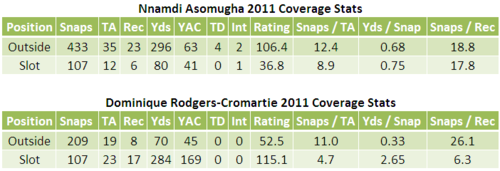
Courtesy of Pro Football Focus, here are Asomugha’s and Rodgers-Cromartie’s stats at the two positions (Samuel played almost exclusively outside):

Nnamdi Asomugha Dominique Rodgers-Cromartie 2011 Coverage Stats

Starting with Asomugha, it’s worth noting that by these metrics he was stellar. Among cornerbacks with at least 25 percent of snaps, Nnamdi ranked first overall in coverage snaps per target, sixth in yards per snap, and second in snaps per reception. Each figure was down from 2010, as he was targeted more often, but they were all still elite.

Regardless, Asomugha provided similar performance no matter where he lined up. He had slightly more targets in the slot, but didn’t allow anything big.

Contrast that with Rodgers-Cromartie, who posted a massive split playing in two different positions. Out of the 44 corners last year with 25 percent or more slot snaps, he ranked 39th in snaps per target, 44th in yards per snap, and 41st in snaps per reception. That is awful. He was arguably the worst slot corner in the NFL.

Put Rodgers-Cromartie outside, and everything changes. In fact, DRC’s numbers on the outside were even better than Asomugha’s. As bad as he was on the inside, Rodgers-Cromartie was one of the best corners in the league when he was playing at his natural position.

Toward the end of the season Rodgers-Cromartie began to get more snaps outside. Partially that was to replace an injured Samuel, but even before that Asomugha would often play the slot in nickel and dime. Clearly, that was a much better defensive formation than what they had going on earlier — and that it took so long to implement is another black mark against Castillo.

Looking forward, I expect Samuel to be traded, freeing up space for DRC to play outside all the time. While Asante is still a great cornerback, playing to everyone’s strengths will be easier next year. The cornerbacks might actually be the fool-proof strength we all expected six months ago.

Photo from Getty.

The Inadequacy of Opponent Adjustments

Semi-annual blogger Derek Sarley:

VOA is a measure of how well a team has played and DVOA corrects for opponents, so you can throw out any concerns about strength of schedule and say things like “DVOA proves the Eagles have the league’s twelfth-best defense, even if you claim they didn’t play very many teams that were any good.”

Except you can’t. DVOA says nothing of the kind, as we can best demonstrate with a couple of charts. Here’s the first one, plotting this season’s DVOAs against VOAs:

Long story short, opponent adjustments are nice, especially for comparing teams quickly. But DVOA and its ilk will never be able to provide a complete understanding of a single team or unit. Even advanced stats need context.

Washburn and Spagnuolo

Peter King:

Someone Who Knows told me a major roadblock to Steve Spagnuolo taking the defensive coordinator job in Philadelphia was the presence of very strong personality Jim Washburn on the defensive line.

This doesn’t surprise me. The Wide Nine was always a red herring in talks about whether a new coordinator would be compatible with Washburn. The bigger issue is that a new coordinator would have to cede all control of the line to his supposed underling. Remember, Washburn doesn’t take orders from anyone.

'Yes, But in Some Cases No.'

Jeff McLane:

Is there any correlation between size and regular-season success? Yes, but in some cases no.

Let me summarize this article for you:

What if the problem on defense is because the Eagles draft small players? Could it be? Maybe, if I repeat the question enough. They are undoubtedly small, though. Well, unless you compare the Eagles to similar defenses. But I’ll call them tiny anyway. Does it matter? This small sample size says yes. But not this slightly larger group. Forget it, I’m just going to cherry pick some stats that support my argument.

'We Can Just Let Him Walk'

Jason Wilde, for ESPN Milwaukee:

“You look at it now, even though they’re saying that stuff, before the season and throughout the whole offseason, everybody had that attitude that they could just replace me, that I was just another player. ‘We can just let him walk,’” Jenkins said in a telephone interview Wednesday afternoon. “Certain players spoke out publicly about guys they hoped they’d bring back, but back then you didn’t hear anybody say too much about me. So I don’t pay it too much attention.”

The Packers’ loss was the Eagles’ gain. I’ll be surprised if the Eagles choose to cut Jenkins just so they don’t have to pay him the $5 million roster bonus in March.

Steve Spagnuolo and a Franchise on the Decline

Steve Spagnuolo

Just a few weeks ago, Jeffrey Lurie stood behind the podium and argued that retaining Andy Reid representedthe best chance for the Eagles to win a Super Bowl next season. But as Steve Spagnuolo, the odds-on favorite to replace Juan Castillo, chose New Orleans instead, that wisdom comes into doubt.

Regardless of playoff results, Lurie was right when he said that the true class of the NFC is represented by the Packers and Saints. Everyone else is playing catch up. And on a day when the best defensive coordinator on the market picked the Saints instead of the Eagles, Reid’s team looks like it’s only losing ground.

Let’s be clear. Regardless of the length or seriousness of the talks between him and the Eagles front office, Spagnuolo knew what he’d be getting into in Philadelphia. He knows Reid, the front office, the situation on defense, probably better than he did the Saints job or any other. The fact that he avoided returning to Philly doesn’t bode well for the Eagles organizational health.

I would say that Spagnuolo’s preference to stay away represents a certain canary-in-the-coal-mine warning, but we already had that last year when the Reid fell back to Juan “Plan H” Castillo. The head coach has had success luring older, mercenary-type assistants to the staff in the last two years. Bobby April, Jim Washburn, Howard Mudd have all had positive impacts on the team. But Reid has now struck out twice (three times if you count McDermott) in trying to bring an experienced veteran in to run the defense.

Lets go back to the Packers and Saints for a moment and their two great offensive-minded head coaches in Mike McCarthy and Sean Payton, not unlike Andy Reid. Both have utilized “defensive head coaches” to win a Super Bowl — Dom Capers and Gregg Williams. Now Steve Spagnuolo will slide into the spot in New Orleans vacated by Williams.

The Eagles used to have a defensive head coach in Jim Johnson. Reid knew his limitations and almost won a Super Bowl with Johnson dialing up blitzes independently from his oversight. Payton and McCarthy have stolen from that playbook, but Reid’s original copy is gathering dust in a closet somewhere.

When Reid announces next week that his first choice at defensive coordinator was always bringing back Castillo, not only will he be lying, but it will be an example of how far he’s fallen from the realm of elite NFL coaches, as well as the latest indictment of an organization stuck in neutral.

Perhaps next season will provide a rebound playoff year, and both Reid and Howie Roseman will refurbish their reputations. But sitting here right now, it’s tough to be anything but pessimistic about the future of this franchise.

Photo from Getty.