Risk, Reward, & Injuries: Why Sign Steve Smith?

Just when you start to think that the Eagles are done making free agent moves, they go out and get former Giants Pro Bowl wide receiver Steve Smith. It was an addition that was as confusing as it was surprising.

Andy Reid’s public explanation was predictably simple: 

“Like I’ve said many times before, Howie Roseman and I are always keeping our eyes open for good football players and players that we think can help our football team win, and Steve Smith certainly fits that category. He’s a Pro Bowl-quality receiver that we will work into our offense as soon as he is ready to go. We feel very good about our current group of receivers, and Steve adds another dimension to that position. He’s played very well against us in the past few years and we’re happy to have him on board.”

I don’t think Reid was lying, per se. All of the above is true. But I find it hard to believe that the move had nothing to do with Jeremy Maclin’s injury.

In the abstract it’s nice to add a player of Smith’s caliber at the low price of $2 million, especially from your division rival. But his microfracture surgery seems to have scared off most other teams, including the Giants. There’s no reason to take on that risk if you’re confident all the pieces from one of the best wide receiver groups in the NFL last year will return. DeSean Jackson, Maclin, and Jason Avant crowd out any need for another starting-caliber wideout.

Again, unless you’re worried that they won’t all be ready to play this season. If Maclin can’t play, suddenly you have a concussion-prone star, a good slot receiver, and nothing but potential and promise. Riley Cooper hasn’t shown that he can start in the NFL. Neither has Chad Hall or Sinorice Moss. No one wants to count on them making a big leap.

To me, signing Smith reeks a little bit of desperation. Obviously the contract isn’t particularly expensive, and thus the risk isn’t too great. But when a guy of Smith’s talent can be bought at such a low price and his former squad chooses not to match it, you have to wonder if the beachfront property you just purchased really exists. 

The Eagles are saying on background that they hope Smith won’t have to miss any games. Hopefully that’s true for Maclin as well, and Smith ends up being just a shrewd insurance policy. But let’s just say I’m less optimistic about that likelihood than I was yesterday.

Photo from Getty.
Eagles First Preseason Game: What to Watch For

The Eagles have their first preseason game on Thursday night. Yes, it is that soon. Despite free agency still underway for a number of players and a grand total of a week and a half in camp, the Eagles will take on the Baltimore Ravens tomorrow night.

For many teams and players, these preseason games are meaningless. For example, I don’t expect to see much from LeSean McCoy, who’s primary goal should be to stay injury free. And Andy Reid has already intimated that none of the starters will play deep into the game. However, there are some things I’ll be looking for:

How is the defensive line embracing Jim Washburn’s attack-first scheme?  I’ll be interested to see what kind of pressure the front four can get in the early going tomorrow. The defense probably wont be blitzing much, so the game will be an interesting first test of Washburn’s system. Even with a number of defensive linemen banged up, hopefully they’ll be able to cause some chaos in the backfield.

Who plays center and right tackle? Rookie sixth round pick Jason Kelce has shared repetitions with injured incumbent Jamaal Jackson in practice, and seems like a leading candidate to usurp the job Jackson once took from Hank Fraley. Keep an eye on that position. Also, check out Ryan Harris, Austin Howard, King Dunlap, and anyone else who gets a shot at right tackle. With Winston Justice on the Physically Unable to Perform list, it would be nice to see that the Eagles have an adequate insurance policy.

How reliable will the new kicking specialists be? While special teams coverage units will be hard to judge, given the ephemeral nature of the roster’s bottom half during free agency, the kicking game itself is basically the same from preseason through the playoffs. I’ll be watching rookie punter Chas Henry and rookie kicker Alex Henery closely.

Will Casey Matthews and the rest of the unheralded young linebacker corps avoid mistakes? As I said yesterday, the best I’m realistically hoping for the linebackers is for them to be average. But even that low level of expectations requires that they play smarter and more experienced than they actually are. The base defenses and relatively simple offenses deployed in the game on Thursday will be a good first test.

Photo from Getty.

Time to Worry About the Eagles Linebackers?

For Eagles fans that I’ve talked to, the position of worry seems to have seamlessly migrated from cornerback to right tackle since free agency began. Even with promising training camp play by new addition Ryan Harris, there still appears to be more concern directed at that spot than anywhere else.

Yet I hear very little worry about another every-down position that seems even more tenuous: linebacker.

Perhaps people are dissatisfied with the position but have resigned themselves to mediocrity, given the  lack of resources that the Eagles have put into it in the Andy Reid era. But I get the sense that there is actually a lot of positive thinking about linebacker, where the Eagles are set to start a 4th round rookie, a sophomore 7th round pick who started less than a handful of games in 2010, and a third year 7th rounder who has done little of note during his time in Philly.

Casey Matthews, Jamar Chaney, and Moise Fokou are young and promising, and I understand the optimism. But then you look at the stats and you have to wonder.

64 linebackers were drafted between the 3rd and 5th rounds over the last five NFL drafts. Exactly zero of them started a full season their rookie year. Only three players even managed to start more than six games, and the player who started the most was former Eagle Chris Gocong, with 12 games. That doesn’t inspire confidence in Matthews.

Here’s a depressing stat for you: out of all the rookie to third-year linebackers drafted in the 3rd through 7th rounds playing in the NFL during the last five years, their combined Pro Bowl appearances is one. How about another? The Eagles are set to start two former 7th round picks. No linebacker drafted in the final round in the last ten years has ever made a Pro Bowl - in any year of his career.

None of this proves anything about the three guys the Eagles have lined up to start. Maybe they can buck the trend. Maybe the scouts have found three diamonds  in the rough. But all the linebackers who came before them say that the ceiling is pretty low. No one should realistically hope for Pro Bowl seasons from these guys, nor should anyone even count on Casey Matthews to start the whole season - and who is his backup?

At best, temper your expectations. They could be average or above average linebackers, although that seems like an optimistic result right now, not a statistical likelihood. At worst, be prepared (yet again?) for linebacker to be the weakest link on the Eagles defense.

DeSean Jackson's Contract Negotiation Primer

With DeSean Jackson reporting to camp at Lehigh, worrying can end about the ramifications of what I considered to be one of the least worrisome holdouts in recent memory. Jackson is, by NFL standards, ridiculously underpaid. As a budding star, he deserves to be compensated better than the long snapper.

Gaining whatever leverage he could from holding out affected nothing about the season. We didn’t really want DeSean getting hit and potentially injured in meaningless practices anyway. And there was never any doubt in my mind that he’d eventually report.

The more interesting question now is how long it will take for the Eagles to give him that new contract. The team told the press that they wouldn’t negotiate with a player holding out. Now there’s no such excuse. Discussions should begin immediately, if they haven’t already.

On one hand, the deal should get done quickly. The market for an established, young, number one wide receiver is set. Look at the numbers for the latest contracts and the age at which these wideouts signed.

Santonio Holmes (27): 5 years, $50 million, $24 million guaranteed.
Miles Austin (26): 7 years, $57 million, $18 million guaranteed.
Brandon Marshall (26): 5 years, $47 million, $12 million guaranteed.
Roddy White (27): 6 years, $48 million, $18 million guaranteed.

White got his deal in 2009, and the average was $8 million. Last offseason Marshall and Austin averaged $9 million a year. Holmes extracted $10 million per season from the Jets a week ago. I would expect about $10 million a year for any contact extension DeSean would sign. That’s the easy part.

But there could be two sticking points in the deal. The first is guaranteed money. The Eagles were already going to be shy about giving Jackson the most guaranteed dollars given his concussion history and slight frame. One big hit could knock him out of the NFL. The Holmes deal, furthermore, raised the bar substantially with $24 million guaranteed. If Drew Rosenhaus wants to use that contract as a guide, it could be more than the Eagles wanted to spend. (Note: as a free agent Holmes had more leverage.)

An even bigger problem could be the length of the deal. Jackson is only 24, younger by two or three years than his comparables. The Eagles, given the risk they probably feel they are assuming with a large contract, will want control over all of DeSean’s prime years. Jackson will want the opportunity for another payday down the line.

Here are my guesses. Given the market, I expect Rosenhaus to start with a deal that would beat Holmes: 5 years, $55 million, $24 million guaranteed. The Eagles first counteroffer might be more like an updated version of Austin’s contract: 7 years, $60 million, $16 million guaranteed.

A fair deal might be something in the middle, perhaps 6 years, $60 million, $18 million guaranteed, although a lot depends on leverage in the negotiations. DeSean won’t want to risk injury without a payday, which the Eagles can basically force him to do. But the Eagles don’t want to lose Jackson in free agency next year. Something’s gotta give.

Photo from Getty.

Get More McNabb or Kolb in the '11 Eagles Annual

Thank you for your continued support of McNabb or Kolb. Glad to see lots of Eagles fans enjoying the free agency bonanza and the start of training camp. It’s an exciting time.

No big new post today. Just wanted to alert you to more great Eagles content. The 2011 Eagles Annual from Maple Street Press is available for order online now and should be on bookshelves in the Philly area soon.

Yours truly penned a piece on the evolution of the passing game from Donovan McNabb through Kevin Kolb to Michael Vick, with a bunch of stats that I had wanted to use for a while. Check it out.

There’s a ton more content where that comes from. Having just received my copy in the mail yesterday, I can tell you it’s 112 pages of pure Eagles analysis, with no ads (kind of like this site). Besides myself, many of your other favorite bloggers lent a hand to the magazine.

Jason Brewer at Bleeding Green Nation was the issue editor. Jimmy Kempski at Blogging the Beast wrote articles about the NFC East competition, Andy Reid, and the Eagles sophomore class. Tommy Lawlor of Iggles Blitz contributed characteristically detailed pieces on the rookies, assistant coaches, and the historic 1991 Eagles squad. Sam Lynch, cap maven, broke down the principles that keep the Eagles on top. Gabe Bevilacqua, also known as everyone’s favorite Bounty Bowl, looked back at the Buddy Ryan days. And, certainly not least, Tom McAllister, who wrote Bury Me in My Jersey, reflected powerfully on the moral quandary of rooting for Michael Vick. Plus much more.

If you are as dedicated of an Eagles fan as I think you are, you’ll want to pick up a copy.

Eagles Front Office Outsmarted Everyone Else

It’s not easy to explain the free agent binge the Eagles have embarked on over the last week. People have tried, of course, but I can’t help but find most of their explanations lacking.
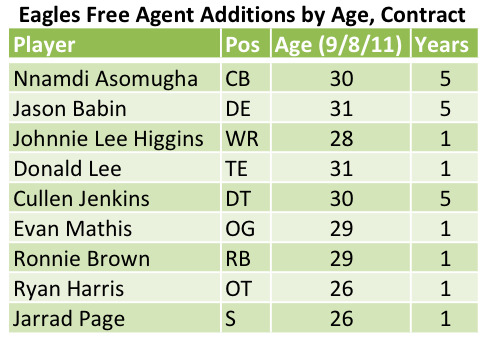
Donovan McNabb’s resentful commentary, as told to Clark Judge, certainly isn’t right. He whined, “You’re seeing Andy taking that chance. It’s not just taking that chance on one guy. They’re taking a chance on a bunch of guys. And they’re spending money. That’s amazing.”

It’s not as easy as saying that Reid and company have changed up, become more aggressive, more willing to spend, or more risky overall. The Eagles front office has never hesitated to go after the best free agents, signing guys like Jevon Kearse, Jon Runyan, and Asante Samuel. While they’ve been prudent with their money, that’s never been a big restraint. And, considering all but the Nnamdi Asomugha deal can be opted out of after a year, they’ve certainly hedged against risk.

I look at the list of free agents additions at right and I don’t see a big shift in philosophy. Some of the guys are older, but they’re top players still in their prime, not fading former stars. And, to reiterate, they haven’t let themselves get too risky with the deals.

Plus, the veteran acquisitions hide the fact that the rest of the Eagles lineup is still very young. A month back I pointed out that the team was poised to have Michael Vick potentially be the oldest Eagle in 2011. That’s unlikely now, but the overall point remains. This team is still young — even after adding a few 30-year-old veterans — and the bounty of 2012 draft picks beckons.

So what has changed? It’s not a willingness to spend or accept risk. It wasn’t aggressiveness that won the free agency period for the Eagles. Nor was it some fateful passing text messages in the night.

It was brains.

Read Jonathan Tamari’s Inquirer story about the Eagles preparation for the end of the lockout and free agency and tell me that the front office’s “blueprint” didn’t run circles around the rest of the league.

Carolina, for example, jumped into free agency like a chicken with its head cut off, throwing huge signing bonuses at every player who threatened to leave. Washington signed so many washed up veteran wide receivers that one backed out of his commitment. The Jets and Cowboys spent days pursuing Asomugha and came up empty.

Meanwhile, during the same window, the Eagles front office signed all their draft picks, picked a bunch of undrafted rookies, traded Kevin Kolb at high market value to the only team who was really interested, signed two Pro Bowl defensive linemen, snatched up the single best free agent with a surprisingly low deal before anyone knew they were even bidding, and then plugged cheap, proven contributors into the remaining holes with cap room to spare.

It makes sense. During the Andy Reid era, the Eagles have always been best at pregame preparation rather than live adjustments. And what was the lockout, ultimately, but an extra long chance to do nothing but plan, prepare, and scheme for the first days back?

Essentially, the Eagles just ran the best first 15 scripted plays they’ve ever called. The outcome of the whole game remains far from decided, but they now have a tremendous head start.

Photo from Getty.

Asante, Asomugha, and Apocryphal Aces

Asante Samuel Nnamdi Asomugha Philadelphia Eagles

Right before free agency began, I started to write a post about what the Eagles could learn from the Phillies. I noted some of the similarities between two front offices that in recent years have been aggressive as well as value-oriented. But I also pointed out that the Eagles might do well to follow the cross town example of Ruben Amaro, who has no qualms about going for it all without qualification.

At the end of the post, I was going to recommend that the Eagles look seriously into signing Nnamdi Asomugha, despite my previous reservations. Adding him, in tandem with Asante Samuel, was as close a move as I could come up with to the Phillies signing Cliff Lee to assemble the Four Aces. Of course, what I didn’t anticipate was that the Eagles would actually follow through on that unpublished suggestion.

Unfortunately, after Samuel’s press conference yesterday, it has become clear that the Eagles may have learned the wrong lesson from the Phils. To put it bluntly, I don’t expect Asante Samuel to still be in Philly a week from now. As I’ve said in other places, this looks a lot like a “trade for Halladay, trade away Lee” deal.

And that’s a shame. There’s a reason the Phillies reversed course and resigned Lee last offseason. Plus, I’m just not sure what the Eagles can get for Asante at this stage. As far as I can tell, the Eagles valued Dominique Rodgers-Cromartie as a second round pick. Samuel is certainly worth more than that. As a consistent Pro Bowler and interception machine, Samuel should command a first round pick in 2012 (only worth a 2011 second rounder) plus something else, like another player or mid round pick. Is any team going to be willing to pay that price?

Hedging bets to be competitive today and in the future has made the Eagles a paragon of consistency. But sometimes you have to break your own rules. Reward requires some risk.

* * *

A couple more notes about the deal.

First, watching Asomugha’s press conference, you can tell he might be the more articulate player to take the microphone in Philly in at least the last decade. Not to slight other geniuses in the locker room, but the man used “apocryphal” in a sentence. He’s raising the bar on and off the field.

Additionally, check out this quote:

I did it the way I like to do it, making the decision early. So that decision was made in March. So once we made that decision, we put all the pieces together, marked off the boxes, saw what we thought was the best fit — when that comes around full circle, you got to go with it.

Was that Nnamdi describing his free agency decision, or Howie Roseman describing the Eagles offseason process? Perfectly in sync.

* * *

Finally, I think if the Eagles do keep Asante, they run the risk of discovering that either he or Nnamdi isn’t quite as good as they thought. When you have one great corner, all the passes can be funneled to the other side. But two great corners means teams will be forced to choose. Whoever they choose would be the weaker link.

Photo from Getty.

What We Learned: Eagles Hated the 2010 Defense

Nnamdi Asomugha Philadelphia Eagles Free Agency Defense

The Eagles defense in 2010 wasn’t awful.

Let me just throw that out there. Football Outsiders ranked the Eagles D 14th in the NFL. That’s better than the median, if only slightly. Similarly, Cold Hard Football Facts placed the Eagles 9th in Defensive Hog Index and 11th in Defensive Passer Rating. Not bad.

Plus, it’s easy to lay the blame for the problems the Eagles did have on a couple specific spots, starting with Sean McDermott’s overcomplicated and ineffective schemes. When he was fired back in January, it was widely perceived to be the biggest change the Eagles would make. McDermott didn’t work out, he was the problem, etc.

But it wasn’t just McDermott who was let go. Andy Reid, for the first time, purged almost the entire defensive coaching staff. He fired defensive line coach Rory Segrest next. He declined to renew linebackers coach Bill Shuey’s contract. He didn’t push to keep secondary coach Dick Jauron around after just one year.

In promoting two assistant positional coaches, picking up Jim Washburn and Johnnie Lynn, and moving Juan Castillo to lead the operation, Reid couldn’t have made a more drastic coaching change. The focus, the scheme, the technique, the personalities — new faces all around.

During the lockout lull, you would have been forgiven for having thought such a major overhaul (on a scale we’d never seen before) was the end. You might have hoped for a new cornerback in free agency to fix that revolving door of ineptitude, but what else did you expect? The change already happened. McDermott wasn’t solely to blame, but coaching was.

Then free agency rolled around, and suddenly the Eagles front office was executing a similarly radical shift in player personnel. The offense went largely untouched, but the defense was gutted and rebuilt. Bye bye to defensive stalwarts like Quintin Mikell and Stewart Bradley. Replace them with rookies and other unproven youngsters. Grab a new RCB in Dominique Rodgers-Cromartie. Sign a new starting LDE in Jason Babin. Another new cornerback: the esteemed Nnamdi Asomugha. A new starting defensive tackle, Cullen Jenkins. Ship Brodrick Bunkley off. Asante Samuel is probably next. Overall, in addition to a brand new coaching staff, the Eagles will likely have at least six new starters on defense.

It’s clear to me now that Andy Reid and the rest of the front office thought the defense, despite anecdotal and statistical evidence to the contrary, was awful in 2010. You don’t replace almost everything about the defense if you think the unit was above average, unlucky, or close to a rebound. Nor do you take this path if you can lay the blame just on or two aspects. In fact, there isn’t a team in the NFL right now that has so dramatically overhauled their defense - even the ones that, on paper, were significantly worse.

Note that I don’t yet call it an improvement. Making that judgment will take time, as new layers assimilate, younger players step up, and new coaching doctrines sink in. There are still question marks, especially at linebacker and safety. The change was extreme, but it’s not yet complete. Plenty of time to see if the revamped Eagles defense is really what was needed.