Andy Reid, Trying Something New On Defense

Andy Reid Philadelphia Eagles Coaching Scheme Change

One item picked up around the blogosphere recently is a quotation by soon-to-be-former Eagles safety Quintin Mikell as told to Geoff Mosher:

“I kind of get that vibe,” Mikell said, when asked if the Eagles were shifting from an aggressive, blitz-happy attack to a tempered Cover 2 scheme. “I know Coach Reid has wanted to run the Cover 2 for a long time. It seems like the past couple of years we’ve been slowly progressing toward that. It might be moving toward that. I think he [Castillo] is going to kind of tweak things here and there. It’s gong to be kind of the same 4-3 but I think it’s going to be a little less based on scheme and more based on guys just kicking somebody’s butt.”

The Cover 2 defensive scheme has a number of variations, but overall it is the opposite of the blitz heavy system that the Eagles have employed through the tenures of Jim Johnson and Sean McDermott. Cover 2 typically involves a lot of zone coverage and preventing big plays rather than pressuring the quarterback above all else. And there are a lot of reasons why such a system makes more sense for this Eagles team.

However, what really strikes me is not the formation change, but the notion that Andy Reid may have wanted to try a different scheme out for a long time. NFL coaches typically spend their entire careers emphasizing the same system with the same type of coaches. Especially guys like Reid, long term successes, don’t often change their ways. But that is exactly what Reid has done, both on the offensive line, bringing in Howard Mudd, and on defense, where he seems to be letting Juan Castillo change a system that has largely been the same for the last 12 years.

This offseason was really the first chance Reid had to shake things up on defense. Even when Jim Johnson passed away, it happened too close to the start of the season to let anyone other than McDermott carry on. But with that chapter closed, Reid can start fresh. And he appears to be taking full advantage of that opportunity. We’ll see how it turns out.

Photo from Getty.
Howard Mudd: O-Line Genius or Overrated?

Howard Mudd Offensive Line Coach Philadelphia Eagles

Last year, I questioned Bobby April’s track record as a genius special teams coach. His results were not quite as stellar, nor his turnarounds as quick as many people seemed to suggest at the time.

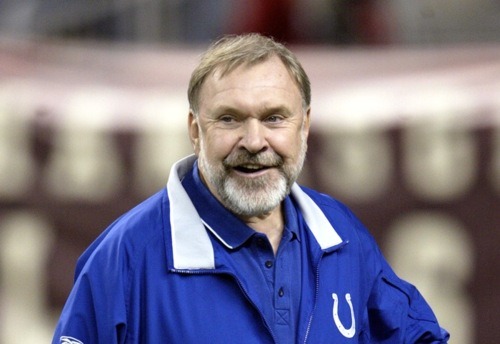
This offseason we have new darling, genius, best-in-the-NFL assistant coaches in Philadelphia. Most notable is offensive line coach Howard Mudd, whom Andy Reid was delighted to lure out of retirement.

Certainly he’s had a lot of success. Mudd’s tenure in Indianapolis from 1998 to 2009 was simply brilliant. In fact, if you’d gone through Football Outsiders offensive line rankings (I have), you would think there’s been a mistake. The Colts were either first or second in the NFL for Adjusted Sack Rate in ten of the twelve years he was their coach. And the only two years in which the Colts weren’t that high, their offensive line was still ranked in the top ten.

Mudd must be doing something right in order to orchestrate such great protection. Unless… it wasn’t actually the offensive line. Unless it was the quarterback. See, it just so happens that Mudd’s first year in Indianapolis corresponded with Peyton Manning’s arrival. And guess what? After Mudd retired following the 2009 season, the Manning-led Colts didn’t skip a beat. In 2010 they were ranked number one yet again in Adjusted Sack Rate.

Furthermore, while the Football Outsider numbers don’t cover years before 1996, we can still look at basic sack rates at Mudd’s previous job. From 1993 to 1997, Mudd was the offensive line coach for the Seattle Seahawks. Only in his final year did the team allow fewer sacks than the NFL average.

None of this is conclusive evidence that Mudd isn’t a great coach. But it does bring into question the evidence for Mudd’s ability to single-handedly mold the Eagles offensive line into a great unit. I hope he can upgrade the Eagles offensive line, but that’s a hope — certainly no guarantee.

Photo from Getty.

Hot Read: Keeping Kolb Redux and a PK Loss

Jeff McLane argued last week that the Eagles should keep Kevin Kolb as a backup. Or something like that. I don’t know Pig Latin.

Jimmy had a good response to that piece over at Blogging the Beast, but I think I already wrote my response back in February: How Much is Kevin Kolb Worth as a Backup?

If you remember, I looked at the statistical likelihood that Michael Vick would miss games and then calculated the average lost wins for a back up quarterback. The results were underwhelming for the “keep Kevin” camp. The difference between sticking with Kolb as the backup and moving on is - at most - half a win. The Eagles could make a bigger difference by trading for an upgrade at right cornerback or, in the long term, multiple high draft picks.

Furthermore, McLane’s biggest example, Green Bay backup Matt Flynn, actually proves that an experienced second QB isn’t necessary. Before he came on in relief of Aaron Rodgers last season, Flynn had only 20 career pass attempts and no starts. He was as big of an unknown as Mike Kafka. Plus, while he performed about as admirably as anyone could have hoped, Flynn couldn’t win either of the two games he played. The Packers survived two losses without Aaron Rodgers and went on to win the Super Bowl anyway.

* * *

I know there’s a sizable contingent of USA soccer fans out there in the Eagles-verse. For those fans, didn’t the women’s final yesterday feel familiar? An offense that had lots of opportunities to score and put the game away but fails to convert and lets the other team back in the game, ultimately losing in the final moments. Sounds like a classic Eagles loss to me.

Graham Setback Exposes Weak Defensive Ends

Brandon Graham Eagles Defensive Ends Injury

“In the National Football League you have to be able to put pressure on the quarterback; you put pressure on the quarterback it makes everybody better. It makes the secondary better, it makes the linebackers better and that really makes the offense better. They get the ball back and can score a little bit more. So, we went out and brought in some guys we felt can rush the passer.”

That’s what Andy Reid said right after the Eagles drafted Brandon Graham in the first round of the 2010 draft. His comment highlights something the Eagles have always done: spend big on pass rushers. Since Reid came to Philadelphia, the Eagles have used their first draft pick to take two defensive ends and four defensive tackles. They’ve also given out fat paychecks to free agents like Jevon Kearse, Darren Howard, and Chris Clemons.

Even though many of those moves didn’t work out, Reid obviously isn’t blowing smoke when he talks about the need for elite pass rushers. He’s putting his money where his mouth is.

Graham was just the latest example of this emphasis, and he was supposed to quickly push for a starting spot opposite of perennial All-Star Trent Cole. Graham rose to that challenge, at least at first, and there was lots of hope that he could progress substantially in his second year. Unfortunately, he suffered an ACL tear in December, cutting his rookie season short and jeopardizing his 2011 as well.

Yet now Graham’s recovery is further in doubt after the news yesterday that he also underwent the even more serious microfracture surgery on that same knee. If Graham’s recovery is anything like Victor Abiamiri’s, he might not get on the field at all this coming season. And projecting for 2012 is just foolish.

That’s a big problem for the vital defensive end unit that already could be characterized as Cole and a bunch of question marks. We weren’t necessarily counting on Graham at the start of the season, but there was always the thought he could contribute. This might eliminate the best possible contender for stepping up at LDE.

So where does that leave the Eagles? If Graham can’t be the guy, they need to go in another direction for a second pass rusher. I’m starting to think the logical step is to make yet another big free agent splash at defensive end.

Ray Edwards of the Minnesota Vikings would be a perfect fit. He’s a young 4-3 end who is used to being the number two guy across from Jared Allen. Edwards is also big — at 6’5”, 270 lbs he fits the Jim Washburn model. Other possibilities include the Panthers’ Charles Johnson or the return of Jason Babin.

If they can’t secure reinforcements, the Eagles loss of Graham could really hurt them when football returns.

Photo from Getty.

A Second Look for Sacks and Selection Bias

Michael Vick Philadelphia Eagles Sacked Statistics

I’m a big fan of the Moving the Chains blog by Sheil Kapadia. It’s nice to see a member of the “lamestream” Philly sports media embrace statistics and the fan’s perspective.

Which is why I’m conflicted about Sheil’s post yesterday, “Why Vick was sacked 34 times.” On one hand it shows some great initiative and effort to go back through all the of the Eagles sacks in 2010. But the analysis lacks context, and therefore the numbers are misleading.

Kapadia broke down Vick’s sacks by the number of opposing rushers. He was sacked 12 times with four rushers, 11 times with five rushers, and seven times with six or more rushers. That’s interesting information, but it’s incomplete. Without any context, it looks like the Eagles gave Vick the least protection when faced with minimal pass rush. But that’s not true.

I don’t have the information for last season yet, but I compiled Football Outsiders information on number of rushers from 2009 (in FOA 2010). Teams averaged four man rushes 60 percent of the time. They blitzed one extra player on 24 percent of pass plays, and rushed two or more (six players plus) just under 10 percent of the time. In other words (not to blow your mind), most teams don’t blitz anywhere close to the majority of the time.

It’s important to note such a fact when you’re listing total sacks. The Eagles likely faced four man rushes about 60 percent of the time — but only gave up 40 percent of their sacks on those plays. Meanwhile, about 60 percent of Vick’s sacks came on blitzes, even though blitzing was likely no more than 35 percent of the time. Suddenly, it looks like blitzes were a much bigger culprit for those sacks than we originally thought.

Now perhaps the Eagles were blitzed more often than most teams, or there was some other anomaly. The truth is that just looking at single set of plays that resulted in sacks is a crude and selection bias-inducing measurement. It might look like there’s correlation there, but you have to step back and consider all of the data for a more complete picture.

I’m hopeful that Sheil’s follow up post will give more context along these lines.

Photo from Getty.

On DeSean Jackson and the Maturity Question

DeSean Jackson Eagles Maturity

DeSean Jackson is a smart, mature man. I know this because Jackson had little trouble learning the NFL routes and starting in his rookie year. I know this because he’s done stand-up work against bullying. I know this because of his pitch-perfect ironic delivery during his turn selling jerseys at Modell’s.

Moreover, I know Jackson is savvy and levelheaded because he has learned from the mistakes of wide receivers past and hasn’t gone to the media with his contract issues. Knowing that keeping his mouth shut can only help negotiations isn’t a difficult concept to understand, but carrying it out when he is in front of the media constantly requires tremendous discipline.

Yet despite all of this evidence, DeSean confounds his fans by continuing to commit absolutely bonehead mistakes on and off the field. There were his goal line celebrations, parts one, two, and three — that threatened to overwhelm the actual events. More recently, Jackson’ directed gay slurs at a rude caller during an appearance on the radio.

I’m not entirely sure how to reconcile these two persona, although I don’t think (as some do) that DeSean’s public character is simply an act. That’s silly and overwrought.

Rather, I think a more likely explanation is that Jackson is simply a 24 year-old kid who still has a hard time balancing and moderating his burgeoning stardom. When he commits the time and energy to doing something the right way, he manages to be a role model as a hard working athlete, an effective community service leader, and a responsible actor in his NFL business dealings.

Paradoxically, it is his quickness that often seems to get him into trouble. DeSean’s feet and tongue tend to run a little bit ahead of his brain, and his fans suffer an uneasy twinge each time he lets a moment get away from him. Hopefully Jackson will grow out of it while he still has that one-of-a-kind speed left to burn.

Photo from Getty.

Overthinking Fandom and Infamy Off the Field

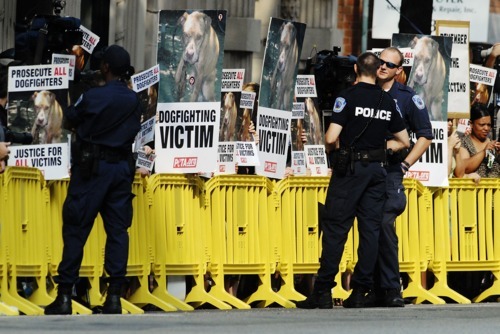
Michael Vick Dog Fighting Trial

One of the authors of the brilliant pop culture analysis blog Overthinking It wrote an interesting article after it was revealed that Arnold Schwarzenegger committed adultery and fathered a child with his maid. The main gist of the post deals with our relationship as fans of public individuals — such as actors — who engage in immoral actions in their private lives. The author grapples with a simple question:

What does it mean to be a fan of someone’s work, rather than a fan of that person? Is such a distinction even possible?

This type of problem applies to our fandom regarding a wide range of other actors and stars, as well as politicians of all parties. Is it possible to continue to support someone after they’ve done something morally repugnant?

When Anthony Weiner tweets pictures of, well… his weiner, it’s easy to denounce him and call for his resignation. But what if you agree with his politics? Scorn flows effortlessly after Schwarzenegger’s actions, but must we disavow his movies as well?

Perhaps in a previous era, when we didn’t know as much about our stars and heroes, turning a blind eye was the obvious answer. Now, even if we choose to accept their private actions, we can’t definitively separate what we know from the person in front of us, be they on the movie screen, the floor of the House of Representatives, or… running by defenders into the end zone.

Yes, ultimately this post comes back to Michael Vick.

Eagles fans seemed as outraged as anyone else when Vick’s dog fighting ring came to light. But time passes, and before we knew it there was #7 in midnight green. Some people immediately and permanently disavowed the team. Most fans adjusted, either by learning to support Vick, or by trying to dissociate his off the field crimes from his on the field feats.

Neither choice is wholly satisfying. The section of fans who quit the Eagles (and I’d venture it was a small sliver) certainly have moral satisfaction. Yet, many of us explicitly or implicitly found that the cost of abandoning our team loyalty wasn’t so easy. We wanted to both root for Vick and condemn him simultaneously. That’s a tremendous burden of cognitive dissonance.

Perhaps more than politics and film, sports fandom rests on an unambiguous moral authority. The Eagles become a sacrosanct piece of ourselves that we support against the corrupt outsiders in Dallas, New York, and Washington. The insults we hurl at opposing teams and fans far surpass what we could get away with in any other context. Disloyal stars take on new dimensions as traitors. This is part of the fun.

Unfortunately, I don’t see a way to reconcile the dissonance. We’ve ceded the high ground and prevented ourselves from being fans with the same moral vigor that we easily held before. With more time and more community service from Vick, we might be able to slowly assuage our lingering doubts. But at the end of the day I just can’t like the guy 100 percent, and that’s enough to taint every touchdown, every scramble, every spectacular pass just a little bit.

Photo from Getty.

Michael Vick is a Scrambler, Not a Runner

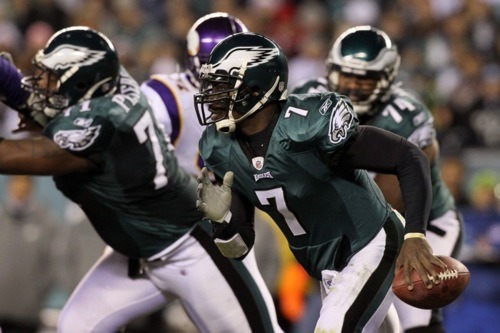
Michael Vick Philadelphia Eagles QB Scrambling

What made Michael Vick so much better in 2010 than he was in 2009? To some extent we already know the narrative. Vick needed a year to mature, to learn the system, to shake off the rust, to get back his trademark speed.

But I wonder now how much was really physical improvement from year one to year two and how much was simply opportunity. Obviously such a question is hard to measure.

One statistic does make that case, though. If we look purely at Vick’s running chances, we see that he didn’t really improve - he just had different (read: better) opportunities.

In 2010, according to Pro Football Focus, Vick was in on 21 planned runs, not including QB sneaks or kneel downs. On those runs, which were mostly wildcat plays, Vick averaged only 3.9 yards per carry and caused only three missed tackles. I wouldn’t necessarily call him ineffective just based on those numbers, but everyone wondered if those snaps were better spent with Donovan McNabb at the helm.

Fast forward a year, and Vick had almost the exact same number of planned runs. In 29 chances, Vick ran for 3.8 yards per carry and four total missed tackles. Those numbers are almost identical to 2009. He didn’t show any increased speed or agility in that category of plays.

Vick’s “newfound” speed in 2010 manifested only in scrambling attempts. In that subset of runs, Vick averaged 9.6 yards per scramble, scored 10 touchdowns and broke 22 tackles in 62 attempts. Since Vick wasn’t on the field to pass in 2009, he never got the opportunity to scramble. Yet that was where he was most effective - and where I’d reckon he has always been most effective.

Vick isn’t a really a “running quarterback.” Like many others before him, Vick is a scrambler. That’s what separates him from the pack, or, more accurately, from the defenders. When he wasn’t utilized that way in the last two years, he was ineffective.

Hopefully, in 2011 the Eagles will leave the planned runs to LeSean McCoy and let Michael Vick do what he does best: improvise.

Photo from Getty.