At the end of practice today, Jeremy Maclin suffered a left knee injury and had to be carted off the field into the locker room. At the moment, word out of Lehigh is that Maclin’s knee is only hyper-extended, not anything more serious like a ligament tear.
The Plight of Moise Fokou
Competition is good. But handing a young player a job based on his potential, lauding him constantly, and then yanking the job away before he’s had adequate time to learn or show his best is folly. Especially now when the team is throwing him into a completely different situation as a “joker” (the linebacker-defensive end hybrid position).
The Decline of the Running Back in the Eagles' Passing Game
My first post here takes us back to the four-year height of Brian Westbrook’s career, 2004-2007. During that span Westbrook was a prolific rusher, but he was perhaps even more valuable catching passes out of the backfield. Westbrook caught 301 passes over those four years. At an average of 75 catches per season, that put Brian on par with the best wide receivers. In fact, only 13 players, all wideouts, had more receptions than Westbrook over that span.
Big News: We're Moving to NBC Philadelphia
I started this blog with a simple goal in mind, to chronicle the franchise-defining offseason, before it had really begun in earnest. Back in January there was little doubt in my mind that the time had finally come for the Eagles to make a definitive choice about the future of the team: McNabb or Kolb.
But over time I grew to enjoy the blogging itself. The posts kept coming, long after a few readers implored me (some jokingly and some not so) to change the name. I tried to look at events and trends and past performance from a different angle, and I hope that whatever small insight may have been achieved over here was worth a few minutes of your Eagles-blog-surfing lifestyle.
This background is not for a goodbye, but for a rebirth. Today I joined the esteemed company of Drew Magary (Deadspin columnist and KSK founder), Vai Sikahema (Former Eagle and NBC 10 Sports Director), Howard Eskin (WIP afternoon radio host), John Clark (NBC 10 Sports Anchor), and others at a new Eagles blog on NBCPhiladelphia.com.
The new blog, Birds Nest, will soon be overflowing with new Eagles content. As for my own contribution, I will be bringing the same inclination toward statistical analysis and refreshing opinion over to NBC, perhaps with more frequent posts than I could accomplish here. You can see my new content starting today, with the first in a series of posts on the Eagles’ passing attack.
I have a number of people to thank, starting with the guys at Iggles Blog: Derek, Gabe, Sam, and now Tommy. They provided me not only with a fabulous model to look toward (multiple times a day), but also also advice, help, and camaraderie. Along with Jason at Bleeding Green Nation and Les Bowen at the Daily News’s Eagletarian, they also graciously furnished links from their popular sites to to this tiny corner of the net. I should also acknowledge John Ness at NBC who spotted this blog and offered me the opportunity to take it before a larger audience.
Thanks finally to you readers. As we get going, I hope many of you will check us out at Bird’s Nest and/or subscribe to our RSS feed. And while it may not be as intimate a location, I hope we can still engage in in discussion in the Birds Nest comments and, as always, by my Twitter and email.
Your humble blogger,
Brian Solomon
Friday Figures: Blitzing Tony Romo (or Not)

Just a quick stats post here for people to ruminate on over the weekend, before I hit you with some big news on Monday…
Today over at Iggles Blog, Derek has an insightful breakdown of the situational blitzing differences between the late Jim Johnson and rookie defensive coordinator Sean McDermott. His analysis led me to look back over the two sample game charts Football Outsiders released: the first halves of the two 2009 regular season Eagles-Cowboys games.
 First of all, let me just throw up the numbers for all of last year’s blitzing on the right. Overall, McDermott seems to have brought a few more blitzers on third down than JJ, but other than that the defensive playcalling was fairly consistent from 2008.
But were the game plans for the Cowboys games very different? Absolutely. In fact, the two were completely opposite. Here they are.
 On top you can see the differences in percentage from the season average for the first game. In this one the Eagles blitzed constantly, sending five, six, and seven guys after the quarterback way more than average. In fact, only on first down did McDermott blitz less than half the time.
Then a complete reversal for week seventeen. In every area where the defense had blitzed more than average in the first game, they did the opposite for the second meeting. Compared to 16 blitzes in the first half of week nine, come January the Eagles only blitzed four times! Perhaps the Eagles coaching staff thought that they had failed with the blitz in the first matchup, or they believed a coverage-based approach would surprise Dallas. Either way, the about-face is startling.
 Of course, we know that this change didn’t work too well. Which leads us to the final charts of the evening (at right), which shows the effectiveness of the two game plans. I’m not sure that this can be extrapolated out for more than this particular case, but here the results suggest one thing.
Blitzing when the Cowboys didn’t expect it, i.e. on first and second down, was fairly successful. Outside of one long second down pass, the Eagles stifled Tony Romo with the blitz. But on third down, the roles were reversed. At least in these two halves, dropping players back into coverage was slightly more effective than blitzing.
Where's Donovan McNabb's Contract Extension?

When the Redskins traded for longtime Eagles quarterback Donovan McNabb, we assumed that a contract extension was just around the corner. Washington Owner Dan Snyder has never been shy about giving big money to veterans. Plus, ever since the trade the Redskins’ front office praised Donovan McNabb as the new face of the franchise.
The team has gone out and said that contract extension is coming:
“Donovan is so excited about this new opportunity — the team has embraced him, our fans clearly have embraced him. We’ll have plenty of time to get something done with him. We see him as part of our future. We would not have made the trade unless we see it that way, and he knows it.”
So what happened? Where’s the extension?
I highly doubt that McNabb is to blame here. He wanted an extension with the Eagles, and knows that Snyder’s past suggests that he will be than generous. There’s little benefit to Donovan in putting off discussions.
If he performs well the Redskins can designate him their franchise player and keep Donovan indefinitely. Furthermore, McNabb has to know that it is likely his numbers could suffer this year, playing behind a haphazard offensive line and with few playmakers. Or he could get hurt. A year from now Donovan could find himself wandering the NFL free agent market for a one-year starting gig contract.
Signing a new extension should thus be at the top of McNabb’s to do list. He has all the leverage from being anointed by the Redskins’ brass as the quarterback of the present and future. He’s coming off a great season which will be difficult to replicate in Washington. Plus, with this team Donovan gets to visit Philadelphia every year.
So if it’s in McNabb’s interest to sign a long-term deal, why hasn’t it been accomplished? Despite their rhetoric, the hesitation has to be on the Redskins.
The team’s rationale reflects all the same reasons McNabb wants a new deal: the Redskins have less leverage to negotiate right now. However, if Bruce Allen and Mike Shanahan can wait into the season, they can see if Donovan is the guy they want to hitch their wagons to over the next 3-5 years.
Washington paid a high price to get McNabb, but there’s no reason to double down quite yet. If McNabb can’t lift an otherwise mediocre team to a winning season, or if he gets hurt, the team might be better off finally gutting the team and rebuilding from scratch — something they resisted doing this offseason.
If everything works out, the team runs the risk of alienating McNabb, their fans, and having to pay Donovan more. But considering McNabb’s track record and public image, he is unlikely to bring his concerns to the media. The potential downside to not striking a quick deal is outweighed by the Redskins’ desire to make sure they don’t make a long-term mistake.
Looking Back at the McNabb Trade Process
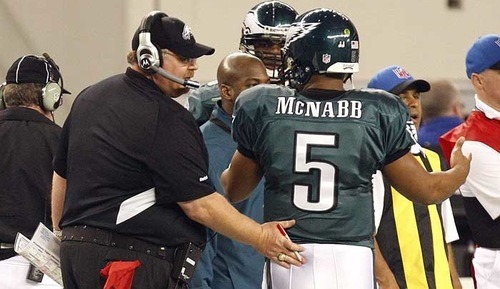
The eighth and final piece in the Inquirer’s “Deciders” series documents the lead up to the Donovan McNabb trade within the Eagles front office more thoroughly than any previous article. Since that’s a topic which pretty much dominated this blog for months, it’s worthwhile to go through a few of the main interesting tidbits and revealing quotes.
Starting at the beginning, we discover that the Eagles knew by early March what their plan was:
Very early that month, inside the NovaCare Complex in a conference room connected to Reid’s office, the core four - Reid, team president Joe Banner, general manager Howie Roseman, and owner Jeffrey Lurie - met to finalize their decision, to talk strategy…
They weren’t going to announce it to the world - or even tell McNabb, not yet - but the Eagles’ brass had already concluded they were ready to look to the next decade. They’d had so many discussions in smaller groups that their decision to trade McNabb felt inevitable.
Just to emphasize, all that talk about how they hadn’t made a decision, or how Donovan was going to be the 2010 starting quarterback, or how eventually all the quarterbacks were on the market? That was all bluff.
It also nicely debunks the stupid rumors that there was some sort of divide among the Eagles top people. Andy, and some of the others, may still have though McNabb had a few more good years left in him, but when push came to shove they were all united. As the article describes, and I’ve talked about before, the decision was obvious. They couldn’t afford to lose both quarterbacks after 2010, and McNabb still had trade value this offseason.
I also like that they acknowledge the discussions had been taking place for years, if less intensely:
One participant said quarterback discussions went from occurring “two years ago, every now and then, ‘What do you think?’ - to this year, quite a bit. Many of them were brief. Some of them were a little more in-depth.”
Another interesting fact:
Lurie said he, Reid, and Banner have always wanted to bring a quarterback along slowly and not rush him into a starting role before he is ready, like they did with McNabb during his rookie year out of Syracuse…
“This is what we always wanted to do,” Lurie said. “Have a player develop for a few years and really develop all the tools necessary so that when the time was to come, you weren’t developing a rookie or putting a rookie in there.”
Even beyond the tired “Donovan is not a typical west-coast quarterback” theme, perhaps Kolb was really the quarterback that Andy and Co. wanted all along. Rebooting a franchise requires that you grab any good young quarterback you can, and the Eagles certainly chose wisely the first time around. But it did prevent the coaches from teaching McNabb the way they clearly wanted.
Oh, the path not taken.
“He’s got two to three years [left] at a high level of play, minimum,” Mornhinweg said of McNabb. “He has had some injury problems, got a little bit of age to him. That’s what I put. The details - it was very detailed - to all of his strengths and weakness…”
Considering Marty was going out of his way to praise Donovan, this doesn’t come across as high praise to me. More like a warning of future danger.
Another Eagles offensive lineman, Todd Herremans, said, “I would say probably the majority of the players are younger players, and they drew to Kevin a little better as the last year went on, especially being able to get in there and actually play with them a couple games. The younger players in the locker room kind of wanted to see Kevin take over and get their own print on the team. As long as Donovan was on the team, it was going to be his thing, not the young kids taking over.”
Entering his sixth season, Herremans said, “We would’ve loved to play with Donovan another year. But the majority of the locker room was leaning toward Kevin. It was not age or ability. They wanted to make their own mark in Eagles history right now.”
The Eagles locker room split seems to be one of the most underrated elements of this whole deal. Andy and the rest of the front office aren’t stupid. If you’re deciding between two players, and one relates to and has the support of more than half of the locker room, while the other is increasingly marginalized by age — who are you going to keep?
The rapid shift to a youth movement gave rise to a corps of confident, even arrogant, new faces on the team. Maybe everything would have been fine for another year, or two, or three. But maybe not. By keeping things the same the Eagles would have been constantly working to alleviate a natural schism in the workplace. By shifting to Kolb, they embraced the team’s cultural shift and coopted the “Young Guns” movement into a unifying force. Very smooth.
If the Eagles hoped they could keep their cards face down, waiting for the trade market to offer up a McNabb trade offer worth taking, it didn’t happen…
Initial offers to the Eagles for McNabb clearly weren’t appealing. A third-round draft choice wasn’t going to cut it. Were some teams calling the Eagles’ bluff, forcing them to be more proactive, to make offers of their own? The marketplace can work like that.
“I really kind of listened - if I thought it was insulting, I said, ‘No, that’s ridiculous,’ ” Reid said. “You’ve got to figure out who’s interested and who’s not, and I didn’t want to just give anybody away.”
This final part of the article, where the reporters discuss the actual trade dicussions, is mostly hearsay and speculation. But the passage forced me to confront what I wrote a few months ago when Andy first told the media that his quarterbacks were up for sale.
At that point I thought that it was a strategic mistake to announce that the quarterbacks were on the market. I assumed that by making it public, other teams would think the Eagles were desperate. Now I’m not so sure.
Giving the front office a little credit, it could be that teams were actually offering a lot less before Reid went public. As long as the Eagles were only reaching out through backchannels, it would have seemed that they were afraid of the truth getting out, that they would take less to keep things quick and quiet.
Once that was impossible, other teams may have been forced to make more realistic offers for McNabb. They knew there was some sort of semi-public auction going on, and they would have to outbid a few other suitors for the quarterback.
Friday Figures: Eagles 2009 Pass Rush Numbers
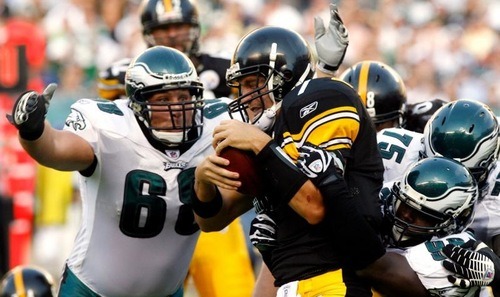
One of the biggest stories of the offseason (second only to the reason I started this blog) has been the complete retooling of the Eagles’ defensive line.
While the Eagles still blitzed a lot with new Defensive Coordinator Sean McDermott, the coaches clearly wanted better production from the front four:
“It would be nice if we’re able to get pressure from just rushing four and not [have to] rely on the blitz as we had to last year to some extent,” McDermott said. “When you can get pressure from your front four, that alleviates a lot of your problems.”
But was the front four really the problem? Looking at PFF’s defensive stats from the last two years, we can see how effective various parts of the pass rush were from the late Jim Johnson in 2008 to McDermott in 2009. The chart below shows the change in percent of total rushes and negatve plays (Sacks, Hits, Pressues, Batted Passes) made by each unit.
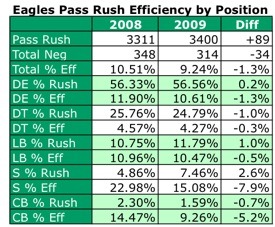
In case the chart isn’t completely intuitive, “DE % Rush” is the percent of total “Pass Rushes” by defensive ends (including the DEs that move inside on passing downs). “DE % Eff” is just the negative plays caused by this group, divided by their number of rushes. Then there’s the year-over-year difference.
As we’ve talked about on multiple occasions, the pass rush from defensive tackles is basically non-existant. Although guys like Bunkley, Patterson, Laws, and Dixon were in the game on more than one quarter of pass plays, they caused negative plays for the offense less than five percent of the time. That’s the most obvious sign yet that the Eagles are getting no pressure from those big fellas.
The linebackers, despite the drastic injuries, seem to have come out pretty much even on blitz pressure. The defensive backs definitely were less effective — but they account for only seven percent of all pass rushes. Still, perhaps because their blitzing was so infrequent, it was more effective than anything else.
So that brings us back to the defensive ends, the guys who are being paid pretty much exclusively to get after the quarterback. How’d they do? Pretty much the same overall from 2008. There was a drop by a little more than a percentage point. This is a much bigger portion of the total rushes, so one percent means a lot more, but it still doesn’t tell me that the Eagles got significantly worse all of sudden along the front line.
What if we compare by player? Here’s 2008 and 2009, for every player who rushed the passer at least 20 times (“Per Game” stats are based on ~62 offensive plays, all passes).
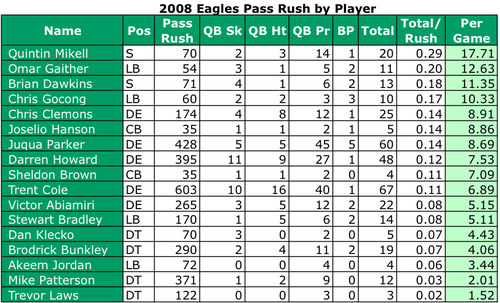
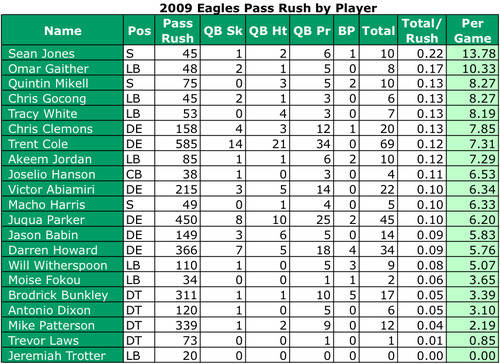
All of the defensive ends outside of Trent Cole and Victor Abiamiri declined from 2008 to 2009. And considering none are really up-and-coming youngsters, it probably was a good idea to bring in some fresh blood.
Other interesting things: Sheldon Brown went from 35 blitzes under Jim Johnson to a mere five with McDermott. A healthy Joselio Hanson looks like his still and effective blitzer from the slot. Surprising no one, Asante Samuel has only blitzed six times in in the last two seasons.
Omar Gaither is a really effective blitzer. Too bad his days in Philly seem numbered. And here’s yet more evidence that Chris Gocong probably should not have been stuck at SAM linebacker.
I really kind of like this “Negative Plays Per Rush” stat. It might be interesting to compare various players, such as Trent Cole, to others around the NFL at their positions…