Where's Donovan McNabb's Contract Extension?

Donovan McNabb Mike Shanahan Washington Redskins Trade

When the Redskins traded for longtime Eagles quarterback Donovan McNabb, we assumed that a contract extension was just around the corner. Washington Owner Dan Snyder has never been shy about giving big money to veterans. Plus, ever since the trade the Redskins’ front office praised Donovan McNabb as the new face of the franchise.

The team has gone out and said that contract extension is coming:

“Donovan is so excited about this new opportunity — the team has embraced him, our fans clearly have embraced him. We’ll have plenty of time to get something done with him. We see him as part of our future. We would not have made the trade unless we see it that way, and he knows it.”

So what happened? Where’s the extension?

I highly doubt that McNabb is to blame here. He wanted an extension with the Eagles, and knows that Snyder’s past suggests that he will be than generous. There’s little benefit to Donovan in putting off discussions.

If he performs well the Redskins can designate him their franchise player and keep Donovan indefinitely. Furthermore, McNabb has to know that it is likely his numbers could suffer this year, playing behind a haphazard offensive line and with few playmakers. Or he could get hurt. A year from now Donovan could find himself wandering the NFL free agent market for a one-year starting gig contract.

Signing a new extension should thus be at the top of McNabb’s to do list. He has all the leverage from being anointed by the Redskins’ brass as the quarterback of the present and future. He’s coming off a great season which will be difficult to replicate in Washington. Plus, with this team Donovan gets to visit Philadelphia every year.

So if it’s in McNabb’s interest to sign a long-term deal, why hasn’t it been accomplished? Despite their rhetoric, the hesitation has to be on the Redskins.

The team’s rationale reflects all the same reasons McNabb wants a new deal: the Redskins have less leverage to negotiate right now. However, if Bruce Allen and Mike Shanahan can wait into the season, they can see if Donovan is the guy they want to hitch their wagons to over the next 3-5 years.

Washington paid a high price to get McNabb, but there’s no reason to double down quite yet. If McNabb can’t lift an otherwise mediocre team to a winning season, or if he gets hurt, the team might be better off finally gutting the team and rebuilding from scratch — something they resisted doing this offseason.

If everything works out, the team runs the risk of alienating McNabb, their fans, and having to pay Donovan more. But considering McNabb’s track record and public image, he is unlikely to bring his concerns to the media. The potential downside to not striking a quick deal is outweighed by the Redskins’ desire to make sure they don’t make a long-term mistake.

Looking Back at the McNabb Trade Process

Andy Reid Donovan McNabb Trade Process Front Office Philadelphia Eagles

The eighth and final piece in the Inquirer’s “Deciders” series documents the lead up to the Donovan McNabb trade within the Eagles front office more thoroughly than any previous article. Since that’s a topic which pretty much dominated this blog for months, it’s worthwhile to go through a few of the main interesting tidbits and revealing quotes.

Starting at the beginning, we discover that the Eagles knew by early March what their plan was:

Very early that month, inside the NovaCare Complex in a conference room connected to Reid’s office, the core four - Reid, team president Joe Banner, general manager Howie Roseman, and owner Jeffrey Lurie - met to finalize their decision, to talk strategy…

They weren’t going to announce it to the world - or even tell McNabb, not yet - but the Eagles’ brass had already concluded they were ready to look to the next decade. They’d had so many discussions in smaller groups that their decision to trade McNabb felt inevitable.

Just to emphasize, all that talk about how they hadn’t made a decision, or how Donovan was going to be the 2010 starting quarterback, or how eventually all the quarterbacks were on the market? That was all bluff.

It also nicely debunks the stupid rumors that there was some sort of divide among the Eagles top people. Andy, and some of the others, may still have though McNabb had a few more good years left in him, but when push came to shove they were all united. As the article describes, and I’ve talked about before, the decision was obvious. They couldn’t afford to lose both quarterbacks after 2010, and McNabb still had trade value this offseason.

I also like that they acknowledge the discussions had been taking place for years, if less intensely:

One participant said quarterback discussions went from occurring “two years ago, every now and then, ‘What do you think?’ - to this year, quite a bit. Many of them were brief. Some of them were a little more in-depth.”

Another interesting fact:

Lurie said he, Reid, and Banner have always wanted to bring a quarterback along slowly and not rush him into a starting role before he is ready, like they did with McNabb during his rookie year out of Syracuse…

“This is what we always wanted to do,” Lurie said. “Have a player develop for a few years and really develop all the tools necessary so that when the time was to come, you weren’t developing a rookie or putting a rookie in there.”

Even beyond the tired “Donovan is not a typical west-coast quarterback” theme, perhaps Kolb was really the quarterback that Andy and Co. wanted all along. Rebooting a franchise requires that you grab any good young quarterback you can, and the Eagles certainly chose wisely the first time around. But it did prevent the coaches from teaching McNabb the way they clearly wanted.

Oh, the path not taken.

“He’s got two to three years [left] at a high level of play, minimum,” Mornhinweg said of McNabb. “He has had some injury problems, got a little bit of age to him. That’s what I put. The details - it was very detailed - to all of his strengths and weakness…”

Considering Marty was going out of his way to praise Donovan, this doesn’t come across as high praise to me. More like a warning of future danger.

Another Eagles offensive lineman, Todd Herremans, said, “I would say probably the majority of the players are younger players, and they drew to Kevin a little better as the last year went on, especially being able to get in there and actually play with them a couple games. The younger players in the locker room kind of wanted to see Kevin take over and get their own print on the team. As long as Donovan was on the team, it was going to be his thing, not the young kids taking over.”

Entering his sixth season, Herremans said, “We would’ve loved to play with Donovan another year. But the majority of the locker room was leaning toward Kevin. It was not age or ability. They wanted to make their own mark in Eagles history right now.”

The Eagles locker room split seems to be one of the most underrated elements of this whole deal. Andy and the rest of the front office aren’t stupid. If you’re deciding between two players, and one relates to and has the support of more than half of the locker room, while the other is increasingly marginalized by age — who are you going to keep?

The rapid shift to a youth movement gave rise to a corps of confident, even arrogant, new faces on the team. Maybe everything would have been fine for another year, or two, or three. But maybe not. By keeping things the same the Eagles would have been constantly working to alleviate a natural schism in the workplace. By shifting to Kolb, they embraced the team’s cultural shift and coopted the “Young Guns” movement into a unifying force. Very smooth.

If the Eagles hoped they could keep their cards face down, waiting for the trade market to offer up a McNabb trade offer worth taking, it didn’t happen…

Initial offers to the Eagles for McNabb clearly weren’t appealing. A third-round draft choice wasn’t going to cut it. Were some teams calling the Eagles’ bluff, forcing them to be more proactive, to make offers of their own? The marketplace can work like that.

“I really kind of listened - if I thought it was insulting, I said, ‘No, that’s ridiculous,’ ” Reid said. “You’ve got to figure out who’s interested and who’s not, and I didn’t want to just give anybody away.”

This final part of the article, where the reporters discuss the actual trade dicussions, is mostly hearsay and speculation. But the passage forced me to confront what I wrote a few months ago when Andy first told the media that his quarterbacks were up for sale.

At that point I thought that it was a strategic mistake to announce that the quarterbacks were on the market. I assumed that by making it public, other teams would think the Eagles were desperate. Now I’m not so sure.

Giving the front office a little credit, it could be that teams were actually offering a lot less before Reid went public. As long as the Eagles were only reaching out through backchannels, it would have seemed that they were afraid of the truth getting out, that they would take less to keep things quick and quiet.

Once that was impossible, other teams may have been forced to make more realistic offers for McNabb. They knew there was some sort of semi-public auction going on, and they would have to outbid a few other suitors for the quarterback.

Friday Figures: Eagles 2009 Pass Rush Numbers

Philadelphia Eagles Pass Rush 2008 2009 Sack Ben Rothlisberger Dan Klecko Juqua Parker Omar Gaither

One of the biggest stories of the offseason (second only to the reason I started this blog) has been the complete retooling of the Eagles’ defensive line.

While the Eagles still blitzed a lot with new Defensive Coordinator Sean McDermott, the coaches clearly wanted better production from the front four:

“It would be nice if we’re able to get pressure from just rushing four and not [have to] rely on the blitz as we had to last year to some extent,” McDermott said. “When you can get pressure from your front four, that alleviates a lot of your problems.”

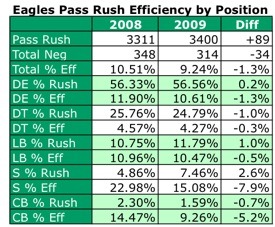
But was the front four really the problem? Looking at PFF’s defensive stats from the last two years, we can see how effective various parts of the pass rush were from the late Jim Johnson in 2008 to McDermott in 2009. The chart below shows the change in percent of total rushes and negatve plays (Sacks, Hits, Pressues, Batted Passes) made by each unit.

Eagles Pass Rush Efficiency by Position

In case the chart isn’t completely intuitive, “DE % Rush” is the percent of total “Pass Rushes” by defensive ends (including the DEs that move inside on passing downs). “DE % Eff” is just the negative plays caused by this group, divided by their number of rushes. Then there’s the year-over-year difference.

As we’ve talked about on multiple occasions, the pass rush from defensive tackles is basically non-existant. Although guys like Bunkley, Patterson, Laws, and Dixon were in the game on more than one quarter of pass plays, they caused negative plays for the offense less than five percent of the time. That’s the most obvious sign yet that the Eagles are getting no pressure from those big fellas.

The linebackers, despite the drastic injuries, seem to have come out pretty much even on blitz pressure. The defensive backs definitely were less effective — but they account for only seven percent of all pass rushes. Still, perhaps because their blitzing was so infrequent, it was more effective than anything else.

So that brings us back to the defensive ends, the guys who are being paid pretty much exclusively to get after the quarterback. How’d they do? Pretty much the same overall from 2008. There was a drop by a little more than a percentage point. This is a much bigger portion of the total rushes, so one percent means a lot more, but it still doesn’t tell me that the Eagles got significantly worse all of sudden along the front line.

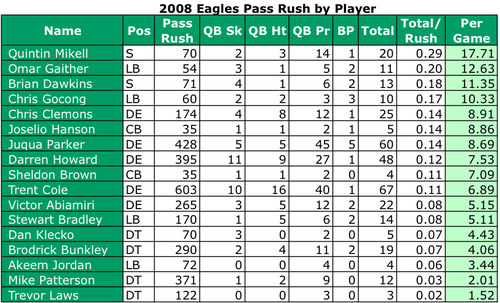
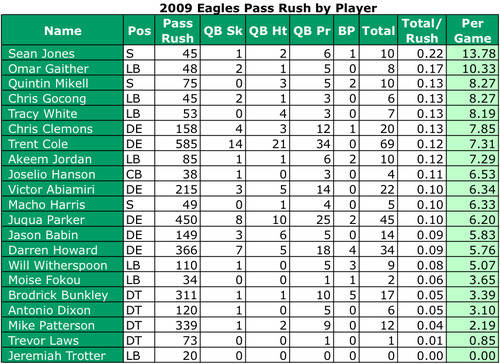
What if we compare by player? Here’s 2008 and 2009, for every player who rushed the passer at least 20 times (“Per Game” stats are based on ~62 offensive plays, all passes).

2008 Eagles Pass Rush by Player

2009 Eagles Pass Rush by Player

All of the defensive ends outside of Trent Cole and Victor Abiamiri declined from 2008 to 2009. And considering none are really up-and-coming youngsters, it probably was a good idea to bring in some fresh blood.

Other interesting things: Sheldon Brown went from 35 blitzes under Jim Johnson to a mere five with McDermott. A healthy Joselio Hanson looks like his still and effective blitzer from the slot. Surprising no one, Asante Samuel has only blitzed six times in in the last two seasons.

Omar Gaither is a really effective blitzer. Too bad his days in Philly seem numbered. And here’s yet more evidence that Chris Gocong probably should not have been stuck at SAM linebacker.

I really kind of like this “Negative Plays Per Rush” stat. It might be interesting to compare various players, such as Trent Cole, to others around the NFL at their positions…

Kevin Kolb: Fourth Grade Bad-Ass, and Other Stories

Kevin Kolb Philadlephia Eagles Angry Face

Go read this. Now.

Fanhouse writer and mid-day WIP host Anthony Gargano went bass fishing with Kevin Kolb. The first part of his story was relatively tame, other than when Kolb recounted a story about how he killed a rattlesnake while hunting with his future wife at 17 years old. The second part of the story is much juicier.

It starts with honestly one of the most disturbing stories I’ve ever heard about any kid, that took place when Kolb was a helper on his football coach dad’s team. He was in fourth-grade and one of the eighth-grade players was teasing him:

And so there was this one time that one kid rode young Kevin Kolb extra hard, and Kolb challenged him to a tug of war with the bath towel wrapped in electrical tape the team sometimes used, and Kolb beat him. And Kolb was so emotionally charged, brimming with fear-breaking sick and tired, that he then beat that one kid with the towel wrapped in electrical tape into submission, whipping him to the ground.

“I beat him until they had to pull me off him,” Kolb spits. “They were like, ‘Kevin … stop!’ Stop! Kevin, stop!’ That kid was a little punk. I was never going to let that happen to me again. I was never going to let anyone make me feel that way again and I never did.”

Gargano writes splendidly, but he tries to gloss this incident over with a simple line that it provided Kolb with “the gift of fortitude.” I think it’s a little more than that. As a fourth-grader, Kolb beat up a kid probably twice his size, and would have continued if people hadn’t restrained him. That’s an incredible competitive fire to have in the Eagles huddle, but it’s also an incredibly violent and disturbing image.

There’s a ton more in the profile. How Kolb’s still “sick” over his interception to Ed Reed in 2008. How Kolb’s high school was basically a semi-pro team. How AJ Feeley thought Kolb should take it easy in practice to make Donovan McNabb look better. How McNabb felt threatened by Kolb’s presence from the beginning, and embraced Michael Vick to push his young challenger down the depth chart.

How former Eagles General Manager and current Browns GM Tom Heckert would have offered the farm for Kolb:

“Whatever Andy wanted, I would have given him,” Heckert said at the time. “A one (draft pick), a two … two ones. No joke. Kolb is legit.”

There’s so much to think about that perhaps I’m getting too hung up on the image of fourth-grade Kolb standing over another kid, beating his snot out. Yet it does repulse me at a very basic level. Hopefully Kolb can channel that “fortitude” into an team attitude that makes losing unacceptable in the Eagles locker room — and he never has to challenge anyone to a tug of war again.

Could Nick Cole be the Eagles' Best Pass Blocker This Year?

Nick Cole DeSean Jackson Philadelphia Eagles Pass Blocking 2009

A week ago we looked at negative plays by offensive linemen. Astute reader Dave pointed out in the comments what I neglected to note in the main post: that the numbers skew unfavorably toward teams that pass more than they run.

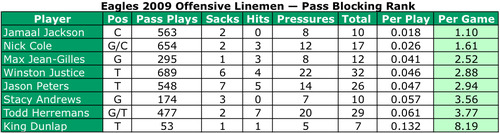
I went back to the PFF numbers and, while I didn’t go through the whole NFL (yet), I re-ranked the Eagles offensive linemen based on negative pass blocking plays, out of the number of pass plays they were in on (Per Game based on passing every offensive down). That should make things a little more even.

Eagles 2009 Offensive Linemen Pass Blocking Rank

Not a lot of complexity to these numbers, although again I’m surprised that Todd Herremans was actually worse than all but King Dunlap. My anecdotal recall of the line play doesn’t account for this.

Nick Cole and Max Jean-Gilles both were surprisingly good at pass protection according to this measurement, although they (and Jamaal Jackson) seem to have an advantage from playing on the inside. Based on the compilation last week, either there’s less pressure/mistakes on the centers and guards or its tougher to see when they make mistakes. Of course, Herremans’s numbers suggest that it isn’t all the “inside effect.”

The other caveat remains that the line, at the end of the day, is one unit. Breakdowns in communication probably cause as many protection problems as physical mistakes. So even if Cole looks good at center, if he can’t recognize blitzes or set up everyone else as well as Jackson did, that will have a negative impact on the rest of the line.

Reid and Banner, Together Forever

Andy Reid Joe Banner Relationship Philadelphia Eagles

The inimitable Tommy Lawlor beat me to my story today, as he artfully deconstructed the Andy Reid-Joe Banner relationship better than I could, pointing out some places where the conventional wisdom is often the product of so much wishful thinking on behalf of the media.

But I do want to point out a few more things about the general topic of Reid-Banner and the article that rehashed the arguments again on Sunday. First of all, this just doesn’t work as an example of Banner taking over:

When Eagles general manager Tom Heckert, Reid’s righthand man for nine years on player personnel issues, left for the same job in Cleveland, and Howie Roseman, Banner’s protege, became GM, it created an appearance that Banner had usurped Reid.

“Created an appearance.” To whom? Where I come from that’s just a phrase that means “We have no real proof of this, but it sounds juicy.”

Of course when you actually examine the switch, the theory doesn’t quite stand up as well. Heckert was always going to be second fiddle to Reid in Philadelphia. He was always going to be in Andy’s shadow (figuratively and physically) when it came to getting respect for building winning teams. Mike Holmgren may be in Cleveland, but as Team President he likely won’t be involved in all of the personnel decisions. Heckert has a chance to prove himself; it isn’t “the same job” at all.

This incident is pretty much the only evidence the Inquirer poses to even show that Banner has usurped power from Reid. Sure, there are a few anonymous quotes:

“If you ask me who’s running the show, I’d say Joe Banner, without question,” said a team source who asked for anonymity because of the sensitivity of the topic. “All along, Joe’s the boss. Jeffrey’s the owner, Joe’s the boss. Everybody knows that.”

But at the end of the day, of course Banner is, in some respect, “the boss.” Along with owner Jeff Lurie, he hired Reid. I imagine he has some sort of power (with Lurie’s permission) to fire him. However, that doesn’t mean things are that simple.

For one, Banner is a smart man. He knows what he’s good at — allocating cap space and crafting player deals. And he knows what he has no experience in — football decisions. Even if Banner had complete control over Andy, it would still be smart to delegate all things not related to money.

There are two things which back this up. First, Andy hasn’t left Philadelphia. It’s not like anything’s tying him to this city. His kids are older. He’s been around the country and back again as a coach. And he’s demonstrated that he can create winning teams. If Banner was taking away his power as “football decider” (a role Andy fought to have), Reid wouldn’t have to stick around and take it. Half the teams in the NFL would jump at a chance to have him.

And, from Banner’s perspective, what do you gain by exerting more say over the team? The partnership has worked for years without problems or major disagreements. They have the wins to show for it. Even the Donovan McNabb trade — perhaps the single biggest decision made by the Eagles in years — went down without as much as a hitch. Does Banner want to go back to finding a new coach who almost certainly won’t be as good as Reid, let alone as compatible?

Sometimes when everyone says the same thing, it isn’t because everyone’s lying and there’s some nefarious backroom plot going on to keep the whole operation from falling apart. Sometimes it’s just because the truth is that easy. Reid and Banner have maintained a succesful partnership for eleven years. Let’s stop trying to invent reasons to think otherwise.

False: The McNabb Deal Can Be Judged in 2010

Donovan McNabb Kevin Kolb Philadelphia Eagles Trade Washington Redskins Winner

I generally like Don Banks and the other NFL guys at SI, but this is just wrong:

It’s going to be fairly easy to determine the success or failure of the move because the standings will tell us. If the Redskins make the playoffs and the Eagles don’t, it’s a big swing-and-miss for Reid and revenge for McNabb. If the Eagles make the postseason with Kevin Kolb and the Redskins don’t with McNabb, Reid gets the check mark and a sense of satisfaction.

Yes, this trade, which affects the short and long-term futures of two franchise quarterbacks, two well-regarded coaches, and two rival franchises is incredibly simple. If the Redskins make the playoffs, they win. If the Eagles make it, they win. So easy.

It’s not like there could be many years of ramifications based on the play of each quarterback. And of course the two high draft picks the Eagles received in the trade don’t factor into any long-term equation.

Everyone’s going to be closely watching the Eagles and Redskins this year, and this probably won’t be the first time a writer makes this case. In fact, I would bet good money that if Mike Shanahan and Donovan come into town the first week of October and win, local and national guys alike will go crazy for that story. It could in fact begin even earlier than that, if Kolb starts out slow or McNabb looks great from the start.

Enough. There’s plenty to discuss and debate about this deal for years to come. No reason to rush to judgement, even after a full season. Let’s just wait and see.

The Meteoric Rise of the Other Football

World Cup Soccer Television Ratings vs US Sports NBA NHL MLB Landon Donovan

It’s easy to write off soccer in this country. We have our own “more exciting” sports that are built into our historical self-image, and the rise of soccer has been long predicted with little to show for it. That’s changing however, in the one metric that truly matters when comparing sports against each other in this country: television ratings.

Last month’s 2010 World Cup in South Africa showed that soccer is no longer a bit player on the sports stage in America. It has become a major sport, and is only increasing.

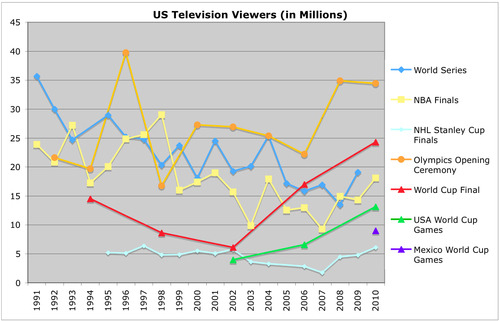
Take a look at the following graph, showing television ratings over the last 20 years for the biggest games across all the major sports (source: Nielsen and TV by the Numbers). The results may surprise you.

US Television Viewers in Millions World Series NBA Finals World Cup Olympics Stanley Cup

I had to leave out football, which dwarfs every other sport here. But overall you can see the fading of two historically “major” sports over the last two decades. Both the NBA and MLB have lost huge numbers of viewers. In basketball’s case, you might be able to attribute that to a weaker product. Baseball’s decline – by about 50% — could be related to their aging fan base. The median world series viewer is six years older than he was in 1991. Both sports need big name teams like the Yankees, Lakers, or Celtics in the championship to redeem their ratings.

In contrast to the decline of those two traditional American sports, look at the rise of soccer in the last decade. That jump is due to a number of factors. The masses of kids who played soccer as kids is growing up. The exposure to soccer on cable is greater than ever before. A better USA team to root for. And finally the huge influx of hispanic immigrants in recent years has brought millions of soccer fans to our nation — there are already more Mexican national team fans than there are NHL fans, by this measurement.

You can see that World Cup soccer already rivals, and in some cases surpasses, the NBA and MLB. Sure, maybe the MLS would be a more even comparison, but the league was only started in 1993. You could even argue that the soccer numbers are unfairly lower than they should be. Time zone problems that place games during the workday puts the World Cup at a distinct disadvantage against the other sports, which operate almost exclusively in prime time. If you subscribe to this theory, 2014’s World Cup in Brazil could be the most popular in America yet.

World Cup soccer now only sits behind only the olympics in popularity. Yet, in some ways, soccer has a higher ceiling. The olympics drama isn’t so much about the sports — most people have never swam, jumped hurdles, or ice skated competitively before. Soccer is a different story. It can provide the national pride as well as an engaging sport that people eventually follow even between World Cup years.

The bottom line is this: in a World Cup final that fielded two countries Americans care little about, in subprime television viewing time, garnered significantly more viewers than either the World Series, NBA Finals, or other events such as the Kentucky Derby.

Soccer has arrived.