Post-Draft Position Breakdown: Running Back

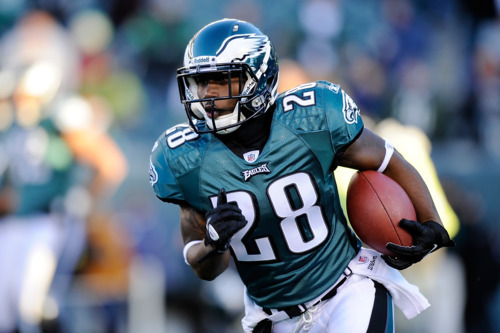
Dion Lewis Eagles

What the Eagles did: The Eagles now have five running backs and three fullbacks on the roster, yet 23-year-old LeSean McCoy is the veteran of the group. The other seven have exactly 42 regular season snaps between them — and all of them from second-year running back Dion Lewis.

Let me just reiterate: that is a staggering level of inexperience. As of this moment, the Eagles still have two open roster spots, so adding a veteran like Joseph Addai or Justin Forsett is still possible. But so far it the front office has intimated that it is comfortable with a youth movement.

There’s no player behind McCoy that you can look at with confidence. Dion Lewis is the only one with NFL experience, and barely so. His kickoffs were a disaster and in limited playing time he showed some burst, but no indication he can take over full time in an emergency. Instead of giving their 5’7”, 2011 fifth-round pick some much needed veteran competition, the Eagles shopped at the discount store, picking up two high-profile rookies with promise as well as major reservations.

Paul Domowitch has a story today about seventh-rounder Bryce Brown’s college meanderings, and it can be summed up with one word: immaturity. Brown never had any legal problems, but he managed to quit on not one, but two football teams in three years. The physical tools on the 5’11”, 225 lb., sub-4.4 40 back are incredible, but he’s nothing more an interesting athlete without his mind in the right place.

The other guy fans are high on is Chris Polk, undrafted free agent out of Washington. Unlike Brown, Polk was tremendously productive in college, rushing for over 4,000 yards. However, his has a huge injury question mark. Despite a draft grade as high as the second round according to some experts, Polk was clearly taken off of all 32 teams boards. That’s not good.

As to fullback, Stanley Havili is the frontrunner, having rode the practice squad all 2012. The Eagles brought in two undrafted free agents to compete with Havili, Stanford fullback Jeremy Stewart and Massachusetts fullback/tight end/linebacker Emil Igwenagu.

What I would have done: The fliers on talented running backs are never a problem, per se. However, those players are like lottery tickets, great if you win but much more likely to end up discarded in the trash. There aren’t many exciting veterans available in free agency, but I would still try to grab one for insurance — at least until Lewis or one of the other backs look ready to step in for McCoy in a pinch. If I could do it all over I might have tried to nab Peyton Hillis as McCoy’s back up back in March. After a disastrous season last year, the multi-dimensional Hillis went to the Chiefs on a cheap deal.

I also would have tried to upgrade at fullback, but that’s a losing argument with this front office.

Way-too-early prediction: I’m not convinced the Eagles are sold on Lewis enough to make him the primary backup. The Ronnie Brown signing never worked, but that doesn’t mean the logic behind that deal doesn’t still apply. Addai or another back could still be in the cards.

Of the rest, Polk’s injury concerns must be worse than we know. Don’t expect anything more than injured reserve for him. There’s probably not a better candidate on the roster right now for training camp darling than Brown. Graig Cooper, an undrafted pick up last offseason, will compete but no one’s given any indication he’s more than a camp body. Havili will probably be the starting fullback and the Eagles will stash one of the others on the practice squad.

Photo from Getty.
Bye McNabb and Kolb, Hello Defense

Sheil Kapadia has the breakdown of the complete haul the Eagles received for our revered blog namesakes:

McNabb and Kolb = Nate Allen, Dominique Rodgers-Cromartie, Casey Matthews, Vinny Curry, Brandon Boykin, and DeMeco Ryans

Remains to be seen how all of these players will turn out but on the surface: not too shabby.

Post-Draft Position Breakdown: Quarterback

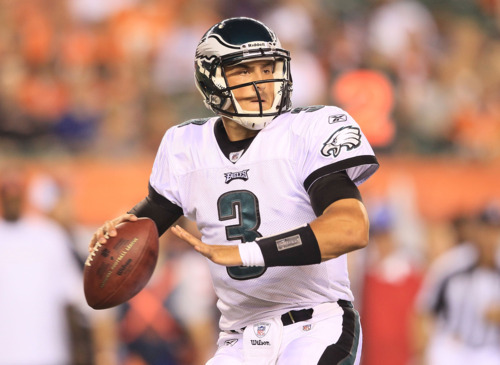
Mike Kafka Eagles

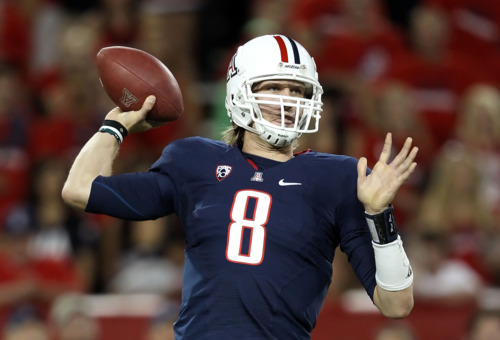
What the Eagles did: I’ve already written about the Nick Foles pick at some length here, although only from the perspective that I think he was overdrafted based on his talent. Foles is an odd selection because he seems so far outside the type of player Andy Reid usually goes for. Huge, with a cannon arm but limited athleticism doesn’t exactly echo through the years of Donovan McNabb, Kevin Kolb, and Michael Vick. It remains to be seen if Reid and Marty Mornhinweg can either fit him into their offense or adjust the offense to fit him.

Because of that, I have a sneaking suspicion that Russell Wilson was the real target. After the Foles pick, Reid denied any interest in Brock Osweiler, but admitted that he “honed in on those two guys,” Foles and Wilson:

“And with these quarterbacks very few of them come from the west coast offense. You saw the kid that went before him (Wisconsin QB Russell) Wilson. He had played in the west coast offense at North Carolina State. There are very few of those that have that opportunity to do that… I liked Wilson, yeah, I sure did. He’s a heck of a player too. We had our eye on those two players and I wish that kid all the best. He’s got a great personality. Not a lot of guys have his size, but he gives you the confidence he’s going to be able to do it.”

Maybe I’m reading too much into his press conference, but my immediate thought after watching it was along the lines of, “that was a much stronger endorsement than Reid gave Foles.” And Wilson just makes so much sense as a player who wouldn’t challenge Vick’s current leadership but could learn a tremendous amount watching him.

Given Wilson was selected only 13 spots ahead of the Eagles by a Seattle team that no one expected to draft another quarterback, Reid and Howie Roseman may have been forced to settle for Foles instead.

What I would have done: Obviously, I wouldn’t have drafted Nick Foles. He doesn’t seem likely to have the talent or the fit to make him a potential starter down the road, nor will he help push Mike Kafka to be a better backup.

The Eagles definitely have a long term need for a franchise quarterback to replace Vick. We won’t know how long term that need is until after this coming make-or-break season for him. Therefore, barring the ability to go get a top talent like Robert Griffin III, drafting someone in the early-middle rounds probably wasn’t the best use of resources. My goal would have been to grab a veteran backup to compete with Kafka instead, perhaps buying low on either Colt McCoy or Seneca Wallace in Cleveland.

Way-too-early prediction: Don’t expect anything from Foles this year, but it will be interesting to see if the Eagles quarterback gurus can help Vick and Kafka rebound from a down year in 2011. As a rule of thumb, one shouldn’t discount the Eagles coaching ability in this area (Vince Young/Mike McMahon nonwithstanding), so I’m reasonably optimistic.

Still, I wonder if we’ve seen the the limits of Vick’s abilities. It’s tough for him to mature into a more responsible quarterback at his age. An improvement from last season is likely, but a return to 2010 may be too much to ask. As to Kafka, I don’t trust him right now but a third-year leap into AJ Feeley territory isn’t out of range.

Oh, and Trent Edwards is not making the team.

Photo from Getty.

Arguing for, um, Jerry Jones

Jimmy Kempski:

They’re a team with no shortage of star power (or at least perceived star power) at the top: Ware, Romo, Witten, Austin, Ratliff, Smith, Lee and if you want to throw in Bryant and Carr too, then OK, I suppose I’ll allow it.

Beyond the stars, there’s mediocrity up and down the starting lineup and typically no depth to speak of whatsoever. This has not been a winning formula, and probably never will be.

The Cowboys’ decision to trade up and utilize their top 2 picks on one player (albeit potentially a great one), especially at a position that didn’t need as much help as other areas, reflects that same pattern.

Jimmy’s point about the Cowboys is well taken, and I can’t find fault with his encyclopedic knowledge of Dallas’s woes up and down their lineup. Still, I actually think trading up for Morris Claiborne is a justifiable, and in fact, possibly great move for Jerry Jones.

My main disagreement is that the Cowboys’ greater need at multiple positions shouldn’t disqualify them from grabbing a player at the top of their draft board. I like the Eagles decision to move up for Fletcher Cox, but they undoubtedly have positions in worse straits as well (e.g. safety and linebacker). Drafting a player that you feel strongly can become a Pro Bowler should come ahead of almost all considerations of need. Sure, more picks are better, but taking one of the consensus top six players in the draft this year probably balances out whomever you could have gotten at pick 45.

Building a roster is a long term game. You can’t solve (or ignore) all your problems in one draft or offseason. Dallas may fail at that in the long term, but in itself, picking Claiborne isn’t a poor decision.

Get Well Soon, Colt

Jonathan Tamari:

“To be at the highest of highs, with your family all around, to being at the lowest of lows when I’m walking off the field,” Anderson said. “I’m a pretty emotional guy, and I didn’t feel anything [in the knee]. It wasn’t hurt. It was just weak, and I was just crying because I knew my season was over. I wasn’t crying because I hurt.”

Anderson had torn his anterior cruciate ligament. It was the first major injury of his career.

With apologies to Ike Reese, Colt Anderson might be the best special teams ace the Eagles have ever employed. Here’s hoping he can heal to the point where the PUP list is a real possibility. Still, I wonder if he’ll ever regain the reckless abandon needed to blow up so many kickoff returns.

Quarterback Draft Inflation: From Kafka to Foles

Nick Foles Arizona

I have a theory about the Eagles third round selection of quarterback Nick Foles. Despite the relatively early pick, it has nothing to do with replacing Michael Vick or even Mike Kafka. It’s about the NFL draft and the dramatic quarterback inflation that has occurred in the last two years.

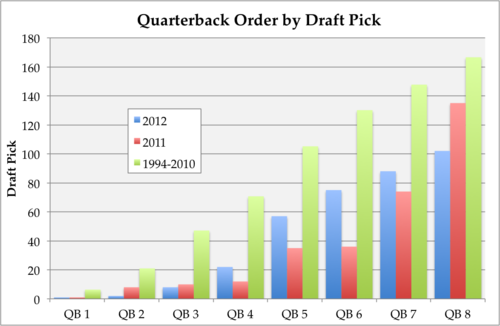
Let’s take a quick journey back to 2010. Sam Bradford went first to the Rams and Denver jumped up to 25 overall to get Tim Tebow. The next quarterbacks off the board were Jimmy Clausen (#48), Colt McCoy (#85), and the Eagles’ Kafka (#122). That order of quarterbacks coming off the board — two in the opening round, another one in each of the following — is right in line with what had been going on ever since the draft was whittled down to seven rounds in 1994.

But that pattern, largely consistent for the previous 15 years, was thrown out the window over the last two. In 2011, four quarterbacks were drafted in the first round, and six in the top 40 picks. That rivaled two of the biggest quarterback-heavy drafts in recent memory, 1999 and 2004, despite talent that few considered equal. Then this most recent draft saw another four quarterbacks taken in the first, something that’s never happened in two straight years. Overall, the 2012 draft was slightly behind the 2011 pace, but it was still far ahead of nearly any prior draft.

Here, see for yourself, in table and graphical forms:

QB Draft Order Table

QB Draft Order Graph

What does this mean about Foles? It means that the Eagles likely drafted a worse quarterback in an earlier round than they ever would have before. For example, the team selected Kafka in the fourth round of 2010, presumably to be a long term backup they could groom. He was the fifth quarterback drafted overall.

Foles, taken a round and a half before Kafka, was only the seventh-best quarterback according to draft order. Perhaps this year’s crop of quarterbacks, and Foles in particular, is better than the group teams had to choose from in 2010 — and nearly every prior year. But my impression is that most experts considered this, pre-draft, to be at best an average class after the two stars.

Two years may be too soon to confirm a trend, but the evidence is there. Quarterbacks have never been more highly valued in the NFL. Desperate teams without a franchise signal-caller give big contracts to former backups and trade for anyone with promise. It only makes sense that such a frenzied demand would trickle down to the draft. As that happens, quarterbacks with starting potential rise from the second and third rounds into the top 30 picks, and those who might have been considered late round projects jump up to take their place.

Suddenly, this starts to look less like a fluke and more like a serious shift in how quarterback prospects are valued. We would be wise to view the Foles pick with that in mind.

Photo from Getty.

Vinny Curry, Best Player Available

Chris McPherson:

Roseman hinted that the team has previously made some reaches in order to fill a need. Roseman was certainly tested in his third draft as the Eagles’ general manager. No situation better highlighted Roseman’s mission than what was presented to them with the 59th overall pick when the Eagles selected Marshall defensive end Vinny Curry.

“He was the best player on our board,” Roseman said. “He was standing out to us. We just felt like we were in a position where we had to take him. He’s a talented guy.”

Since the first press conference after Curry was drafted, the Eagles front office and PR squad have aggressively hawked the fact that he was the best player available — something they haven’t found necessary to mention (let alone pound into the narrative) with any other draft pick. Methinks they dost protect someone’s feelings too much.

Grade the Eagles Draft Picks

Philly.com lets you rate each Eagles draft pick, from A to F. Here are the results so far, with A & B grades constituting “positive” ratings:

Fletcher Cox: 98.6% positive
Mychal Kendricks: 95.3% positive
Vinny Curry: 94.3% positive
Nick Foles: 38.6% positive
Brandon Boykin: 93.9% positive
Dennis Kelly: 46.5% positive
Marvin McNutt: 74.6% positive
Brandon Washington: 70.7% positive
Bryce Brown: 60.0% positive

Overall Draft: 94.9% positive