Notes on the Rest of the 2012 Eagles Draft

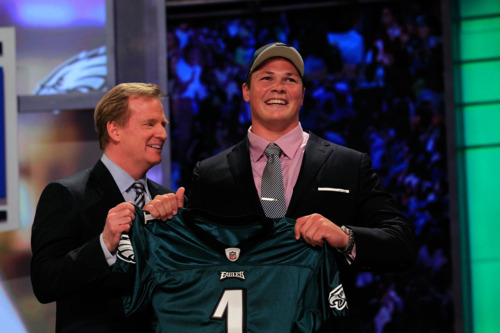
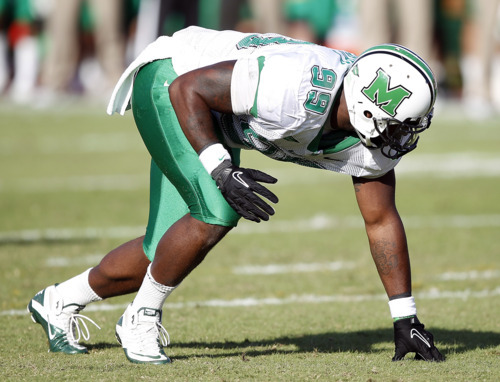
Vinny Curry Marshall Philadelphia Eagles

The NFL draft is now in the books, and by almost all accounts the Eagles did little to complain about. Here are my miscellaneous thoughts on what happened on days two and three:

  • Watch the Vinny Curry interviews, then watch them again and again. His Eagles fandom is clearly as raw as yours and mine, and it’s awesome to see the excitement one of us would undoubtedly have, had we the talent to end up playing for our hometown team.

  • Nick Foles, the big reach. There has been serious quarterback inflation in the last two drafts, something which will be the focus of my post tomorrow. Until then, just consider that Nick Foles was the seventh quarterback selected, at pick 88 overall. Mike Kafka was the fifth off the board in 2010, at pick 122. A round and a half earlier, for a worse quarterback? Maybe. (Also, I’m 95 percent convinced that Russell Wilson was the real target.)

  • The Eagles have drafted defensive players with 9 of their last 11 first, second, and third round picks. So far, the results have been atrocious. Let’s hope this last batch can turn things around.

  • After complaining in recent years that the Eagles had become too safe in the late rounds and undrafted free agency, I certainly can’t complain about the wave of longshot, troubled players the Eagles snagged this time around. I actually like the strategy, especially at running back, where the team took a major athlete with limited production and questionable work ethic (Bryce Brown) and a productive talent who was taken off seemingly everyone’s draft board due to injuries (Chris Polk). Especially at running back, which other than pass protection is relatively easy to pick up, one of these longshots could pay off. A veteran back up would still be nice, though.

  • There are some other interesting names on the UDFA list. Kentucky punter Ryan Tydlacka should give Chas Henry some much needed competition. Another long snapper is a shot across reliable Jon Dorenbos’s bow. And not one but two fullbacks means we’ll have a healthy fight for one of the most marginalized positions on the team.

  • Please direct all your “steal” or “reach” designations here.

  • Two things granted: Brandon Boykin had great college production and the slot corner role is becoming more and more important. That said, I’m a little hesitant about drafting a guy whose size has made every draft expert who has looked at him say, “what a great nickel back.” In some ways, this pick was the opposite of the Curtis Marsh selection last year, when the Eagles went for physicality over refined performance. It will be interesting to watch which pick turns out better for the Birds going forward.

  • There’s a lot riding on Mychal Kendricks being Andy Reid’s first successful second round linebacker — and the results need to show right away. Under no circumstance should more than one of last year’s linebackers start in 2012. Right now Brian Rolle has the inside track on keeping his weakside job, but Casey Matthews could push him there, after ending last season on a relative high note.

  • My draft predictions weren’t half bad, if I do say so myself.

Photo from Getty.
What We Learned from the Fletcher Cox Selection

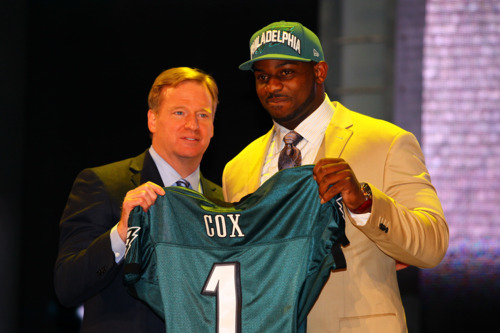
Fletcher Cox

I can’t remember the last time the Eagles picked somebody in the first round that both draftniks and fans loved. Look at Bleeding Green Nation’s fan poll on the pick: Cox’s approval rating sits at 94 percent. A year ago, Danny Watkins eked out majority approval by a margin of just 21 votes out of about 1,600.

The fact that Cox is popular doesn’t, on it’s own, make the selection a good one. But it fits in so many ways. Let’s break down what we learned last night:

  1. The Eagles have become remarkably clumsy at deploying smokescreens for their first round pick. Was anyone other than a few reactionary mock drafters buying a Dontari Poe selection? The way the Eagles led him on a pointless parade past reporters a few weeks back on raised major red flags. What Reid said last night about Kansas City and Poe confirmed that they never had any real interest.

  2. Scheme matters. On a related note, it is important to keep in mind the scheme prospects look most suited for. There were plenty of DT options in the middle of the first round, but the Eagles made sure to grab the one who fit best with Jm Washburn’s penetrating style.

  3. Despite the trades, the first eight picks played out almost exactly as planned. The elite eight ended up being a game of musical chairs (propelled by more reasonable contracts), but that didn’t matter much to the Eagles. Other than Mark Barron, who reportedly was never a NovaCare target, all the players you expected to go early did. That allowed the Eagles to sit back and wait for either Luke Kuechly or Fletcher Cox to drop. Note: I would wager that had the Panthers taken Cox instead, we would probably be having the same conversations we’re having now, except it would be Kuechly coming to Philly today.

  4. Don’t draft an immediate starter. The Cox selection continues a general trend in which the Eagles rarely draft anyone with the expectation that they will start right away. The defensive line is aging and Cox can step right in a contribute, without having to be a starter until year two, when the writing is on the wall for Cullen Jenkins.

  5. Valuing the second round picks more? Andy Reid talked about having a limit on what they were willing to pay for a trade up. He said they didn’t want to give up a second round pick, as Dallas did, to jump up into the top 10. I wonder if this is actually a change in policy dating back to the disastrous trade up for Jerome McDougle in 2003. Since then, the most the team has paid in a trade was a third round pick to move up for Brandon Graham. That hasn’t been a resounding success either. The fourth and sixth round picks the Eagles gave up this time amounted to an exceedingly reasonable price. (The draft value chart says the difference between pick 12 and pick 15 is properly a late third round selection.)

What to watch for tonight: If the Eagles make all three of their next selections, I would guess they’re looking to come away with a linebacker, defensive end, and some sort of offensive weapon at either wide receiver or tight end. But given their recent history, a trade back to accrue more picks (and starting linebackers) is likely in the cards.

Photo from Getty.

My 2012 Eagles Draft Predictions

Danny Watkins Eagles NFL Draft

Last year at this time I made eight predictions about what the Eagles would do in the draft. Some of them were more conservative than others, and I missed on one of my biggest guesses — saying that the team wouldn’t draft at their assigned first round spot. Still, I managed to get six of eight correct, and predicted the general thrust of the draft rather well (linebacker and offensive line, not defensive line).

So I’m back again for another round of likely folly. Here are my predictions for what we will see over the next few days.

  1. Carpet-bombing the defense: early and often. Big picture: all the talented young players are on offense. You can quibble with this if you want, since there’s no reason to give up already on guys like Brandon Graham or Nate Allen. Still, the defense needs more playmakers going forward, and the only way to do that is to spend at least three out of the Eagles first four picks on defensive players. I expect the team to come out of the draft with as many as half their picks going toward the front seven.

  2. No rookie running back, no safety. Unless the Eagles fall in love with one prospect, I just don’t see much benefit in adding another young running back or safety. Both positions have a single open back up job and that spot really needs to be filled with a veteran whose only responsibility is to fill in this year if something goes wrong. Instead, watch out for an Ellis Hobbs-type trade for a marginalized veteran player.

  3. One offensive lineman, maximum. Last year the Eagles snatched up three interior linemen to build out Howard Mudd’s new blocking scheme. If not for Jason Peters’s injury, I’m not sure they would have bothered drafting even one this year, but a long term project at tackle now makes sense.

  4. Chad Hall 2.0. Andy Reid loves the multidimensional ability that Hall brings to the offense so much that he’s willing to overlook his complete lack of NFL-caliber skills. I think the Eagles will draft someone like Florida’s Chris Rainey to return kicks and serve as a speedier x-factor on offense. Best case scenario, the team also gets its long-term replacement for Jason Avant with this guy.

  5. Choir boys. Howie Roseman made some comments to reporters recently in which he seemed to flirt with the idea of taking more character risks. His actions over the last two drafts say otherwise. I expect the Eagles’ fascination with captains, seniors, and consistent, big-school performers to continue (e.g. no Vontaze Burfict).

  6. Michael Vick is still safe. With few good quarterback options in this draft and the whole organization focused on getting Vick back on track in 2012, there’s no good case to reach for a quarterback of the future. Trent Edwards is tremendously uninspiring, but his competition is likely to be either a late round flier (Russell Wilson, Kellen Moore) or a veteran to be pursued later.

  7. Surprise neglect of cornerback early on. With Asante Samuel gone, there’s plenty of room to go after Dre Kirkpartrick or another cover guy in the first round. But of the Eagles defensive spots, cornerback still has the most options. The team is heavily committed to Nnamdi Asomugha over the next few years and Dominique Rodgers-Cromartie is a likely candidate for a contract extension. Curtis Marsh is the wildcard. He made no impact in 2011, but was always considered a project with all the skills. Todd Bowles may not need another youngster.

  8. At least ten rookies. Last year one of my failed predictions was that the Eagles wouldn’t use all of their picks. But of course, they love drafting players and will probably end up trading back to add picks at least once.

I’m not making a prediction for the first round, although I already laid out what I think the Eagles are thinking (Peter King shoutout). Fletcher Cox is the potential trade-up candidate, Luke Kuechly the likely front-runner if they stay at 15 overall. Barring that I’m less sure, although a versatile pass rusher like Melvin Ingram makes the most sense of the remaining players.

Photo from Getty.

Cornerbacks Worth More than Asante, Since 2008

Antonio Cromartie, 2011 2nd round pick
Josh Wilson, 2011 5th
Chris Houston, 2010 6th, 2011 7th
Sheldon Brown, 2010 4th
Lito Sheppard, 2010 4th
Bryant McFadden, 2010 6th
Ellis Hobbs, 2009 5th, 5th
DeAngelo Hall, 2008 2nd, 2009 5th
Pacman Jones, 2008 4th

According to the team stenographer. Some rounds approximate.

Bungling the Asante Trade From Start to Finish

Depending on which report you believe, the Eagles could have traded Asante Samuel before last season for either a second round pick or two third rounders. Now the Eagles look like they will have to get lucky just to pull out a fourth round pick in this inevitable deal.

What happened?

I don’t agree with some of the reporters who have suggested that the price drop is due to Samuel’s age or contract. He hasn’t gotten significantly older or more expensive in the last few months. His contract does go up, and he’s now 31. That’s true. But neither Samuel’s salary nor his age are prohibitive factors at this point. He hasn’t shown any signs of slowing down, and $10 million is reasonable for a top cornerback.

This is the point where people start to bring up Asante’s flaws as a player: he freelances too much, doesn’t know how to tackle, blows coverages more than you would like. For the most part, you wouldn’t be wrong to make that argument. But Samuel has demonstrated those same deficiencies his entire career. Before he ever arrived in Philly, we knew he couldn’t tackle, couldn’t resist gambling for interceptions — and you can bet that Detroit and whichever other teams inquired after him in 2011 knew those things as well.

Moreover, there’s little evidence to suggest that Samuel has fallen off since a year ago. His interception rate did drop, which has a lot to do with luck. His targets increased, but so would yours if you went from playing across from Dimitri Patterson to Nnamdi Asomugha. On a per target basis, Samuel was every bit as good in 2011 as he was in 2010 — and with an utter failure of a defensive coordinator to boot.

What has changed in the last few months is that the Eagles’ leverage in negotiations has evaporated. Having bungled the 2011 trade and alienated Samuel permanently, then installed a defensive coordinator who was completely unprepared to utilize three Pro Bowl cornerbacks, the front office created a buyer’s market for Asante. Everyone knows the team can’t afford, in the books or on the field, to keep Samuel for another year. He’s worth less to the Eagles than anyone else and they have no choice but to get rid of him.

Howie Roseman has largely been hailed as a great deal maker (often as an antidote to poor drafting results), but this whole Samuel situation was terribly handled, and it has and will continue to cost the team.