Howard Mudd is the 'Real Deal'

Bo Wulf, for the Eagles Website:

“After the visit (with the Eagles), I talked to him and I said, ‘Jason, what do you think about coach Mudd?’” said Bell. “He said, ‘He’s the real deal … If you want to be a Pro Bowler, come here and you have coach Mudd and me behind you and you don’t have a choice.’ So that’s a great business decision for me.”

You don’t get much better endorsements. Apparently, Mudd is also the reason Demetress changed the spelling of his name.

(via Derek)

Watch and Judge All 24 Sacks of Michael Vick

Jimmy Kempski does an amazing job in this post, culling the video for all sacks Michael Vick took in 2011. More than anything, the Eagles quarterback doesn’t come out looking too good. Many of the sacks are poor decisions by Vick, and a number of the others look suspiciously like poor blitz recognition and protection adjustments at the line of scrimmage.

The one thing that is worth keeping in mind is these are only 24 plays, and by definition are likely to show the worst mistakes. There isn’t a companion video that shows how many times Vick escaped pressure in his face and turned it into a positive gain.

I’m also not sure I follow Jimmy’s logic at the end, where he notes poor right tackle play from Winston Justice in 2010 as a reason to keep Todd Herremans on that side. But all in all, really informative and interesting.

Dion Lewis and the Eagles Kickoff Return Futility

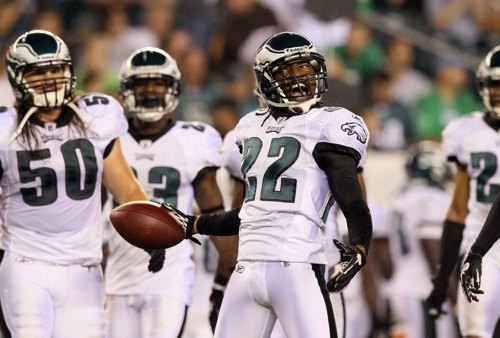
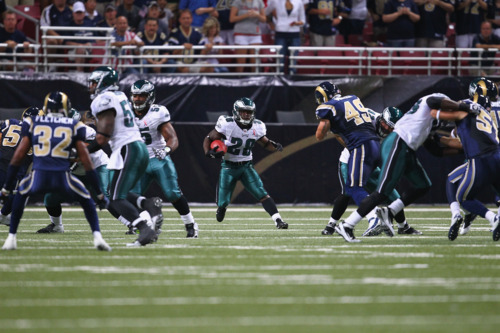
Dion Lewis Eagles Kickoff Return

When you looked at the 2011 Eagles roster as a whole, it was plain that the team had enough overall talent to win more than eight games. But over and over again they demonstrated that they were less than the sum of their parts, failing at all the little parts of the game, like tackling and holding on to the ball.

Another one of these factors was kickoff returns. Dion Lewis, the rookie running back who didn’t return kicks in college, took nearly all of the Eagles returns. And he was (predictably) dreadful at it.

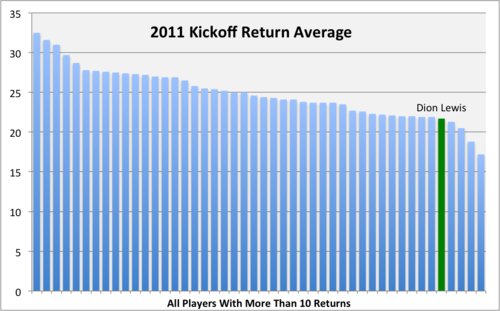
2011 Average Kickoff Returns

As you can see above, out of 47 players who returned at least 10 kickoffs, Lewis ranked 43rd. His 21.7 yards per return was 3.3 yards from the median, which cost the Eagles an extra 100 yards (over 30 returns) they surely could have used.

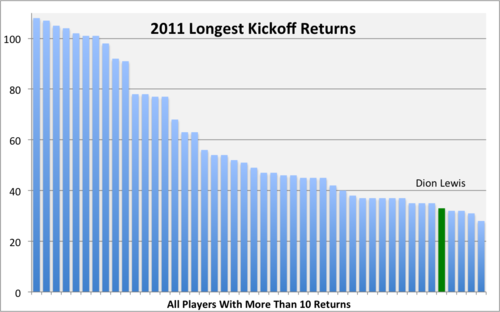
2011 Longest Kickoff Returns

Lewis’s longest kickoff return was a mere 33 yards, again 43rd in the NFL. Whatever vision or explosiveness or speed that an kick returner needs to break through for a big gain, he didn’t show it last year.

Note: Long returns do skew the average kick return results, obviously. In some ways that’s good — achieving that is part of what makes a good returner. However, a returner could be overall below average but have one big return that skews everything upward. For the record, taking out the top return does little to improve Lewis’s numbers relative to everyone else.

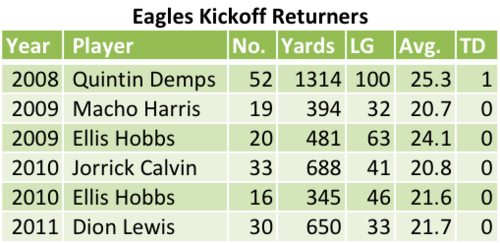
Eagles Kickoff ReturnersIt’s worth pointing out that this isn’t a problem solely related to the rookie from Pitt. Lewis is only the latest in a string of poor kick returners, who you can see at right. He was actually better than Jorrick Calvin. Quintin Demps, back in 2008, was the last above-average returner the Eagles employed. It would be nice to see the Eagles try to correct that in 2012, although I won’t be holding my breath.

Photo from Getty.

The Inside Track to a Meaningless Job

In this Eagles website video, Stanley Havili says that he’s put on 25 lbs since he came to the Eagles, up from 225 to over 245 lbs. When he was drafted in 2011, Havili looked more like a large running back than a true fullback. Perhaps the added weight will help him as a blocker.

I mentioned Havili when I discussed the fullback position a couple months back. His versatility as a runner and pass catcher could make him a more valuable contributor than Owen Schmitt. But the irony is that as the second tight end eclipses the fullback in most situations, that player’s ability to excel in other areas actually becomes less important. If the fullback is almost exclusively going to play in short yardage, I-formation sets, it would be better for him to specialize in actual blocking.

Trouble on the Post-Jason Peters Offensive Line

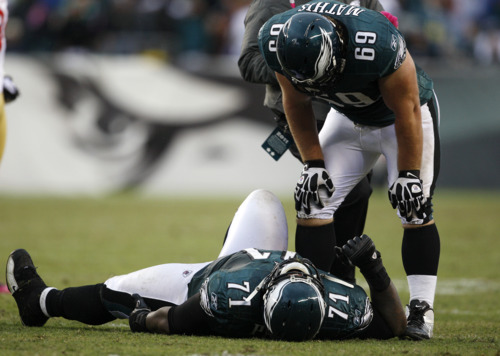
Jason Peters Injured

Losing Jason Peters for the year, as the Eagles did when he ruptured his achilles last week, is a devastating blow to the team’s hopes in 2012. Peters, if not the best offensive tackle in the league, is certainly in the top five. He’s a nimble mountain on the field, protecting Michael Vick and steamrolling defenders for LeSean McCoy. No matter when it happened, this injury would cause a big step back on offense.

However, despite some reporters’ unconvincing headlines, the Eagles are especially unprepared to deal with Peters’s injury. The team is lucky that there are still free agent options available and that they have a variety of early round picks if they want to go that route. But compared to past years, the Eagles have few players on the roster who can step into Peters’s shoes.

Because Juan Castillo (remember him?) built his lines from the outside-in, the most important tackle spots often had multiple potential replacements. Back in 2006, 2007 the Eagles had three players other than starters Tra Thomas and Jon Runyan prepping to step into their shoes. Todd Herremans and Shawn Andrews, both tackles in college, were starters at guard, and Winston Justice was learning as a backup tackle.  

There was nothing guaranteed about their success, and indeed Andrews flamed out spectacularly after that. But there was no question as to what options were available if and when Thomas/Runyan couldn’t go. Even before Peters’s injury though, the depth at offensive tackle had worn thin. King Dunlap has shown flashes of potential in limited action, but has a meager pedigree and limited expectations. Justice, an adequate starter for two seasons, was shipped off for pennies to Indianapolis.

Moreover, Howard Mudd’s offensive line seems to be assembled in the opposite direction from Castillo’s. Whereas Jamaal Jackson was a huge linemen who would have shifted out to guard at least, Jason Kelce’s sub-300 lb. frame couldn’t play anywhere but center. Evan Mathis and Danny Watkins both played tackle in college, but projected to guards in the NFL (not that you would trust Watkins out there anyway). The team may try one or both on the outside, but neither has the potential to star as a tackle, like Herremans, Andrews, and Justice did.

Building and maintaining a NFL roster is tremendously difficult. At any moment, even in the offseason, an injury can take a position from strength to weakness. That’s why depth is so important, and unfortunately, the Eagles have burned through their tackle depth over the last few years and failed to replace it. In the last three drafts, Howie Roseman drafted just one tackle — Fenuki Tupou, who never took a single regular season snap.

Likely that will change this year, and the Eagles will take at least one early draft pick to compete for Peters’s spot. But depth isn’t necessarily something you can manufacture in a few weeks. With that in mind, it may already be too late to avoid disaster.

Photo from Getty.
Yikes: Jason Peters Injured His Achilles?

Geoff Mosher reporting up a storm on Twitter today, after King Dunlap returned to the Eagles on a one year deal:

I’m hearing that one BIG reason that the Eagles re-signed King Dunlap today is that Jason Peters may have an injury. Working to confirm…

I’m hearing its an Achilles injury. But again, working to confirm from more sources, so hang with me.

League source tells me Eagles had no dialogue with King as of last week re: contract and suddenly “a lot of dialogue” this week.

Also told by a different source that Peters sustained the injury during a workout.

Update: The Eagles confirmed Mosher’s story. Just a devastating blow to the team’s 2012 hopes.

Is Trading Asante Samuel the Right Move?

Asante Samuel

Everyone knows an Asante Samuel trade will happen some time in the next few weeks, if not days. Andy Reid and Howie Roseman barely even provide us real denials any more. But let’s not kid ourselves here. The Samuel trade was inevitable as soon as the Eagles signed Nnamdi Asomugha last August.

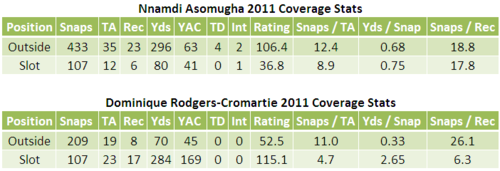
With two massive salaries at the cornerback position, and another starting-caliber player in Dominique Rodgers-Cromartie, this was never fated to last. In fact, it’s amazing the three players lasted this long. If not for some stubbornness on Howie Roseman’s behalf regarding compensation for Samuel, the live-wire cornerback could easily have watched the Eagles founder in 2011 from a safe distance.

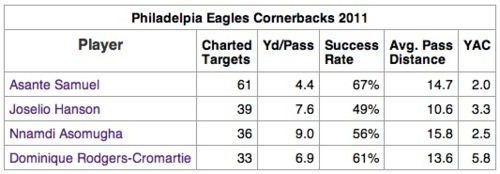
That said, there has been a significant undercurrent of opinion since last summer that argues that the Eagles shouldn’t trade Samuel. That cause got a boost yesterday, when Aaron Schatz at Football Outsiders released their 2011 cornerback charting stats, including the numbers for the Eagles top four corners:

Football Outsiders Eagles Cornerback Data

If you read the entire post, you can see that Asante not only ranks at the top of Eagles corners, but one of the best in the NFL last season. Passes that go his way just don’t end up with a lot of yardage, something that was also true last year.

But statistics are never that simple; the matter of targets complicated things. The Football Outsiders data also shows that Samuel was targeted nearly twice as much as Asomugha. As Sheil Kapdia wrote today, Pro Football Focus has similar findings. Clearly, opponents would rather pick on Samuel than his counterpart.

At this point, you’re looking at statistics that come to opposite conclusions: do you want the guy who is rarely targeted but gives up more yardage, or the guy who’s targeted often but doesn’t give up big plays?

Regardless, keeping both certainly didn’t work. It made everyone worse, because Roseman and company didn’t see realize how different each of the three players are, and how much Juan Castillo was incapable of finding any arrangement that made them all happy. It was a mess.

The right move was probably to not sign Asomugha in the first place, but that’s over with now. At this point, trading Samuel isn’t necessary the right move, but it is the only move. It’s unclear which corner — Nnamdi or Asante — is the better player, but they can’t coexist (at least with Castillo as coordinator). Time to get what you can for Samuel and hope that Asomugha can stave off his decline, and DRC can live up to his potential playing on the outside.

We’ll miss the self-proclaimed Pres, but there’s really no other choice.

Photo from Getty.

Beyond 'I Goofed'

The full transcript of Andy Reid’s interview with McLane and Domo is up, and it has some juicier quotes than just the “goofed” line.

“From a coaching standpoint, we probably gave [Michael Vick] a little too much too soon protection-responsibility wise. You can’t take quite as much as we did early and do that with a guy. Even though he’s been in the league as long as he has, it’s a different (protection) scheme. If I had to go back on it, I would have backed up and just gradually fed him the stuff. You’re talking about a very intelligent guy. Very intelligent. But you can’t dump years and years of things on the table and expect him to go and perform.”

That’s the first time, to my knowledge, that Reid has admitted that a lot of the protection/decision issues were on Vick.

“The first thing that happens in this league is, if the coach doesn’t know what he’s talking about, the players are going to let you know. They’re gonna be very verbal about that. But everybody stayed on board with Juan Castillo. I thought that was a tribute to him, his coaching ability and his staff.”

In trying to tell us, “Hey, at least the players like him better than that McDermott guy,” Reid actually places Castillo in a category of coach that “doesn’t know what he’s talking about.” Stunning.