By the Numbers: Look, It's a Running Back!

Eagles LeSean McCoy

Finally, a win.

It wasn’t always pretty, but at least the Eagles have grabbed back a bit of pride going into the bye week. I shudder to think what the next two weeks would have been like at 1-5. Let’s break down the game a little bit, shall we?

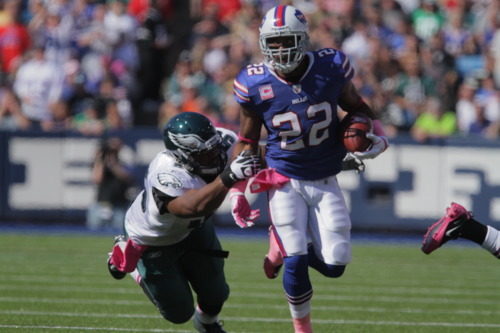
28 = Carries by LeSean McCoy. Ah, sweet run game. As I said last week, not increasing McCoy’s workload would be a fire-able offense. So Andy Reid and company get to keep their jobs, at least for now (even though after the game McCoy intimated that having so many runs wasn’t the plan). I think the plan was to protect the offensive line, and on Sunday that meant a heavy dose of McCoy, as well as short drops and quick passes. Michael Vick did his job, not trying to hold on to the ball too long. Most of the time it was three/five steps, immediate throw.

+2 = Eagles turnover differential. How to lose games, for dummies: turn the ball over. Vick and Vince Young each threw an interception, so that hasn’t improved much. But the defense, with a career performance by Kurt Coleman and a huge assist from Rex Grossman, showed up to play.

9 of 17 = Receptions, of total, by the Redskins tight ends and running backs. The Eagles defense did a good job against the run for the first time this year (only 42 yards on 14 carries). But they definitely didn’t solve their tight end problem, seeing as Fred Davis was basically Washington’s only offensive threat. At least on the first watch, it looked like Jamar Chaney was covering Davis on the majority of plays, and he didn’t inspire much confidence in that role. Still, if that’s the biggest problem on defense, the Eagles can live (and win) with it.

2:27 = Time remaining in the second quarter, after which the Eagles let up 13 unanswered points the rest of the game. This kind of inconsistent effort is why I didn’t want to celebrate last week’s second half comeback. Through six weeks, this team has yet to play a complete game. If you want to win consistently (read: against quarterbacks with a sense of ball control), you need to play well for more than a quarter here and there.

Photo from Getty.
Time to Unleash LeSean McCoy

LeSean McCoy

As I described yesterday, the odds of the Eagles finishing off the season with only two losses and making the playoffs are very small. Anyone who has watched this team for even a few minutes can tell that this is a below .500 club right now. And I have little hope that the main issues plaguing the team will be fixed any time soon.

But I can be convinced that the Eagles will win on Sunday against the Redskins, in spite of those issues. I think that requires one thing: unleashing LeSean McCoy.

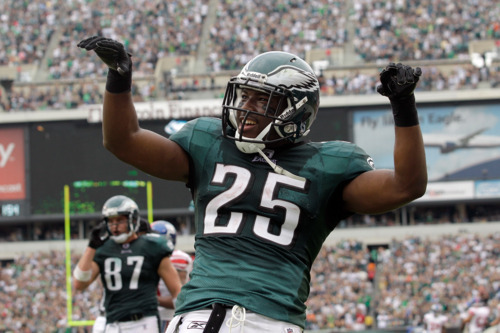
Let me try to illustrate just how great McCoy’s season has been through five games. Only seven running backs in the last 20 years with more than 100 carries in a season have scored higher than 30 percent on Football Outsiders rushing DVOA, a statistic that measures performance above the average player. If McCoy can keep it up, his will be the highest of all of them:

  1. 2011 LeSean McCoy — 39.1%
  2. 2000 Marshall Faulk — 35.0%
  3. 2010 Jamaal Charles — 33.9%
  4. 2002 Priest Holmes — 31.1%
  5. 2003 Onterrio Smith — 30.8%
  6. 2006 Marion Barber — 30.5%
  7. 2004 Larry Johnson — 30.0%

And this isn’t a fluke. McCoy has the highest yards per carry average in the NFL among running backs with at least 30 carries. He is tied for the second-most rushing touchdowns, first all-purpose. This production is despite an offensive line suffering from injuries, poor blocking by rookies and journeyman free agents, and a general inability to gain an inch on short yardage and goal line plays. Oh, and he’s seemingly the only Eagles offensive skill player to not have a fumble. That is a historic season in the making.

Yet, even by Andy Reid’s low standards, McCoy hasn’t gotten nearly enough touches. There are 13 running backs with more rushing attempts. If you look at rushing attempts by team, the Eagles are ranked fifth. But that includes Michael Vick’s 38 scrambles. Take those away, and the Eagles are suddenly 29th.

McCoy was handed the ball only 20 times in the last two games. To let that trend continue against Washington would be a crime. The Redskins have the fifth-ranked defensive DVOA this year, but are just 17th in run defense. Furthermore, it would take the pressure off Vick, expose play-action pass opportunities downfield, and keep the woeful Eagles defense on the sideline.

There is no easier gameplan than pitting your biggest strength against the opponent’s biggest weakness (See: Gonzalez, Tony vs. Eagles LBs). Missing that opportunity with McCoy in week six — and the rest of the season — would be a fire-able offense.

Photo from Getty

The Eagles Best Case Scenario for 2011

Eagles DeSean Jackson

If yesterday was “bash Andy Reid” day, today seems to be all about finding the silver lining. Tommy Lawlor wants you to know that “the Eagles are closer to being a good team than you think.” Paul Domowitch says “the worst is over.”

Let me do you the courtesy of quashing your hopes before you get too excited. This team is not, and will not, be a good team this year.

The optimists want you to believe that the Eagles turned a corner in the second half of Sunday’s game against the Bills. That after the demoralizing 10-play, 80-yard touchdown drive to start the third quarter, Juan Castillo’s defense adjusted and finally played up to its potential. They only let up 3 points the rest of the way.

Yet, even beside the fact that the Bills got more conservative in the fourth quarter, we’ve seen this type of one-half improvement before. Remember, against San Francisco the Eagles got out to a 23-3 lead through the middle of the third quarter. But eventually, they collapsed. The fact that in last week’s loss the defensive collapse was in the the first half rather than the second is a pretty weak argument to stand on.

Believe it or not, even a bad defense that gives up more than 26 points per game tends to keep the offense from scoring on the majority of drives. Sometimes those stops are evenly dispersed throughout the game, sometimes you manage to keep the opponent down for two quarters before letting up the lead. But at the end of the day, you’re still giving up too many points. I wouldn’t read much into one fourth quarter shutout by this defense, just because the Eagles took Jarrad Page off the field.

We hope that the youngsters who are now getting a shot, like Kurt Coleman, Nate Allen, Jamar Chaney, Brian Rolle, and Danny Watkins, will be better than the players they replaced. But none of them have shown that they consistently can be even average starters.

Perhaps the turnover rate will revert closer to the mean, but there’s no guarantee of that either. Michael Vick has been especially loose with the ball, whether throwing it to no one over the middle to avoid a sack or holding it out away from his body when scrambling. And drops have been common from every Eagles receiver.

Oh, and lest we forget, Juan Castillo is still your defensive coordinator.

The very best case scenario, in which the Eagles mostly fix their problems and rally for the remainder of the season, is unlikely. But even in that hypothetical, it’s doubtful they’d accomplish more than the 2010 San Diego Chargers, who sunk to 2-5 after some horrible special teams play. That team had a top ten offense and defense, strung together four straight wins, and still missed the playoffs at 9-7.

The 2011 Eagles are remarkably and unexpectedly bad. And it’s not hard to predict improvement when things seemingly can’t get any worse. But do me a favor. Save your optimism for next year.

Photo from Getty.

What Good is a "Defensive Consultant"?

Eagles Jason Babin

The biggest Eagles news of the day (besides every local beat writer piling on to the Fire Andy Reid camp) is an ESPN report from Chris Mortensen that the team will consider bringing in a “defensive consultant” during the bye week.

My initial reaction to that news was, “Yes, please.” We’ve noted for a long time now that Juan Castillo appears completely incapable of scheming this defense successfully. Adding an experienced defensive mind to the game planning can only be a positive.

But then I got to thinking, would it really make a difference?

This addition (if it happens at all) is unlikely to be any more experienced than the guys Castillo already has as position coaches. Jim Washburn has been a defensive line coach in the NFL for more than a decade, and has college experience dating back to 1976. Johnnie Lynn has been a defensive backs coach since breaking into the league in 1994 with Tampa Bay.

Either this pair is as incompetent as Castillo (unlikely), their concerns and suggestions have been ignored (more likely), and/or the Eagles players are so bad and Castillo is such a bad play-caller that they basically don’t matter (very likely).

I doubt adding another voice under Castillo — be it Chuck Cecil, Greg Blanche, Eric Mangini, or Jeff Fisher — will change that equation. Replacing Castillo with one of those names might help. Or finding a bunch of linebackers and safeties who can tackle.

Outside of those more radical shake-ups though, Andy Reid would just be applying a band-aid to a gunshot wound.

Photo from Getty.

By the Numbers: What Did You Expect?

Fred Jackson Eagles

I don’t often pick against the Eagles. Generally I have a pretty optimistic take on the team and its talent. That’s been reasonable, considering the series of winning seasons Andy Reid has strung together. But not this week. This week I picked against the team, and I didn’t have many reservations either.

The 2011 Eagles are not a winning football team. You can make excuses, come up with different angles about how there have just been a lot of mistakes, a few too many turnovers. But that’s true for all bad teams.

I’ll admit, this year’s group completely fooled me. After the offseason, I thought a deep playoff run was in the cards. But they are failing in all phases, with coaching and personnel and everything in between. Time to, begrudgingly, look at the story the stats tell this week:

1 = Play over 25 yards by the Buffalo offense. I don’t want to hear any more talk about how the Eagles defense just needs to stop the big plays. On Sunday, they mostly did. It was the consistent chunks of yardage that killed them. The defense couldn’t stop Fred Jackson, to the tune of 26 carries, 111 yards. They couldn’t stop Ryan Fitzpatrick, who put up a completion percentage of almost 80 percent.

0 = Points allowed by the Eagles in the fourth quarter, a record low for them after being outscored 36 to nothing over the previous three weeks. You could also spin this as a positive, that the defense finally adjusted and came up on top at the end. But I don’t see it that way. For starters, the Bills shut things down and focused on the run game to bleed the clock in the final quarter (a foreign concept in Philadelphia).

45 to 14 = Runs called vs. passes called by the Eagles. That’s a 76 percent pass-run ratio, which is actually only slightly higher than the 73 percent Reid and Marty Mornhinweg have gone with for the season. That’s insane. First of all, that’s 5 percent higher than last year and 11 percent higher than 2008. Second, and more importantly, the coaches are ignoring what could be an absolutely record-breaking season for LeSean McCoy. Even at his current meager workload, McCoy is projected for more than 1400 rushing yards, 60 receptions, and 20 touchdowns. He’s averaging 5.75 yards per carry. Only 8 running backs in modern NFL history (75+ rush, 5+ games started) had yards per carry above that for a season.

6 = Official quarterback hits on Michael Vick. I know that Howard Mudd’s unit is near the top of the Adjusted Sack Rate leaderboard, and are only likely to climb after Sunday’s one-sack performance. But Vick is getting pressured and hit constantly back there, and I don’t see anyone to blame other than the offensive line. The Bills ran a number of blitzes and stunts to get pressure, but you have to expect that since Vick has shown he will torch defenses that give him time.

Photo from Getty.

Why Castillo? Look to Sean McDermott

Sean McDermott

Others have tried to explain what exactly Andy Reid was thinking when he promoted Juan Castillo to defensive coordinator. For the record, I didn’t understand it to begin with:

Even scarier is that Castillo seemingly has no conceptual plan for the defense… Washburn runs the defensive front autonomously, and Castillo’s going to plan the back seven to “complement” his ideas? That doesn’t sound like a defensive coordinator with a coherent plan… At the end of the day, Reid couldn’t justify this decision with Castillo’s experience or knowledge or preparation. He had to fall back on “desire” and even an outlandish connection to the risk other people took when promoting Reid himself (under much more logical circumstances).

The best explanation I can come up with nine months later doesn’t actually have much to do with Castillo himself, but rather his predecessor Sean McDermott.

To start, I don’t think Reid is particularly partisan when it comes to defensive schemes. He was happy to bring Jim Johnson and let him run his blitz-happy system, although if Johnson was a Cover Two guy, it might not have made much difference. Reid has always been an offensive coach, and making sure he had a defensive coordinator who could pick a successful system and run it without help must have been the goal.

When Johnson died in 2009, Reid promoted McDermott, hoping that the young secondary coach could carry the defense forward. And if you remember, all of McDermott’s statements echoed that call for stability. Like this one:

“There is one thing I know, and that is that this system,” McDermott said. “It works. Jim has spent a considerable amount of time in his coaching career researching and finding things that work and finding things that didn’t work, quite frankly, and I’m going to respect that and we’re going to build on that. From there we’ll add wrinkles.”

Not only did the Eagles not have the time to conduct a full coordinator search, Reid was hoping that McDermott could keep everything going in such a way that the head coach wouldn’t have to worry about things on that side of the ball.

Obviously it didn’t work out. But what problems did McDermott have that Reid felt he couldn’t ignore? The first was tactical. McDermott’s schemes were often overly complicated. His “wrinkles,” like frequently dropping Trent Cole back into a zone or having a linebacker race across the defense to cover a tight end or running back, hurt more than they helped. Complicated schemes made the players seem a step slow. McDermott also lost the respect of the players in the locker room. Reporters started to hear off-the-record bad mouthing of the coach that never would have happened during Johnson’s time.

If those were your two biggest problems, I could see where it might seem logical to find someone as opposite of McDermott as possible. That’s where Castillo comes in. The man has always been respected and praised by his unit. He’s an enthusiastic, energetic leader. Plus, without a deep background in defensive coaching, a simpler scheme was almost guaranteed:

“First of all, what we’re going to do is be fast and physical, and we’re going to be fundamentally sound. We have good players here. This is the NFL, you change, you upgrade, players get hurt, but that’s what we’re going to do.”

As Sam Lynch noted, Reid’s course correction away from the McDermott errors may have been the right move in theory. But, clearly, Castillo’s promotion took the idea at least a a few steps too far.

Photo from Getty.

What Does the Danny Watkins Promotion Mean?

Eagles Danny Watkins

Geoff Mosher of The News Journal reports today that Danny Watkins, the Eagles first-round pick this year, will replace Kyle DeVan as the starting right guard this Sunday against Buffalo for his first NFL start.

This is big news for Watkins, obviously. After the Eagles gave him every chance to start in the preseason, Watkins looked completely unprepared to start. There were certainly limiting factors. He was hurt by the lockout and a brief holdout, both of which prevented him from making the transition to the NFL as fast as possible.

Still, at 26 years-old, Watkins was supposed to be NFL-ready when he arrived in Philly. The fact that he didn’t even dress for three out of the first four games strikes major doubt into estimations of Howie Roseman’s drafting, especially when the starter DeVan was so bad. Pro Football Focus pegged DeVan with the blame on both 49ers sacks, as well as four QB pressures last week. Meanwhile, the offense couldn’t buy a first down in short yardage. But really, how much did the Eagles expect out of a guy they pulled off the street a week before the season started?

With this news, we’re left wondering if Watkins was promoted due to his own progression or because the Eagles simply had no other choice. The jury is definitely still out on Watkins, and I’m not ready at all to write him off just because he couldn’t start right away. But I’m leaning toward the second option for two reasons.

First, nothing has really changed since Sunday when the Eagles decided that Watkins wasn’t good enough to put on a uniform. He couldn’t show sudden progress in practice just a day or two later. The only thing that happened recently was the coaches reviewing the game tape and seeing how bad DeVan was against the 49ers.

Second, promoting Watkins mirrors a move the Eagles made just a week ago, when they officially promoted Nate Allen to the starting lineup. Another high draft pick, Allen had been dogged with injuries but also looked completely out of his element in the preseason. He wasn’t inserted into the lineup because he healed or because he suddenly fixed his problems. No, it took a tackle “attempt” by Kurt Coleman against the Giants. Since that point, Allen hasn’t exactly looked like a stud, either.

The Eagles figured that if they’re going to get beat, it might as well be with the guys they’ve recently invested top picks in. As such, the countdown to Jaiquawn Jarrett’s promotion begins… right now.

Photo from Getty.