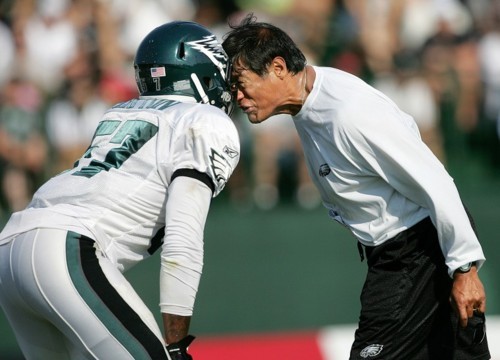
Time for Andy Reid to Move On?

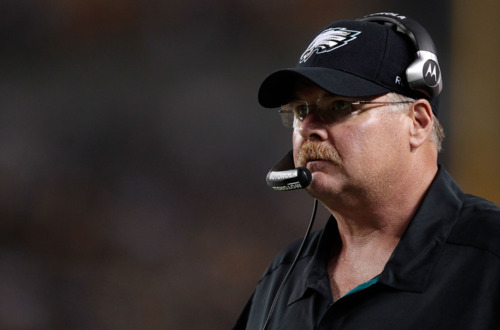
Andy Reid

One of my favorite stories about Andy Reid is the one about his coaching binder. It goes something like this:

As an up and coming assistant coach on Mike Holmgren’s staff, Reid saw that his mentor kept a notebook with everything from basic football philosophy to detailed notes on training camps schedules. At some point Holmgren’s notes outgrew his notebook, so he copied it into a new form and threw away the old one. Reid plucked it out of the trash.

By the time he was interviewing for the head coaching job in Philadelphia, Reid’s binder had ballooned to six inches thick. All that detail, all that preparation before he ever had a top job. It was impressive to say the least. And, like the Reid we know today who still hasn’t lost a game after the bye, he didn’t let that preparation go to waste.

Reid took over a moribund team and transformed it, improving it each year for six straight years. He found the right quarterback, hired the right assistants, drafted well, and made smart free agent acquisitions. 5-11, 11-5, 11-5, 12-4, 12-4, 13-3. Four straight NFC Championship games, one Super Bowl appearance. It was masterful, if ultimately incomplete.

The binder full of notes worked almost to perfection during those first six seasons. But six seasons later, I wonder how much of that binder is left. It’s doubtful that Reid ever had a plan for what to do after the climax of 2004. Since then, he’s mostly been spinning his wheels.

Keeping an NFL team competitive this long is very difficult, but Reid and company have managed. They’ve kept the team at or above .500 every year after 2005 and reached the playoffs four times. But the team also hasn’t improved during that span. Some of the same problems remain, some have changed, but at the end of the day Reid hasn’t lived up to the standard of constant improvement he set in his first six seasons.

When the Eagles have brought in top free agents over the last few years, one of the things they almost invariably mention is continuity. Reid’s long tenure and the relative stability of the front office is comforting. The Eagles “are always competitive” and “always have a shot to win it all.”

That’s certainly better than never having a shot, but continuity also implies a certain complacency and stagnation. The Eagles of the first half of Reid’s tenure marched forward relentlessly, like a man who pushes himself a mile further each day, intent on completing a marathon. Those Eagles didn’t have continuity, they were aggressively ascending.

Those Eagles were like an army growing in strength and resolve as it approached its target. Today’s team seems to have set up camp outside the enemy’s capital, in the sixth year of a siege that shows no sign of ending. Sometimes they launch an attack, sometimes they just sit and wait. They’re always close to taking the city, but the progress and the urgency is gone.

I’ve long been a supporter of Reid, and I still believe he can win the Super Bowl. But the road doesn’t get easier as you stay in the job longer and that urgency slips away. He may have missed his window in Philadelphia.
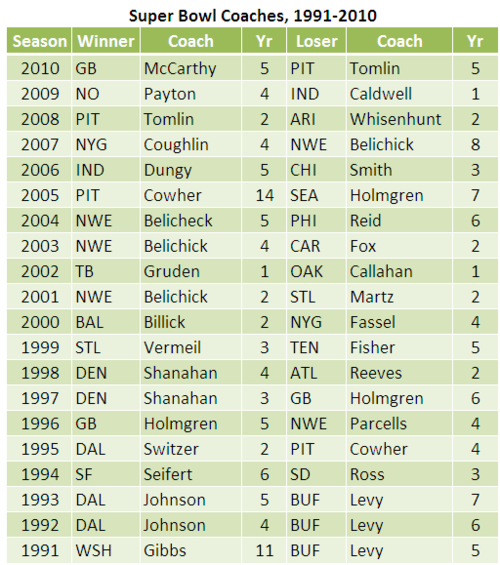
Super Bowl Coaches 1991-2010Look at the list of Super Bowl coaches over the last 20 years. They average just 4.3 seasons of tenure as the head coach of their team. Only Bill Cowher and Joe Gibbs have managed to win it all after their 6th season.

To some degree there’s a bias here, because coaches don’t often last much beyond their 6th season, if they make it that far. But list the longest tenured coaches and you don’t see many Cowhers. Andy Reid, Jeff Fisher, Brian Billick, John Fox. They last and they last and ultimately never find that elusive second chance. Whether that’s because they lose their edge, because their can’t find the right personnel, or because they can’t replace coaching talent, I don’t know.

The Eagles front office has bungled the 2011 season in multiple ways. With better coaching and one or two different acquisitions, maybe they’re off to a 4-0 start. But perhaps those mistakes aren’t one-off blunders. Perhaps they are indicative of a franchise that’s been running in place for six years. And if that’s the case, it’s probably time to clean house and start over.

Photo from Getty.
Fire Juan Castillo Yesterday

Juan Castillo

If he can’t bottle up the anemic San Francisco offense, Juan Castillo deserves to be fired posthaste.

That’s what I wrote just two days ago. And after the defense’s wretched performance in the second half against the 49ers, it’s time to end this farce.

Look, Castillo is not and has never been the only problem on the 2011 Eagles. Dropped passes, missed opportunities, bad playcalling, turnovers, inadequate rookies. You can spread that 1-3 blame around pretty easily.

But there is simply no denying that the Juan Castillo Experiment™ is over. The results are impossible to ignore. Three straight fourth quarter leads blown. Career high passer ratings for the last two mediocre quarterbacks to visit the Linc. An incompetent run defense rivaled only by a routinely torched pass defense.

Some people (at least as of a few days ago) still put the blame on the players. And, heck, the players certainly blame themselves. But let me explain to you exactly why it’s Castillo, not the players, who’s at fault.

Let’s start by traveling back in time about 10 months, when Andy Reid kicked Sean McDermott to the curb. I don’t think there were many people who disagreed with that move. The Eagles defense had disappointed for two straight seasons and McDermott had lost the respect of the locker room.

That defense also had major personnel holes. Neither Ellis Hobbs nor Dimitri Patterson were quality NFL starting cornerbacks. Ernie Sims played like a shark out of water. Stewart Bradley was similarly, if not quite so hopelessly inept in the middle. And there was not a single pass rushing threat outside of Trent Cole.

Ultimately, the Eagles decided to overhaul both the players and the coaching. They let Sims, Patterson, Bradley, Bunkley, and Mikell walk. In their place they brought in Pro Bowlers Jason Babin, Cullen Jenkins, Dominique Rodgers-Cromartie, and Nnamdi Asomuga. McDermott was fired, along with the rest of the defensive staff. Reid brought in Jim Washburn to install a new defensive line scheme and Castillo to oversee it all.

After four games, we can see what was evident in the preseason: the defense continues to have major personnel issues. The linebackers, even slightly improved with Brian Rolle subbing for Casey Matthews, remain a work in progress. Jarrad Page leads a revolving door of subpar safeties. Still, overall you can’t look at this defense and say that the talent isn’t significantly better than the one McDermott managed to a 10-6 record last year.

Castillo has more to work with, but has done less than the man he replaced. He has so far been completely unable to scheme around and protect his weaker starters. There is zero evidence of adjustments as the games go on, causing second half leads to disappear faster than full sentences at a Reid losing game press conference.

Even worse, Catillo’s schemes have actually mitigated the strengths of some of his best players. Look at Asomugha. This is a player who’s one of the top two or three man-to-man press cover cornerbacks in the NFL. When they call his number to match up one on one against Roddy White or Hakeem Nicks or Vernon Davis, he shuts them down. That’s what the $60 million contract was for. But frequently Castillo asks Asomugha to drop back into zone coverage, give the wide receiver a big cushion, or go all the way back into a free safety spot. Quite simply, that hasn’t worked.

In today’s game, for example, Asomugha was playing zone on an Alex Smith rollout pass in the third quarter. Nnamdi was sucked out of position to his left, allowing Kendall Hunter to break free for a 44 yard gain. It was ugly, but foreseeable. A good defensive coordinator finds ways to maximize the talents and minimize the weaknesses of his players.

Furthermore, Castillo’s main message all offseason was a return to fundamentals. Supposedly he was going to re-instill a basic attacking defense that lets the players play without overthinking. After all the missed tackles and blown assignments, it’s clear that he can’t even deliver on that promise.

Castillo may be a great motivator for his players. But he’s bringing little else to the table. His promotion didn’t make sense at the time, and after an offseason and a quarter of the season gone, Castillo still hasn’t done anything to change our minds. Time to fire him while you still might be able to salvage the defense.

Photo from Getty.

Juan Castillo's Last Chance

Eagles Defensive Coordinator Juan Castillo

There is little question in my mind that Juan Castillo, much like the young linebackers he has thrust into the spotlight, simply isn’t ready for primetime. So far there has been nothing to suggest that Castillo can game plan effectively to utilize his great defensive line and shutdown corners or minimize his personnel weaknesses.

Thus, this Sunday’s game is a must-win for the defensive coordinator. If he can’t bottle up the anemic San Francisco offense, Castillo deserves to be fired posthaste.

Let me detail for you just how bad the 49ers offense is. According to Football Outsiders, they have the second-worst pass blocking offensive line, the worst starting running back in Frank Gore, and no wide receiver with more than seven receptions. Alex Smith is the 25th-best quarterback in the NFL, just behind Bengals rookie Andy Dalton.

The 49ers have exactly one serious offensive weapon: Vernon Davis, the athletic tight end who has twice the receptions as San Fran’s next best receiving threat.

Planning to defend and disrupt this offense should be the football equivalent of handing someone a nearly completed crossword puzzle, final word: three letters, “easy as ___”.

Given the Eagles huge advantages against the 49ers wide receivers and offensive line, they should be able to keep San Fran from scoring much more than 10 points. And Juan Castillo has no excuse for letting Vernon Davis or anyone else on that team beat him, even with the problems the Eagles linebackers and safeties have had.

If the Eagles can’t shut this offense down, there will be no more time to let him rearrange a few players here and there. Castillo either wins this week or he’s out the door.

Photo from Getty.

Offensive Responsibility: Stop the Turnovers

Michael Vick

The number one problem with the Eagles through three games is their defense. By almost every measure other than sacks, Juan Castillo’s unit ranks near the bottom of the league. But I sense there’s a healthy sense of dissatisfaction with the offense as well.

On the surface, those concerns seem overblown. The Eagles offense, after all, ranks 10th in the NFL in points per game and sixth in yards.They have the fourth-most first downs and the fourth-highest third down conversion rate. Moreover, they’ve done all of this despite an offensive line that was hastily stitched together and having their MVP quarterback get knocked out of two games.

So what’s the problem? Obviously, after last week, short yardage and red zone concerns are high on the list of many Eagles fans. We will have to see if those issues linger through the rest of the season.

But perhaps the biggest culprit in the offense’s sporadic ineptitude has simply been turnovers. Against Atlanta Michael Vick threw an interception and lost two fumbles. Then last Sunday the Giants came away with three interceptions, one from Vick and two gifts from Mike Kafka. The Eagles currently have the 6th-worst turnover per drive ratio in the NFL.

Off those six turnovers, the Eagles opponents scored 28 points — easily the difference between winning and losing against the Falcons and Giants. A large portion of that blame rests with the Eagles defense, which needs to step up and protect the lead when the offense makes a mistake. But the defense’s ineptitude doesn’t absolve the offense of responsibility either.

Until Castillo can shore up the Eagles defense, Vick (with injured hand) and company have to be extra smart with the football. Even with a sieve of a linebacker corps, both of the last two games were winnable until the end. A few more points, a couple fewer mistakes, and maybe you start turn things around again.

Photo from Getty.

The Myth of Andy Reid's Late Season Success

Andy Reid Philadelphia Eagles

This post is going to be short and sweet. The takeaway: Andy Reid’s teams do not always improve as the season goes on.

Fans and commentators often repeat the same conventional wisdom that Reid has the Eagles running at peak performance coming down the stretch. Right now, some people are using it to ward away bad feelings about the Eagles’ disappointing first three games. Unfortunately it’s a myth propagated by poor use of statistics.

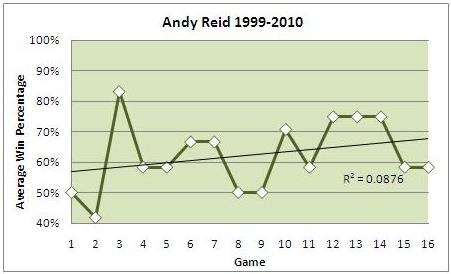
You might have seen the statistic that Reid is 35-14 in December. But it’s a rather crazy idea to suggest that the month of December somehow brings out the best in the Eagles. What’s so special about that month over others? Let’s look at Reid’s win percentage over the last 12 years by game:

Andy Reid Win Percentage

I’ve included the trendline, which makes it look like there’s improvement. But check out the r-squared value. The “improvement” isn’t significant. If there’s any correlation at all, it’s dwarfed by other factors.

You can cherry-pick games 12, 13, and 14 where his win percentage is 75 percent. But (a) over 12 years that result is less than 1 win better than average, and (b) in the bookend games 11 and 15 the team is actually below average. Making any argument based just on those three games is a multiple endpoints problem.

I wouldn’t try to blame Sunday’s game on a typically slow start either. It’s true that week two is the only week where the Eagles have more losses than wins, but until the Giants loss, Reid had won the last 10 week three games.

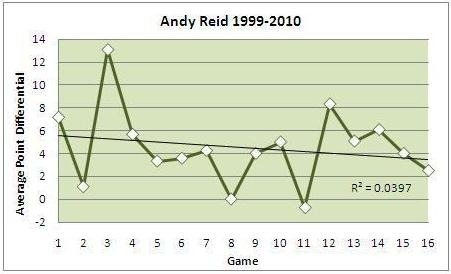
Andy Reid Point Differential

Above I’ve averaged Reid’s career by point differential, rather than win percentage. This gives more credit to big wins, less credit to close losses, etc. And again, no significant correlation. The wins and losses might as well be distributed at random across all weeks.

Reid is a good coach whose teams have consistently won most of their games. And the team might yet turn things around in 2011. But Reid is no more likely to do better late in the season than he’s doing right now.

Photo from Getty.

The Afternoon After

I’m a big fan of blogger and scout Tommy Lawlor. There is absolutely no one who works harder in the Eagles blogosphere, and his detailed breakdowns of each week’s game are must-reads for anyone who considers him or herself to be a fan.

But sometimes Tommy is just a little too cheery. Today, when he posted his thoughts “The Morning After”, Tommy obfuscated some of the issues that made most Eagles fans retch during Sunday’s game. Follow along with my inline rebuttal below.

In some ways the game was better on tape.

In that you knew what to expect going in?

Missed tackles by Kurt Coleman, Jarrad Page, and Jamar Chaney were the worst. Those guys turned short plays into big gainers and/or TDs… Coleman’s miss on Victor Cruz should never happen. Kurt had him lined up and should have made a routine play. Cruz did nothing special. The mistake was all on Kurt for making a horrible, horrible attempt.

Wait. Was it a mistake or a “horrible, horrible attempt”? Those seem like two different things…

Kurt’s idiocy gave them a 74-yard gift. Huge, huge turning point in the game.

So Coleman is just dumb? And again, is that a mistake or a horrible attempt? Maybe it will become clear later on.

I am obviously frustrated with the team, but still have feelings of optimism as well. I know that makes me a delusional homer/idiot/delusional idiot/nut job, but hear me out.

It doesn’t, I want to be convinced.

At the 11:43 mark of the 4th quarter yesterday we led 16-14. The Giants had 232 yards of offense to that point (205 in the 1st half, 27 in the 3rd Qtr). Those yards came on basically 4 plays… 4 plays led to 177 of 232 yards. We’d largely controlled the game, aside from our mistakes.

For starters, why are we talking just about the first three quarters? Didn’t the big collapse happen in fourth? If I read this right, “we” held the injury-depleted Giants to only 55 yards through three quarters — if you take away every big play. I’m convinced already. Actually, this is the post-game pep talk for every team the Eagles beat last year, isn’t it? “Well, if you remove those big plays we gave up and that one awful quarter that lost us the game… VICTORY MONDAY!”

I’m not excusing the mistakes. We made them and they cost us 14 points. But…to that point, we’d kept things under control and had taken the lead. Unfortunately that’s when Andy went for it on 4th/1 and gave the Giants renewed hope. Horrible, horrible decision by Big Red. The Giants may still have won the game, but that call really changed things instantly.

It was a poor decision. But am I supposed to blame the Eagles giving up the next 15 unanswered points on that one fourth down call? I thought the defense “controlled the game” through three quarters.

My point in all of this is that our biggest problem is our own mistakes. That is something that can be fixed.

Or not, seeing as there isn’t exactly a wealth of talent behind those guys.

Last year no matter what the coaches did Dimitri Patterson was still going to be Dimitri Patterson. Hakeem Nicks killed him. Cruz got us for 2 TDs yesterday, but they involved a horrid tackle attempt and our CB missing the ball by maybe 2 inches. That’s far different than having a player who simply can’t match up with the opposing player.

When Tommy classifies something as a “mistake” he means that the player is good but just had a momentary horrible play. The truth is that making mistakes is what makes you a bad player. Casey Matthews doesn’t get to say “well, I just made one mistake.” The mistake proves he isn’t ready to start.

Also, it takes some twisted logic to say that getting beat by a bad player is more excusable than getting beat by a good one.

I understand that there is no guarantee the mistakes will get fixed. Some teams never get fully on track. I have faith in Andy Reid and the players…

Even after this the way this season has started? Based on what?

Let’s not forget that Reid has been backed into a corner before. The 2003 team started 0-2 before rallying to go 12-4… The 2006 team was 5-6 at one point… That team then won 5 in a row and even a playoff game. The 2008 team bottomed out at 5-5-1 after a rough defeat in Baltimore. That group went 4-1 and just missed a trip to the Super Bowl. Set us aside. Green Bay last year was 3-3 and couldn’t stop the run. They made some adjustments on offense and defense and finished okay as I recall. The 2007 Giants started 0-2.

Right, because most teams that start poorly end up going to the Super Bowl. Let’s go see who started 1-2 in 2010… Broncos, Jaguars, Chargers, Raiders, Giants, Redskins, Cowboys, Vikings, Rams — none of whom made the playoffs.

If the coaches make the right changes and the players respond, we’ll be okay. If not, we’re in for a long year. Reid has a track record of making the right adjustments and getting things worked out…

Like “adjusting” his offensive line coach to be defensive coordinator?

By the Numbers: A Miserable Disaster

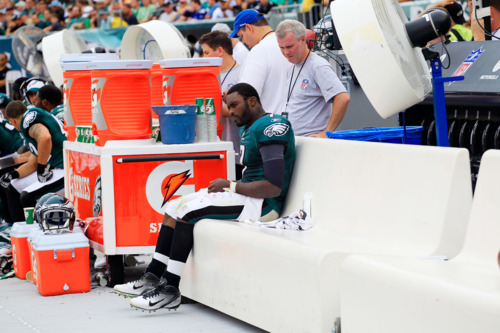
Michael Vick Bench

Let me revise my opening statement from a week ago: Last night’s Yesterday’s loss was cruel a disaster. The Eagles showed extended stretches of dominance on both offense and defense, but made vital mistakes, suffered awful injuries, and came up just short in the end ended up losing by two touchdowns to a depleted Giants team. Oh, and the coaching stunk.

Let’s break it down with some statistics:

13:42 = Time of possession advantage to the Eagles. They had the ball over 50 percent more than the Giants, ran 21 more offensive plays, and reached 11 more first downs. Yet the Eagles only scored 16 points. How is that possible? One word: coaching. Those numbers are indicative of the talent disparity in the Eagles favor. Only horrible play calling (see: Schmitt, Owen and shovel pass, predictable) could cause the Eagles to settle for three field goals in the red zone.

4 = Times the Eagles were stopped in short yardage situations, including three plays from the one-yard-line and a fourth down attempt. We will have to see if this becomes a theme. Howard Mudd’s offensive line philosophy requires smaller, athletic linemen. That hasn’t been a benefit on short yardage. During his time in Indianapolis, Mudd’s lines averaged only 19th in Power Success.

6th = Most rushing yards in game for an Eagles player in the post-Duce Staley era. Pretty much the only positive you can take away from this game is the play of LeSean McCoy, who has quietly made his case for being the best offensive player on the team, if not the whole league. McCoy’s play warranted the almost even split of run to pass calls Andy Reid doled out yesterday.

4 = Big plays allowed of 25 yards or more, including three touchdowns. Sometimes it’s easy to assign blame, like on the Brandon Jacobs touchdown wheel route when Casey Matthews (AKA white Ernie Sims) failed to pick him up. Sometimes it’s more difficult, like on the patented Eli Manning interception gift that Victor Cruz somehow beat out Nnamdi Asomugha and Jarrad Page for the go-ahead TD. It doesn’t matter, though. Other than experimenting with Brian Rolle at weakside linebacker, hardly a sure thing, the cupboard’s empty. With big personnel holes and a coordinator who seems completely incapable of making schematic adjustments, the Eagles defense is lost.

8 = First week of the NFL season that the Eagles have any hope of seeing Michael Vick return to the field after his broken hand. The team faces teams that are a combined 7-1 over the next three weeks. Unless Vince Young or Mike Kafka can summon some heretofore unseen magic and the defense improves rapidly, this team could rapidly dig a hole for themselves that’s too deep for even Vick to get them out of.

Photo from Getty.