For when setting people on fire is funny. See y’all in the press box.
Week Three
New York Giants @ Philadelphia Eagles
1:00 pm ET on FOX
For when setting people on fire is funny. See y’all in the press box.
Week Three
New York Giants @ Philadelphia Eagles
1:00 pm ET on FOX
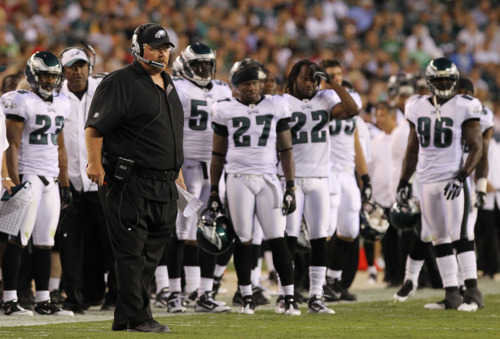
Three weeks back, on the last day of roster cuts, the Eagles released cornerback Joselio Hanson. At the time, I wasn’t too worried about the move. Sure, it would have been nice if the Eagles could have gotten something back for Hanson in a trade, but ultimately the fourth corner is little more than an injury insurance policy.
Only a few days later though, Hanson was back in the fold. Apparently he initially refused to take a pay cut, but realized afterward that the reduced salary was still better than what was offered by other teams.
So, after a little bit of drama, Howie Roseman and the Eagles seemed to come out on top. They kept a solid player at a discount. It was the last of an offseason’s worth of smart moves. All the preparation for this free agency period, the aggressive signing of stars like Nnamdi Asomugha, Cullen Jenkins, and Jason Babin, has already started to pay off.
But for all that the Eagles front office did to outmaneuver the competition, stealing players away from division rivals and wowing the league with their salary cap smarts, they have been remarkably shortsighted on some smaller matters.
The normal idiom is “penny wise and pound foolish,” describing a person that does all the little things right but throws larger chunks of money away. In some ways, the Eagles front office has displayed the opposite problem. They made a ton of big moves that look great right now. Grabbing all these Pro Bowlers was remarkable. Based on those decisions, the team should be Super Bowl-bound.
So what’s holding them back? The small things. There were plenty of cheap, starting-caliber (if not All-Star quality) linebackers on the open market. Instead, the team went with a fourth-round rookie and two other young, unproven players. That decision may have cost them a win at Atlanta. The late reshuffling of the offensive line hasn’t hurt the Eagles. But the rookie kicker and punter don’t look confident yet. We’ll see if that becomes a problem down the road.
Meanwhile, in two games, Hanson has played just three snaps. 3. Not that the Hanson signing precluded bringing a linebacker in, but wouldn’t the money have been better spent on a linebacker insurance policy?
The Eagles went to such great lengths to win the offseason, but failed to fill a few crucial holes. With some luck and some adjustments, those oversights don’t have to cripple the team’s Super Bowl chances. But they sure are making things a lot harder on themselves.
Photo from Getty.

Last week I told you why the Falcons weren’t a team to worry about. Of course, they ended up beating the Eagles. Now I’m going to tell you that this week’s opponent, the Giants, are a surprisingly worrisome matchup. Given my track record, the Eagles will probably end up blowing out the Giants. But let me air my concerns anyway.
On the whole, the Giants defense is an injury-riddled unit. But those pass rushers still look formidable. I have no desire to see Justin Tuck bearing down either on injured Michael Vick or first-time starter Mike Kafka. If the Eagles quarterback - whoever it is - can get time to throw, the Giants secondary is eminently beatable. But will they have that time? So far Howard Mudd’s offensive line has exceeded my expectations. Let’s see if they can keep it up this weekend.
I also worry, as usual, about the Eagles run defense matched up against a team that enjoys playing power football. Looking at the Adjusted Line Yard stats for the Eagles defensive line is instructive. The attacking defensive line is definitely disrupting running backs, as the Eagles have the second best “power success” rate and fifth best “stuffed” rank. But once the play gets to the linebackers, yikes. The Eagles are ranked 29th in “second level” rush yards (5-10 yards from scrimmage) and 31st in the “open field” (10+ yards). And don’t expect some big improvement just because the Eagles are rearranging the deck chairs.
Finally, isn’t odd that people don’t seem concerned about Vick missing this game? Perhaps fans are more sure that Vick will return from his concussion than I am, but I don’t know what that’s based on. As of Thursday morning he hadn’t passed his concussion tests. Is everybody sure that Kafka can win the game on Sunday? He looked like he belonged last week, and might have been a Jeremy Maclin drop away from winning the game. Not to mention, his performance was better than other, more highly touted quarterbacks coming off the Eagles bench in the past. But will he be able to step up for a full game? That’s still very much up in the air.
The most lopsided matchup in the whole game will be Eli Manning against the Eagles pass rushers and cornerbacks. Luckily for the Eagles, Manning doesn’t have a Hall of Fame tight end to rely on either. So there’s a good chance they will sack and pick off Eli enough to obviate any other issues.
But if that’s not enough, don’t say I didn’t warn you.
Photo from Getty.
One of the things I never thought I’d say about new Eagles defensive coordinator Juan Castillo was that his schemes are too complicated. And while overall his system seems to be an order of magnitude simpler than ex-coordinator Sean McDermott, Castillo still shares his predecessor’s maddening tendency to overcomplicate things in some respects.
When I re-watched the Eagles pass defense in their loss to the Falcons on Sunday, some defensive breakdowns were apparent. There was poor coverage here and there by all the linebackers as well as the safeties. Overall, though, I wasn’t as discouraged by the performance of the players as one particular scheme that Castillo came back to on multiple occasions.
That scheme involved bringing one or more of the safeties, Jarrad Page and Kurt Coleman, up into the box or into underneath coverage on a receiver. Either Asante Samuel or Nnamdi Asomugha dropped back and played center field instead.
Now, it may seem obvious why this sounds like a flawed plan. For starters, you’re taking one of the two best coverage players in the entire NFL away from a receiver they can cover. Plus, neither player has much, if any, experience at safety. This scheme actually takes one of your top defensive assets and turns him into a liability.
Turns out that’s exactly what happened against the Falcons. Let me highlight two plays in particular.
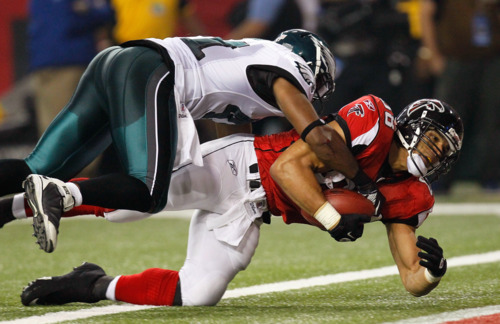
On the first play, the Falcons had 1st and 10 in the red zone during the third quarter. Asomugha was at safety, while Page moved up to cover Tony Gonzalez in the slot. Page gives fair coverage on Gonzalez, but isn’t athletic enough to mark him perfectly. The ball comes in the seam up the middle, and Page is slightly beat.
This is where a safety might come in handy. But Asomugha indecisively shifted over to the opposite side, where Samuel already had good coverage on his man. When Gonzalez made the catch and pushed in for the touchdown, Nnamdi was still 8 yards back in the end zone.
The Eagles played a similar scheme later in the quarter. Samuel is matched up on the outside against Roddy White, who runs the only pass route on a play action play. Asante takes the outside coverage on White’s slant, expecting safety help in the middle. But Asomugha doesn’t read the play in time. He’s still backing up when the ball reaches White for a 17 yard gain.
Maybe there are benefits to this scheme that I’m not aware of, but all the evidence from the Falcons game suggests that it’s a poor strategy. Castillo would be better off putting his best cover corners on the opponent’s top receiving options and letting them do what they do best. Then put the safeties in their normal spots, and let the opposing teams try to beat them.
Don’t overthink it.
Photo from Getty.
Over the last few weeks, I’ve talked a lot about linebacker and my concerns about the position that appears to be the Eagles biggest Super Bowl hurdle. So last night I went back and re-watched the Falcons loss, focusing only on the run defense to try to see what was going on there.
I counted 23 Atlanta rushes. 15 of those came against the base Eagles defense, with Jamar Chaney, Casey Matthews, and Moise Fokou at linebacker. 7 came against the nickel, with only Chaney and Matthews playing, including the final 6 runs of the game. 1 play, at the goal line, involved 6 defensive linemen and four linebackers with the addition of Keenan Clayton.
Of those plays, 7 involved a defensive line stop or, often, tackle for a loss. Trent Cole, as everyone noticed live, absolutely manhandled Falcons left tackle Sam Baker. But the defensive line certainly didn’t bottle up everything. There were big holes at times and Atlanta utilized trap blocks and counters heavily to exploit them.
Of the 16 plays that got to the linebacker level, I gave the group a generous 8 stops. On this half, most were solid plays by Matthews or Chaney. They refused to get sucked in on movement and worked their way out of traffic or blocks from the Falcons offensive linemen. Don’t think I charted one good play of run defense from Fokou.
And the other half? Those were very poor showings by the linebackers. Sometimes they were too anxious to rush up the field or engage with blockers instead of staying in their lanes. Other times they were on their heels, thinking too much and not reacting.
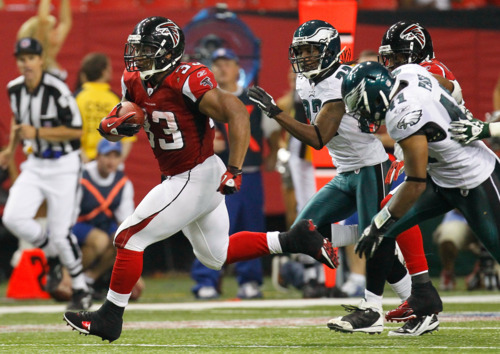
I don’t have the stats to compare this (if anyone does please let me know), but having one third or more of all runs make it to the third level doesn’t look pretty for the defense. Now, the secondary could certainly do a better job on run defense as well. Turner’s 61-yard run was particularly damning for Kurt Coleman (awful angle), Jarrad Page (hesitation & stumble), and Dominique Rodgers-Cromartie (Asante-itis).
Still, it’s hard for me to speak positively about the linebacker corps. They did show promise, in that they did well sometimes. But inconsistent would be an understatement. The only change I’d make to my aforementioned suggestion would be to replace Fokou before Matthews, since the third-year player looks even more hopeless than his rookie counterpart. Perhaps another 7th-round pick, Brian Rolle, would be better, although that’s far from a sure thing.
Otherwise it’s time for a Will Witherspoon-esque pick-up or for Juan Castillo to change up the scheme. Something’s gotta give.
Photo from Getty.
Last night’s loss was cruel. The Eagles showed extended stretches of dominance on both offense and defense, but made vital mistakes, suffered awful injuries, and came up just short in the end. Let’s break it down with some basic statistics:
14 = The number of targets by Matt Ryan to his wide receivers, for a meager 71 yards.
14 = The number of targets by Ryan to his tight ends and running backs, for a much-less-meager 123 yards. The Eagles defense stifled the wide receivers once again, keeping them to only 5 yards per target. But the linebackers (and Jarrad Page) proved they can’t be trusted to cover at all. They let an aging Tony Gonzalez and “No Afterburner” Michael Turner rack up a ridiculous 9 yards per target, a completion percentage of 71 percent, and 3 touchdowns.
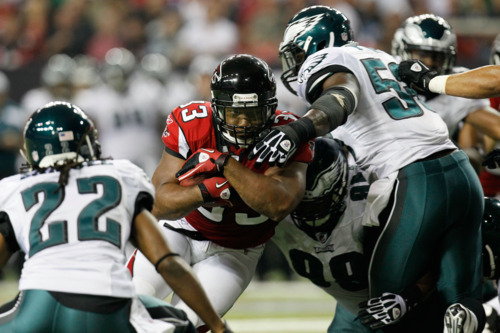
4 = Tackles for a loss by Trent Cole. It’s a testament to the Eagles ineptitude at linebacker that Cole could have such a beast of a day and the defense could still struggle to stop the run. I couldn’t see them on every play, but Casey Matthews especially took horrendous routes to away from the ballcarrier.
222 to 98 = Number of first half yards gained by the Eagles compared to the Falcons. If you’re ever asked how it’s possible to out-gain an opponent by more than twice the yards and still be down going into the half, there’s only one answer: turnovers. Take away one of those fumbles by Michael Vick, the Eagles run away with the game.
1 = Helmet-to-helmet roughing the passer personal foul on Todd Herremans. If Vick doesn’t come out of the game with a concussion at the end of the third quarter, there’s no question in my mind that the Eagles win. On that drive, the Eagles extended their come-from-behind lead to 10 points, having scored 3 touchdowns in the last 4 possessions. Meanwhile, Atlanta was foundering. On their three possessions prior to Vick’s injury, the Falcons ran 7 plays for 0 yards, an interception, and 2 punts. After, they had 2 drives with 19 plays, 170 yards, and 2 touchdowns to retake the lead. That’s called “new life.”
And yet, despite everything, if Jeremy Maclin catches that 4th and 4 pass from AJ Feeley Mike Kafka, the Eagles still might have won this game. What does that tell us? That the Falcons were lucky to sneak out with a win. If Vick comes back healthy and Andy Reid benches his in-over-his-head rookie middle linebacker, I’d make them a two touchdown favorite in a playoff rematch.
Photo from Getty.
Flashing lights appear to be a theme this year.
Week Two
Philadelphia Eagles @ Atlanta Falcons
8:20 pm ET on NBC
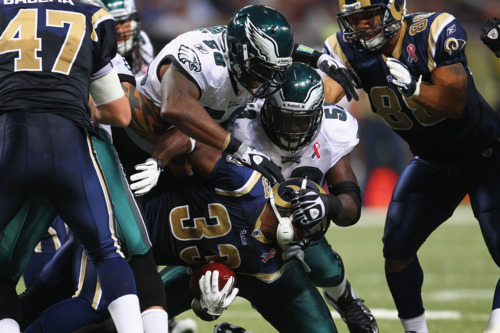
Over at Bleeding Green Nation, Route36 had a nice video rewind, looking just at the Eagles run defense. He comes out of that exercise much more optimistic about the linebackers than when they went in, mostly based on their improvement over the course of the game.
It’s an interesting study, but I’m not convinced yet.
First of all, assigning positive and negative grades to plays based on outcome seems quite arbitrary. There aren’t many I disagree with, but it’s odd when plays marked as “Chaney misses the tackle which would have allowed only 4 yards” is listed as a positive play for the defense. If you mark a few of those negative, then you’re very quickly at the point where the Eagles are at equal good and bad plays. That doesn’t seem like the makings of a good run defense to me.
Furthermore, saying that all runs 5 yards or more are “negative” doesn’t quite cut it. For example, 7 of the 10 plays marked negative actually allowed 10 yards or more. If we classify those as “super negative” plays for the defense, things don’t look quite as rosy.
Second, I don’t really see the case for discounting the first quarter performance. A defense that has many poor plays is likely to give up some big runs, like the one they allowed to Steven Jackson. And as I intimated earlier in the week, it might be more appropriate to only look at the first half, since the second half quickly got away from the Rams. When the game was close, they were shredding the run defense. I’m sure a better team like the Falcons hopes to keep the game competitive and pound away.
Third, we do all remember that Jackson got hurt early in the game, right? I’m not encouraged by the defense allowing worse than the league average on running plays to castoff backs like Cadillac Williams and Jerious Norwood.
Finally, there’s the matter of attributing credit and blame. Rewatching these plays only reinforces the notion in my mind that if the defensive line doesn’t do something to stop the run, it’s going to be a bad play. The vast majority of “positive” examples of run defense involve one or more defensive linemen making the stop or otherwise causing it. When the Rams got past the first line, the linebackers rarely did anything to stop the bleeding. In other words, the Rams “second level” rushing yards were still very high - a bad sign for the linebackers.
Overall I’m still hopeful that the run defense and specifically the linebackers can improve, but I just don’t think we saw enough last Sunday to tell us that process is already underway. If the Eagles can limit Michael Turner this week, then we’ll talk.
Photo from Getty.