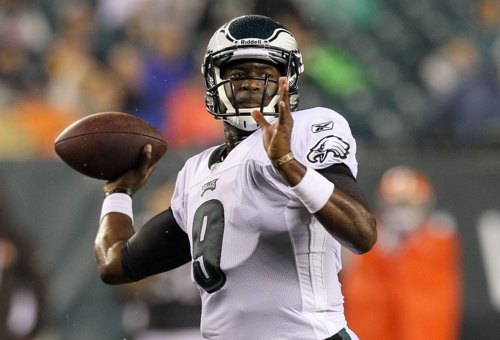
Final Eagles 53-Man Roster Prediction

Final roster cuts happen this weekend and there are still a few question marks. Here’s my final prediction for the 53 man roster.

Quarterback: (3) Vick, Young, Kafka. Easiest spot on the team. 

Running Back: (4) McCoy, Brown, Lewis, Schmitt. I suppose Eldra Buckley had a shot, but the new rookie from Pitt has had a tremendous preseason.

Tight End: (2) Celek, Harbor. Donald Lee put some good tape on for some team last night, but it wasn’t the Eagles.

Wide Receiver: (6) Jackson, Maclin, Avant, Smith, Cooper, Hall. Chad Hall gets the final offensive skill spot because of his versatility. His place is in jeopardy once Steve Smith is healthy enough to contribute, though.

Offensive Line: (9) Peters, Herremans, Kelce, Mathis, Watkins, Jackson, Dunlap,  Howard, Vandervelde. I don’t buy Reggie Wells as anything more than a camp body and Ryan Harris’s back makes him expendable. Mike McGlynn has fallen even further out of favor than Jackson. Winston Justice to PUP.

Defensive End: (6) Cole, Babin, Tapp, Parker, Te’o-Nesheim, Hunt. They could try to sneak Hunt onto the practice squad or cut Parker to save money. But I anticipate them going heavy at DE. Brandon Graham to PUP.

Defensive Tackle: (4) Jenkins, Patterson, Dixon, Laws. Trevor Laws played well last night to solidify his spot. Anthony Hargrove and Derek Landri have been camp favorites, but I don’t see the upside. Plus, the Eagles have always been willing to move guys inside from end for that extra rush presence.

Linebacker: (6) Matthews, Fokou, Chaney, Jordan, Rolle, Clayton. Greg Lloyd has injury redshirt written all over him. Brian Rolle looked much more impressive than Keenan Clayton in recent days. I hope the Eagles snag another veteran back up and put Clayton on the practice squad.

Cornerback: (6) Asomugha, Samuel, Rodgers-Cromartie, Marsh, Lindley, Hughes. Right now I’m leaning toward a Joselio Hanson trade. 

Safety: (4) Coleman, Allen, Jarrett, Page. I’m sure Bobby April really wants to keep Colt Anderson. but at this point I’m worried enough about Nate Allen that Jarrad Page has to stay.

Specialist: (3) Dorenbos, Henry, Henery.

If I did my math right, that’s 53. Sound off in the comments if you disagree.

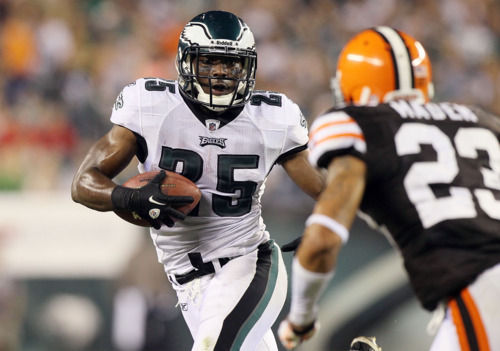
Photo from Getty.

A Reason for Optimism on the Young Linebackers

Since the Football Outsiders Almanac was released, I haven’t had a chance to really delve into some of its more interesting conclusions.  The first of these gives me, the down-on-our-linebackers poster boy, a reason for optimism.

That reason: the Eagles linebackers were much worse in 2010 than I realized. 

First of all, the linebackers took a huge step back in coverage. In 2009, when stalwarts Chris Gocong, Akeem Jordan, and a resurrected Jeremiah Trotter all received extensive playing time, the Eagles were ninth in the league covering tight ends and a middling 16th covering running backs out of the backfield. Last year, those dropped to 19th and 31st, respectively. 

If you remember, coverage was supposed to be a strength of the 2010 group. Stewart Bradley and Ernie Sims were expected to be every down backers. Yet Bradley was still a step slow from injury and Sims from general bone-headedness.

Their run-stuffing skills also suffered. In 2009, the Eagles ranked sixth in the NFL in defensive second level rushing yards, those five to ten yards after the line of scrimmage that the linebackers should generally be responsible for. Last season, that rank dropped to 23rd.

So the linebackers were bad. Why does this give me hope? Because I went into this offseason thinking that the linebackers weren’t a big problem. The Eagles coaches, supported by Football Outsiders, realized that wasn’t true. The linebackers were bad and needed to be majorly shaken up. While I wanted the team to bring back Bradley, it seems clear now that he probably wasn’t worth the money. And, obviously, good riddance to Sims.

Maybe optimism is the wrong word. We still don’t know if this group of youngsters will be any better than last year’s stiffs. But at least now I at least understand and support the Eagles rationale for making a change.

Photo from Getty.

What to Do With Joselio Hanson?

Last year during training camp, I talked about how Joselio Hanson could be on the chopping block. That didn’t come to pass and Hanson had a pretty good year overall. He didn’t have gaudy stats, but his solid play was a welcome respite as the rest of the cornerbacks not named Asante Samuel looked like turnstiles on gameday.

Yet here we are again, debating Hanson’s merits because of a bigger lockjam at cornerback than last year. With the additions of Nnamdi Asomugha and Dominique Rodgers-Cromartie, the Eagles now have three starting-caliber corners. That pushes Hanson down to dime back, a role that doesn’t put him on the field very often.

According to Football Outsiders, the average NFL team only ran eight percent of its offensive plays with four or more wide receivers. And against the Eagles defense last season, they only ran formations like that a miniscule three percent of the time. Is it worth paying Hanson about $2.2 million for that small bit of playing time and some injury protection?

Plus, if Hanson is going to be active on game day as the fourth corner, he’d have to play great special teams. Last year though, Hanson contributed very little in that area.

Meanwhile, the Eagles have three younger cornerbacks who have all shown promise. Trevard Lindley was last year’s fourth round pick. He may not fit this system any more, but it would be rare to see him go so soon. The Eagles drafted Curtis Marsh this year in the third round, so he’s not going anywhere. Then there’s Brandon Hughes, who has impressed in practice since the Eagles signed him off the Giants practice squad late last year.

I anticipate that the Eagles will try to keep six corners, but even so there’s not enough room for everyone. And with a Samuel trade looking more unlikely by the day, that means the team will either have to cut loose one of its young guys or find a suitor for Hanson.

At this point that last possibility looks relatively likely. I’d give it a 60 percent chance that Hanson is with another team by next week. If that’s the case, I wouldn’t mind trading him within the division, even to the cornerback-needy Giants. Hanson is a solid player, a great nickel back — but he’s not starting caliber. If the Eagles can get a mid-round draft pick in return for a guy who is unlikely to play much this year, that’s a win.

Of course, I also speculated about Hanson last year, and nothing ever happened. So maybe he’ll stick around once more.

Photo from Getty.

Michael Vick, Meet Your New Burden

“We’re sitting here, and I’m supposed to be the franchise player, and we’re talking about practice.”

The NFL has done a semantic disservice by creating a “franchise player” tag. That designation means little more to the team than “best free agent we don’t want to lose.” A real franchise player, as Allen Iverson understood it, was a player who transcended the normal relationship between player and team.

The franchise player is both the indispensable star on the field as well as the jersey that is directly entwined to the team off of it. All players are blamed for poor performance and coaches are always intently questioned after losses. But no one takes more direct criticism for or is more closely associated with overall problems than the franchise player.

Last year, even after the Eagles hitched their wagon to the Second Coming, Vick wasn’t the franchise player. Number seven was still a revelation, much like a penny stock you buy on a whim and ride to millionaire status. Fans, spectators, commentators were playing with house money. They enjoyed the ride and wondered how long it might last.

There were whispers of disapproval as Vick fell back to mortality at the end of the season. Perhaps the NFL has figured Vick out, they said. Maybe he’s not really as good as we thought. Are we sure that sending Kevin Kolb away is the right decision?

In the moment, those voices never amounted to any substantial chorus. There was still too much optimism, too much residual exuberance. Today, however, with the announcement of Vick’s new $100 million contract, that all changes.

Vick’s days as a miracle child are over. He is a high-priced investment expected to perform at an elite level and, more importantly, expected to carry the Eagles to a Super Bowl win. There is no doubt that anything less in 2011 will be a failure for the team as a whole, and specifically for Vick — no matter what stats he puts up or how well he plays. And that paradigm will continue for as long as Vick remains an Eagle.

Vick’s exploits transcended the Eagles in 2010. The team was mediocre, stumbling into the playoffs and exiting in the first round. But Vick became a story much bigger. In 2011 and beyond that will no longer be possible. The franchise player is constrained within the boundaries of his team. Iverson was a star, but once he became more than that for the Sixers his individual efforts never soared quite as high. One could say the same about Vick during his time in Atlanta. The franchise player carries his team. Every spectacular performance lifts the organization. Every loss increases the player’s burden.

Michael Vick is well compensated and adequately prepared to take on this challenge. But accepting the title of franchise player is easy. Enduring it, especially in Philadelphia, is the hard part.

Photo from Getty.

Bring Back the Brian Westbrook Offense

I have always chided fans and commentators for calling on Andy Reid to run ball more. First of all, such pleas fall on deaf ears within the Eagles organization; Reid has his offense and it doesn’t change much. Second, Reid is right - statistics show that passing is now a much more effective way to win football games.

However, at the risk of reading too much into Thursday night’s third preseason game, it might be time to shift the scales back more to the Brian Westbrook-centered offense we saw from 2006 through 2008. It’s not that the Eagles ran so much more during that span, but their entire offense largely went through Westbrook with runs, screen passes, dump offs.

That wasn’t, I think, by choice. Reid realized that the Eagles had few other offensive weapons. Of course, that certainly isn’t the case now. But that doesn’t mean the strategy won’t still work. Here are three reasons it makes sense:

  1. After last season’s coming out party for Vick, it seems clear to me that defenses are going to load up in the secondary to prevent the deep ball from beating them. Unless I missed one, Vick hasn’t completed a single one of his signature downfield bombs this preseason. Right now, opponents would rather let Vick complete dink and dunk passes underneath than beat them with one quick, demoralizing touchdown. And especially as Jeremy Maclin may not be 100 percent, the Eagles offense doesn’t have a full complement of downfield weapons.

  2. The offensive line is still in a state of flux. With King Dunlap at right tackle and two rookies starting in the interior against the Browns, pass blocking was a nightmare. Unless that line improves rapidly, Vick is not going to have time to sit back and let deep routes develop. The quick passes, the dump offs underneath, and the run game will likely continue to be more consistent options.

  3. LeSean McCoy, the new Westbrook, is making a quietly persuasive case to be the number one offensive threat. He never got the headlines last year, even though his production was very impressive for a second year running back. Recliner GM found that in 2010 McCoy became only the ninth RB to post more than 1,670 yards before his 23rd birthday. And if the preseason can be trusted for anything, it has shown that McCoy might be ready for even more now. For a player who came into the league in Westbrook’s shadow, he’s already close to surpassing his mentor.

The offense from the third preseason game wasn’t pretty, but it hinted that a McCoy-centric system could win football games. With defenses gearing up to stop the deep passing game and a leaky offensive line, why not use DeSean Jackson more as a decoy in the early going? Do the unexpected and run the football right at these over-aggressive defensive tackles. Take what they give you and ram it back at them. If you’re successful, defenses will have to respect McCoy, and the long balls for DeSean and company will surely open up.

Photo from Getty.

Overreacting to the Problem at Right Tackle

There’s an important, if often overlooked difference between critic and cynic. The critic questions the current situation thoughtfully and wonders what other options exist. He might second-guess decisions and rethink conventional wisdom. But the cynic overreacts to the most recent information. He might call a good team a “house of cards” or demand that they shake everything up for one questionable improvement.

That’s where we stand at this moment with the Eagles. Some of us are willing to criticize and question, and others are quick to call for changing everything immediately. You can watch this dichotomy play out in the debate about right tackle.

The calls are out for Andy Reid to move Todd Herremans away from his normal left guard spot to shore up the right tackle position. Admittedly, right tackle could be a problem for the Eagles. Winston Justice’s knee injury hasn’t fully healed yet, his replacement Ryan Harris now has back problems, and temporary starter King Dunlap hasn’t proven he can hold his own at this level yet.

But moving Herremans over to tackle is a desperate move, one that many in the media have been pushing for days. They ask Reid whether he’d consider moving Herremans and Andy says the same thing every time: he know that’s a possibility if he needs it, but he has other options right now. To me, that quotation is clear. Herremans can be a last resort if no one else is even adequate, the way a salad is a last resort for Reid after every possible cheesesteak and hamburger option has left the building.

And why would Herremans at right tackle be anything more than that? He hasn’t taken a snap at tackle in almost two years, and hasn’t gotten regular playing time at the position since his rookie year in 2005. We know he can slide over in a pinch, but you don’t sacrifice the only solid thing the Eagles offensive line has going for it - the left side - for a questionable upgrade.

Like every other team in the NFL, the Eagles have problem spots. Injuries at right tackle, a rookie middle linebacker, and a few more. But we shouldn’t lose sight of the fact that with these offensive weapons, pass rushers, and cornerbacks, the Eagles on paper rival any team of the Andy Reid era.

Criticism is always good. Cynicism gets old.

Photo from Getty.

Is Asante Samuel Overrated?

Asante Samuel had a rough preseason game last Thursday, giving up one of the worst touchdown receptions in recent memory. If you missed the game, just picture a Steelers receiver jogging into the end zone for an uncontested throw-and-catch from Ben Rothlisberger.

If everyone else hadn’t also looked so bad, and if the game had actually counted for anything, you can bet Eagles fans and commentators would be livid at Samuel for giving up such a weak touchdown. We’ve come to accept Asante’s gambles because he gets more interceptions than any other cornerback in the NFL. Plus, last year Samuel finally gained the respect he lacked when he was first signed as a free agent. Opposing quarterbacks rarely targeted him, and when the ball did come his way the average gain was minuscule.

Samuel is widely regarded as one of the top five corners in the NFL. Yet, a few weeks back, when the Eagles dipped into their pocket books to sign Nnamdi Asomugha, I suggested that having two of the best corners on the field at the same time might expose flaws in their games previously uncovered. That’s because a great cornerback, if he is substantially better than his partner on the other side of the field, will mostly push quarterbacks to avoid him.

Last year’s Eagles were a great example. Ellis Hobbs and Dimitri Patterson were awful at right cornerback. Some of Asante’s success in 2010 was the result of quarterbacks picking on the easier targets. When he knew the ball wouldn’t come to him except in certain situations or with the quarterback under pressure, Samuel could read and react to the pass, take gambles, and jump routes.

With Asomugha and Dominique Rodgers-Cromartie replacing Hobbs and Patterson, quarterbacks will probably look back to Samuel’s side more often and exploit weaknesses he never had to hide. That was my qualitative judgment, anyway. What about quantitative?

I went back through the pass coverage statistics helpfully compiled by Pro Football Focus for the last three seasons. As you might recall, Asante had a rather poor season in 2008, especially considering he had just received a $57 million contract. Samuel only had four interceptions and was largely outplayed by Sheldon Brown. In 2009 Samuel stepped up his game, grabbing a league-leading nine picks as Sheldon Brown showed signs of age. Last season, with a bunch of junior varsity players at right cornerback, Asante had his best season yet.

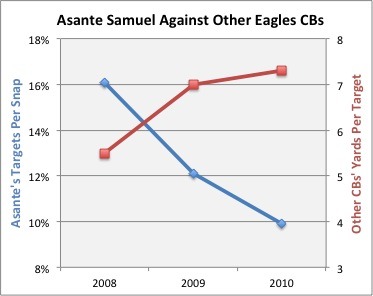
Seeing a trend? You will if you look at the graph at right. I’ve plotted Samuel’s targets per coverage snap on the left axis, designated in blue. In red and on the right axis is the yards given up per target by Samuel’s counterparts at cornerback.

As you can see, in 2008 Brown and Joselio Hanson allowed a meager five and a half yards per attempt. That corresponded to Samuel being targeted on 16 percent of his coverage snaps, and his worst season in Midnight Green. Over the following two years, receptions and yardage against the other Eagles corners spiked. At the same time, Asante saw the ball a lot less. During his great 2010 campaign, Samuel was targeted more than a full third less than he was in 2008.

Now these are only correlations and may not tell the full story. Perhaps 2008 was an off year because Samuel was still learning the Eagles defense. Maybe his improved play caused both the decline in targets and contributed to his compatriots having a worse time. It’s very possible that having better corner opposite Asante will actually allow him to gamble more and produce better results.

But this data at least raises questions. Once the season begins, we can closely watch Samuel’s play to see what, if anything, changes.

Photo from Getty.

Hot Read: Egotism, Attitude, and a Safety Puzzle

There’s no easier character for the sports media to portray than the athlete megalomaniac. Perhaps it’s the public’s fault. We demand that our stars be humble and empower our media representatives to take them down a notch when necessary.

There’s no other way to explain the overblown reactions to stories like this and this. Fans love to hate, and the media is happy to oblige in blowing small quotes up into page view-chasing controversies.

Of course, what makes two overconfident remarks from quarterbacks proof of their egotism, and another quotation only a positive example of appropriate confidence is beyond me.

* * *

Relatedly, is it such a bad thing if this year’s Eagles team has an “us against the world” mentality?

Spygate didn’t work out so poorly for the loaded Patriots in 2008. Maybe channeling some anger and isolation back at the rest of the NFL is a good attitude to take. Everyone is going to be gunning for the Eagles anyway.

* * *

Safety is a really interesting spot these days for the Eagles defense. 

Nate Allen is supposed to be the unquestioned starter out there, but his knee isn’t 100 percent, so now he’s sharing snaps. Kurt Coleman has taken over as one of the more consistent and trusted youngsters on the defense, despite the team drafting his replacement. That rookie, Jaiquawn Jarrett, hasn’t shown the ability to contribute much right away. Meanwhile, Patriots castoff and cheap free agent pick up Jarrad Page is getting some first team reps. All while the fifth guy on the depth chart, Colt Anderson, was called out recently by Bobby April for his star special teams contributions.

Last year the Eagles started the season with only three safeties. Not sure what the answer is to that puzzle in 2011.