Overreacting to the Problem at Right Tackle

There’s an important, if often overlooked difference between critic and cynic. The critic questions the current situation thoughtfully and wonders what other options exist. He might second-guess decisions and rethink conventional wisdom. But the cynic overreacts to the most recent information. He might call a good team a “house of cards” or demand that they shake everything up for one questionable improvement.

That’s where we stand at this moment with the Eagles. Some of us are willing to criticize and question, and others are quick to call for changing everything immediately. You can watch this dichotomy play out in the debate about right tackle.

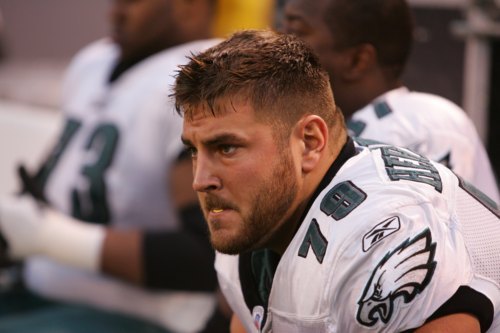
The calls are out for Andy Reid to move Todd Herremans away from his normal left guard spot to shore up the right tackle position. Admittedly, right tackle could be a problem for the Eagles. Winston Justice’s knee injury hasn’t fully healed yet, his replacement Ryan Harris now has back problems, and temporary starter King Dunlap hasn’t proven he can hold his own at this level yet.

But moving Herremans over to tackle is a desperate move, one that many in the media have been pushing for days. They ask Reid whether he’d consider moving Herremans and Andy says the same thing every time: he know that’s a possibility if he needs it, but he has other options right now. To me, that quotation is clear. Herremans can be a last resort if no one else is even adequate, the way a salad is a last resort for Reid after every possible cheesesteak and hamburger option has left the building.

And why would Herremans at right tackle be anything more than that? He hasn’t taken a snap at tackle in almost two years, and hasn’t gotten regular playing time at the position since his rookie year in 2005. We know he can slide over in a pinch, but you don’t sacrifice the only solid thing the Eagles offensive line has going for it - the left side - for a questionable upgrade.

Like every other team in the NFL, the Eagles have problem spots. Injuries at right tackle, a rookie middle linebacker, and a few more. But we shouldn’t lose sight of the fact that with these offensive weapons, pass rushers, and cornerbacks, the Eagles on paper rival any team of the Andy Reid era.

Criticism is always good. Cynicism gets old.

Photo from Getty.
Is Asante Samuel Overrated?

Asante Samuel had a rough preseason game last Thursday, giving up one of the worst touchdown receptions in recent memory. If you missed the game, just picture a Steelers receiver jogging into the end zone for an uncontested throw-and-catch from Ben Rothlisberger.

If everyone else hadn’t also looked so bad, and if the game had actually counted for anything, you can bet Eagles fans and commentators would be livid at Samuel for giving up such a weak touchdown. We’ve come to accept Asante’s gambles because he gets more interceptions than any other cornerback in the NFL. Plus, last year Samuel finally gained the respect he lacked when he was first signed as a free agent. Opposing quarterbacks rarely targeted him, and when the ball did come his way the average gain was minuscule.

Samuel is widely regarded as one of the top five corners in the NFL. Yet, a few weeks back, when the Eagles dipped into their pocket books to sign Nnamdi Asomugha, I suggested that having two of the best corners on the field at the same time might expose flaws in their games previously uncovered. That’s because a great cornerback, if he is substantially better than his partner on the other side of the field, will mostly push quarterbacks to avoid him.

Last year’s Eagles were a great example. Ellis Hobbs and Dimitri Patterson were awful at right cornerback. Some of Asante’s success in 2010 was the result of quarterbacks picking on the easier targets. When he knew the ball wouldn’t come to him except in certain situations or with the quarterback under pressure, Samuel could read and react to the pass, take gambles, and jump routes.

With Asomugha and Dominique Rodgers-Cromartie replacing Hobbs and Patterson, quarterbacks will probably look back to Samuel’s side more often and exploit weaknesses he never had to hide. That was my qualitative judgment, anyway. What about quantitative?

I went back through the pass coverage statistics helpfully compiled by Pro Football Focus for the last three seasons. As you might recall, Asante had a rather poor season in 2008, especially considering he had just received a $57 million contract. Samuel only had four interceptions and was largely outplayed by Sheldon Brown. In 2009 Samuel stepped up his game, grabbing a league-leading nine picks as Sheldon Brown showed signs of age. Last season, with a bunch of junior varsity players at right cornerback, Asante had his best season yet.

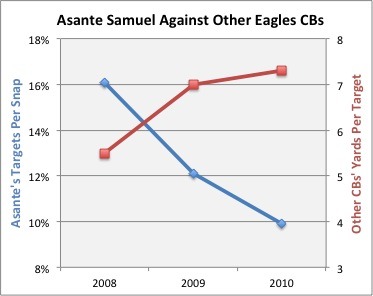
Seeing a trend? You will if you look at the graph at right. I’ve plotted Samuel’s targets per coverage snap on the left axis, designated in blue. In red and on the right axis is the yards given up per target by Samuel’s counterparts at cornerback.

As you can see, in 2008 Brown and Joselio Hanson allowed a meager five and a half yards per attempt. That corresponded to Samuel being targeted on 16 percent of his coverage snaps, and his worst season in Midnight Green. Over the following two years, receptions and yardage against the other Eagles corners spiked. At the same time, Asante saw the ball a lot less. During his great 2010 campaign, Samuel was targeted more than a full third less than he was in 2008.

Now these are only correlations and may not tell the full story. Perhaps 2008 was an off year because Samuel was still learning the Eagles defense. Maybe his improved play caused both the decline in targets and contributed to his compatriots having a worse time. It’s very possible that having better corner opposite Asante will actually allow him to gamble more and produce better results.

But this data at least raises questions. Once the season begins, we can closely watch Samuel’s play to see what, if anything, changes.

Photo from Getty.

Hot Read: Egotism, Attitude, and a Safety Puzzle

There’s no easier character for the sports media to portray than the athlete megalomaniac. Perhaps it’s the public’s fault. We demand that our stars be humble and empower our media representatives to take them down a notch when necessary.

There’s no other way to explain the overblown reactions to stories like this and this. Fans love to hate, and the media is happy to oblige in blowing small quotes up into page view-chasing controversies.

Of course, what makes two overconfident remarks from quarterbacks proof of their egotism, and another quotation only a positive example of appropriate confidence is beyond me.

* * *

Relatedly, is it such a bad thing if this year’s Eagles team has an “us against the world” mentality?

Spygate didn’t work out so poorly for the loaded Patriots in 2008. Maybe channeling some anger and isolation back at the rest of the NFL is a good attitude to take. Everyone is going to be gunning for the Eagles anyway.

* * *

Safety is a really interesting spot these days for the Eagles defense. 

Nate Allen is supposed to be the unquestioned starter out there, but his knee isn’t 100 percent, so now he’s sharing snaps. Kurt Coleman has taken over as one of the more consistent and trusted youngsters on the defense, despite the team drafting his replacement. That rookie, Jaiquawn Jarrett, hasn’t shown the ability to contribute much right away. Meanwhile, Patriots castoff and cheap free agent pick up Jarrad Page is getting some first team reps. All while the fifth guy on the depth chart, Colt Anderson, was called out recently by Bobby April for his star special teams contributions.

Last year the Eagles started the season with only three safeties. Not sure what the answer is to that puzzle in 2011.

Wishing for a Plan B at Middle Linebacker

One of the most frustrating aspects of playing sports video games is process of allocating a certain arbitrary number of “skill points” to the entire team. 10 points to the offensive line. 10 to the wide receivers. 15 to the quarterbacks. 5 to the kicker?

The process is about as harrowing as fake team management can get. There are always just too few points to make the choices easy. Do I go short at wide receiver or running back? Safety or linebacker?

Of course, the truth is that this process is consistent, on a much simpler scale, with what real front offices have to deal with. No matter how much room under the salary cap you have to sign All Stars, you’ll never sign one to every position. You’ll always have to make compromises.

With that said, I still think there’s ample room to criticize Eagles management for their consistent neglect of one rotating position on the roster. Last year it was either right guard or right cornerback. In years prior we had punt returner, back up tight end, fullback. Where generally you would allot at least a modicum of points to a position, there’s always one spot it seems that the Eagles leave barren.

But let’s stop a moment here and go over all the ways you can fill a potential hole in your roster. Signing a Pro Bowler long term is probably the most consistent and most expensive path, and the Eagles have done plenty of that over the years. You could also grab a veteran starter on a short term deal or through a trade, a tactic the team has consistently employed with linebackers. The Nate Allen/Danny Watkins route means drafting a talented rookie and giving him every chance to win the job over the veteran insurance policy (Marlin Jackson/Evan Mathis). Perhaps you give the same chance to a lower round rookie like Jason Kelce, but having an alternate veteran starter in place already is more important.

The Eagles chose none of these normal options last season with regard to right guard and right cornerback. Who was surprised when injured Stacy Andrews and perennial back ups Nick Cole and Max Jean-Gilles couldn’t get the job done? Or when Ellis Hobbs, mediocre on his own, went down for the year and Dimitri Patterson proved woefully unprepared to take over?

And yet I look at the linebackers for this coming season and I see a unit that could blow up faster than either of last year’s problem spots. Even if you trust the supposed soon-to-be Pro Bowler Jamar Chaney and the consistently underwhelming Moise Fokou, how can you justify slotting in undersized, unprepared fourth round pick Casey Matthews at starting middle linebacker? Given how unlikely it is that he’ll succeed immediately, I’m surprised that there seems to be no back up plan. Akeem Jordan is a lesser version of Ike Reese. Maybe Jamar Chaney could slide over, but that just opens up another hole where similarly unproven players like Keenan Clayton would have to contribute.

I could at least see some logic in 2010 at guard. Throwing some veterans against the wall and hoping one sticks is a plan, albeit a weak one. But now at middle linebacker you have one mid-round rookie and basically nothing else.

The Eagles are a remarkably smart organization and I’m sympathetic to the herculean task of assembling a team that’s good at every position. But there’s a difference between having a couple of question marks (like the injury problems at right tackle) and announcing that you’ll be completely ignoring one of the holes in Whac-A-Mole. Problems are almost guaranteed to pop up. Why are there no contingencies in place?

Photo from Getty.

Mandatory Weekend Reading: FOA 2011 Out Now

The Football Outsiders Almanac isn’t always right. Last year, it said this about Michael Vick:

“If Vick had to take over as the starter in case of a Kolb injury, the move would be nothing short of disastrous for the Eagles.”

Still, nobody’s perfect. If you like the NFL or statistics (presumably both if you’re reading this), the FOA is an all-you-can-eat buffet. Stuff yourself and forget about last night’s preseason debacle.

Purchase your copy for download here.

Ten Reasons to Excuse Last Night's Eagles Stinker

  1. It’s only the preseason. 

  2. Michael Vick had a horrible preseason last year, and that turned out alright (endorsed by Spuds).

  3. No Jeremy Maclin, Steve Smith, or Jason Avant (came out with minor contusion) meant Vick had to force his throws.

  4. Both of the Eagles run-stopping defensive tackles - Mike Patterson and Antonio Dixon - never played.

  5. The Steelers did go to the Super Bowl for a reason.

  6. It’s Will Leitch’s fault.

  7. Having some humble pie might be good for them right now. Good chance for Andy Reid to kick this “dream team” in the rear end.

  8. After a radical defensive makeover, the Eagles are going to need some time to learn how to play as a unit.

  9. At least there were no major injuries.

  10. LeSean McCoy looked good. And Mike Kafka. And Dion Lewis… until he fumbled.

One Reason to be Concerned About Last Night’s Game

  1. That was &@$%ing awful.

Journalism is Dead, Long Live Reactionism

One of the biggest problems with journalism today is that it’s transporting a worldview associated with filling up the limited space of a printed page into a new media world where that page is limitless. This is true on the Internet, obviously, where opinion and analysis columns have become blogs and news reporting has moved to the Twittersphere. The shift is also apparent on television, where an increasing number of 24-hour cable news stations echo the same vast emptiness of air time demanding to be filled.

When the column inches of a newspaper or magazine ran out, there was no more need for additional writing or reporting. Journalists had to limit themselves to only the most important stories and only the ones to which they had something to say. Now that requirement is abolished.

Anything can be published, which has led to: everything should be published. As a rabid sports (or anything else) fan, this is actually a positive development. I’ve never heard anyone complain that there’s too much coverage of a topic they care about. For example, in this corner of the web there is an insatiable appetite for specific NFL and Eagles news. Local beat writers can publish a story about the fourth-string tight end and people will want to read it. They can tweet the mundane minutiae of training camp to a rapt audience of followers.

Again, this is good. Or it would be, if journalists could find enough real, solid reporting and analysis to fill the unlimited potential. But all it takes is a few minutes of ESPN coverage to clue you in to the fact that there’s a much easier way to fill those minutes: reaction, endless reaction.

Valuable reporting still exists, both at the largest and smallest levels. But the majority of “content” put out on the web and on TV is simple, uniformed reaction to those few original pieces.

When Bill Barnwell at Grantland throws some statistics out that question DeSean Jackson’s true value, the reactions came swiftly from every corner of the web. 140 characters here, a few sentences and some pull-out quotes there, giving half a shake of agreement or anger. Last night, Deadspin decided to react to a Michael Vick interview in GQ before the article even came out. Soon we had instant reactions to that first, ethically dubious reaction, with more certainly on the way. The state of reactionism is so bad that writers now complain when information about a player’s possibly life-threatening health concerns isn’t leaked to them ahead of schedule. There’s no appropriate response other than deference, respect, and relief, yet being first in line to make your voice heard matters?

Ultimately, journalists and publishers have to realize that they can never actually fill the vast server space they now have at their disposal. It’s impossible. So instead of trying to do so by focusing on endless, mindless reactions and retweets, it’s time to change up the pattern.

You don’t have to be first on anything by a few second or minutes. You don’t have to respond to every bit of news with repetitive drivel. More is better, but more crap isn’t worth the pixels it’s printed on.

Photo from Getty.

How Many Roster Battles Remain for the Birds?

With the Eagles breaking camp on Tuesday, the countdown begins in earnest to the start of the season. I was going to take this opportunity to take stock of the latest depth chart battles. However, glancing over the Eagles roster today, I don’t see many competitions left, and those that remain are for the final few spots.

Let’s run through the positions.

Quarterback: The namesakes have departed, leaving Vick, Young, And Kafka. No drama here.

Running Back: Owen Schmitt has gotten no real competition for the lone fullback spot. Supposedly there’s a competition underway for the 3rd RB, but I’d be surprised if fifth round pick Dion Lewis didn’t win that job.

Tight End: Anyone who tells you Green Bay castoff Donald Lee is going to make the team, barring unforeseen injury, is crazy.

Wide Receiver: If Steve Smith really comes off the PUP list before the season starts, Chad Hall is the only guy the team might stretch to keep.

Offensive Line: Lots of dead weight here I wouldn’t mind showing the door. McGlynn and either Austin Howard or King Dunlap will be gone, along with the rest of the camp bodies.

Defensive Line: The tackles are a mess due to injuries, but at the end of the day it comes down to Laws or Hargrove. Defensive end is just a matter of keeping CFL star Philip Hunt or not.

Linebackers: I actually still think a veteran backup middle linebacker makes sense here. Both Greg Lloyd and Brian Rolle can probably be stashed on the practice squad.

Cornerback: If the Eagles still have high hopes for both Hughes and Lindley, they will find a suitor for Hanson.

Safety: Allen, Coleman, Jarrett compete for starting jobs. Colt Anderson makes the team as special teams maven.

Special Teams: Hope you like rookies.

The Eagles free agent binge has filled in a lot of spots we thought might have been contested. There will probably be a good deal of talk about the final roster, but about 90% of it already looks complete.