Eagles Draft Night: Playing the Predictions Game

Roger Goodell NFL Draft Eagles Predictions

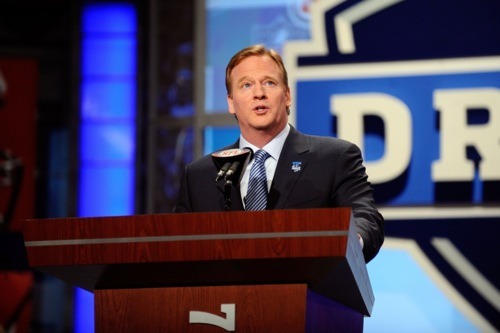
Let me preface this post with a reference to last year, when I predicted that the Eagles would trade back out of the first round. Turned out the Eagles did the exact opposite and traded up 11 spots to grab defensive end Brandon Graham. Howie Roseman, Andy Reid, and the rest of the Eagles front office are pretty unpredictable. So why try? Because it’s fun.

Tonight the draft will kickoff with the first round in prime time. Before you sit down to watch, check out my predictions and sound off if you have other opinions:

  • The Eagles will not take Jimmy Smith. Despite his talent, Smith has a whole host of behavior issues. “Two abortions, aggravated assault, two minors in possession, three failed drug tests… that’s a little excessive,” an anonymous NFL personnel man told the Milwaukee Journal-Sentinel. The Eagles have never drafted a player with that much criminal history. Yes, they took a chance on Michael Vick, but only after weeks of due diligence and a very low-risk contract. I don’t see the front office taking that chance with their number one pick. Plus, I think if the team were interested in Smith, they wouldn’t have let all these rumors stand about him being their top interest. The media have largely anointed him as the Eagles pick, and I think the team is content to let that smokescreen stand.
  • But the Eagles will take a top cornerback in the top few rounds. I have my eye on the second round crop, where the team could draft a player of similar caliber to Nate Allen, who they snatched with the 37th overall pick last year. Virgina’s Ras-I Dowling sticks out as a possibility. Lots of talent, senior year lost to injury — he’s tailor-made for the Eagles.
  • The Eagles won’t pick at 23rd overall. They haven’t gone with their assigned spot since 2006, which not coincidentally was their highest pick in a long time. With the Eagles consistently drafting in the latter half of the first round  (26, 19,  21, 24 over the last four years), it makes sense to either move up to snatch a truly valued player (Jeremy Maclin, Brandon Graham) or drop back into the second round and get similarly value at a lower price (Kevin Kolb, DeSean Jackson).
  • At least two more linebackers in this year’s draft plans, after the team snatched Keenan Clayton and Jamar Chaney in 2010. As I wrote about last week, there are only three linebackers who will definitely be around in 2011 — Clayton, Chaney, and Moise Fokou. Even if you assume Stewart Bradley returns, that’s just four players for six or seven spots.
  • Less than 10 rookies. After taking 13 players last year and seeing three of those never take a single snap in 2010, the Eagles won’t use all of their selections this year. Some of those picks will be packaged to move up in this draft or get future picks in 2012.
  • No quarterback. Sorry conspiracy theorists, it just doesn’t make sense for the Eagles to add another quarterback this year with Mike Kafka in place as a back up and plenty of veterans on the market. Plus, drafting another quarterback before trading Kevin Kolb takes away some of that leverage the Eagles have by arguing that they could just keep him.
  • Correll Buckhalter 2.0. With Brian Westbrook admirably replaced by LeSean McCoy, the Eagles need a running back who they can develop to be the long term back up. Neither Jerome Harrison nor Eldra Buckley is that guy, but mid round prospects like Hawaii’s Alex Green, Cal’s Shane Vereen, Oklahoma’s DeMarco Murray, or Oklahoma State’s Kendall Hunter could be.
  • Ignoring the defensive line? After heavily targeting pass rushers in last year’s draft, the Eagles have a glut of young players along the defensive line. Outside of Trent Cole, none of them really stand out (especially with Graham’s ACL injury). But you can’t address every weakness and if the Eagles don’t add a top d-lineman early, I could see them passing entirely in favor of additions along the offensive line and elsewhere.

Originally published at NBC Philadelphia. Photo from Getty.

Assessing Kevin Kolb's NFL Draft Trade Value

Kevin Kolb Trade Rumors Value NFL Draft Analysis

With the draft just a day away, fans are discussing trade scenarios constantly. Could the Eagles move up the draft to nab that one special player? Or would they move back? What would they have to give up? What kind of return could a trade for Kevin Kolb return?

Unfortunately, barring some last minute deal to start the new league year and end the lockout (despite Judge Nelson’s latest ruling), the Eagles will not be able to trade Kolb for more draft picks. Nor will any other team be able to trade players.

Yet when Kolb and others (such as old Philly friend Donovan McNabb) finally get traded, they will likely be dealt for future draft picks rather than other players. With these trades, the question becomes: how can we quantify the value of NFL players on the trading block?

With pick-for-pick trades, the rule of thumb is the “trade value chart,” which assigns a set number of points to each draft choice. For example, the number one overall pick is worth 3,000 points. In order for another team to trade up for that pick, they’d need a package of picks worth about the same total value. So, why not use the trade value chart to help us determine the trade value of veteran players and, in doing so, better estimate the potential return on any hypothetical trade involving a player like Kolb? 

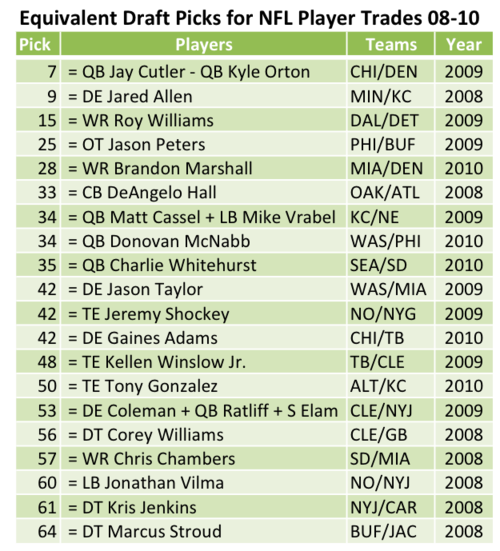
That was my task as I sorted through the last three years of NFL trades involving players and draft picks. I added up the total value of the picks and subtracted one round’s worth of value from each future pick, thus determining the equivalent draft pick that the player(s) involved in the deal were worth.

Equivalent Draft Picks for NFL Player Trades 2008 to 2010At right you can see a list of all NFL players who were traded in the last three years for the equivalent of at least a second round pick. There are some interesting trades in there.

The highest pick value traded was equivalent to the seventh overall selection: sent by Chicago to Denver in exchange for “the difference between” Jay Cutler and Kyle Orton. Obviously the Bears thought that gap was huge, and more valuable than any single player traded in the last three seasons. Next up is Jared Allen, traded for the equivalent of the ninth overall pick, and then Roy Williams (15th), in Jerry Jones’s debacle of a deal. The Eagles’ trade for Jason Peters valued the offensive tackle as a late first rounder; same with Miami’s acquisition of Brandon Marshall. All of these players were, at least in theory, expected to be stars.

There’s also an interesting “run” on quarterbacks worth the equivalent of a top second round pick. All three players are different — McNabb was the aging but productive veteran, Matt Cassell had played only one full season, and Charlie Whitehurst had never even started a game — yet essentially all three were valued equally.

What does this say about Kevin Kolb’s trade potential?

Last year, trade offers for Kolb were rumored to exceed those for McNabb, and one would expect that his production warrants a healthy bonus over a completely unproven quarterback like Whitehurst. At the same time, all the players worth first round compensation since 2008 were established Pro Bowlers before getting traded. Kolb doesn’t fit that profile as a “sure-thing” star, but it’s likely that the barren quarterback market will boost his price into the mid-to-late first round.

Originally published at NBC Philadelphia. Photo from Getty.
How to Draft a Pro Bowl Quarterback: Pick Early

Michael Vick Cam Newton NFL Draft Quarterbacks Pro Bowl 1st Pick

The history of the NFL draft is filled with quarterbacks: the high picks, the big expectations, and the heartbreaking busts. Finding the gem can lift your team to the heights for a decade or more. Squandering your chance can keep you in the basement for just as long.

This year will be no different. A bunch of star college quarterbacks — Auburn’s Cam Newton, Missouri’s Blaine Gabbert, Washington’s Jake Locker, and others — will be picked later this week with high hopes for their success, and only a few will succeed in their transition to the NFL. Are there any guides we can use to bring some order to the chaos? Any ways to sort through the dozen quarterbacks who might get selected and figure out who will make it? Not many.

We do know one thing: it’s essential to get a great one. No team the last 24 years has won the Super Bowl without a quarterback who’s been to the Pro Bowl at least once in his career.

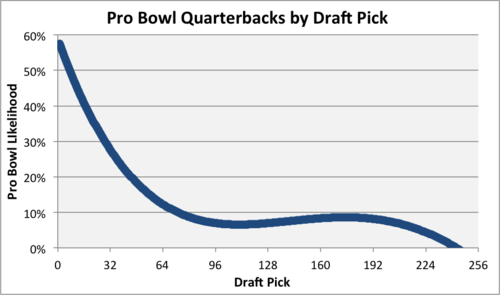
I went back and analyzed all the quarterbacks drafted from 1995 to 2006 to see who turned into a Pro Bowler and who flamed out. Check out the graphs to see what I found.

Pro Bowl Quarterbacks by NFL Draft Pick

The first chart above organizes the quarterbacks by draft pick, with markers for the last pick in each round (32, 64, 96…) at the bottom. The percent chance of that player making the Pro Bowl is measured on the left.

As you can see, taking a quarterback with one of the top picks is a huge advantage. You’ll get a player who has a greater than 50 percent chance of making at least one Pro Bowl. But the probability falls off sharply after that. By the time we’ve reached the end of the first round, the chance of getting a future Pro Bowler drops by more than half to only one in four. At the start of the third round things are even worse: it’s only a 10 percent chance of striking gold. Oddly, there isn’t much more decline the rest of the way. Quarterbacks drafted in rounds three through seven have roughly the same chance (or lack thereof) to make it to a Pro Bowl.

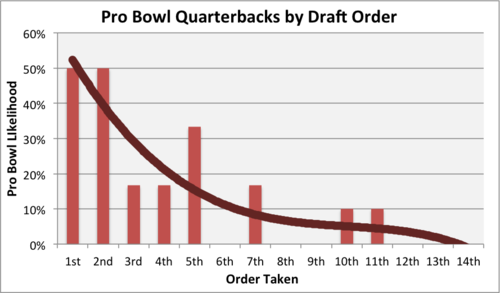
Pro Bowl Quarterbacks by NFL Draft Order

We see a similar trend when the quarterbacks are arranged in the order they were selected, even though this only ranks players against the others in their class. For example, it doesn’t show that five quarterbacks were taken in the top 12 picks in the 1999 draft, but zero made it that high in 2000.

Again, there’s the 50-50 probability for early quarterbacks and then truly long-shot chances later in the draft. Interestingly, though, there’s no difference between quarterbacks drafted first and those picked second. Often those guys are so close that it’s unclear who’s really the best — this data backs that up.

What’s the big picture?

There are constraints inherent in the this data. For example, early draft picks get more chance to prove themselves as starters, and a Pro Bowl season doesn’t necessarily make a player great (see: Young, Vince). But overall this analysis shows how inherently difficult it is to find a Super Bowl-caliber quarterback in the draft if you don’t take one early on. With the first few picks at least you have a coin flip chance of success, in the second round you’re delusional if you expect better than three-to-one odds, and later on you might as well try the lottery.

Originally published at NBC Philadelphia. Photos from Getty.

2011 Eagles Offseason Guide: Linebacker

Stewart Bradley Philadelphia Eagles Linebackers 2011

This is the seventh in a series of posts breaking down the Eagles position by position in advance of the upcoming draft and (hopefully) free agency. We’ve already looked at quarterback, running back, wide receiver, tight end, offensive line, and defensive line. Today we’ll examine the linebackers.

2010 Recap: Stewart Bradley returned to middle linebacker after missing all of 2009 with a knee injury, but didn’t display the same explosive form he showed in the NFC Championship Game run in 2008. Pro Football Focus grades showed that he improved as the year went on, but Bradley hurt his elbow in week 14 and missed the rest of the year. New addition Ernie Sims was highly touted after the Eagles traded a fifth round pick for the former Lion, but had more of an impact hitting his teammates too hard in practice than he ever had in a game. Moise Fokou took over for Akeem Jordan at strongside linebacker and did alright. He certainly wasn’t anything special, but there weren’t many problems either. The brightest spot was seventh round pick Jamar Chaney, who started in place of Bradley over the last few games and performed better than anyone expected. Jordan, Omar Gaither, and fourth round pick Keenan Clayton mostly contributed on special teams.

Who’s Leaving: The team declined to offer restricted free agent tenders to Sims, Gaither, or Jordan, signalling that they don’t want any of them back. Bradley, who has four years of experience, was tendered at the second-round level, meaning any team who wanted to sign him under the current rules would have to send the Eagles a pick in that round. Presumably Bradley will be back in midnight green next season. He deserves a shot to show he can improve in year two after his ACL tear.

2011 Depth Chart: The likely starters are Fokou at strongside, Bradley in the middle, and Chaney on the weak side. Clayton would need a big jump in year two to win a job over one of the other three. That leaves two or three more back up spots, which will likely be filled in the draft of free agency. The team already signed one competitor, Rashad Jeanty, a veteran back up and special teams player with the Bengals in 2009 before a fractured tibula caused him to miss all of last season.

Potential Additions: Eagles have never drafted a linebacker higher than the second round in the Andy Reid era, and both of those picks were busts. Furthermore, the team has only drafted one linebacker as high as the fourth round since 2007, despite constant turnover at the position. Thus, unless new defensive coordinator Juan Castillo has a completely opposite philosophy from his predecessors, I don’t expect the Eagles to draft any highly-ranked linebackers. They will likely draft one or two more in the mid-to-late rounds, along with a free agent or two who can give at least token competition to the starters.

Future Outlook: The Eagles don’t have any old linebackers. That means there’s a lot of potential, but not much guaranteed. Maybe Chaney, Fokou, and Clayton are the future of the Eagles linebacker corps, or maybe none of them have the talent to make it long term. Bradley’s been around for four seasons and is still a question mark. Most likely, until the front office changes priorities and chooses to focus more resources (money, high draft picks) on the position, it will remain a question mark every year.

Originally published at NBC Philadelphia. Photo from Getty.

2011 Eagles Offseason Guide: Defensive Line

Trent Cole Eagles Defensive Ends 2011

This is the sixth in a series of posts breaking down the Eagles position by position in advance of the upcoming draft and (hopefully) free agency. We’ve already looked at quarterback, running back, wide receiver, tight end, and offensive line. Today we’ll examine the defensive line.

2010 Recap: At defensive end, last season was all about the injuries. Only Trent Cole had another normal, star season at defensive end — where he posted 10 sacks and 55 hurries. Former second round pick Victor Abiamiri missed the entire season after undergoing microfracture surgery. The Eagles fifth round selection in 2010, Ricky Sapp, was also lost for the year after arthroscopic knee surgery. Brandon Graham, the defensive end that the Eagles traded up in the draft to get, showed some early promise. He started six games, compiled three sacks, and on a per pass rush basis, was actually one of the most effective defensive linemen in the NFC East. However, Graham was also bit by the injury bug, succumbing to a torn ACL in Week 14.

Veteran Juqua Parker shared playing time with Graham for most of the season and although he’s never been a star, Parker began to show some liability, especially against mobile quarterbacks like Minnesota’s Joe Webb. Darryl Tapp, who the Eagles traded for in the offseason, contributed four sacks as a rotational player. Another rookie, Daniel Te’o-Nesheim did little to justify his third round selection. Finally there were the host of other names that came in and out during the year: Antwan Barnes, Derrick Burgess, and Bobby McCray.

At defensive tackle, the longtime starters Mike Patterson and Broderick Bunkley were finally pushed. Patterson started the whole year, with his typically solid run defense and lackluster pass rush. But Bunkley, after missing two games with an elbow injury, lost his starting spot to Antonio Dixon, a player the Eagles claimed on waivers after he went undrafted in 2009. Dixon, 6’3” 325 lbs, is the biggest Eagles tackle and perhaps the most explosive off the ball. Trevor Laws, who looked like a bust a year ago, resurrected his career somewhat as a solid inside pass rusher. Finally, 2010 7th round selection Jeff Owens spent most of the year on the practice squad only to be called up in Week 16 and promptly rupture his left patellar tendon.

Who’s Leaving: McCray’s a free agent. DT Jeremy Clark, another late season pick up, will compete but is a long shot. Through an odd loophole of the Physically Unable to Perform list, Abiamiri’s 2011 free agency was delayed a year — meaning he’ll get one more chance to show what he’s got.

2011 Depth Chart: Cole and Parker are probably the starters at defensive end, assuming it takes Graham more than six months to recover from ACL surgery. Tapp, Te’o-Nesheim, Sapp, Abiamiri, and Canadian Football League star Philip Hunt (16 sacks in 2010) will compete for the backup spots, and one or more will probably end up on the outside looking in. Seems like there should be open competition at tackle, where the scheme set up by new defensive line coach Jim Washburn will have a big impact on who starts, and who potentially become trade bait. Not even sure I can handicap that race right now.

Potential Additions: Some fans have talked about bringing back DE Jason Babin, who had 12.5 sacks last year working with Washburn. I doubt the Eagles will be the highest bidder for his services. I also don’t expect the Eagles to trade for Washington malcontent Albert Haynesworth, despite his immense talent. If the team does want to add veteran talent, Vikings end Ray Edwards would be a potential target.

The defensive line is considered a strong area of this year’s draft. Players like Purdue’s Ryan Kerrigan could get a long look in the first round.

Future Outlook: The future depends a great deal on Washburn’s new philosophy and who fits into his system. But certainly Graham’s injury deals a big set back to the Eagles plans at defensive line. The team will need other young, talented defensive ends to ensure an acceptable transfer into the post-Cole era.

Originally published at NBC Philadelphia. Photo from Getty.

Analyzing the Latest Kevin Kolb Trade Rumors

Kevin Kolb 2010 Cowboys Trade Rumors Contract

An odd report emerged yesterday that questioned the trade market for quarterback Kevin Kolb. However, the report from 1500ESPN is so full of bizarre assumptions and a host of anonymous NFL sources that its assertions are tough to take seriously.

First, the headline: Kolb’s agents have been telling teams that they’re looking for a multi-year deal with a cost one “NFL decision-maker” described as “significant enough to make me nervous.” The reporter, Tom Pelissero, makes it sound as though this is both unexpected and a deal-breaker. But in reality, teams already knew Kolb was going to want a long term contract extension — and if they are going to trade for him as their starting quarterback, the teams will want that too.

The money was always going to be high. With less starting experience than Kolb, Matt Schaub immediately received a six-year, $48 million contract upon his trade to Houston in 2007 — a deal which turned out to be a bargain. In 2009, Kansas City similarly acquired Matt Cassel from the Patriots after only one year as a starter, giving him a six-year, $62.7 million contract that included $28 million in guaranteed money.

Those kind of contracts are now expected for franchise quarterbacks, and any team that was considering Kolb would have to consider paying just as much to an unproven rookie or retread free agent with just as many question marks.

Furthermore, Pelissero emphasized one anonymous scout’s doubts about Kolb, while downplaying three more he spoke with who agreed that the Eagles quarterback was worth a first round draft pick. Clearly there’s a market out there for Kolb, even with supposedly high contract demands and limited experience.

Obviously Kolb isn’t a fit everywhere, and some teams may not be enamored with his skill set. But there are so many teams out there looking for starting quarterbacks, at least a few feel like they’re one player away from competing. Those teams are going to be willing to take a chance on Kolb.

Last offseason rumors suggested that teams were offering more for Kolb than they were for Donovan McNabb. There’s no reason to think that’s changed. Since McNabb netted the Eagles a top second round pick, I expect eventually to see a first round selection and possibly more coming to Philadelphia for Kolb.

Originally published at NBC Philadelphia. Photo from Getty.

2011 Eagles Offseason Guide: Offensive Line

Jason Peters 2011 Eagles Offensive Line

This is the fifth in a series of posts breaking down the Eagles position by position in advance of the upcoming draft and (hopefully) free agency. We’ve already looked at quarterback, running back, wide receiver, and tight end. Today we’ll examine the offensive line.

2010 Recap: By most metrics, the Eagles offensive line had a bad year in 2010. They gave up 50 sacks, tied for second-worst in the NFL, and were ranked 28th in Football Outsiders’ adjusted sack rate. Not only were there a lot of sacks, but the line was so porous that defenses knocked not one, but two different quarterbacks out of the starting lineup.

Most of the problems started on the right side of the line. Center Jamaal Jackson played only 20 snaps in week one before suffering a torn triceps that ended his season. He was replaced by Mike McGlynn, who was serviceable at best. To McGlynn’s right the guard spot was a revolving door of Nick Cole, Reggie Wells, and Max Jean-Gilles. Jean-Gilles had the job at the end of the season, but primarily by process of elimination. Hurt by the uncertainty next to him and apparently a bone chip in his knee, Winston Justice was also sub par at right tackle.

Jason Peters and Todd Herremans held steady on the left side of the line, and were the only two Eagles lineman that Pro Football Focus awarded positive grades. In run blocking especially they provided a ray of sunshine: backs averaged over 4.5 yards per carry going to the left, compared to a dismal 3.7 yards headed right.

Who’s Leaving: It’s possible that none of the 2010 right guards will be back. Wells is an unrestricted free agent. The Eagles didn’t bother putting a restricted free agent tender on the 6 ft., 350 lb. bowling ball that is Nick Cole. They did offer Jean-Gilles a 4th round tender, which might be enough to keep him if the same rules apply in the new collective bargaining agreement.

2011 Depth Chart: The left side of the line is set, and the team hopes that Jackson can return to solidify the center spot. If the season started tomorrow McGlynn would probably start at right guard, although he should be challenged by Jean-Gilles and a rookie. After last year’s letdown, Justice won’t be handed his starting spot either. He’ll likely have to compete with King Dunlap and/or a rookie.

Other players already on the roster competing for back up positions will be tackles Austin Howard and Fenuki Tupou, center A.Q. Shipley and center/guard Dallas Reynolds.

Potential Additions: This draft has a lot of offensive linemen for the Eagles to throw into the mix, and I’ve gone on record suggesting that it’s the most likely position the team will address in the 1st round. Wisconsin tackle Gabe Carimi has been mentioned a lot in mock drafts. Florida center/guard Mike Pouncey is another option. A few days ago, Tommy Lawlor identified Georgia guard Clint Boling as potential addition in the second round. It’s tough to speculate across such a huge range of players, but adding talent that can compete immediately is essential to restoring the line in 2011.

Future Outlook:  Peters, Herremans, Jackson, and Justice are all signed through 2013, but new line coach Howard Mudd will have this season to determine if the last two are capable long term solutions. McGlynn, Dunlap, and Howard have all shown flashes of potential as well, but it’s unclear at this time where or if they fit into Mudd’s plans for — especially if the team devotes more high draft picks to the position.

Originally published at NBC Philadelphia. Photo from Getty.

2011 Eagles Offseason Guide: Tight End

Eagles Tight End Brent Celek 2011 Offseason

This is the fourth in a series of posts breaking down the Eagles position by position in advance of the upcoming draft and (hopefully) free agency. We’ve already looked at quarterback, running back, and wide receiver. Today we’ll examine the tight ends.

2010 Recap:  Donovan McNabb always liked his tight ends, and two years ago Brent Celek led the Eagles in receptions with 76. The switch to Kevin Kolb, a quarterback with a weaker arm, was supposed to bolster that relationship even more. That’s why the Eagles gave Celek a six year, $30 million contract extension in 2009. But things didn’t quite go as planned.

Last year, with Michael Vick at the helm, Celek became an afterthought. His role as a blocker increased from 14 percent of pass plays to 22 percent and his targets dropped from 111 in 2009 to only 77 last season. As the wide receivers take over, receptions from the tight end spot have become less important — and Celek’s numbers dropped accordingly.

Clay Harbor, a rookie, picked up the back up role without much problem — although he wasn’t asked to do a lot. It did seem like his blocking was improving by the end of the season though. Garrett Mills, who the Eagles promoted from the practice squad midway through the season, was the only other tight end to catch a pass.

Who’s Leaving:  Mills is gone already, claimed off waivers in December. Not exactly a big loss.

2011 Depth Chart: Celek and Harbor seem set in the first two spots, which will likely be the only ones that matter. Two other players will serve as token competitors to Harbor. The first is a familiar face, Cornelius Ingram, who the Eagles drafted in the 5th round of the 2009 draft. Ingram was cut last offseason after a rookie year lost to a torn ACL, and then brought back on the practice squad at the end of 2010. The other player is John Nalbone, who was selected by the Dolphins just eight picks after Ingram in 2009 but never caught on their either.

Potential Additions: I honestly don’t see any reason the Eagles would add another tight end this summer. They seem to think only two tight ends are necessary for the active roster, and there are already four in camp. Unless the coaches are more in doubt about Harbor than we thought, he should be pretty safe.

Future Outlook:  Celek’s signed until 2016. The biggest thing to look at long term is how Harbor progresses. Will he have to permanently compete for the back up job, or does the team think might he has the talent to stick around after Celek?

Originally published at NBC Philadelphia. Photo from Getty.