Arguing for, um, Jerry Jones

Jimmy Kempski:

They’re a team with no shortage of star power (or at least perceived star power) at the top: Ware, Romo, Witten, Austin, Ratliff, Smith, Lee and if you want to throw in Bryant and Carr too, then OK, I suppose I’ll allow it.

Beyond the stars, there’s mediocrity up and down the starting lineup and typically no depth to speak of whatsoever. This has not been a winning formula, and probably never will be.

The Cowboys’ decision to trade up and utilize their top 2 picks on one player (albeit potentially a great one), especially at a position that didn’t need as much help as other areas, reflects that same pattern.

Jimmy’s point about the Cowboys is well taken, and I can’t find fault with his encyclopedic knowledge of Dallas’s woes up and down their lineup. Still, I actually think trading up for Morris Claiborne is a justifiable, and in fact, possibly great move for Jerry Jones.

My main disagreement is that the Cowboys’ greater need at multiple positions shouldn’t disqualify them from grabbing a player at the top of their draft board. I like the Eagles decision to move up for Fletcher Cox, but they undoubtedly have positions in worse straits as well (e.g. safety and linebacker). Drafting a player that you feel strongly can become a Pro Bowler should come ahead of almost all considerations of need. Sure, more picks are better, but taking one of the consensus top six players in the draft this year probably balances out whomever you could have gotten at pick 45.

Building a roster is a long term game. You can’t solve (or ignore) all your problems in one draft or offseason. Dallas may fail at that in the long term, but in itself, picking Claiborne isn’t a poor decision.

Get Well Soon, Colt

Jonathan Tamari:

“To be at the highest of highs, with your family all around, to being at the lowest of lows when I’m walking off the field,” Anderson said. “I’m a pretty emotional guy, and I didn’t feel anything [in the knee]. It wasn’t hurt. It was just weak, and I was just crying because I knew my season was over. I wasn’t crying because I hurt.”

Anderson had torn his anterior cruciate ligament. It was the first major injury of his career.

With apologies to Ike Reese, Colt Anderson might be the best special teams ace the Eagles have ever employed. Here’s hoping he can heal to the point where the PUP list is a real possibility. Still, I wonder if he’ll ever regain the reckless abandon needed to blow up so many kickoff returns.

Quarterback Draft Inflation: From Kafka to Foles

Nick Foles Arizona

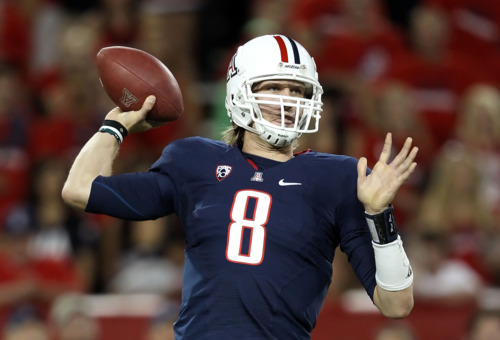
I have a theory about the Eagles third round selection of quarterback Nick Foles. Despite the relatively early pick, it has nothing to do with replacing Michael Vick or even Mike Kafka. It’s about the NFL draft and the dramatic quarterback inflation that has occurred in the last two years.

Let’s take a quick journey back to 2010. Sam Bradford went first to the Rams and Denver jumped up to 25 overall to get Tim Tebow. The next quarterbacks off the board were Jimmy Clausen (#48), Colt McCoy (#85), and the Eagles’ Kafka (#122). That order of quarterbacks coming off the board — two in the opening round, another one in each of the following — is right in line with what had been going on ever since the draft was whittled down to seven rounds in 1994.

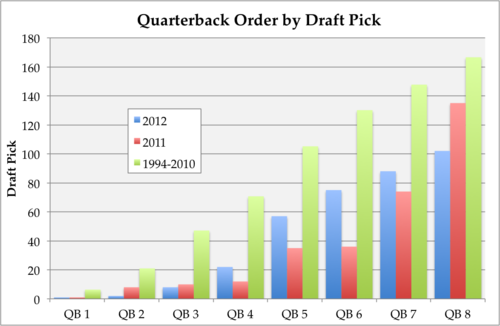
But that pattern, largely consistent for the previous 15 years, was thrown out the window over the last two. In 2011, four quarterbacks were drafted in the first round, and six in the top 40 picks. That rivaled two of the biggest quarterback-heavy drafts in recent memory, 1999 and 2004, despite talent that few considered equal. Then this most recent draft saw another four quarterbacks taken in the first, something that’s never happened in two straight years. Overall, the 2012 draft was slightly behind the 2011 pace, but it was still far ahead of nearly any prior draft.

Here, see for yourself, in table and graphical forms:

QB Draft Order Table

QB Draft Order Graph

What does this mean about Foles? It means that the Eagles likely drafted a worse quarterback in an earlier round than they ever would have before. For example, the team selected Kafka in the fourth round of 2010, presumably to be a long term backup they could groom. He was the fifth quarterback drafted overall.

Foles, taken a round and a half before Kafka, was only the seventh-best quarterback according to draft order. Perhaps this year’s crop of quarterbacks, and Foles in particular, is better than the group teams had to choose from in 2010 — and nearly every prior year. But my impression is that most experts considered this, pre-draft, to be at best an average class after the two stars.

Two years may be too soon to confirm a trend, but the evidence is there. Quarterbacks have never been more highly valued in the NFL. Desperate teams without a franchise signal-caller give big contracts to former backups and trade for anyone with promise. It only makes sense that such a frenzied demand would trickle down to the draft. As that happens, quarterbacks with starting potential rise from the second and third rounds into the top 30 picks, and those who might have been considered late round projects jump up to take their place.

Suddenly, this starts to look less like a fluke and more like a serious shift in how quarterback prospects are valued. We would be wise to view the Foles pick with that in mind.

Photo from Getty.

Vinny Curry, Best Player Available

Chris McPherson:

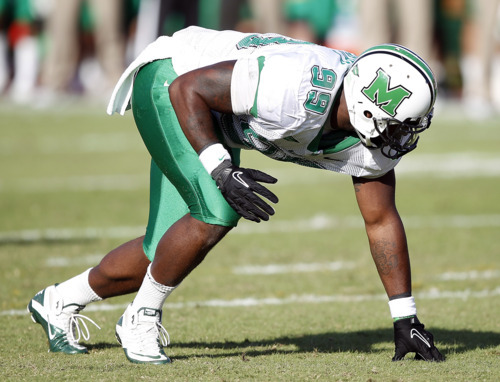
Roseman hinted that the team has previously made some reaches in order to fill a need. Roseman was certainly tested in his third draft as the Eagles’ general manager. No situation better highlighted Roseman’s mission than what was presented to them with the 59th overall pick when the Eagles selected Marshall defensive end Vinny Curry.

“He was the best player on our board,” Roseman said. “He was standing out to us. We just felt like we were in a position where we had to take him. He’s a talented guy.”

Since the first press conference after Curry was drafted, the Eagles front office and PR squad have aggressively hawked the fact that he was the best player available — something they haven’t found necessary to mention (let alone pound into the narrative) with any other draft pick. Methinks they dost protect someone’s feelings too much.

Grade the Eagles Draft Picks

Philly.com lets you rate each Eagles draft pick, from A to F. Here are the results so far, with A & B grades constituting “positive” ratings:

Fletcher Cox: 98.6% positive
Mychal Kendricks: 95.3% positive
Vinny Curry: 94.3% positive
Nick Foles: 38.6% positive
Brandon Boykin: 93.9% positive
Dennis Kelly: 46.5% positive
Marvin McNutt: 74.6% positive
Brandon Washington: 70.7% positive
Bryce Brown: 60.0% positive

Overall Draft: 94.9% positive

Notes on the Rest of the 2012 Eagles Draft

Vinny Curry Marshall Philadelphia Eagles

The NFL draft is now in the books, and by almost all accounts the Eagles did little to complain about. Here are my miscellaneous thoughts on what happened on days two and three:

  • Watch the Vinny Curry interviews, then watch them again and again. His Eagles fandom is clearly as raw as yours and mine, and it’s awesome to see the excitement one of us would undoubtedly have, had we the talent to end up playing for our hometown team.

  • Nick Foles, the big reach. There has been serious quarterback inflation in the last two drafts, something which will be the focus of my post tomorrow. Until then, just consider that Nick Foles was the seventh quarterback selected, at pick 88 overall. Mike Kafka was the fifth off the board in 2010, at pick 122. A round and a half earlier, for a worse quarterback? Maybe. (Also, I’m 95 percent convinced that Russell Wilson was the real target.)

  • The Eagles have drafted defensive players with 9 of their last 11 first, second, and third round picks. So far, the results have been atrocious. Let’s hope this last batch can turn things around.

  • After complaining in recent years that the Eagles had become too safe in the late rounds and undrafted free agency, I certainly can’t complain about the wave of longshot, troubled players the Eagles snagged this time around. I actually like the strategy, especially at running back, where the team took a major athlete with limited production and questionable work ethic (Bryce Brown) and a productive talent who was taken off seemingly everyone’s draft board due to injuries (Chris Polk). Especially at running back, which other than pass protection is relatively easy to pick up, one of these longshots could pay off. A veteran back up would still be nice, though.

  • There are some other interesting names on the UDFA list. Kentucky punter Ryan Tydlacka should give Chas Henry some much needed competition. Another long snapper is a shot across reliable Jon Dorenbos’s bow. And not one but two fullbacks means we’ll have a healthy fight for one of the most marginalized positions on the team.

  • Please direct all your “steal” or “reach” designations here.

  • Two things granted: Brandon Boykin had great college production and the slot corner role is becoming more and more important. That said, I’m a little hesitant about drafting a guy whose size has made every draft expert who has looked at him say, “what a great nickel back.” In some ways, this pick was the opposite of the Curtis Marsh selection last year, when the Eagles went for physicality over refined performance. It will be interesting to watch which pick turns out better for the Birds going forward.

  • There’s a lot riding on Mychal Kendricks being Andy Reid’s first successful second round linebacker — and the results need to show right away. Under no circumstance should more than one of last year’s linebackers start in 2012. Right now Brian Rolle has the inside track on keeping his weakside job, but Casey Matthews could push him there, after ending last season on a relative high note.

  • My draft predictions weren’t half bad, if I do say so myself.

Photo from Getty.

What We Learned from the Fletcher Cox Selection

Fletcher Cox

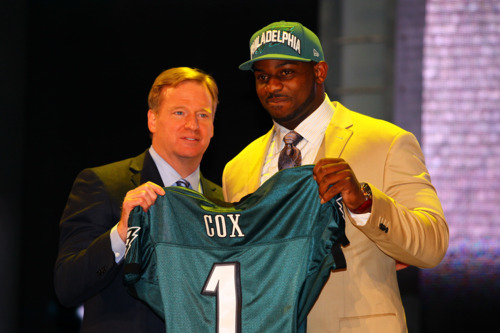
I can’t remember the last time the Eagles picked somebody in the first round that both draftniks and fans loved. Look at Bleeding Green Nation’s fan poll on the pick: Cox’s approval rating sits at 94 percent. A year ago, Danny Watkins eked out majority approval by a margin of just 21 votes out of about 1,600.

The fact that Cox is popular doesn’t, on it’s own, make the selection a good one. But it fits in so many ways. Let’s break down what we learned last night:

  1. The Eagles have become remarkably clumsy at deploying smokescreens for their first round pick. Was anyone other than a few reactionary mock drafters buying a Dontari Poe selection? The way the Eagles led him on a pointless parade past reporters a few weeks back on raised major red flags. What Reid said last night about Kansas City and Poe confirmed that they never had any real interest.

  2. Scheme matters. On a related note, it is important to keep in mind the scheme prospects look most suited for. There were plenty of DT options in the middle of the first round, but the Eagles made sure to grab the one who fit best with Jm Washburn’s penetrating style.

  3. Despite the trades, the first eight picks played out almost exactly as planned. The elite eight ended up being a game of musical chairs (propelled by more reasonable contracts), but that didn’t matter much to the Eagles. Other than Mark Barron, who reportedly was never a NovaCare target, all the players you expected to go early did. That allowed the Eagles to sit back and wait for either Luke Kuechly or Fletcher Cox to drop. Note: I would wager that had the Panthers taken Cox instead, we would probably be having the same conversations we’re having now, except it would be Kuechly coming to Philly today.

  4. Don’t draft an immediate starter. The Cox selection continues a general trend in which the Eagles rarely draft anyone with the expectation that they will start right away. The defensive line is aging and Cox can step right in a contribute, without having to be a starter until year two, when the writing is on the wall for Cullen Jenkins.

  5. Valuing the second round picks more? Andy Reid talked about having a limit on what they were willing to pay for a trade up. He said they didn’t want to give up a second round pick, as Dallas did, to jump up into the top 10. I wonder if this is actually a change in policy dating back to the disastrous trade up for Jerome McDougle in 2003. Since then, the most the team has paid in a trade was a third round pick to move up for Brandon Graham. That hasn’t been a resounding success either. The fourth and sixth round picks the Eagles gave up this time amounted to an exceedingly reasonable price. (The draft value chart says the difference between pick 12 and pick 15 is properly a late third round selection.)

What to watch for tonight: If the Eagles make all three of their next selections, I would guess they’re looking to come away with a linebacker, defensive end, and some sort of offensive weapon at either wide receiver or tight end. But given their recent history, a trade back to accrue more picks (and starting linebackers) is likely in the cards.

Photo from Getty.