Why DeSean Should Accept the Franchise Tag

DeSean Jackson

With Jeff McLane’s latest report suggesting that the Eagles plan to place the franchise tag on DeSean Jackson, and sources close to the wide receiver in the same report saying that Jackson “would not balk at signing the Eagles’ one-year tender,” I’m starting to wonder if this whole ugly situation might be resolved with less drama than we thought.

At its most basic, every negotiation is a game of chicken, and the Eagles-Jackson contract mini-feud is no exception. It’s all about who flinches first to prevent the worse possible outcome — a season in which the Eagles keep DeSean but he refuses to sign the franchise tender and play the 2012 season without a new long term deal.

Jackson folding first means he would just sign the franchise tag and play out the year with a guaranteed $9.5 million. The Eagles, on the other hand, could give up and trade Jackson for minimal return. Neither side wants the worst outcome, so someone has to break.

Looking at the prospects again, it seems like Jackson is in the weaker position, largely because the Eagles can legitimately pre-commit to their course of action. One of the ways to win a game of chicken — typically illustrated by two cars driving right at each other — is to pre-commit by signaling to the other driver that you have locked your steering wheel into place and cannot deviate from the collision path. Thus, if the other driver doesn’t want to end up crashing, he must flinch first.

The Eagles can’t lock their proverbial steering wheel, but their history of negotiation shows enough evidence that they won’t budge. In fact, the Eagles over the years have almost never traded a player or given him a contract extension just because he demanded it. They would rather let Terrell Owens ruin a season or let Lito Sheppard ruin his trade value than capitulate. They also have refused to accept below-market value for trades, even when a player’s public comments gave other teams leverage negotiations.

DeSean knows these things, and can’t be anxious to end up as the next Vincent Jackson circa 2010.

Plus, speaking of the Chargers wideout, this free agent wide receiver class is very good. Dwayne Bowe, Marques Colston, Stevie Johnson, and others can claim similar or higher value than DeSean.

Meanwhile, Jackson’s performance in his original walk year of 2011 left a lot to be desired. He regressed on the field and showed immaturity off it.

Given Jackson’s contract demands, high trade cost, and underachieving performance, the market for his services may not be nearly as fruitful as he might have hoped a year ago. While he may try to play out the game, perhaps even into training camp, there’s not much downside to signing a one year, $9.5 million guaranteed deal. If he can improve in 2012, there will be even more opportunities to hit it big in free agency next time around.

Photo from Getty.

In Which Danny Watkins Buys a Fire Truck

Jason Kelce reports, with photo and video evidence, that fellow Eagles offensive linemen Danny Watkins has purchased a fire truck, apparently for personal use.

On one hand, this could easily be a prank. On the other, it does seem like the rather inevitable conclusion of this and this.

Sure, Why Not?

Jason Cole, Yahoo Sports:

In addition, according to a source close to Moss, the Philadelphia Eagles and the New York Jets are at least curious and the San Francisco 49ers could look to fill a hole if they let go of Josh Morgan in free agency. A source with one of those teams conveyed via text it would be “intriguing” to see what Moss has left in the tank after a year away from the game.

Agent rumor-mongering at its best. Still, Randy Moss has long been on the Andy Reid wish list, and we know Howie Roseman is a big texter. Time to double-down on mercurial, contact-fearing wide receivers!

(via Sam Lynch)

Room to Improve for LeSean McCoy as a Receiver

LeSean McCoy

LeSean McCoy had an All-World rushing season last year, racking up 1300 yards and 17 touchdowns, good enough for best in the NFL in DYAR, by far. McCoy is also a more complete player than most other backs. His pass blocking has, by all accounts, improved significantly since he entered the league. And out of the backfield, McCoy has caught 166 balls over the last three seasons — third-most among all running backs.

Despite all those catches, however, there still seems to be room for improvement in the receiving department. While McCoy has already met or surpassed his mentor’s rushing ability, Brian Westbrook was a much more natural receiver. In fact, he was probably the best wideout the Eagles had for a number of years there.

At a basic level, Westbrook averaged 8.9 yards per catch over his entire career. McCoy has only managed 7.3 yards. That’s a large difference, although it’s hard to tell exactly why McCoy is deficient in that area.

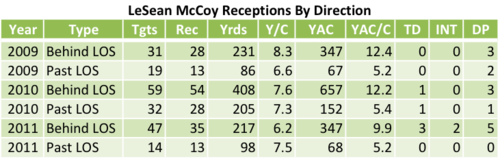
One way to get a second-level look at McCoy’s receiving stats is to look at his receptions by distance. Pro Football Focus tracks passes thrown by direction, including whether those passes were thrown behind or in front of the line of scrimmage. Here is McCoy’s receiving production by year, delineated by passes thrown behind the line of scrimmage and past it:

LeSean McCoy Receiving Statistics

For starters, McCoy has always been targeted more in the backfield. Most of those are swing passes, screen passes, and shovels. However, at least until this year, he was also turning those passes into bigger gains. There’s an interesting trend, which may or may not be significant, where McCoy’s screens have become less effective each season while his receptions on pass routes past the line of scrimmage resulted in bigger gains.

(Note that YAC, yards after catch, include yards gained behind the line of scrimmage.)

So that’s interesting. But in order to get any context for those numbers, we have to compare them to other running backs. I averaged the 2011 reception figures for five comparable backs: Darren Sproles, Ray Rice, Chris Johnson, Arian Foster, and Matt Forte.

Other Running Backs Receiving Statistics

In many ways, these backs had the opposite production of McCoy. Most of their receptions came from routes past the line of scrimmage, not screens and swing passes. They were also more effective running those real pass routes than McCoy, with an average of 10.8 yards per catch beyond the line of scrimmage.

Granted, the reason McCoy runs few wide receiver-type routes is because he’s so valuable in the backfield — even as a decoy. But that’s true about these other running backs as well.

One way McCoy can take his game to the next level would be to apply himself this offseason to becoming a better route-runner and receiver when put in motion out of the backfield. That extra element made Brian Westbrook a multidimensional threat, and McCoy would be wise to follow in his footsteps.

Photo from Getty.

Report: DeSean to be Franchised

Jeff McLane:

They will not let their Pro Bowl receiver - whose contract is set to expire - walk without getting something in return, according to NFL sources.

The franchise tag doesn’t come as a surprise, but given McLane’s general stance as mouthpiece for the Eagles front office, we can assume this comes from the top.

The Eagles still hold negotiating rights to Jackson and still have the opportunity to work out a contract extension. But unless Jackson and his agent, Drew Rosenhaus, drastically drop their asking price - believed to be in the five-year, $50 million range - that proposition is unlikely as the Eagles have typically been steadfast in negotiating.

I wonder whether McLane got that five-year, $50 million figure from the organization as well, or it’s just a guess based on Santonio Holmes’s contract.

Bowles Turned Down Raiders Coordinator Job

Jonathan Tamari:

Bowles, the only new addition to the coaching staff, took the Eagles job over offers to become the defensive coordinator in Oakland, to remain the assistant head coach/secondary coach in Miami, or take the same position in Cincinnati.

Obviously, we’re taking new secondary coach Todd Bowles at his word here, but it’s surprising to say the least. Perhaps Bowles thought that his input would actually have a bigger impact working “under” Juan Castillo rather than defensive-minded Raiders head coach Dennis Allen.

Training Days With Luke Kuechly

Sheil Kapadia:

Essentially, Kuechly runs through a mini-combine on a daily basis. And he’s not alone. While there are currently 30 prospects training at IMG Academy, there are 300-plus training around the country. The combine presents a series of predictable tests. It’s the job of agents, trainers, coaches and advisers to make sure there are no surprises, that the prospects know exactly what they’re being asked to do when the spotlight’s on them.

Great breakdown of a combine trainee’s daily schedule. Boston College’s Luke Kuechly makes almost too much sense for the Eagles in the middle of the first round.

Extend LeSean McCoy's Contract Already

LeSean McCoy

One of the most worrisome characteristics of Eagles front office in the last couple of years has been its seeming reluctance to hand out early contract extensions to their young players.

Now, there have been extenuating circumstances. For starters, the drafting has been poor overall, so there haven’t been many players since 2008 that have been worth extending. Additionally, the collective bargaining agreement drama delayed some contract talks.

However, the Eagles now have three young offensive stars who are/should have been prime candidates for extensions. DeSean Jackson, obviously, is the most urgent name. He’s scheduled to be a free agent in just a few weeks and the team is reportedly far apart in negotiations. Perhaps Jackson has been asking for a salary that’s too high, but in any case this could be a failure the Eagles front office hasn’t seen since Jeremiah Trotter left after the 2001 season.

On the flip side, Jeremy Maclin still has two years on his deal, so it’s not quite an emergency for him. If the Eagles are still operating with the same principles they did a few years back, though, he would be a prime candidate for a below-market value extension this offseason.

The middle case is LeSean McCoy, the Eagles All-Pro running back, who is about to enter the final year of his rookie contract. An extension with McCoy has to happen as soon as possible, lest the Eagles risk another DeSean situation. If an extension is worked out, we may be able to write off that problem as one special to, if not created by, Jackson.

Besides, McCoy has said publicly that he doesn’t want to end up like DeSean:

“Let me be honest with you, I never want to be in that situation,” McCoy said. “Everybody’s situation is different. [An extension] would be a blessing if that happened because I don’t want to go anywhere else or play anywhere else. I love it here. I’m a Pennsylvania guy – from high school to college to here.”

(Read what you will into McCoy twice firing and and re-hiring Drew Rosenhaus during the season.)

Still, the Eagles have already hurt themselves by failing to lock up McCoy a year ago. Back in October, I wrote about what that potential contract could look like. Here, again, are the most recent running back deals:

2011- Chris Johnson (25): 6 years, $55 million, $30 million guaranteed
2011- Adrian Peterson (26): 7 years, $96 million, $36 million guaranteed
2011- Frank Gore (28): 4 years, $26 million, $14 million guaranteed
2011- DeAngelo Williams (28): 5 years, $43 million, $21 million guaranteed
2010- Jamaal Charles (24): 6 years, $28 million, $10 million guaranteed
2009- Maurice Jones-Drew (24): 5 years, $31 million, $18 million guaranteed
2008- Steven Jackson (25): 6 years, $45 million, $21 million guaranteed
2008- Michael Turner (26): 6 years, $35 million, $15 million guaranteed

At the time I suggested McCoy’s production put him in line for a similar deal to the one signed by Jamaal Charles, who had comparable stats through his first three seasons. However, McCoy’s monster 2011 dwarfs Charles’s top production so far. That one year still doesn’t get him up to Peterson-Johnson stratosphere, but I’d be surprised if isn’t looking more at the Jones-Drew range.

A complicating factor is the pending free agency status of Ray Rice and Matt Forte. Both young, complete running backs are likely candidates for long term extensions in the coming weeks. The Eagles and McCoy may choose to wait until the running back market is set by those players before getting serious about negotiations.

It’s not ideal, given the opportunity the Eagles had to lock him up at a lower rate, but as long as a contract extension happens this offseason I don’t think any fans will complain.

Photo from Getty.