The Truth About Bad Luck

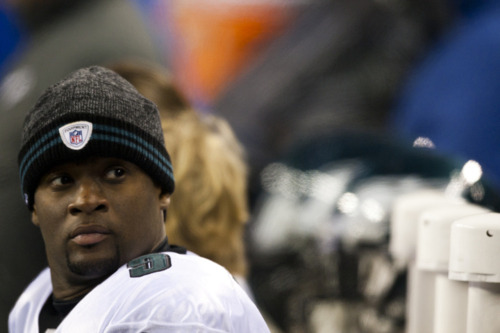
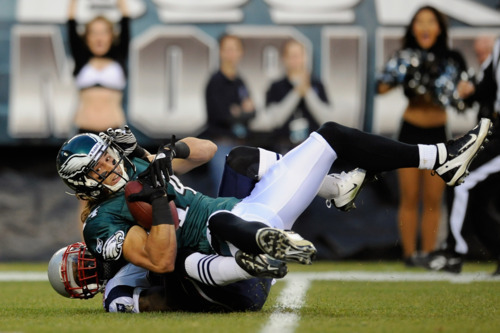
Riley Cooper Philadelphia Eagles

Friend of the blog Justin F. wrote a post at Bleeding Green Nation in which he calculated the Eagles’ Pythagorean win percentage, a metric that estimates a team’s wins based simply on points scored and allowed. Justin notes that the Eagles jump up to just over .500 if you calculate win percentage using the Pythagorean method (compared to .385 in real life). Then he offers a common explanantion:

So why is there a such a discrepancy between the Eagles’ actual win percentage and Pythagenport win percentage?

A very good question, and the answer probably is not what people want to hear and/or believe, although it is true. In one word: luck. In two words: bad luck.

What follows in the comments at BGN is a discussion that unfortunately devolves into rambling incoherency, where the luck explanation is aligned with a belief in stats and doubters read like WIP callers. But the truth is more nuanced.

Explaning the difference between actual and Pythagorean win percentage as “bad luck” is overly simplistic. That is one possible explanation, but should not be used as an all-encompassing default. Rather, we must examine whether bad luck is actually the cause.

There are certain well-known measures for luck in the NFL. For example, fumble recovery, field goal percentage, schedule strength, and injuries. However, the Eagles haven’t had a problem with any of those.

The Eagles have recovered 48 percent of fumbles, just barely below average. They’re 10th-best in field goal percentage, with Alex Henery hitting 86 percent. Meanwhile, Eagles opponents are actually worst in the NFL, making only 65 percent of their attempts. The Eagles have faced the 18th-hardest DVOA schedule, and the three games Michael Vick lost to injury were average. No evidence of bad luck here.

However, there are plenty of other non-luck outlying factors that could account for the actual-Pythagorean discrepancy. Factors like:

  • 30th in the NFL in opponent red zone TD percentage.
  • 26th in fourth quarter points allowed.
  • 32nd in interception percentage.
  • 25th in first down-inducing penalties.
  • 19th in DVOA variance.
  • 27th in missed tackles (as of week nine).

If you’re going to call the 2011 Eagles underachieving — a label I’m not adverse to using — don’t blame it on the easy out. Luck is always involved, but it shouldn’t be an automatic determination. The above factors are much more likely to be the cause.

Photo from Getty.
By the Numbers: A Win!

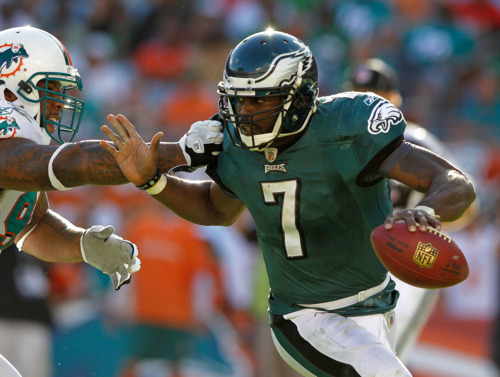
Michael Vick Dolphins

Jason Babin, after the game:

“I don’t know how many times we stopped them, but it was almost unfathomable. I wouldn’t have even guessed we could stop them that much.”

I think I speak for all Eagles fans when I say, yes, that is “almost unfathomable.”

10 = Stops by the Eagles on downs of two yards or fewer. Very unexpected, although if you go through them individually as the above linked article does, you’ll see not a single linebacker’s name among the list of defensive players who came up big in short yardage.

9 = Sacks by the Eagles, including 3 each by Trent Cole and Jason Babin. Note that no one is talking about how bad the wide nine formation is today.

1.4 = LeSean McCoy’s yards per carry. McCoy finally got a ton of carries, but he was largely stuffed. Undoubtedly this will be used as proof that running the ball doesn’t work, and Marty Mornhinweg will call 50 passes next week against the Jets.

12 = Interceptions for Michael Vick in 10 games. In 2010, Vick had a 1.6 percent interception rate — better than Donovan McNabb’s career rate. This year that’s up to 3.6 percent, which is just barely off the Hall of Fame-type pace set by Mike McMahon in 2005.

57 = Yards from scrimmage by the Eagles in the second half. That’s in 7 possessions, with 6 punts and 1 interception. Good thing they got out to such a big lead in the first half.

1 = Win. If you look at the box score, it’s hard to understand how the Eagles won. Their leading rusher went for 38 yards, their leading receiver for 59, and their quarterback completed only half his passes. Still, getting a victory has been nigh impossible for this team at various points in the season, so it’s hard to be too negative. Plus, playoff possibilities!

Photo from Getty.

Juan Castillo, Dead Man Walking

Guest post from the peerless BountyBowl:

The headlines say that the players back Embattled Defensive Coordinator Juan Castillo™, but man, the quotes seem to tell a different story. Or maybe I just don’t know what “back” means. Does it mean “Politely acknowledge that his ass is getting fired”? If so, then no problem.

Winston Justice: “Not entirely his fault.”

“I know Juan. He’s a fighter. He’s going to keep going to the end,” offensive tackle Winston Justice said yesterday, as the Birds prepared for this weekend’s visit to Miami. “In the NFL, you have to have a scapegoat, I guess … It’s not Juan’s fault. Not entirely his fault.”

Darryl Tapp: “All you can do is just move forward.”

“It’s been the perfect storm of negatives for him,” Tapp said. “I feel bad that all the stuff is getting directed at him, because we all have a part and we all understand that right now. But all you can do is just move forward.”

JamJax: “It’s just not working out.”

“It’s definitely been a learning experience [for Castillo], I can tell you that much,” Jackson said. “Juan’s a hard worker, man, and he’ll figure it out, as we’ve done in the past, offensively. “Will Castillo get a chance to figure it out? “I sure hope so,” said Jackson, who agreed that in terms of the defense coming together, “from the looks of it, it’s just not working out.”

Dolphins and Eagles: Two Roads Diverged

Vince Young Eagles

I shall be telling this with a sigh
Somewhere ages and ages hence

Let’s take a trip back to week nine. The Eagles were 3-4 with some momentum, having just defeated the Redskins and Cowboys in back-to-back weeks. It was the high point of the season, when everyone was still talking about Andy Reid’s ability to turn his team around down the stretch.

Conversely, week nine for the Eagles’ upcoming opponent was their lowest point. Miami was 0-7 going into that game, and people were discussing the Dolphins in the same sentence as the Colts for worst team in the NFL honors.

Of course, things didn’t stay that way for long, for either team. The Eagles tanked, winning only one of their next five contests. The Dolphins turned their fortunes around, winning four of five.

So, how did that happen? There are basically two reasons: defense and turnovers.

The Eagles defense over the last five weeks has been atrocious. They’ve allowed an average of 26 points and 365 yards from scrimmage. Miami has only given up 11 points per game and 288 yards over that span. 15-point swing per game? No wonder.

But an equally big difference comes in quarterback play. The Eagles were universally hailed this offseason for getting a quarterback of Vince Young’s quality for their backup job. Matt Moore’s signing with the Dolphins went mostly unnoticed. Yet Young has been an interception machine in replace of Michael Vick, while Moore has been a steady hand.

Over his last three starts, Young threw for four touchdowns and eight interceptions. Three of those interceptions came in the second half last week, as the Eagles failed to mount any kind of challenge to the lowly Seahawks. Even in Young’s game against the Giants, the team won despite of his many mistakes.

The unheralded Moore has thrown five touchdowns and zero interceptions in the last three games (and 8 TDs, 1 Int in the last five). He doesn’t have the special physical skills of a guy like Young, but when he plays safe and relies on his defense, Moore is a much better quarterback.

This Eagles team is dysfunctional in so many ways that you can’t count on them to do anything right. Even with Vick back from injury, I’m not predicting an Eagles win this weekend. After the road this team has taken so far, how could anyone?

Photo from Getty.

DRC Makes No Excuses

Reuben Frank, at CSNPhilly:

He makes no excuses.

“It’s been frustrating basically playing a new, different position, but I’m young, I’ve got a lot of time to just learn,” he said at his locker before practice Thursday. “Slot is a difficult position to play if you’ve never done it before. I never really even paid attention to it because you’re outside doing your thing.

“Outside is a whole different ballgame. That’s really been the most difficult thing. Trying to make that your spot. I asked guys around the league how difficult playing the nickel is and they tell you but until you get out there, you don’t realize how difficult it is and how different it is.

“Once I get it, I got it. But there’s a lot of new concepts. Gotta read run, gap responsibilities – your mind has to work quickly. But with more experience, it’ll come. In the long run, it’ll make me a better corner. I’ll have a better mindset or mentality of the game because playing inside, it makes you more versatile and makes you a better player.”

Is it too late to get Patrick Peterson?

Calling All Asante Samuel Interpreters

Asante Samuel, as quoted by Les Bowen:

“We were top five [in turnover differential, at plus-9] last year, huh? What do you think the difference is?” Samuel asked. “You don’t want to say it? I got no comment.”

Who does Samuel blame most? Is it “the offensive line coach?” Maybe it’s those pesky front office boys “playing fantasy football with the owner’s money.” Or could he be casting well-earned blame on his teammates?

You decide.

(Via BountyBowl)