McNabb-Baiting

Bob Ford, for the Inquirer:

All that said, and all that considered, here’s one for you: If the Philadelphia Eagles actually believe the final four games of this season might mean something, they should release Vince Young immediately and sign McNabb. (I know, I know. I am aware there is a large percentage of you who must now blindly search the floor for your heads, because they have popped off your necks and rolled away. And, yes, there is a part of me that wrote the sentence just to have that happen. But let’s wait and see where the column goes. I have no idea, either.)

It’s nice when columnists admit they’re going off the rails.

Babin to Reporters: Brush Your Teeth

Jason Babin, on Twitter:

Wow reading some of these articles, if u where in the L room & saw some of these reporters, u would understand. It’s like they never saw a; Tbrush, shower, and problly the only time they leave their mom’s basement….. I said some, other are dead on…

Poor hygiene, but at least we can spell?

Short Term Players, Long Term Problems

Jeremiah Trotter Philadelphia Eagles

Former Eagles tight end Chad Lewis, to Derek Sarley in 2009:

It’s a fine line and it’s very hard to define.  You have to push to have strong team chemistry at the same time you push to win.  Sometimes those are competing forces.  Sometimes it requires Trotter in the locker room getting in someone’s face.  Or it requires Donovan sharing a joke to keep people laughing and cut through and dissolve some of the pressure that every one of us feels is on us to perform. 

Andy fostered that team chemistry.  But it’s dynamic.  It’s alive and moving.  Once you get it, it doesn’t mean it will stay forever.  You have to care enough to keep it or get it back.

What does it take to be an effective locker room leader? Through most of the Andy Reid years, the Eagles have had no shortage of leaders. But what are the necessary traits? I’ve narrowed it down to five requirements, complete with one players who embodies the trait and one who doesn’t.

  1. Talented — If you’re not a starter, no one is going to take you seriously. Jon Runyan vs. Winston Justice.
  2. Experienced — Veterans command proper respect. Brian Westbook vs. LeSean McCoy.
  3. Vocal — Silence doesn’t get you anywhere. Jeremiah Trotter vs. Trent Cole.
  4. Mature — Responsible, accountable players only. Quintin Mikell vs. Asante Samuel.
  5. Tenured — On at least your second contract with the team. Brian Dawkins vs. Nnamdi Asomugha.

If you look up and down the Eagles roster, you’ll find players that fit into the first four categories. There are talented veterans who are outspoken role models for the youngsters, but there’s a real shortage of players who’ve been with the organization for the long haul.

Why is this important? A good team has players that set an example for others to follow. Sometimes they get in your face, sometimes they crack jokes, but they hold everyone accountable and united.

These players aren’t around anymore, though. Look at the following graph, which shows the Eagles starters by the number of years they’ve been with the team. This isn’t NFL experience, but rather experience with this organization in particular.

Click for bigger version:

Eagles Starters Experience

The 2011 team has the most first-year starters of any team after 1999. It’s tied with 1999 for the most first and second year starters. It has more starters with three or fewer years with the organization than any other in Andy Reid’s time as coach, and is tied with 2000 for the most four years or fewer. The 2011 Eagles are also only the second team to have not a single standard-bearer who has been with the team for more than seven years.

In real terms, that means the team has exactly four starters — Brent Celek, Todd Herremans, Trent Cole, and Mike Patterson — who have been with the Eagles for longer than four years. DeSean Jackson and Asante Samuel are de facto veteran role models at four years a piece. Not a single starter has played in a Super Bowl as an Eagle.

In retrospect, it’s not a coincidence that this team is falling apart any more than it’s surprising that the 2008 team stuck together and engineered a deep playoff run. That squad had a wealth of veterans on their second contracts, players who knew how to band together and make the sum greater than the individual parts. Those were players who conveyed what it meant to be an Eagle, and the team had reinforced that notion by keeping them around.

Now almost all of those players are gone and no one has been groomed to replace them. The front office drafted “high character” guys who haven’t seen the field. They brought in veteran free agents to fill a void, but as outsiders they can’t set the locker room attitude.

But the biggest problem is that this leadership vacuum isn’t going away any time soon. The free agent pickups are getting older. Most of the draft picks from 2006-2010 washed out, and those that didn’t (e.g. DeSean Jackson) largely haven’t been extended.

What’s the core of this team? Who are the locker room role models going forward? If those questions can’t be answered, the team might be closer to “blow it up” than “one more year.”

Photo from Getty.

The Missile Manifesto

Sam Lynch, at Iggles Blitz:

As we go through the rubble of this epic disaster of a season, there is a great deal of evidence that this team’s figurative guidance system has been broken for some time. More bluntly, the team’s front office philosophy and personnel appear to be fundamentally flawed. And when we think about how to fix this franchise, it is the front office that needs the most immediate attention. Even before we think about what the implications are for the coaching staff.

What are you still doing here? Go, read.

By the Numbers: Why Even Try?

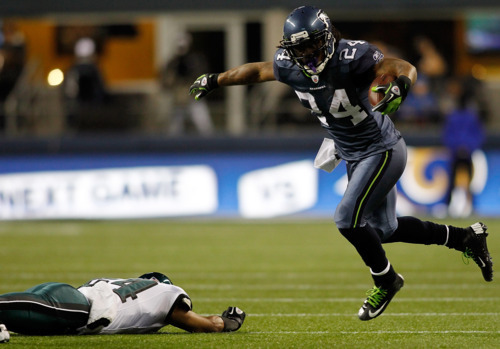
Nnamdi Asomugha Marshawn Lynch

After last night, it seems pretty clear that the Eagles have hit the low point of Andy Reid’s tenure as head coach. The only question now is whether you have any hope that he can turn things around. I assume many of those folks who have stubbornly supported Reid over the last few games are starting to change their minds, but we’ll find out.

7.9 = Vince Young’s interception percentage this season. For comparison, Mike McMahon had a 3.9 percent interception rate in 2005. I’ve never seen a team get four second half possessions, and give the ball away in three of them. If Michael Vick is out again, Mike Kafka will undoubtedly get his chance next week.

57.9 = Young’s completion percentage this season, worst season of his career. What happened to quarterback gurus Andy Reid and Marty Mornhinweg?

6 = Two game stretches when Reid has had a worse point differential than the last two games. It’s one thing to get blown out by New England, but Seattle?

1 = Torn ACL for Colt Anderson. It’s not fair that one of guys who consistently plays the hardest had such a career-threatening injury in a meaningless game.

137.0, 6.7 = Tarvaris Jackson’s QB rating and Marshawn Lynch’s yards per carry from last night. What was that about the Eagles defense improving?

133 = Total yards from scrimmage for LeSean McCoy. Bright spot!

0 = Emotional reaction to yet another embarrassing loss.

Photo from Getty.

The Last Eagles-Centric Walkthrough

The inimitable Mike Tanier, at Football Outsiders:

So there they were, two of my favorite performers, two legends of contemporary music, being completely non-entertaining as they indulged their worst instincts. But I could not turn away, because I am a Springsteen and U2 fan. I kept waiting for it to get better. Maybe they would rip into some song I don’t expect or do something truly magical. I felt obligated to watch and feel exasperated.

I promise, it’s about the Eagles.

'You Need to Have a Plan'

Earlier today, I quoted a point Tommy Lawlor made about the question of whether or not to fire Andy Reid. Sam Lynch elaborated on that viewpoint in the comments. For those who don’t visit the comments (shame on you), I’ve re-posted his response below. Also, follow Sam on Twitter here.

I think Tommy is absolutely right. His point is consistent with the post I made at Iggles Blitz a couple of months ago now: you have to answer a lot of questions before you figure out what moves need to be made.

Here is how I would have expressed his thought:

You can’t fire Andy Reid just because you are mad at the world, at the team’s record, at whatever. That is a really bad idea. That is really bad management.

If you fire Andy Reid, you have to know exactly what it is that he isn’t doing, you have to know why he isn’t doing it, and you have to have an idea of who or what can be done to make that thing happen.

Let me put forth two very different (though not mutually exclusive) views of the Eagles that illustrate that point.

In the first, the problem that the team has faced is really that Andy was given bad players in the offseason. The front office thought it had a MLB, but didn’t really. The front office thought it had a pro bowl caliber rookie guard, and didn’t really. The front office thought it could reach a deal with the star WR and keep him from going off the rails, but couldn’t. The front office thought it had great safety depth because Nate Allen is a quick healer and Jarrett is a star, and was so wrong. The front office planned to flip one of the three CBs for value and didn’t.

In that case, taking this out on Andy Reid doesn’t fix the real underlying issue with the organization. Yes, he is the face of the organziation, there is fatigue among the fans, and he is what his record says he is. But what coach do you bring in who would solve that problem? You are throwing away a lot of good things when the bad things that have gone on this year aren’t really his fault.

In the second view, Andy Reid failed to put together a coaching staff that could coach adequately at the NFL level. That doesn’t just apply to Juan Castillo, but also to Reid’s proclivity towards offense and his own inability to understand defensive coaching and schemes and how they can and should be applied in the NFL. It applies to the hiring of Howard Mudd, who is a great coach but forced us to focus time and resources on overhauling the style and personnel of an offensive line that had the talent in place already to be a good line using the prior style. Andy Reid has continually failed to put his team in the best position to succeed because of baffling offensive play calling, poor in game management, and failure to make adequate adjustments in game. He is loved by players but they have reached the point where they take advantage of it — he has lost the ability to keep players any more disciplined than they are inclined to be themselves. Reid can no longer identify who on his team is good and who is not, and the top notch self-scouting that used to be the hallmark of this team has disappeared. And none of that even gets into how much influence he has with respect to front office decision making.

In that second view, there is a pretty clear reason for making a change and a pretty clear image of the coach you need to come in and fix things: a guy who can present a cohesive plan for the entire team, who can manage a game while that game is being played, who is not so much of a player’s coach but is a disciplinarian, and who has a strong eye for talent. A guy who is a Head Coach, not a glorified coordinator.

That’s why you make a move, if you choose to make it. Because Andy Reid is fundamentally flawed in a way that can no longer be masked with talented, expensive players.

So Tommy is right. You need to have a plan. You can’t just make a change because you want to shake things up. You have to know how you want your organization to be set up, and what the skills that a head coach has to have in that organization. And you have to know that Andy Reid is, in fact, not the guy with those skills.

That isn’t saying that you keep him as a default, or you keep him because you are afraid you might do worse. It is saying that you have to know very clearly what you want in a new head coach before you decide whether you should get rid of your old one.