Rule #4: Make sure Jason Kelce knows you’re in shotgun!
Week Nine
Chicago Bears @ Philadelphia Eagles
8:30 pm ET on ESPN
Rule #4: Make sure Jason Kelce knows you’re in shotgun!
Week Nine
Chicago Bears @ Philadelphia Eagles
8:30 pm ET on ESPN

“If the Bears prevail, nobody is going to write that the Eagles’ season is over,” says Les Bowen.
Not so sure about that. I might.
Lets take a look at the Eagles’ playoff chances. Football Outsiders’ odds prior to this weekend gave them a 34 percent chance of making the postseason. The team was slightly more likely to win the division than the wild card, a result of a rather weak division.
But the Giants’ win over the Patriots last night put them a few lengths ahead of the rest of NFC East field. The Cowboys also won, meaning the Eagles — if they lost tonight — would be behind the leader by three games and the second-place team by a game. That scenario is not pretty.
And a loss to the Bears puts the Eagles further behind in the wild card standings as well. The Lions are way ahead at 6-2. The Eagles, at 3-5, would be two games down to both Chicago and Atlanta, both of whom would also have head-to-head victories against Philadelphia. They’d also be a game back of Tampa Bay and the Cowboys.
To make the playoffs with 8 games left, the Eagles would have to go 7-1 the rest of the way and still get lucky, hoping that five out of the six teams ahead of them flop. Sure, there would be a token chance. But at that point, you’re really just playing for pride and Andy Reid’s future.
Demolishing the Cowboys last week was a necessary step, and it showed that there’s still a chance the Eagles could close out the season with a big winning streak. But the margin for error is razor-thin, especially against another team in the wild card hunt.
Photo from Getty.

Yesterday, I detailed how Jim Washburn’s coaching resurrected Jason Babin’s career and turned him into a sack machine. But what about other players? How is Washburn and the wide nine formation treating veteran Eagles defensive linemen?
That’s the question I set out to answer, using Pro Football Focus’s great stats. Below is a table calculated based on snap counts and pressure data compiled in 2010 and 2011 for Eagles linemen who have played in both Washburn’s system and Sean McDermott’s.
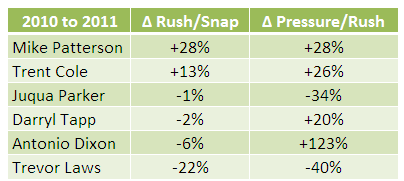 The first column shows change (Δ) in frequency of pass rushes per snap the player is in the game. There are some interesting trends there alone.
Mike Patterson used to be a largely first and second down defensive tackle, but he’s now getting the chance to rush the passer more. The opposite appears to be true for Trevor Laws. Meanwhile, Washburn has smartly eliminated Trent Cole’s occasional coverage responsibilities in 2010.
So, once these players are going for the quarterback, how are they doing? There are clearly some winners and some losers.
Patterson, Cole, and Darryl Tapp are all way up in total pressure per rush (sacks, hits, pressures). Antonio Dixon was too, before his season-ending injury. Juqua Parker seemed like he’d be a good fit for Washburn’s scheme, especially because Babin’s addition would keep him fresh. But that hasn’t happened at all. As for Laws, the numbers don’t match up with my anecdotal memory of his solid performance.
Overall, it’s clear that Washburn and the addition of successful free agents is having a big, positive effect on the Eagles pass rushers. You probably already knew that, but now at least you have the stats to back it up.
Photo from Getty.

Jason Babin is just a hair off the pace to tie Reggie White’s record for most single-season sacks (21) as an Eagle. That’s crazy, especially because it was less than two years ago that the career journeyman was kicked to the street by the same Eagles team he now stars on.
I would say that the 31-year-old’s career was revived in Tennessee, but that would be inaccurate. “Revived” suggests that he returned to a former glory, one that never existed. At age 30, Babin signed a one year deal with the Titans. It was his fifth team in six seasons. After the Texans drafted him in the 1st round and immediately slotted him into the lineup, Babin only started 10 games over the next five years.
And then came Jim Washburn. Below are the sacks per pass rush and total pressure (sacks + hits + pressures) per pass rush stats, courtesy of Pro Football Focus:
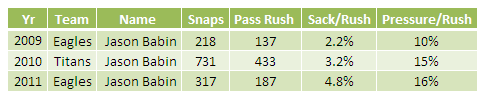
What a huge jump from 2009 to 2010. Babin got pressure and sacks 50 percent more in the wide nine formation than he did the previous season in Sean McDermott’s more typical 4-3 scheme. And that’s despite more playing time on run downs.
I was worried that Babin’s 2010 performance was a fluke, but his numbers have only gone up since returning to Philadelphia. His overall pressure per rush figure is similar, but he’s actually getting more sacks — another 50 percent bump. Maybe that’s luck, but maybe not. Considering his only two games without sacks came while Trent Cole was injured, it isn’t much of a leap to suggest that his opportunities are increasing with a fellow Pro Bowler coming at the quarterback.
Photo from Getty.
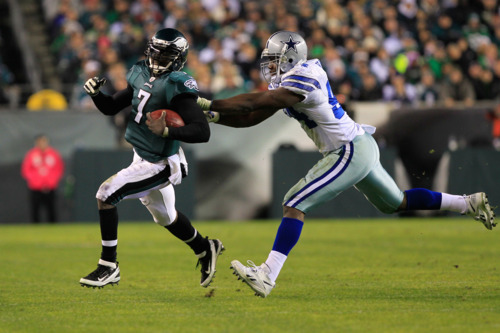
After the Redskins game, I noted that despite losing, Washington successfully exploited a weakness in Michael Vick’s game by blitzing him on almost every third down and goal line situation. Naturally, I expected Rob Ryan’s physical Cowboys defense to pursue a similar strategy.
In some ways Dallas did mold their initial game plan around this strategy. Ryan often blitzed an extra defender off the edge, and sometimes succeeded in getting pressure and forcing Vick to make poor decisions. For example, they sacked Vick this way on the Eagles first play from scrimmage. He was also slightly less effective the whole night when the Cowboys brought at least one blitzer (all four sacks, yards per attempt down about one yard, completion percentage down over 20 percent).
However, there are a few reasons why Ryan’s strategy failed to pay off against the Eagles offense.
For starters, LeSean McCoy. The Eagles running back is such an elite force that you have to respect him in your defensive scheme. A couple of times Dallas brought extra rushers but were burned when McCoy broke through the line and already reached the third level of defenders. When Andy Reid actually commits to the run the way he’s done the last two weeks, it becomes more difficult to focus solely on Vick.
Second, when Dallas did blitz they did so without general awareness. One of the keys to blitzing against Vick is that you have to keep containment. Frequently, Cowboys were streaking up the field, leaving wide lanes for Vick to take advantage of with his legs. Reid and Marty Mornhinweg also dialed up a bunch of different screen passes that seemed to take the Dallas defenders by surprise. If you’re going to blitz the Eagles, at least be prepared for that possibility.
Finally, Ryan didn’t copy the Redskins’ model exactly. He generally blitzed an additional defender or two, not resorting to zero coverage. And when they didn’t blitz, Dallas dropped their safeties way back, exposing chunks of the middle of the field that the linebackers needed to cover. The Cowboys linebackers were not up to that task. It was an amazing Casey Matthews-esque performance from that group.
I’d still expect opponents to try blitzing Vick. But those teams will have to learn from the Cowboys’ mistakes if they want to make that strategy successful against this multifaceted and explosive offense.
Photo from Getty.
Judy Battista, The New York Times:
Another victim of the lockout: the Philadelphia Eagles, who might have looked a lot more the way they did Sunday night if their off-season haul of free agents had been able to work together during a normal season. Instead, it has taken nearly two months for the Eagles to find the form that was expected of them.
Rob Maaddi, Associated Press:
It took time for the new guys to get acclimated and returning players also had to adjust to a new defensive coordinator and new offensive line coach without benefit of minicamps because of the lockout.
Nick Fierro, The Morning Call:
Watching how the Philadelphia Eagles pulled together vs. Dallas Sunday night, Washington two weeks earlier and the second half of the Buffalo game a week before that, it’s not hard to conclude that they’re now where they thought they’d be going into the season had they not been locked out all summer.

In previewing week eight, I called the Cowboys match up a “show me” game. In other words, show me something that should give some hope that the Eagles can actually accomplish what will be an uphill battle to the playoffs.
They certainly didn’t answer all of my questions, but the 34-7 trouncing of the Dallas Cowboys was nothing if not proof that the Eagles can play at an elite level. Let’s break down the win.
7 = Number of receptions by Brent Celek, more than in the last three games combined. Jason Avant also had a big day, as Michael Vick torched the Cowboys over the middle of the field. Celek noted after the game that Dallas often lined up in deep Cover Two formations to prevent the big pass play. The formations worked, in a sense, but the Eagles picked them apart underneath those safeties.
185 = Rushing yards for LeSean McCoy on 30 attempts. Only three Eagles in history had more rushing yards than McCoy in a single game. Only three times has a running back received more rushing attempts in Andy Reid’s 12 years as head coach. McCoy is not only quickly convincing the rest of the NFL that he deserves to be included in the conversation about the best running back, but he seems to have already sold Reid. 58 carries in the last two games means Reid took my humble advice and, well, ran with it. (It also helps to have Jason Peters back.)
1 = Embarrassed coach. Rob Ryan, after the game: “I got out-coached, out-everything. It’s all on me.”
13 = Straight wins after the bye for Reid. Looked like he was one step ahead of Ryan the whole game.
100% = Eagles “Drive Success Rate.” Football Outsiders says that the Patriots have the highest rate in the league of drives with either a first down or touchdown, at 79%. The Eagles accomplished that on every drive Sunday night. The offense also converted more than half of their third down chances for the first time this season since week one.
88% = Cowboys “Drive Success Rate.” Oddly enough, the Cowboys offense also scored well against this metric. Of course, only in their final two drives did they manage to reach a third set of downs.
9.3 = Rushing yards per attempt by DeMarco Murray on 8 carries. The Eagles defense had a great day, its best against a quarterback not named Grossman. But there were still some problems that didn’t look fixed. Murray had no problem gashing the defense when he had the ball in his hands. Poor tackling was still an issue from Jamar Chaney and others. Kurt Coleman also allowed a ghastly 70 yard touchdown pass to Laurent Robinson.
Perhaps the truest thing that can be said about Sunday’s victory was that the Eagles won the way they are built to win. This team was constructed to jump out to big leads and then force the opponent to comeback against a relentless pass rush and Pro Bowl cornerbacks. Howie Roseman and Reid essentially had this performance in mind when they made all those offseason changes. We’ll see if that revived blueprint can hold going forward.
Photo from Getty.
Redneck Cowboys fans? Really?
Week Eight
Dallas Cowboys @ Philadelphia Eagles
8:15 pm ET on NBC